How to grow the Flame Tree? A detailed guide to its cultivation methods
The Flame Tree is native to the tropics and by nature loves hot and humid environments. The temperature range most suitable for its growth is 20-30°C, which is why late spring to early summer and autumn are its most vigorous growing seasons in China. The Flame Tree is not cold-tolerant, so plants grown in the open need to be protected from the cold in winter, keeping the temperature no lower than 10°C, otherwise there is a risk of freezing to death.
Soil: The Flame Tree can tolerate relatively poor soil, but it prefers fertile, organic-rich and loose soil conditions. Grown in the most suitable soil environment, the flame flowers it produces are even more brilliant and striking. The Flame Tree has a shallow root system, but its roots are very well developed and firmly anchored, giving it strong wind resistance.
Transplanting and planting out: Transplanting of the Flame Tree is aimed at seedling growth; seedlings about 1-2 years old should be transplanted into a fertile, loose and sunny environment. Transplanting is usually carried out in early spring, and after transplanting the row spacing of the plants should be kept at about 60 cm. After 1-2 years of transplanting, once the seedlings have grown, they can be planted out. Planting out has low soil requirements and poor soil is acceptable, but the site chosen should also be open and sunny.
Watering: The Flame Tree can withstand drought, but the amount of water must be controlled. Because its roots have rhizobia, in poor soil it can fix nitrogen to increase soil fertility, but waterlogging will cause the death of the rhizobia, thereby affecting the normal growth of the whole plant.
Propagation methods of the Flame Tree
A common propagation method for the Flame Tree is propagation by seed. Seeds are generally sown in spring and mature in 12 months. Before sowing, the seeds need to be soaked: first soak the seeds in boiling water, then after the water cools, soak for about 2 days, with one change of water in between. Only after this treatment can the seeds be sown. They generally begin to sprout in about a week and begin to emerge in 3 weeks.
What is the flower meaning of the Flame Tree? How to grow the Flame Tree
What is the flower meaning of the Flame Tree? The Flame Tree is named for "leaves like the feathers of a flying phoenix, flowers like the crown of the red phoenix." Because of its bright red or orange flowers combined with bright green pinnate compound leaves, the Flame Tree is praised as one of the most brilliantly coloured trees in the world. So what is the flower meaning of the flame flower? And what cultivation methods does it need? Let's take a look below.
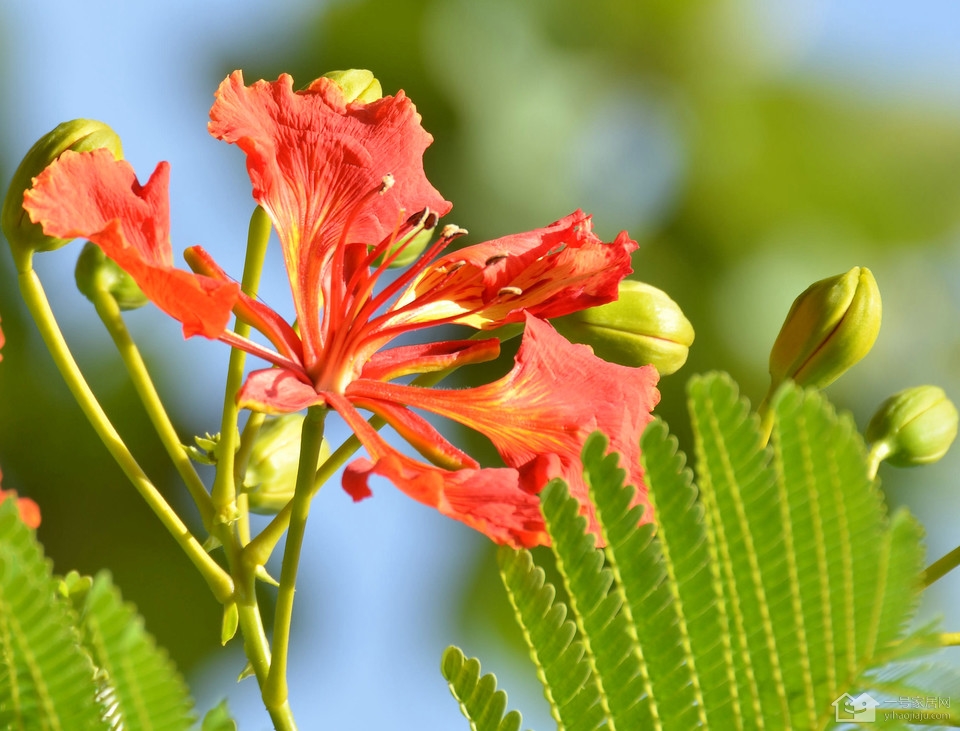
1. What is the flame flower
The flame flower, taken literally, is the flower of the Flame Tree. The Flame Tree has a tall crown and luxuriant branches and leaves, flowering from May to the end of summer. The flower is divided into five petals, large and fire-like, with red flowers and green leaves, magnificent and splendid, and it is praised as one of the trees with the most fiery red colour. Because "leaves are like the feathers of a flying phoenix, flowers like the crown of the red phoenix," it is named the Flame Tree, and it is a famous tropical ornamental tree species.
2. Habits of the flame flower
The Flame Tree is a tropical tree species, beginning to flower 6-8 years after planting. It likes high temperatures, high humidity and a sunny environment, with an optimum growing temperature of 20-30°C. It is not cold-tolerant, and the winter temperature should not be lower than 10°C. Deep, fertile, organic-rich sandy loam is suitable; it fears waterlogging, so drainage must be good; it is relatively drought-tolerant and tolerates poor soil. It has a shallow root system, but the roots are well developed and its wind resistance is strong. It resists air pollution. It has strong sprouting ability and grows rapidly. Generally a 1-year-old plant can reach 1.5-2 m tall, a 2-year-old plant can reach 3-4 m tall, and it begins to flower 6-8 years after planting. In South China, winter buds sprout in early February each year, growth peaks from April to July, growth decreases in late July due to excessively high temperatures, growth speeds up after mid-to-late August as temperatures drop, growth slows after October, and leaves fall from December to January of the following year.
The Flame Tree begins to flower 6-8 years after planting. It by nature likes high temperatures and sunny days, and must be in a sunny spot to grow luxuriantly, so it grows faster in the tropical south. Generally a 1-year-old plant can reach 1.5-2 m tall, a 2-year-old plant can reach 3-4 m tall; the tree is tall with a large crown. The Flame Tree likes light and has a shallow root system, with an average optimum temperature of 20-24°C. Winter buds sprout in early February each year, growth peaks from April to July, growth decreases in late July due to excessively high temperatures, growth speeds up after mid-to-late August as temperatures drop, growth slows after October, and leaves fall from December to January.
It likes light and a hot, humid climate. The cultivation site can adapt to full sun or partial sun. The soil must be fertile, organic-rich sandy loam with good drainage. It is not tolerant of drought or poor soil, is not cold-tolerant, and resists wind and air pollution. It is used as a garden landscape tree, shade tree and street tree. The Flame Tree is suitable for planting in sandy soil with plenty of sunlight, some shade and good drainage. The flowering period is June to July. For propagation and cultivation, seed propagation requires first soaking in 90° hot water for 5-10 minutes, which gives a higher germination rate.
3. Flower meaning of the flame flower: longing, parting, fiery youth
Though it seems a fiery, passionate colour, the flower meaning of the flame flower also carries the meaning of parting; that touch of crimson red represents endless longing. When you walk among the flower-lined paths that seem like a red carpet, at the moment you look up, the petals touch your heart, and the longing is hard to put into words. Yet its fiery passion cannot drive away youth, for that is a colour full of vitality; under the sun, it leaps with the melody of youth and plays touching notes.
4. Cultivation methods of the flame flower
Soil: The Flame Tree can tolerate relatively poor soil, but it prefers fertile, organic-rich and loose soil conditions. Grown in the most suitable soil environment, the flame flowers it produces are even more brilliant and striking. The Flame Tree has a shallow root system, but its roots are very well developed and firmly anchored, giving it strong wind resistance.
Transplanting and planting out: Transplanting of the Flame Tree is aimed at seedling growth; seedlings about 1-2 years old should be transplanted into a fertile, loose and sunny environment. Transplanting is usually carried out in early spring, and after transplanting the row spacing of the plants should be kept at about 60 cm. After 1-2 years of transplanting, once the seedlings have grown, they can be planted out. Planting out has low soil requirements and poor soil is acceptable, but the site chosen should also be open and sunny.
Watering: The Flame Tree can withstand drought, but the amount of water must be controlled. Because its roots have rhizobia, in poor soil it can fix nitrogen to increase soil fertility, but waterlogging will cause the death of the rhizobia, thereby affecting the normal growth of the whole plant.
5. Propagation methods of the flame flower
A common propagation method for the flame flower is propagation by seed. Seeds are generally sown in spring and mature in 12 months. Before sowing, the seeds need to be soaked: first soak the seeds in boiling water, then after the water cools, soak for about 2 days, with one change of water in between. Only after this treatment can the seeds be sown. They generally begin to sprout in about a week and begin to emerge in 3 weeks.
The above is the relevant introduction in this article. I believe that after reading it you now have a simple understanding of this. If you need more, you can continue to follow No.1 Home Network to learn more information.
Flame flower picture collection: Flame Tree cultivation techniques
The Flame Tree is praised as one of the most brilliantly coloured trees in the world. Its flower colour is vivid, and its bright red or orange flowers combined with bright green pinnate compound leaves look especially beautiful, with great ornamental value. Below, the editor will take everyone to enjoy them.
Flame flower pictures
About the flame flower:
The Flame Tree (Delonix regia) is named for "leaves like the feathers of a flying phoenix, flowers like the crown of the red phoenix." Also known as golden phoenix flower, red-flowered phoenix tree, fire tree, foreign phoenix, etc., the Flame Tree is praised as one of the most brilliantly coloured trees in the world because of its bright red or orange flowers combined with bright green pinnate compound leaves. It is the national tree of the Republic of Madagascar in Africa, the city tree of Xiamen, Tainan City in Taiwan, China, and Panzhihua City in Sichuan, the city flower of Shantou City in Guangdong Province, the city flower of Zhanjiang City in Guangdong during the Republic of China period, and the school flower of Shantou University and Xiamen University.
The Flame Tree is tall, reaching more than 20 metres. Because its crown spreads horizontally and droops, dense, broad and wind-catching, it plays the role of a shade tree in tropical regions. It by nature likes high temperatures and sunny days, and must be in a sunny spot to grow luxuriantly. It is distributed in southern and southwestern China, its place of origin Madagascar, and tropical regions around the world.
Flame flower pictures
Morphological characteristics of the flame flower:
A tall deciduous tree, thornless, more than 20 metres tall, with a trunk diameter at breast height of up to 1 metre; the bark is rough and greyish brown; the crown is oblate, with many spreading branches; the twigs are often covered with short soft hairs and have obvious lenticels. The leaves are bipinnately even-pinnate compound leaves, 20-60 cm long, with stipules; the lower stipules are obviously pinnately divided, the upper ones become bristle-like; the petiole is 7-12 cm long, smooth to covered with short soft hairs, with a groove on the upper side, and the base is swollen into a pad shape; the pinnae are opposite, 15-20 pairs, up to 5-10 cm long; the leaflets are in 25 pairs, densely opposite, oblong, 4-8 mm long and 3-4 mm wide, covered with silky hairs on both sides, with a blunt tip, an oblique base and an entire margin; the midrib is obvious; the petiolules are short. The corymbose raceme is terminal or axillary; the flowers are large and beautiful, 7-10 cm in diameter, bright red to orange-red, with a pedicel 4-10 cm long; the receptacle is disc-shaped or short top-shaped; there are 5 sepals, red inside with greenish yellow edges; there are 5 petals, spoon-shaped, red, with yellow and white markings, 5-7 cm long and 3.7-4 cm wide, curling back toward the calyx after flowering, with a slender claw about 2 cm long; there are 10 stamens, red, of unequal length, 3-6 cm long, curving upward, with thick filaments, the lower half covered with cottony hairs, and red anthers about 5 mm long; the ovary is about 1.3 cm long, yellow, covered with soft hairs, sessile or with a short stalk, the style is 3-4 cm long, and the stigma is small and truncate. The pod is strap-shaped, flat, 30-60 cm long and 3.5-5 cm wide, slightly curved, dark reddish brown, blackish brown when mature, with a persistent style at the tip; there are 20-40 seeds, transversely oblong, smooth, hard, yellow stained with brown spots, about 15 mm long and about 7 mm wide. The flowering period is June-July, and the fruiting period is August-October.
Flame flower pictures
Growth habits of the flame flower:
The Flame Tree is a tropical tree species, beginning to flower 6-8 years after planting. It likes high temperatures, high humidity and a sunny environment, with an optimum growing temperature of 20-30°C. It is not cold-tolerant, and the winter temperature should not be lower than 10°C. Deep, fertile, organic-rich sandy loam is suitable; it fears waterlogging, so drainage must be good; it is relatively drought-tolerant and tolerates poor soil. It has a shallow root system, but the roots are well developed and its wind resistance is strong. It resists air pollution. It has strong sprouting ability and grows rapidly. Generally a 1-year-old plant can reach 1.5-2 m tall, a 2-year-old plant can reach 3-4 m tall, and it begins to flower 6-8 years after planting. In South China, winter buds sprout in early February each year, growth peaks from April to July, growth decreases in late July due to excessively high temperatures, growth speeds up after mid-to-late August as temperatures drop, growth slows after October, and leaves fall from December to January of the following year.
Flame flower pictures
Cultivation techniques for the flame flower:
Seed sowing is commonly used to raise seedlings. The thousand-seed weight is about 400 grams. The seed coat absorbs water with difficulty, so the seeds need to be scalded with 80°C warm water to promote germination, then after natural cooling, continue soaking for 24 hours, and drain before use. Sow by the drill or spot sowing method. Seedlings are relatively sensitive to frost; in the early stage a compound fertiliser may be applied, with little nitrogen fertiliser, and fertilisation should stop after autumn to encourage early lignification. In winter, if the leaves have not yet fallen, they can be removed manually, and plastic film covering or individual wrapping can be used to prevent frost. 1-year-old seedlings can be lifted from the nursery for planting out.
Flame flower pictures
Ornamental value of the flame flower:
The Flame Tree has a tall crown. In the flowering period the flowers are red and the leaves green, the whole tree like fire, magnificent and splendid. Because "leaves are like the feathers of a flying phoenix, flowers like the crown of the red phoenix," it is named the Flame Tree. It is a famous tropical ornamental tree species.
It is planted quite extensively in botanical gardens and parks in cities in southern China, as an ornamental tree or street tree.
Street tree: As street greenery, in summer it has a microclimate effect of lowering temperature and increasing humidity, and is a landscape tree for greening, beautifying and scenting the environment.
Shade tree: In midsummer, a Flame Tree with a trunk diameter at breast height of 7-8 cm can have a maximum crown spread of 8-10 metres, and its shading rate is between 50% and 70%. The Flame Tree has many branches, and the difference between the middle and edge of the crown is not great, so the shading effect is relatively even and the ventilation conditions are better. The relative temperature inside the crown is 3°C lower than in exposed places outside, and at most 6°C lower. In summer the planting site is generally maintained at around 23-28°C, and the relative humidity inside the crown is 10%-20% higher than in exposed ground outside.