A Detailed Guide to Growing and Caring for Wintersweet
1. Soil: For potted wintersweet, use loose, fertile, sandy loam rich in humus.
2. Watering: Wintersweet is by nature drought-tolerant and afraid of waterlogging. If there is too much moisture and the soil is overly wet, the plant grows poorly and flower bud differentiation is affected. Therefore, for potted wintersweet it is best to keep the soil on the dry side, and ordinarily do not water until the soil is dry; when you do water, water thoroughly. But during the "dog days" of high summer heat, water more to keep the plant growing normally and allow the flower buds to develop properly.
3. Temperature: Wintersweet likes sunlight and also tolerates partial shade. It fears wind and is fairly cold-hardy; it can overwinter safely when temperatures do not drop below -15°C. It can be grown outdoors in regions south of Beijing. If temperatures reach -10°C during the flowering period, the flowers suffer cold damage.
4. Pruning: Wintersweet branches vigorously, hence the saying "wintersweet never lacks branches." Pruning at the right time prompts it to produce more strong flowering branches and thus bloom more. Generally, prune at the right time after the flowers fade and before leaves emerge: cut out dead branches, overly dense branches, crossing branches, and diseased or pest-infested branches, and for one-year-old branches leave 2 to 3 pairs of buds at the base, cutting off the upper portion of the branch to encourage branching.
5. Fertilizing: Wintersweet is a flowering plant that likes fertilizer; timely feeding promotes flower bud differentiation and more blooms. Fertilize wintersweet mainly with phosphorus and potassium, and apply little nitrogen; the approximate ratio of phosphorus, potassium and nitrogen is 2:1:0.5. Fertilizing this way makes wintersweet produce large, numerous and richly fragrant flowers.
6. Pests: Wintersweet has relatively few diseases but many insect pests. Common ones include aphids, scale insects, slug moths and leaf-roller moths. Aphids suck sap on tender shoots, young leaves and flower buds; scale insects suck sap on the branches; slug moths and leaf-roller moths chew leaves, new buds and flower buds. To reduce pollution of the growing environment, homemade methods can also be used to kill pests: for example, scale insects can be killed with a vinegar solution, aphids can be killed with laundry detergent water, and if there are only a few, they can be caught by hand.
How to Grow Wintersweet
Wintersweet can be grown by sowing, layering, grafting, division and other methods. The sowing method is generally not used, because it does not easily preserve the original fine characteristics of the plant and its advantage lies in large-scale propagation, whereas wintersweet usually only needs a few plants. The most commonly used method is grafting. Grafting includes two methods, cut grafting and approach grafting, and cut grafting is used most often.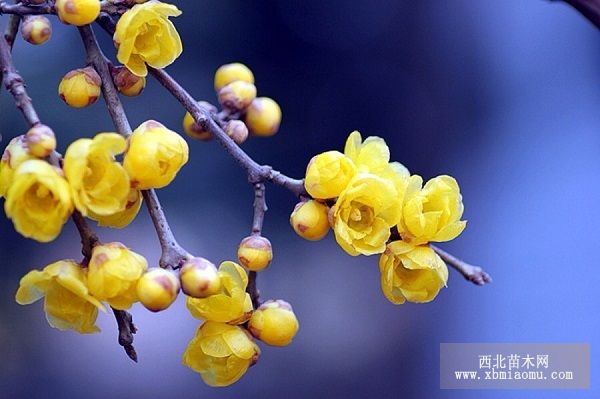
Some people also grow wintersweet by division. If you only need a few plants, this method is suitable. Division is generally done in spring between February and March, when the leaf buds have not yet begun to swell. When dividing, first dig away the soil on the side of the mother plant's roots next to the offset, then use a sterilized sharp knife to cut the offset away from the mother plant's roots, making a new plant. Then plant it, shade it after planting, and keep the soil moist. After the dog days have passed, apply liquid fertilizer once every half month. In the same year it will grow vigorous branches and leaves, and it will bloom after 2-3 years. This method is simple and easy, gives a high survival rate, shortens the propagation time, and brings flowers quickly.
How to Grow Calycanthus chinensis
1. Light and temperature
Calycanthus chinensis can tolerate a brief high temperature of 40°C and a low temperature of -15°C. Calycanthus chinensis likes warm, humid conditions, and an environment without strong sunlight suits its growth better. If Calycanthus chinensis is exposed to full sunlight for a long time, its leaves turn yellow and it grows poorly. Therefore, Calycanthus chinensis should avoid direct sunlight and being placed in the sun for long periods. It only needs appropriate light and temperature each day.
2. Watering
Calycanthus chinensis is drought-tolerant and afraid of waterlogging, so the soil needs to be kept in a semi-moist state. However, it must not lack water in summer, and in the rainy season it should be drained promptly so that flower bud formation is not affected. During the flowering period of Calycanthus chinensis, the amount of water must be reasonable: too little water causes the flowers to open unevenly, while too much water easily causes flowers and buds to drop.
3. Soil
Calycanthus chinensis is suited to growing in fertile, loose, well-drained sandy loam. The potting soil can be prepared by mixing sand and coniferous humus soil in a 1:1 ratio.
4. Fertilizing
Calycanthus chinensis likes fertilizer, and timely feeding promotes flower bud differentiation and more blooms. In spring, apply leaf-growing fertilizer twice; from the end of June to just before the dog days, fertilize Calycanthus chinensis about once every half month to encourage flower bud formation. Apply fertilizer once more in autumn to plump up the flower buds. After flowering until leaf drop, apply two or three topdressings. Before winter sets in, apply one more dilute hoof water to provide the nutrients needed for flowering and help it through the winter.
Now that we understand how to grow Calycanthus chinensis, let's look at what needs attention when growing it!