How to grow Phalaenopsis orchids? These care methods are essential to master
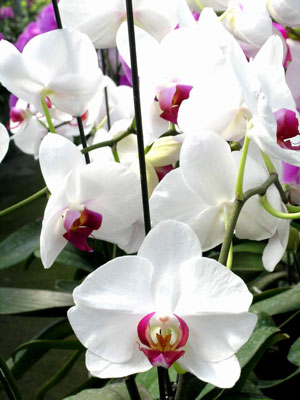
1. The care of Phalaenopsis orchids needs to be divided into two stages: early-stage management and late-stage management. At each different period, you need to adjust the temperature, moisture, and pay attention to pest control. For example, during the flowering period in the late-stage care, water and fertilizer management is especially important. >>More
2. During care, focus on the following issues.
1. Watering too frequently can cause root rot. Friends who grow Phalaenopsis orchids always worry that the orchid lacks water, so regardless of whether the growing medium is dry, they water it every day, causing severe root rot.
2. Maintain an appropriate temperature; do not let the temperature get too low. Usually, flowering Phalaenopsis plants are mostly marketed in early spring, and after being bought and taken home, they are generally placed in places such as the living room for enjoyment. Although the daytime temperature in these places is sufficient, the nighttime temperature is somewhat on the low side. On the other hand, professionally cultivated orchids are mostly kept in well-equipped greenhouses. By comparison, the temperature and humidity at home are somewhat insufficient, so the plant's growth tends to weaken day by day. Therefore, sometimes no matter how well it is cared for, the orchid still may not bloom. >>More
3. Disease prevention. Phalaenopsis orchids mainly have the following diseases, which we should pay key attention to.
1. Bacterial brown spot disease is the most serious disease of Phalaenopsis orchids. The symptom is the appearance of brown spots on the leaves. They are oily or heart-shaped, surrounded by yellow areas. Treatment methods include adjusting the nitrogen amount in the fertilizer solution, removing diseased plants, and maintaining stable relative humidity. Chemical agents have no effect on this disease. Only by using well-growing, healthy plants can this bacterial problem be avoided.
2. Mold. Too much variation in moisture in the medium or an unsuitable EC value can cause root damage, thus prompting mold to attack the tissue. The way to deal with it is to lower the EC value of the irrigation water and temporarily reduce the moisture content of the medium. >>More
Phalaenopsis cultivation methods | Phalaenopsis care methods | Phalaenopsis pictures
Phalaenopsis flowers are full and graceful, with strong growth and a flowering period lasting several months. Potted plants are especially suitable for placement in homes, offices, and hotels, vivid and lively, appearing elegant and luxurious.
Phalaenopsis is a perennial evergreen herb
The stem is short, and the leaves are large. The flower stem is long and arched. The flowers are large, butterfly-shaped, and densely borne. Phalaenopsis is native to tropical regions of Asia. It often grows wild in tropical high-temperature, humid, low- and mid-altitude mountain forests, and likes hot, humid, and semi-shady environments. The suitable growth temperature is 25-28°C during the day and 10-20°C at night. When the summer high temperature is above 35°C or the winter low temperature is below 0°C, Phalaenopsis stops growing. If low temperature persists, the roots stop absorbing water, causing physiological water shortage, and the plant will die. However, Phalaenopsis flower bud differentiation does not require high temperature; 16-18°C is suitable. Phalaenopsis likes a high-humidity environment because it does not have thick pseudobulbs to store water. If the air humidity is low, the leaves will lose water. Therefore, when cultivating Phalaenopsis, air dryness and dry winds are what it fears most.
Sunlight is very beneficial to the growth and development of Phalaenopsis
Therefore, with stable sunlight in winter, Phalaenopsis leaves grow robustly and the flowers are brightly colored. However, long periods of strong direct light in summer can scorch the leaves, so shade netting is needed for shading treatment, which is beneficial to the normal growth of the leaves. However, if grown under shade netting for a long time, the leaves are soft, the flower stems elongate, and the flowers lack luster and are not bright. For this reason, during long periods of rain and snow in winter, when sunlight is insufficient, artificial lighting should be added as a supplement.
Common propagation methods for Phalaenopsis are division and tissue culture
Division propagation: carried out before new buds sprout in spring or after flowering. At this time, nutrients are concentrated and disease resistance is strong. Generally, it is done in combination with repotting. Take the mother plant out of the pot, injuring the roots as little as possible, gently separate the orchid clump, and select 2-3 plants to pot directly. If division is done during the high-temperature summer season, it is easy to rot. If divided in winter, because the temperature is slightly lower, recovery after planting is slower.
Tissue culture propagation: Phalaenopsis is a monopodial orchid and rarely produces lateral buds, so only the shoot tip of a mature plant can be used as an explant. Leaves can also be used for culture. Generally speaking, the younger the plant age and the tenderer the leaves, the easier it is to produce callus tissue, and the greater the number of differentiated protocorm-like bodies.
Phalaenopsis is an epiphytic orchid. When cultivating it, the roots must have good aeration. The potting medium must be loose, well-draining, and breathable. Commonly used materials include moss, fern roots, bark chunks, coconut shell, or vermiculite. After a new plant is potted, it takes about 30-40 days to grow new roots.
During the growing period, fertilize once every ten days. From flower bud formation to the flowering period, apply more phosphorus and potassium fertilizer
and frequently spray water on the ground and leaves to increase air humidity, which is very beneficial to the growth of stems and leaves. From May to June each year, when new roots begin to grow after flowering, repot, and the temperature should be 20-25°C. If the temperature is too low, the new plant recovers slowly and is also prone to rot. A high temperature above 32°C is unfavorable to the growth of Phalaenopsis, will cause it to enter a semi-dormant state, affect flower bud differentiation, and result in no flowering. Phalaenopsis has long flower spikes and large flowers. When potted, supports need to be set up to prevent tipping over and affecting the floral appearance.
Common diseases and pests of Phalaenopsis include brown spot disease and soft rot disease, which can be sprayed with a 1000-fold solution of 50% carbendazim wettable powder. Pests include scale insects and whiteflies, which can be killed by spraying with a 3000-fold solution of 25% deltamethrin EC.
How to grow Phalaenopsis, Phalaenopsis care methods, Phalaenopsis cultivation methods
How to grow Phalaenopsis, Phalaenopsis care methods: Below, the author will talk about the cultivation methods of Phalaenopsis.
1. Growing medium
The common growing medium for Phalaenopsis is mainly sphagnum moss (water moss).
2. Temperature
The suitable growth temperature for Phalaenopsis is 16-30°C. In winter, place it in a room with heating facilities or on a warm balcony; in summer, place it in a cool, ventilated place. If placed in an air-conditioned room, it must not face the air conditioner directly, and the temperature can be kept at around 26°C.
Humidity
3. Humidity
The suitable air humidity for Phalaenopsis growth is 50-80%. If the humidity is too low, place a water basin nearby or use a humidifier, but do not spray water on the flowers.
4. Light level
The suitable light level for Phalaenopsis increases as the plant grows. Generally, home cultivation is mainly for flowering plants. Phalaenopsis dislikes strong direct light the most, so in winter it is enough to place it near sunlight, and in summer place it in a ventilated spot with scattered light. Outdoors, shade treatment is needed.
5. Watering and fertilizing
Phalaenopsis roots are fleshy roots, sensitive to salt, and should not be waterlogged; otherwise, they rot easily. The principle should be to water when dry and stop when wet, and apply light fertilizer frequently. In a general home, watering once every 10 days is enough. The water temperature must be above 18°C. Phalaenopsis fears strong fertilizer, so the fertilizer solution concentration should be low. Generally, a 3000-fold dilution of a water-soluble complete nitrogen-phosphorus-potassium orchid fertilizer is best. During the flowering period, water but do not fertilize; do not water or fertilize during low temperatures or rainy days.
6. Ventilation
The normal growth of Phalaenopsis requires flowing fresh air, so home-grown Phalaenopsis should be placed in a ventilated place.
7. Other
It takes about 15 months for a small seedling to grow to flowering, but the flowering period can last as long as 3 months. After the ornamental period of Phalaenopsis is over, cut off the flower stalk from the base. Because the flowering period consumes a great deal of nutrients, it needs to be nourished for a few months before forcing flowers again, and it will surely bloom well again the next year. When a large number of roots grow out of the pot, repotting is needed. It is best done after flowering: remove it from the original pot, wrap another layer of sphagnum moss around the roots, place it in a slightly larger pot, and after a week of slight shading, normal care can resume.