How to Make and Care for Miniature Bonsai
Miniature bonsai win people over with their simple structure and easy making, as well as their graceful forms and profound meanings, and thus have become a wonderful gem in cultural and artistic life that appeals to both refined and popular tastes.
Miniature bonsai are best made in spring and autumn. At this time, plants grow slowly, water evaporation is low, metabolism is relatively weak, and the survival rate is higher.
The materials for making small bonsai can be purchased from flower and tree shops or nurseries, or wild small plants from mountain slopes and valleys can be used, such as: Serissa japonica, Nandina domestica, Chinese wolfberry, elm, bamboos, etc.…… After digging them up, plant them in pots for one year, and after repotting they can be used for making bonsai.
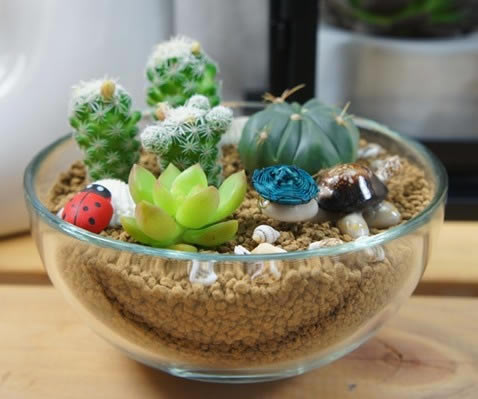
Beginners can start with forest-style bonsai, selecting several plants of differing heights, thicknesses, densities, and forms, such as: boxwood, pond cypress, elm, golden larch, bamboos, etc. They can be planted singly or in groups, but the styling must have a certain variation and not be rigidly uniform. The layout should alternate density and openness, with high and low staggered, with emptiness and solidity, balanced left and right, so that the layout is natural and can form a three-dimensional picture. Then add a few stones of different sizes and small grasses, and it will give the feeling of a "wild forest."
After the initial introduction, you can gradually prune and train tree stumps into bonsai. The shaping methods are generally divided into two types: the wire-training method and the pruning method. ① Wire-training method: following the plant's ecological habits and using metal wire binding to make it into a unique form and achieve an artistic effect, this is called the wire-training method. Materials suitable for the wire-training method include: five-needle pine, azalea, yew, Caragana sinica, black pine, etc. ② Pruning method: according to the plant's growth characteristics, by pruning and truncating the trunk and controlling the growth direction of its branches and buds and the length of the branches, it is made into a unique form; this is called the pruning method. Materials suitable for the pruning method include: Chinese plum yew, Nandina domestica, firethorn, maple, plum, peach, etc.
For miniature bonsai, rainwater is best for watering. If tap water is used, it is best to store it for two or three days to let the chlorine in the water volatilize before use. In spring and autumn, water once every morning and evening; during the plum rain period, avoid heavy rain washing to prevent lodging and affecting growth; in summer when temperatures are high and the air is dry, prevent heatstroke and cool down, and increase the frequency of spraying and watering; in winter, bonsai should be placed indoors. To do a good job of keeping warm and preventing freezing, watering should be reduced, and it is better to keep it drier than usual; the water temperature should preferably be close to room temperature.
Because miniature bonsai have small pots, if fertilizer is not applied in time, it will cause early decline of tree vigor or withering of branches. Therefore, around Qingming Festival, before the plants sprout, apply once a thin liquid fertilizer that has been fully decomposed using the immersion-pot method. Foliage-viewing bonsai should be given fertilizer liquid mainly based on nitrogen; flower-viewing and fruit-viewing bonsai should be given more phosphorus and potassium fertilizer liquid; pine and cypress bonsai only need one base fertilizer application per year. During the plum rain season, because temperature and humidity conditions are suitable, potted plants easily send out new shoots and tender leaves and grow very fast. Therefore, replenishing fertilizer for potted plants is very important. In this way, their branches and leaves can be maintained in growth. In addition, fertilization should be carried out on sunny days when the potting soil is rather dry, so that the fertilizer is not easily lost.
As for how much fertilizer to apply, it can be determined according to specific requirements. For small bonsai mainly for flower viewing, after flowering, continue applying thin liquid fertilizer to keep next year's flower buds numerous and full; for fruit-viewing varieties, a thicker fertilizer is needed, and apply a light fertilizer once before and after flowering to maintain nutrient supply and help increase the fruit-setting rate; in deciduous miscellaneous-tree bonsai, except when growth is too weak, generally it is not advisable to apply too much fertilizer, otherwise it will cause leggy growth and affect the beauty of the form.
Pruning and pinching. Summer is the growth period of tree-stump bonsai. Plants grow quickly and have strong sprouting ability, which often affects the perfection of their forms. Therefore, pruning and pinching must be carried out.
For plants with particularly strong sprouting ability, such as Serissa japonica, Chinese plum yew, elm, etc., prune five to six times each year to maintain their graceful forms; Buddhist pine should be pruned once each in about June and October; five-needle pine, when it changes to new leaves in April, should not only have overly dense young branches cut away, but also be pinched, removing 1/3 of the new buds; black pine and Huangshan pine can, when sending out new buds, have all the main buds removed, leaving the newly grown secondary buds; boxwood and golden larch, after sprouting, should be pinched after leaving one to two nodes, so that they sprout more, and then be pinched again. In this way, their branches can be numerous and short, maintaining a graceful form.
For flower-viewing and fruit-viewing varieties, such as Hall crabapple, Japanese quince, firethorn, etc., more flowering branches should be kept, generally leaving 1-2 nodes on flowering branches; pomegranate is a bonsai for both flower and fruit viewing, and its growth is also very vigorous, so more buds should be removed and branches pruned; winter jasmine, plum, peach, etc., should have short shoots and thin branches trimmed away after flowering, so that they send out robust new shoots again; Chinese juniper should have dead branches under the crown cut away from late May to early July, and tender branches protruding beyond the crown should be picked off by hand, so that the crown is neat and full.
For deciduous tree stumps, after leaf fall, drooping branches, leggy branches, crossing branches, overlapping branches, diseased and insect-damaged branches, etc., should all be removed together, so that the layers are distinct and beauty can be maintained.
Making and Caring for Miniature Bonsai
Miniature bonsai win people over with their simple structure and easy making, as well as their graceful forms and profound meanings, and thus have become a wonderful gem in cultural and artistic life that appeals to both refined and popular tastes.Miniature bonsai are best made in spring and autumn. At this time, plants grow slowly, water evaporation is low, metabolism is relatively weak, and the survival rate is higher.
The materials for making small bonsai can be purchased from flower and tree shops or nurseries, or wild small plants from mountain slopes and valleys can be used, such as: Serissa japonica, Nandina domestica, Chinese wolfberry, elm, bamboos, etc.…… After digging them up, plant them in pots for one year, and after repotting they can be used for making bonsai.
Beginners can start with forest-style bonsai, selecting several plants of differing heights, thicknesses, densities, and forms, such as: boxwood, pond cypress, elm, golden larch, bamboos, etc. They can be planted singly or in groups, but the styling must have a certain variation and not be rigidly uniform. The layout should alternate density and openness, with high and low staggered, with emptiness and solidity, balanced left and right, so that the layout is natural and can form a three-dimensional picture. Then add a few stones of different sizes and small grasses, and it will give the feeling of a "wild forest."
After the initial introduction, you can gradually prune and train tree stumps into bonsai. The shaping methods are generally divided into two types: the wire-training method and the pruning method. ① Wire-training method: following the plant's ecological habits and using metal wire binding to make it into a unique form and achieve an artistic effect, this is called the wire-training method. Materials suitable for the wire-training method include: five-needle pine, azalea, yew, Caragana sinica, black pine, etc. ② Pruning method: according to the plant's growth characteristics, by pruning and truncating the trunk and controlling the growth direction of its branches and buds and the length of the branches, it is made into a unique form; this is called the pruning method. Materials suitable for the pruning method include: Chinese plum yew, Nandina domestica, firethorn, maple, plum, peach, etc.
For miniature bonsai, rainwater is best for watering. If tap water is used, it is best to store it for two or three days to let the chlorine in the water volatilize before use. In spring and autumn, water once every morning and evening; during the plum rain period, avoid heavy rain washing to prevent lodging and affecting growth; in summer when temperatures are high and the air is dry, prevent heatstroke and cool down, and increase the frequency of spraying and watering; in winter, bonsai should be placed indoors. To do a good job of keeping warm and preventing freezing, watering should be reduced, and it is better to keep it drier than usual; the water temperature should preferably be close to room temperature.
Because miniature bonsai have small pots, if fertilizer is not applied in time, it will cause early decline of tree vigor or withering of branches. Therefore, around Qingming Festival, before the plants sprout, apply once a thin liquid fertilizer that has been fully decomposed using the immersion-pot method. Foliage-viewing bonsai should be given fertilizer liquid mainly based on nitrogen; flower-viewing and fruit-viewing bonsai should be given more phosphorus and potassium fertilizer liquid; pine and cypress bonsai only need one base fertilizer application per year. During the plum rain season, because temperature and humidity conditions are suitable, potted plants easily send out new shoots and tender leaves and grow very fast. Therefore, replenishing fertilizer for potted plants is very important. In this way, their branches and leaves can be maintained in growth. In addition, fertilization should be carried out on sunny days when the potting soil is rather dry, so that the fertilizer is not easily lost.
As for how much fertilizer to apply, it can be determined according to specific requirements. For small bonsai mainly for flower viewing, after flowering, continue applying thin liquid fertilizer to keep next year's flower buds numerous and full; for fruit-viewing varieties, a thicker fertilizer is needed, and apply a light fertilizer once before and after flowering to maintain nutrient supply and help increase the fruit-setting rate; in deciduous miscellaneous-tree bonsai, except when growth is too weak, generally it is not advisable to apply too much fertilizer, otherwise it will cause leggy growth and affect the beauty of the form.
Pruning and pinching. Summer is the growth period of tree-stump bonsai. Plants grow quickly and have strong sprouting ability, which often affects the perfection of their forms. Therefore, pruning and pinching must be carried out.
For plants with particularly strong sprouting ability, such as Serissa japonica, Chinese plum yew, elm, etc., prune five to six times each year to maintain their graceful forms; Buddhist pine should be pruned once each in about June and October; five-needle pine, when it changes to new leaves in April, should not only have overly dense young branches cut away, but also be pinched, removing 1/3 of the new buds; black pine and Huangshan pine can, when sending out new buds, have all the main buds removed, leaving the newly grown secondary buds; boxwood and golden larch, after sprouting, should be pinched after leaving one to two nodes, so that they sprout more, and then be pinched again. In this way, their branches can be numerous and short, maintaining a graceful form.
For flower-viewing and fruit-viewing varieties, such as Hall crabapple, Japanese quince, firethorn, etc., more flowering branches should be kept, generally leaving 1-2 nodes on flowering branches; pomegranate is a bonsai for both flower and fruit viewing, and its growth is also very vigorous, so more buds should be removed and branches pruned; winter jasmine, plum, peach, etc., should have short shoots and thin branches trimmed away after flowering, so that they send out robust new shoots again; Chinese juniper should have dead branches under the crown cut away from late May to early July, and tender branches protruding beyond the crown should be picked off by hand, so that the crown is neat and full.
For deciduous tree stumps, after leaf fall, drooping branches, leggy branches, crossing branches, overlapping branches, diseased and insect-damaged branches, etc., should all be removed together, so that the layers are distinct and beauty can be maintained.
For juniper and pine plants, scissors should not be used for pruning, otherwise the healing wounds will develop rusty spots, and they should be picked off by hand. When pruning forest-style bonsai, the integrity of the group should be considered so as to benefit the display.
How to Make and Care for Miniature Bonsai
Miniature bonsai win people over with their simple structure and easy making; their graceful forms and profound meanings, and thus have become a wonderful gem in cultural and artistic life that appeals to both refined and popular tastes. Miniature bonsai are best made in spring and autumn. At this time, plants grow slowly, water evaporation is low, metabolism is relatively weak, and the survival rate is higher.
The materials for making small bonsai can be purchased from flower and tree shops or nurseries, or wild small plants from mountain slopes and valleys can be used, such as: Serissa japonica, Nandina domestica, Chinese wolfberry, elm, bamboos, etc. …… After digging them up, plant them in pots for one year, and after repotting they can be used for making bonsai.
Beginners can start with forest-style bonsai, selecting several plants of differing heights, thicknesses, densities, and forms, such as: boxwood, pond cypress, elm, golden larch, bamboos, etc. They can be planted singly or in groups, but the styling must have a certain variation and not be rigidly uniform. The layout should alternate density and openness, with high and low staggered, with emptiness and solidity, balanced left and right, so that the layout is natural and can form a three-dimensional picture. Then add a few stones of different sizes and small grasses, and it will give the feeling of a "wild forest."
After the initial introduction, you can gradually prune and train tree stumps into bonsai. The shaping methods are generally divided into two types: the wire-training method and the pruning method. ① Wire-training method: following the plant's ecological habits and using metal wire binding to make it into a unique form and achieve an artistic effect, this is called the wire-training method. Materials suitable for the wire-training method include: five-needle pine, azalea, yew, Caragana sinica, black pine, etc. ② Pruning method: according to the plant's growth characteristics, by pruning and truncating the trunk and controlling the growth direction of its branches and buds and the length of the branches, it is made into a unique form; this is called the pruning method. Materials suitable for the pruning method include: Chinese plum yew, Nandina domestica, firethorn, maple, plum, peach, etc.
For miniature bonsai, rainwater is best for watering. If tap water is used, it is best to store it for two or three days to let the chlorine in the water volatilize before use. In spring and autumn, water once every morning and evening; during the plum rain period, avoid heavy rain washing to prevent lodging and affecting growth; in summer when temperatures are high and the air is dry, prevent heatstroke and cool down, and increase the frequency of spraying and watering; in winter, bonsai should be placed indoors. To do a good job of keeping warm and preventing freezing, watering should be reduced, and it is better to keep it drier than usual; the water temperature should preferably be close to room temperature.
Because miniature bonsai have small pots, if fertilizer is not applied in time, it will cause early decline of tree vigor or withering of branches. Therefore, around Qingming Festival, before the plants sprout, apply once a thin liquid fertilizer that has been fully decomposed using the immersion-pot method. Foliage-viewing bonsai should be given fertilizer liquid mainly based on nitrogen; flower-viewing and fruit-viewing bonsai should be given more phosphorus and potassium fertilizer liquid; pine and cypress bonsai only need one base fertilizer application per year. During the plum rain season, because temperature and humidity conditions are suitable, potted plants easily send out new shoots and tender leaves and grow very fast. Therefore, replenishing fertilizer for potted plants is very important. In this way, their branches and leaves can be maintained in growth. In addition, fertilization should be carried out on sunny days when the potting soil is rather dry, so that the fertilizer is not easily lost.
As for how much fertilizer to apply, it can be determined according to specific requirements. For small bonsai mainly for flower viewing, after flowering, continue applying thin liquid fertilizer to keep next year's flower buds numerous and full; for fruit-viewing varieties, a thicker fertilizer is needed, and apply a light fertilizer once before and after flowering to maintain nutrient supply and help increase the fruit-setting rate; in deciduous miscellaneous-tree bonsai, except when growth is too weak, generally it is not advisable to apply too much fertilizer, otherwise it will cause leggy growth and affect the beauty of the form.
Pruning and pinching. Summer is the growth period of tree-stump bonsai. Plants grow quickly and have strong sprouting ability, which often affects the perfection of their forms. Therefore, pruning and pinching must be carried out.
For plants with particularly strong sprouting ability, such as Serissa japonica, Chinese plum yew, elm, etc., prune five to six times each year to maintain their graceful forms; Buddhist pine should be pruned once each in about June and October; five-needle pine, when it changes to new leaves in April, should not only have overly dense young branches cut away, but also be pinched, removing 1/3 of the new buds; black pine and Huangshan pine can, when sending out new buds, have all the main buds removed, leaving the newly grown secondary buds; boxwood and golden larch, after sprouting, should be pinched after leaving one to two nodes, so that they sprout more, and then be pinched again. In this way, their branches can be numerous and short, maintaining a graceful form.
For flower-viewing and fruit-viewing varieties, such as Hall crabapple, Japanese quince, firethorn, etc., more flowering branches should be kept, generally leaving 1-2 nodes on flowering branches; pomegranate is a bonsai for both flower and fruit viewing, and its growth is also very vigorous, so more buds should be removed and branches pruned; winter jasmine, plum, peach, etc., should have short shoots and thin branches trimmed away after flowering, so that they send out robust new shoots again; Chinese juniper should have dead branches under the crown cut away from late May to early July, and tender branches protruding beyond the crown should be picked off by hand, so that the crown is neat and full.
For deciduous tree stumps, after leaf fall, drooping branches, leggy branches, crossing branches, overlapping branches, diseased and insect-damaged branches, etc., should all be removed together, so that the layers are distinct and beauty can be maintained.
For juniper and pine plants, scissors should not be used for pruning, otherwise the healing wounds will develop rusty spots, and they should be picked off by hand. When pruning forest-style bonsai, the integrity of the group should be considered so as to benefit the display.