A Complete Guide to Masson Pine Bonsai Care Techniques, Helping You Master a New Skill
With the improvement of living standards, people in this information age are especially fond of plants. Staring at a computer every day really wears people out, so keeping a potted plant during rest time is a very good choice. Do you know Masson pine? What characteristics does it have? What techniques are there for caring for Masson pine bonsai? Next, let the editors of Yiqizhuangxiu.com introduce them to you one by one.
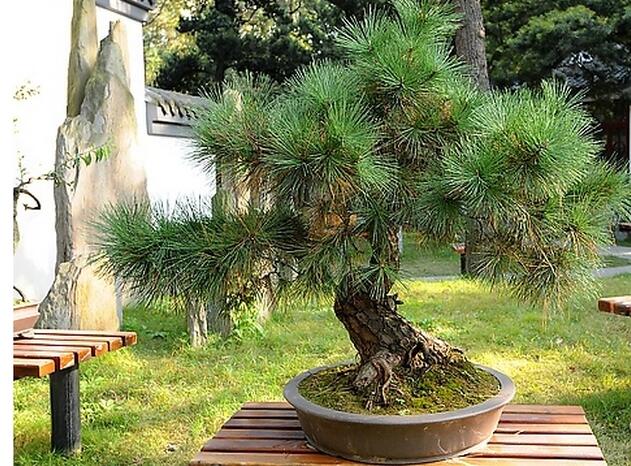
Masson Pine Bonsai Care Techniques, Get a New Skill
Characteristics of Masson Pine
Masson pine is also called mountain pine. It is a pine tree with a relatively straight trunk and bark that is dark reddish-brown with a slight gray tinge. Masson pine is not rot-resistant. The difference between heartwood and sapwood is not obvious; it is light yellowish-brown, with long longitudinal cracks and long flaky peeling; the wood grain is straight and the texture is coarse; it contains resin and is resistant to water and moisture. Specific gravity 0.39-0.49, elastic, rich in resin, weakly rot-resistant. It is an important timber tree species and also a pioneer tree species for afforestation on barren hills.
Morphological characteristics: evergreen tree. One-year-old twigs are light yellowish-brown, hairless; winter buds brown. Leaf sheath membranous. Flowers unisexual, monoecious; male inflorescences stalkless, catkin-like, axillary at the base of new branches, stamens arranged spirally; female inflorescences spherical, one to several borne at the top or upper part of new branches. Needles in bundles of 2, slender and flexible, with fine serrations along the edges, 12-20 cm long, sharply pointed at the tip; resin canals 4-7, marginal. Cones oblong-ovate, 4-8 cm long, 2.5-5 cm in diameter, chestnut-brown when mature; scale shields flat or slightly thickened, with slight transverse ridges; umbo slightly concave, without a prickly tip, rarely with a short prickly tip. Seeds oblong-ovate, winged. Flowering period April-May, fruiting period September-October.
Masson Pine Bonsai Care Techniques
1. Light. Requires plenty of sunlight; must not be shaded.
2. Temperature. When potted, avoid freezing; any temperature between 0-35°C is acceptable.
3. Watering. Because pine bonsai have relatively little soil in the pot, watering should be done in small amounts many times each time, thoroughly watering once, alternating between dry and wet. When the ambient temperature is low in winter, it is better to keep it dry than wet.
4. Ventilation. Requires good ventilation; must not be stuffy and enclosed.
5. Fertilizing. There is no strict demand for fertilizer; generally fertilizing several times from spring to autumn is enough. When fertilizing in autumn, use less nitrogen and more potassium.
6. Pruning. Gradually design the shape according to the trunk framework or maintain the original form through pruning. In short, the goal is to ensure good ornamental value.
7. Pest and disease control. Scale insects are commonly seen, while diseases are rarely seen, so during daily care just pay more attention and prevent them early.
Masson Pine Bonsai Making, Masson Pine Bonsai Pruning, Masson Pine Bonsai Price, Masson Pine Bonsai Care
Masson Pine Bonsai
Some people do not like using flowers to decorate and arrange the home environment, and prefer foliage plants, trees, and the like that have ornamental value. Masson pine is one of them. So what is Masson pine like? Let us learn about it together below.Masson Pine Bonsai Making
I. Selecting the raw material
Although Masson pine bonsai material can be cultivated from a young age, without more than ten or twenty years the trunk will not develop rough bark, and making it into a fine bonsai takes a very long time. When conditions allow, the main approach is to dig up old stumps from the wild. Those old stumps that have been cut by woodcutters year after year, or battered by harsh environments, with short and sturdy ancient-looking trunks, twisted changes, gnarled roots, and clustered branches, and that cannot become timber, are precisely good raw material for making bonsai. Emphasis should be placed on choosing those that are dwarfed, aged, and can be developed into a naturally tapered and richly varied trunk, preferably with existing grafted branches, or with reasonably positioned branches, relatively compact buds, room for selection, and prospects for cultivation. Next is to choose stumps with a relatively coordinated root spread, more lateral roots, relatively flat extension, and easier survival. Digging stumps in the wild must minimize the impact on the environment as much as possible, and measures such as replanting seedlings should be taken; random digging like a scorched-earth policy is opposed.
Pruning of Masson Pine Bonsai
1. The sealing issue
In books, magazines, and on web pages, some people use white latex to seal cuts, but in my own experiments its effect is not significant.
Many people use erythromycin ointment to seal cuts, but in practice it does not work. Erythromycin ointment is actually a kind of salve. When gelatinous resin flows out from the cut, the soft ointment simply cannot stop the resin from overflowing. It can prevent wound infection, but most of the ointment is lost as the resin overflows, and only a very small amount remains attached to the wound, so the effect is not great.
Using mud to seal cuts. In my experiments, the effect was actually quite good. When cutting branches of mountain pine on the mountain, smear some plain soil from the mountain on the wound a few times. Observing the next day, the wound no longer flows resin. Instead, the original gelatinous resin and the solid mud stick to each other and solidify together, effectively stopping the resin from flowing out.
Masson Pine Bonsai Care
1. Light. Requires plenty of sunlight; must not be shaded.
2. Temperature. When potted, avoid freezing; any temperature between 0-35°C is acceptable.
3. Watering. Because pine bonsai have relatively little soil in the pot, watering should be done in small amounts many times each time, thoroughly watering once, alternating between dry and wet. When the ambient temperature is low in winter, it is better to keep it dry than wet.
4. Ventilation. Requires good ventilation; must not be stuffy and enclosed.
5. Fertilizing. There is no strict demand for fertilizer; generally fertilizing several times from spring to autumn is enough. When fertilizing in autumn, use less nitrogen and more potassium.
6. Pruning. Gradually design the shape according to the trunk framework or maintain the original form through pruning. In short, the goal is to ensure good ornamental value.
7. Pest and disease control. Scale insects are commonly seen, while diseases are rarely seen, so during daily care just pay more attention and prevent them early.
Masson Pine Bonsai Price
There are quite a few varieties of Masson pine bonsai, and prices differ by region. The specific shape, height, age, and other factors also matter. It is suggested that you can go to the flower market to take a look.
Related Encyclopedia
Tourmaline mattress, Christmas decorations, stamp albums, splashed-ink landscape paintings, abstract paintings, paper rattan flowers, warp-knitted fabric, wheat straw paintings, crystal flowers, Alxa agate, water-heating blankets, Franz porcelain, golden toad, bedding, Ming Dynasty blue-and-white porcelain, Jingdezhen blue-and-white porcelain, Song Dynasty Ge kiln porcelain, crystal vases, Shu embroidery, Aimeng mattresses
Cultivation Methods for Masson Pine Bonsai, Daily Care and Management Experience for Masson Pine
“How to Make Masson Pine Bonsaihas already been introduced to everyone. I do not know how well everyone has learned it. What I want to share with you today isMasson Pine Bonsai Cultivation Methodsand daily care techniques. Let us learn about them together.
I. Masson Pine Bonsai Cultivation Methods
1. Root cutting for seedling cultivation: For planting Masson pine, Masson pine is a taproot tree species. When cultivating bare-root seedlings in the field, the main root is thick and long, and the lateral fibrous roots are few and fine, so the afforestation survival rate is low. The seedling recovery period is long, and young forests grow slowly in the early stage. Using plastic bags or root-type cultivation containers for seedling raising can improve the quality of Masson pine seedlings and the afforestation survival rate, but because the cost of seedling cultivation is relatively high and the cost of transporting seedlings increases, promotion is very difficult. During the field seedling cultivation growth period of Masson pine, using an iron root-cutting shovel to timely and appropriately cut away part of the original main root of the seedlings promotes root growth, increases the number of lateral fibrous roots, raises the mycorrhizal infection rate, lowers the height-to-diameter ratio, and controls the crown-to-root ratio, which can significantly improve the quality of field bare-root Masson pine seedlings and the afforestation survival rate.
2. Root-cutting seedling plot: The root-cutting seedling plot for Masson pine should be chosen with open terrain, facing the sun, gentle slope, close to a water source, loose texture, and acidic loam or sandy loam with no or very few stones and gravel.
3. Land preparation and bed making: Turn and dig the nursery land 3-6 months in advance, with a preparation depth of 20-25 cm. In conjunction with land preparation, broadcast ground ferrous sulfate powder at 15-20 kg per mu or quicklime at 30-40 kg per mu for soil disinfection, and apply phosphate fertilizer at 60-100 kg per mu as base fertilizer. Then open boxes across the hill to make raised beds, with bed width 1 m, height 20 cm, and path width 30 cm. If the previous crop on the nursery land was not a Masson pine forest or pine seedlings, then a layer of pine forest mycorrhizal soil also needs to be evenly spread on the bed surface.
4. Sowing: To ensure that the pine seedlings can meet the requirements when root cutting is carried out, the sowing time should be appropriately advanced, preferably from late February to early March, and no later than the end of March. The sowing method is drilling, with a sowing spacing of 15-20 cm, and the direction of the sowing furrow should preferably be parallel to the direction of the seedbed. The sowing rate for selected and disinfected superior Masson pine seed is 3-4 kg per mu. Early-sown seedbeds can be covered with film or rice straw to keep warm and moist, promote earlier seed germination, and ensure neat emergence.
5. Early-stage management: First, during the emergence period, pay attention to film management to prevent "scorching" the seedlings; second, after the seedlings have emerged completely, spray Bordeaux mixture at 1:1:120 once every 10-15 days, for 2-3 consecutive times, to prevent damping-off disease; third, combine weeding and loosening the soil with frequent application. Apply diluted topdressing 3-5 times; after mid-June, apply urea in water 1-2 times, with a concentration of 0.3-0.5% as appropriate, to promote seedling growth; fourth, in low mountain and hilly areas, when continuous clear and high-temperature weather occurs, drought resistance and seedling protection are needed. After the summer drought ends, thin and finalize the seedlings in time. Remove those that are too dense and fine.
6. Root-cutting time: To ensure the effect of root-cutting seedling cultivation, the seedling height at the time of root cutting needs to reach 12 cm, and the main root length must be more than 15 cm. Therefore, for all those where the investigated root and stem growth of the seedlings before the summer drought has already reached the requirement, root cutting can be carried out before mid-July; otherwise, root cutting must wait until after the summer drought ends and the autumn rains arrive, from late August to early September. In mountainous areas above 800 m altitude with no summer drought or where the summer drought impact is not great, the root-cutting time is entirely determined by seedling growth, but at the latest it must not be later than mid-September; otherwise, after root cutting the seedlings will have too short a growth time, and the root-cutting effect will be poor.
II. Masson Pine Bonsai Care Experience
1. Light: Requires plenty of sunlight; must not be shaded.
2. Temperature: When potted, avoid freezing; any temperature between 0-35°C is acceptable.
3. Watering: Because pine bonsai have relatively little soil in the pot, watering should be done in small amounts many times each time, thoroughly watering once, alternating between dry and wet. When the ambient temperature is low in winter, it is better to keep it dry than wet.
4. Ventilation: Requires good ventilation; must not be stuffy and enclosed.
5. Fertilizing: There is no strict demand for fertilizer; generally fertilizing several times from spring to autumn is enough. When fertilizing in autumn, use less nitrogen and more potassium.
6. Pruning: Gradually design the shape according to the trunk framework or maintain the original form through pruning. In short, the goal is to ensure good ornamental value.
7. Pest and disease control: Scale insects are commonly seen, while diseases are rarely seen, so during daily care just pay more attention and prevent them early.
The above isMasson Pine Bonsai Cultivation Methodsand an introduction to daily care techniques. Masson pine bonsai has extremely good decorative and ornamental effects, but keeping it at home still requires more care.