What are the precautions for growing miniature bonsai?
Art is a kind of value. In the past, many people only knew how to make money but did not know how to enjoy life, which is clearly different from people today. In today's society, many industries pay great attention to artistic elements, and every time a new product is developed, attention is paid to its artistic quality. Having said so much off-topic, let us now get to the point. I believe everyone knows and has seen miniature potted plants; they are quite beautiful, so how are they made? This question must have stumped you, right! Haha, let's learn about it!
Miniature bonsai is mainly composed of flowers and grasses, embellished with small items such as rocks. It mostly uses plants such as stone iris, asparagus fern, saxifrage, spider plant, orchid, lucky bamboo, narcissus, chrysanthemum, banana plant, reed, and other wild flowers and grasses. Miniature bonsai focuses on small size, exquisite and unique shapes, and places even more emphasis on the connotation of overall artistic beauty. The various decorative pieces in each small bonsai group need to display different forms, and attention must be paid to the overall layout. With a balance of gathering and scattering, and a prominent theme, it ultimately achieves the creator's artistic conception and aesthetic taste, and this is where the vitality of miniature bonsai art lies.
Miniature bonsai is mainly composed of flowers and grasses, embellished with small items such as rocks. It mostly uses plants such as stone iris, asparagus fern, saxifrage, spider plant, orchid, lucky bamboo, narcissus, chrysanthemum, banana plant, reed, and other wild flowers and grasses. Miniature bonsai focuses on small size, exquisite and unique shapes, and places even more emphasis on the connotation of overall artistic beauty. The various decorative pieces in each small bonsai group need to display different forms, and attention must be paid to the overall layout. With a balance of gathering and scattering, and a prominent theme, it ultimately achieves the creator's artistic conception and aesthetic taste, and this is where the vitality of miniature bonsai art lies.
First, choose suitable plant materials and pair them with finely crafted, beautifully shaped small purple clay pots. Rectangular or oval pots carved from white marble can also be used, as well as other small containers with unique shapes and fine craftsmanship; as long as a hole is drilled in the bottom, any of them can be used as a pot. After selecting the plant, it can be planted into a suitable pot. Generally, in tall cylindrical pots, a semi-cascade or full cascade style is suitable. In rectangular and oval pots, an upright trunk or slanting trunk style is suitable.
The most suitable time for shaping general plants should be from after the beginning of winter until before the plants bud in the following spring. Before shaping, a design concept for the styling should be developed based on the characteristics and posture of the tree being planted, and the styling method should be determined. The main trunk is the primary part of miniature bonsai styling. If an upright trunk style is chosen, no wiring is applied, keeping the trunk straight and tall while cultivating side branches; for the slanting trunk style, the trunk is also only planted at a slant without wiring; but for the cascade style, the trunk must be bent into shape by wrapping it with lead wire. When working, the branches and leaves should not be too dense; generally l to 2 branches are kept, with simplicity and smoothness as the main focus, to fully display their natural beauty. Through simple and exaggerated pruning or wiring, shaping the branches with l to 2 bends is sufficient. For messy branches that hinder the styling, such as crossing branches, parallel branches, opposite branches, radiating branches, and reverse branches, they should be thinned or shortened, so that the branches are orderly in density, clearly layered, and moderate in height. For varieties with relatively strong root systems such as Caragana, winter jasmine, and elm, the roots can also be exposed on the pot surface when planting, to increase the aged appearance of the tree.
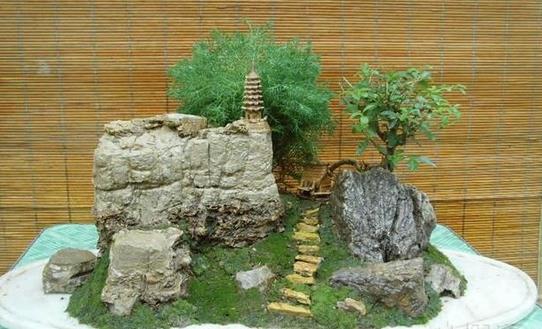
Precautions for growing miniature bonsai
For miniature landscape bonsai, stone materials such as pumice, axe-cut stone, and reed tube stone are commonly used. For the pot, shallow rectangular or oval pots processed from white marble, white jade, and the like are often chosen. The styling and production mostly use the high-distance style, and the flat-distance style is not suitable. The rocks placed in the pot should not be numerous, but there should still be a main peak, secondary peak, and accompanying peak. A small decorative ornament of appropriate proportion can be placed to set off the height of the rocks.
What should be noted when growing miniature bonsai?
Art is a kind of value. In the past, many people only knew how to make money but did not know how to enjoy life, which is clearly different from people today. In today's society, many industries pay great attention to artistic elements, and every time a new product is developed, attention is paid to its artistic quality. Having said so much off-topic, let us now get to the point. I believe everyone knows and has seen miniature potted plants; they are quite beautiful, so how are they made? This question must have stumped you, right! Haha, let's learn about it!
Miniature bonsai is mainly composed of flowers and grasses, embellished with small items such as rocks. It mostly uses plants such as stone iris, asparagus fern, saxifrage, spider plant, orchid, lucky bamboo, narcissus, chrysanthemum, banana plant, reed, and other wild flowers and grasses. Miniature bonsai focuses on small size, exquisite and unique shapes, and places even more emphasis on the connotation of overall artistic beauty. The various decorative pieces in each small bonsai group need to display different forms, and attention must be paid to the overall layout. With a balance of gathering and scattering, and a prominent theme, it ultimately achieves the creator's artistic conception and aesthetic taste, and this is where the vitality of miniature bonsai art lies.
Miniature bonsai is mainly composed of flowers and grasses, embellished with small items such as rocks. It mostly uses plants such as stone iris, asparagus fern, saxifrage, spider plant, orchid, lucky bamboo, narcissus, chrysanthemum, banana plant, reed, and other wild flowers and grasses. Miniature bonsai focuses on small size, exquisite and unique shapes, and places even more emphasis on the connotation of overall artistic beauty. The various decorative pieces in each small bonsai group need to display different forms, and attention must be paid to the overall layout. With a balance of gathering and scattering, and a prominent theme, it ultimately achieves the creator's artistic conception and aesthetic taste, and this is where the vitality of miniature bonsai art lies.
First, choose suitable plant materials and pair them with finely crafted, beautifully shaped small purple clay pots. Rectangular or oval pots carved from white marble can also be used, as well as other small containers with unique shapes and fine craftsmanship; as long as a hole is drilled in the bottom, any of them can be used as a pot. After selecting the plant, it can be planted into a suitable pot. Generally, in tall cylindrical pots, a semi-cascade or full cascade style is suitable. In rectangular and oval pots, an upright trunk or slanting trunk style is suitable.
The most suitable time for shaping general plants should be from after the beginning of winter until before the plants bud in the following spring. Before shaping, a design concept for the styling should be developed based on the characteristics and posture of the tree being planted, and the styling method should be determined. The main trunk is the primary part of miniature bonsai styling. If an upright trunk style is chosen, no wiring is applied, keeping the trunk straight and tall while cultivating side branches; for the slanting trunk style, the trunk is also only planted at a slant without wiring; but for the cascade style, the trunk must be bent into shape by wrapping it with lead wire. When working, the branches and leaves should not be too dense; generally l to 2 branches are kept, with simplicity and smoothness as the main focus, to fully display their natural beauty. Through simple and exaggerated pruning or wiring, shaping the branches with l to 2 bends is sufficient. For messy branches that hinder the styling, such as crossing branches, parallel branches, opposite branches, radiating branches, and reverse branches, they should be thinned or shortened, so that the branches are orderly in density, clearly layered, and moderate in height. For varieties with relatively strong root systems such as Caragana, winter jasmine, and elm, the roots can also be exposed on the pot surface when planting, to increase the aged appearance of the tree.
For miniature landscape bonsai, stone materials such as pumice, axe-cut stone, and reed tube stone are commonly used. For the pot, shallow rectangular or oval pots processed from white marble, white jade, and the like are often chosen. The styling and production mostly use the high-distance style, and the flat-distance style is not suitable. The rocks placed in the pot should not be numerous, but there should still be a main peak, secondary peak, and accompanying peak. A small decorative ornament of appropriate proportion can be placed to set off the height of the rocks.
Miniature potted plants are very exquisite and quite easy to learn. The completion of a pot of miniature potted plants depends on one's own ideas and creative ability. Miniature potted plants are inherently grand and elegant, and are pleasing wherever they are placed. Nowadays, many people like to place one or two pots in their office, balcony, or garden. Especially with the Chinese New Year atmosphere, many people like to buy potted plants to place at home, making the New Year atmosphere stronger and showing off the more beautiful side of their home for the guests who come during the New Year. Have you bought a miniature potted plant?
Growing miniature bonsai
To make a miniature bonsai, we first need to prepare plant materials, and then collect them. Before making it, we need to have a certain understanding of the forms of various trees, and choose materials that are relatively small in shape and easy to survive after being moved into a pot. Artistic processing is carried out according to the characteristics of each trunk to make it more clearly layered.
During shaping, the tree needs to be transplanted from a clay pot into a purple clay pot, or another pot that suits the plant's styling. The last step is the care of the miniature potted plant. The soil should be kept moist, and the placement environment should be chosen according to the plant's characteristics.