Hydroponic Anthurium Growing Methods to Make Your Indoor Potted Plants More Beautiful
Anthurium is a plant in the Araceae family and also a plant with fairly strong hydrophilicity. However, growing it hydroponically is slightly difficult. So how do you grow hydroponic Anthurium? How much do you know? Below, let me give everyone a detailed introduction to how to grow hydroponic Anthurium.
Hydroponic Anthurium Growing Methods
For hydroponic Anthurium growing methods, you need to change the water regularly and clean the flower's roots, correctly choose and use nutrient solution, and flexibly adjust according to the environmental conditions of different seasons. These are the keys to whether you can grow hydroponic Anthurium flowers well.
The length of time between changing the hydroponic nutrient solution can be determined according to the temperature in different seasons and the growth condition of the flowers.
In spring and autumn, under conditions of 15°C to 28°C, for hydroponic flowers with robust branches and leaves, replace the nutrient solution once every 7 to 10 days. First take out the hydroponic flowers, pour out all the used nutrient solution (it can be used to water potted flowers), clean the container, remove the flowers' dead roots and rotten roots, rinse the root system, replace with new nutrient solution, and put them back into the container for static hydroponic culture.
When the temperature exceeds 30°C, most flowers are in a dormant or semi-dormant state, and their physiological metabolism is slow. At this time, nutrient solution hydroponic culture can be stopped and tap water can be used instead for growing. It is likewise necessary to change the new water once every 7 to 10 days, clean the container, remove dead roots and rotten roots, rinse the root system, and restart hydroponic culture. When the temperature drops below 28°C, use nutrient solution for culture again. Most foliage flowers suitable for hydroponic culture stop growing in environments below 10°C, and do not need nutrient solution hydroponic culture either. Replace with new tap water once every 15 to 20 days. While changing the water, clean the container and rinse the root system. Because the water temperature is lower in winter, pathogens will not multiply in large numbers, and the flower root system is not prone to rotting. However, some aged roots die off and should be removed when rinsing.
As for the nutrient solution used, the flower market has varieties specifically for keeping flowers and fish together, called "flower and fish co-culture."
The root system of Anthurium has very strong respiration, and putting it directly into water easily hinders its breathing. The best method is to use a substrate, and the best substrate is ceramsite. Since Anthurium's roots are fleshy roots and the leaves emerge from the roots, the usual method of customized orchid + stone + easy method does not easily produce small leaves. Ceramsite, however, is light in texture and has enough space, making it easy for small leaves to emerge... The Anthurium I currently grow hydroponically in the office uses ceramsite cultivation. I have already grown it for 2 years, and each plant has 3 to 4 flowers.
To grow Anthurium hydroponically with ceramsite, first wash the roots clean, trim old roots and residual roots, and remove flowers. Then place the plant into the container. Fill it with ceramsite, then dilute rooting powder according to the ratio, spray and moisten the ceramsite, and be careful not to let too much water accumulate underneath. If there is too much water, pour it out. After a long wait, you will be pleasantly surprised to find that Anthurium's thick, white fleshy roots are growing on all sides, all clinging to the edge of the container. At this point, congratulations: one hydroponic Anthurium is considered complete. What you need to do next is regularly add nutrient solution and care for its growth.
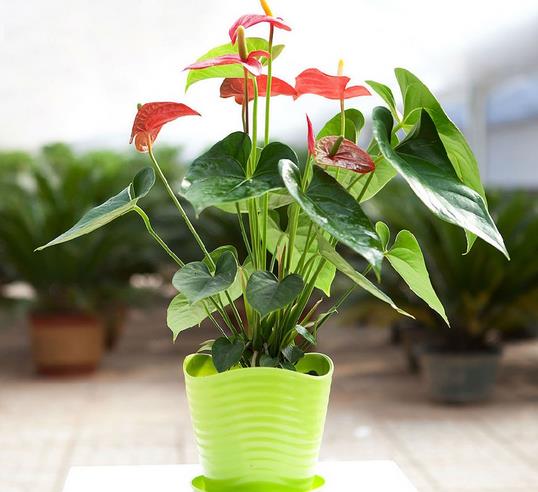
Hydroponic Anthurium Growing Methods to Make Your Indoor Potted Plants More Beautiful
Notes on Growing Anthurium at Home
1. Choice of cultivation substrate. In the process of standardized large-scale production, the substrate I use is mainly peat soil plus a small amount of perlite and coarse river sand, with a small amount of floral foam placed at the bottom of the pot. For small-scale home use, it is recommended to buy prepared potting soil from a garden store and then mix it with ceramsite or dry bark (ratio 2:1) as a substrate; trading is also quite ideal. The prepared substrate must be disinfected.
2. Requirements of the cultivation environment. Since Anthurium is a semi-shade plant, the suitable growth temperature for Anthurium is between 14°C and 35°C. When the temperature is below 10°C, cold damage will occur; when the temperature is above 35°C, the plant will also be harmed. In this situation, water should be sprayed promptly on the plant and around it. To a certain extent, when the humidity is also high under high temperature conditions, damage will not be so easily caused.
3. Management of fertilizer and water. Anthurium plants generally have a higher demand for "magnesium fertilizer" than other foliage plants. It is recommended to apply a complete fertilizer with P:N:K=1:1:1. For general small-scale home growing, you can buy 15-15-15+3Mgo (Magnum) granular slow-release fertilizer from a garden store and apply it together with a foliar fertilizer, or buy Baolifeng No. 2, Huaduoduo general-purpose and other fully water-soluble compound fertilizers, dilute them into an 800-1000 times liquid fertilizer, and apply regularly (no less than once per week). The principle of fertilizing Anthurium is to prefer dilute over heavy, and small meals more often; otherwise it easily causes root damage, affects plant growth, and directly causes plant death. Anthurium likes moisture (high relative humidity), but the substrate should be on the dry side. Therefore, watering is best done together with applying liquid fertilizer. Usually spray water on the leaves and around them more often to increase the relative temperature of the cultivation environment.
4. Prevention and control of pests and diseases. The pests that most commonly occur on Anthurium are red spider mites, nematodes, cabbage caterpillars, whiteflies, thrips, snails, and scale insects, among which red spider mites, nematodes, and cabbage caterpillars are especially the main ones. Anthurium is very sensitive to insecticides, and the concentration must be correct when used; its concentration is usually lower than that used for other flowers. Pay special attention that copper-containing pesticides as well as dimethoate, methamidophos, dichlorvos, malathion, parathion, etc. will cause toxicity to Anthurium.
After reading the detailed introduction above, do you have a better understanding of hydroponic Anthurium cultivation?
Can Anthurium Be Grown in Water? Hydroponic Anthurium Growing Methods
Anthurium's flower shape is similar to a goose palm, so people often call it goose palm red, and some also call it Anthurium andraeanum, a plant in the Araceae family, Anthurium genus. So can Anthurium be grown in water? The following text will introduce the growing methods of hydroponic Anthurium, home Anthurium growing methods, and some common notes on Anthurium cultivation.
Can Anthurium be grown in water?
Anthurium likes warm, humid, semi-shade environments and is very suitable for hydroponic culture. When growing Anthurium, pay attention to moisturizing. Anthurium's graceful posture and beautiful flowers cannot be separated from moisture. Growing Anthurium in water does not mean adding too much water to the cultivation pot, but rather paying attention to maintaining the humidity of Anthurium's living environment.
Not only should you change and add water for Anthurium, you should also spray water into the room where Anthurium is grown, so that the leaves can fully retain enough moisture. More importantly, you should spray water on Anthurium leaves. Moisture is the key to Anthurium's fiery red blooms and graceful posture.
Introduction to Hydroponic Anthurium
Hydroponic Anthurium is a plant with fairly strong hydrophilicity. However, growing it hydroponically is slightly difficult. It is a flower plant from South America and likes warm, humid, semi-shade environments. Hydroponic Anthurium originated in tropical South America and is now widely cultivated in Europe, Asia, and Africa.
Morphological Characteristics
Root and stem: Hydroponic Anthurium is a perennial evergreen herbaceous flower. Its plant height is generally 50-80 cm, varying by variety. It has fleshy roots and no stem.
Leaves: The leaves of hydroponic Anthurium emerge from the rhizome, have long petioles, are solitary and heart-shaped, bright green, with sunken veins.
Flowers: The flowers of hydroponic Anthurium are axillary, with a waxy spathe, from round to ovate, bright red, orange-red flesh-colored, or white, with a spadix, cylindrical and upright. Hydroponic Anthurium blooms in all four seasons.
Hydroponic Anthurium Growing Methods and Precautions
1. Transplanting
Dig the potted Anthurium out of the soil, cut off rotten roots, hairy roots, and old leaves, wash the roots clean with clean water, place them in potassium permanganate solution for disinfection, and then rinse the Anthurium again with clean water. If using a transparent glass container for hydroponic Anthurium, it is best to cover the outside of the glass with a black plastic bag to prevent strong light. Cover the top with a transparent convenient bag (for heat and moisture retention). Place it in a place with scattered light, and keep the temperature above 10 degrees.
2. Changing Water
Anthurium's root system has very strong respiration, so you should regularly change the water for Anthurium, remove the mucus secreted by Anthurium's root system and some algae, and cut off old roots and rotten roots. This also helps increase the dissolved oxygen content in the water. Generally change the water once every 2 or 3 days; in winter, once a week, and add nutrient solution once each time you change the water.
When growing hydroponic Anthurium, just immerse 1/2 of Anthurium's root system in water and leave the other roots exposed to the air so that Anthurium's roots can breathe. Insufficient dissolved oxygen in the water will cause Anthurium root rot.
3. Light and Temperature
Anthurium likes warm, semi-shade environments and avoids direct sunlight. During the process of growing hydroponic Anthurium, pay attention to the placement position; it is best to place it in a ventilated and breathable place that can also avoid strong light. In summer, the ambient temperature around hydroponic Anthurium should not be higher than 28°C. In winter, the growing temperature for hydroponic Anthurium must not be lower than 14°C; below this temperature, Anthurium will suffer cold injury.
Summary: Finally, the editor also needs to remind everyone that when learning the growing methods and precautions for hydroponic Anthurium, you must master Anthurium's growth cultivation substrate. The cultivation substrate must have strong water and fertilizer retention capacity, good permeability, no water accumulation, no toxic substances, and the ability to fix the plant. You also need to pay attention to air humidity, moisture, and temperature, etc.; otherwise, Anthurium leaf rot will occur.
Hydroponic Anthurium Growing Methods and Precautions for Hydroponic Anthurium Cultivation
Hydroponic Anthurium plants are highly ornamental and look very good when blooming. Some friends also like to grow them indoors, which can not only make home life more vibrant but also cultivate character. Below, let us take a detailed look at hydroponic Anthurium growing methods and precautions for hydroponic Anthurium cultivation.
1. How do you grow hydroponic Anthurium?
1. Transplanting: Dig the potted Anthurium out of the soil, cut off rotten roots, hairy roots, and old leaves, wash the roots clean with clean water, place them in potassium permanganate solution for disinfection, and then rinse the Anthurium again with clean water. If using a transparent glass container for hydroponic Anthurium, it is best to cover the outside of the glass with a black plastic bag to prevent strong light. Cover the top with a transparent convenient bag (for heat and moisture retention). Place it in a place with scattered light, and keep the temperature above 10 degrees.
2. Changing water: Anthurium's root system has very strong respiration, so you should regularly change the water for Anthurium, remove the mucus secreted by Anthurium's root system and some algae, and cut off old roots and rotten roots. This also helps increase the dissolved oxygen content in the water. Generally change the water once every 2 or 3 days; in winter, once a week, and add nutrient solution once each time you change the water. When growing hydroponic Anthurium, just immerse 1/2 of Anthurium's root system in water and leave the other roots exposed to the air so that Anthurium's roots can breathe. Insufficient dissolved oxygen in the water will cause Anthurium root rot.
3. Light and temperature: Anthurium likes warm, semi-shade environments and avoids direct sunlight. During the process of growing hydroponic Anthurium, pay attention to the placement position; it is best to place it in a ventilated and breathable place that can also avoid strong light. In summer, the ambient temperature around hydroponic Anthurium should not be higher than 28°C. In winter, the growing temperature for hydroponic Anthurium must not be lower than 14°C; below this temperature, Anthurium will suffer cold injury.
4. Master Anthurium's growth cultivation substrate. The cultivation substrate must have strong water and fertilizer retention capacity, good permeability, no water accumulation, no toxic substances, and the ability to fix the plant. You also need to pay attention to air humidity, moisture, and temperature, etc.; otherwise, Anthurium leaf rot will occur.
2. What are the precautions for hydroponic Anthurium cultivation?
1. Newly hydroponically grown Anthurium with ceramsite is not suited to direct sunlight; just place it in a shady room.
2. At the beginning of hydroponic culture, do not add nutrient liquid; it is best to add rooting powder.
3. The container for growing Anthurium should be slightly larger, preferably wide at the top and narrow at the bottom, V-shaped, and it should also have a certain height.
4. How long can hydroponic Anthurium live? Those grown hydroponically with ceramsite can live a very long time. I have grown it for 2 years and now it produces leaves and flowers every year; it is estimated it can live even longer.
5. If you want to grow Anthurium hydroponically, it is recommended to use ceramsite to induce it first, then switch to pure hydroponic culture. Directly putting it into water is not recommended.
For Anthurium, the hydroponic method is relatively difficult to carry out. In addition to mastering the relevant methods, you also need to be extra careful and attentive during the growing process. After hydroponic Anthurium is planted well, sometimes because there is not enough water, or not enough nutrient solution, or because it cannot get sunlight, Anthurium's leaves may turn yellow. So friends should adopt different methods to solve the problem according to the specific situation. And if the planting method is wrong during the hydroponic process, it may also cause hydroponic Anthurium root rot. Everyone can consult relevant methods to solve it; the editor will not explain it in detail here.
The above is the relevant introduction in this article. I believe after reading it you also have a simple understanding of this. If needed, you can continue to follow No. 1 Home Network to learn more information.