A Detailed Guide to the Growing Habits and Cultivation Methods of Jasmine
I. What are the growing habits of jasmine?
Jasmine prefers warmth and humidity, and grows best in a well-ventilated, semi-shaded environment. In summer, with high temperatures, humidity and strong light, it produces the most flowers and the strongest fragrance. If light is insufficient, the leaves become large, the internodes thin, and the flowers small. The most suitable soil is a slightly acidic sandy loam rich in humus. Most varieties prefer a warm climate, are afraid of cold and drought, and cannot tolerate frost, waterlogging or alkaline soil. When the winter temperature drops below -3°C, the branches and leaves are prone to frost damage, and if it lasts a long time, the plant will die. The optimum growing temperature is 25-33°C. During the growing period it needs plenty of water and a humid climate, with air humidity of 80%-90%. It likes fertilizer, pH 5.5-7.0. Deciduous climbing varieties, however, are very cold- and drought-tolerant.
Jasmine prefers a warm, humid environment with plenty of sunshine. Jasmine is fairly sensitive to temperature, able to adapt to high temperatures but not tolerant of low temperatures, with poor cold resistance. At 0°C, the leaves and the tender parts of the shoots may wither in mild cases, or most of the branches may wither and die in severe cases. The optimum growing temperature for jasmine is 25-35°C. Below 10°C it grows extremely slowly, or even stops growing. It can sprout at around 19°C. Below 25°C it grows slowly, and only above 25°C does it develop flower buds. At 30-40°C the buds form and develop well, and 32-37°C is the optimum temperature for the buds to mature and open. Above 37°C the flowers may still open, but often become dull and yellow with poor fragrance.
Jasmine is a light-loving long-day plant. Direct sunlight is most suitable for its growth and development. If light is insufficient or it is shaded, the leaves become larger and thinner, pale green, and growth is poor. The stronger the light, the more developed the root system, the more robust the plant's growth, and the stronger its resistance.
Wind has a certain influence on the growth and development of jasmine. In summer, southeasterly winds prevail, carrying a large amount of water vapor, which increases air humidity and makes jasmine grow vigorously. Westerly or northwesterly winds lower air humidity and temperature, inhibit bud development, and the flowers often fail to open fully, with some flowers turning purplish red. In the hot summer, northerly winds blowing on jasmine promote white flowers and a strong fragrance; southerly or easterly winds increase evaporation, causing water loss and leaf drop, and affecting growth.
As for soil requirements, a loose, fertile sandy loam with a pH of 6-6.5 is most suitable. For potting soil, a mixture of garden soil and rice husk ash, or garden soil with vermiculite and leaf mold, can be used.
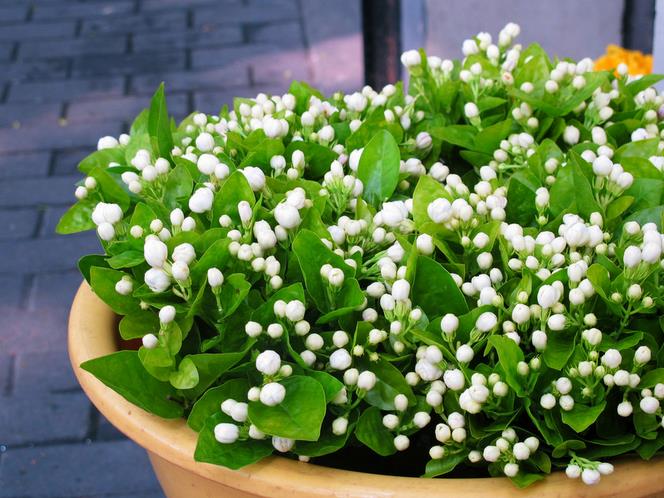
What are the growing habits of jasmine? What are the cultivation methods for jasmine?
II. What are the cultivation methods for jasmine?
1. Cultivation techniques for jasmine
Summer: In midsummer, water every morning and evening; if the air is dry, supplement with misting.
Winter: During the winter dormant period, control watering; if the potting soil is too wet, it will cause root rot or leaf drop. During the growing period, apply a thin cake fertilizer solution once a week.
Spring: After repotting in spring, pinch back and shape frequently; after the peak flowering period, prune heavily to encourage new shoots, making the plant neat and robust with abundant flowers.
1. Soil conditions for growing jasmine
The soil for potted jasmine needs to be rich in organic matter and have a certain degree of aeration and drainage. The soil can be made from four parts compost, four parts garden soil, two parts rice husk ash or two parts river sand, plus well-rotted dry cake fertilizer residue and chicken or duck manure, etc. Sift out some coarser particles and powder and spread them at the bottom of the pot.
2. Fertilization for growing jasmine
Jasmine likes plenty of water and fertilizer during the flowering period. Its flowering period runs from June to September, and during this time it needs frequent fertilization, preferably with a liquid fertilizer rich in phosphorus, such as fish wastewater fertilizer solution or rotted soybean cake, or superphosphate and ammonium sulfate, etc., applied once every two to three days. A liquid fertilizer rich in nitrogen, phosphorus and potassium can be applied once a week; alternating it with alum fertilizer water gives even better results. This not only balances the plant's nutrition, keeping the leaves green and thick with large, fragrant flowers, but also effectively prevents chlorosis. When the chemical fertilizer content is too high, it may burn the jasmine plant; in that case, we can spray the jasmine leaves in the evening with a 0.1% potassium dihydrogen phosphate aqueous solution, which promotes more flowering.
3. Water requirements of jasmine
Jasmine likes a humid environment, and during its flowering period watering is even more important. Because summer temperatures are higher and the plant transpires more, it should be given plenty of water, with a thorough watering each morning and evening, plus a spray of clean water on the leaves and around the pot each mid-morning and mid-afternoon to increase air humidity. Note, however, that on cloudy and rainy days watering should be reduced or skipped, and on rainy days care should also be taken to avoid rain exposure and prevent water accumulation in the pot.
4. Pruning for growing jasmine
Jasmine flowers on new shoots, so during its flowering period pruning should be strengthened, with special attention to pinching back. Stems that have already flowered should also be cut back promptly to encourage more side branches and more flower buds. Jasmine blooms most abundantly on 3-6 year old plants, after which it ages year by year and must be heavily pruned and renewed in time. Before sprouting in spring, the previous year's branches can be cut back appropriately, keeping 10-15 cm at the base, so that many sturdy new shoots emerge. If the new shoots grow very vigorously, they should be pinched back when they reach 10 cm to encourage a second flush of shoots, resulting in more flowers, a compact shape and high ornamental value.
Note: Pruning should be done on sunny days, and can be combined with thinning the leaves and removing diseased branches; the plant can also be adjusted accordingly, which benefits growth and bud formation and flowering.
5. Sunlight for growing jasmine
Jasmine likes light, heat, humidity and a well-ventilated environment, and needs plenty of sunlight. Insufficient light tends to make the branches thin and the leaves yellow, but too much light also requires appropriate shading, otherwise the leaves are easily scorched by the sun. Jasmine can be placed in a semi-shaded spot, receiving only light before 9 a.m. and after 5 p.m. Jasmine is afraid of cold; in the south, potted jasmine can be grown outdoors to overwinter, while in the north, warmth must be provided in autumn and winter, moving it indoors to a south-facing spot. With strong light, the branches are robust, the leaves dark green, and the flowers numerous and fragrant; with insufficient sunlight, the internodes are sparse, the flowers few and not fragrant.
What are the growing habits of jasmine? What are the cultivation methods for jasmine?
What are the morphology and growing habits of jasmine, and the precautions to know for planting
Jasmine is deeply loved by people. Its flower language represents respect, purity and chastity, simplicity, delicacy and charm. But how much do you really know about jasmine - what are its morphology and growing habits, and what value and uses does it have? Next, the editor will tell you about jasmine.
Growing habits
Leaves: opposite, simple, papery, round, elliptical, ovate-elliptical or obovate, 4-12.5 cm long, 2-7.5 cm wide, rounded or blunt at both ends, sometimes slightly heart-shaped at the base, with 4-6 pairs of lateral veins, slightly sunken or raised above, raised below, the fine veins often distinct and slightly raised on both sides, hairless except for the tufts of hair often present in the vein axils below; petiole 2-6 mm long, pubescent, with a joint.
Flowers: terminal, usually 3 per cluster, sometimes single or up to 5; peduncle 1-4.5 cm long, pubescent; bracts minute, awl-shaped, 4-8 mm long; pedicel 0.3-2 cm long; flowers extremely fragrant; calyx hairless or sparsely pubescent, lobes linear, 5-7 mm long; corolla white, corolla tube 0.7-1.5 cm long, lobes oblong to nearly round, 5-9 mm wide, rounded or blunt at the tip. Fruit spherical, about 1 cm in diameter, purplish black. Flowering period May-August, fruiting period July-September.
Efficacy
Jasmine has the effect of promoting the flow of qi and opening the body. The volatile oily substances contained in jasmine have the effect of promoting qi and relieving pain, relieving depression and dispersing nodules, and can ease chest and abdominal distension and pain, and tenesmus in dysentery and other symptoms, making it a good dietary remedy for pain relief. Jasmine is cold in nature, fragrant and mild in taste, and relieves bloating; it is pungent and sweet, warm in nature. Jasmine's efficacy includes regulating qi and relieving pain, warming the middle and harmonizing the stomach, reducing swelling and detoxifying, and strengthening the immune system, and it has a very good anti-inflammatory and detoxifying effect on dysentery, abdominal pain, conjunctivitis and sores and toxins. The fragrance of jasmine can calm the emotions, and jasmine's efficacy also includes removing bad breath, regulating the endocrine system, and moisturizing the complexion, and it has a considerable effect on menstrual irregularities. The fragrance can enhance the body's ability to cope with complex environments, and eliminate mental fatigue and nervousness.
Precautions
During jasmine cultivation, special attention should be paid to fertilizing it. Generally, from May onward, apply a thin soybean cake water once every 7 days; during the bud and flowering stages, apply light fertilizer frequently, about once every 5 days. Stop fertilizing from October onward. In the rainy season, when grown outdoors, switch to dry fertilizer, such as soybean cake residue (loosen the surface soil in the pot, add the soybean cake residue, and cover it with soil). During the growing period, apply 0.2% ferrous sulfate water once every 10 days to maintain soil acidity. Proper water regulation is the key to jasmine cultivation: jasmine likes humidity and fears waterlogging, and overly wet potting soil easily causes root and leaf rot or even death. When jasmine only grows branches and leaves without flowering, it is generally because too much nitrogen fertilizer has been applied, or because of a lack of sunlight. Therefore, when jasmine enters its vigorous growth period, the amount of nitrogen fertilizer should be strictly controlled and it should be given more sun, to avoid the plant growing leggy.
The above is the relevant information I have introduced about jasmine; I hope it is helpful to everyone. Please continue to follow Duorou Huapu for more information.
How to grow jasmine? Flowering-period care methods for jasmine
Image: Jasmine
[Common Questions]: How to grow jasmine this way?
[Expert Answer]:To grow jasmine well, first let us look at its growing habits. Jasmine prefers warmth and humidity, and grows best in a well-ventilated, semi-shaded environment. The most suitable soil is a slightly acidic sandy soil rich in humus. Most varieties are afraid of cold and drought, and cannot tolerate frost, waterlogging or alkaline soil. So, knowing jasmine's growing habits, how should jasmine be planted?
[Growing environment]:
1. Light:Jasmine likes a hot, humid, well-ventilated environment, and needs plenty of sunlight. Jasmine is afraid of cold; in the south, potted jasmine can be grown outdoors to overwinter, while in the north, warmth must be provided in autumn and winter, moving it indoors to a south-facing spot. With strong light, the branches are robust, the leaves dark green, and the flowers numerous and fragrant; with insufficient sunlight, the internodes are sparse, the flowers few and not fragrant.
2. Water:Jasmine is not drought-tolerant, but also dislikes waterlogging. In the rainy season, promptly pour out any accumulated water in the pot, otherwise the leaves easily turn yellow. In hot, sunny summer, water twice a day, once in the morning and once in the evening; if the leaves are found curling and drooping, spray water on the leaves to promote growth.
3. Soil:For growing jasmine, fertile sandy and semi-sandy soil is best. Grown in slightly acidic soil with a pH of 6 to 6.5, the root system is dense and growth is vigorous; if the soil is heavy clay, lacking organic matter, low in fertility and poorly aerated, then the root system is sparse, the plant short, the stems and leaves thin, and the flowers few and small.
Image: Jasmine
[Flowering-period care]:
Jasmine loves fertilizer; with proper care, a potted jasmine can bloom three times a year. If fertilizer is insufficient and nutrients are inadequate, it will not bloom again after flowering once. With proper management, it can bloom continuously from the end of May to early November. The key is pruning, sunlight, and the control of fertilizer and water.
Jasmine begins flowering from early summer onward, and with proper management, three peak flowering periods can occur.
In early June, jasmine begins to produce early flowers. The method of picking is to remove the flower together with the leafy young shoot, prompting new shoots to grow and the branches and leaves to flourish. At this time, apply dilute fertilizer water twice a week and keep the potting soil moist.
From late June to early July is the first peak flowering period. At this time, fertilizer and water management should be strengthened, applying light fertilizer frequently, fertilizing once every 2 days with a fully rotted organic liquid fertilizer, with a fertilizer-to-water ratio of 1:4. Watering should be plentiful, generally once a day. Watering is usually best done in the morning, while fertilizing is best done in the evening. Continuing this until late July, thanks to the ample fertilizer and water, the flowers will be large and numerous.
In early August, the second flowering period forms. At this time, fertilizing should be slightly more concentrated than before, generally with equal parts fertilizer and water. To promote better flowering in jasmine, a superphosphate solution can also be sprayed on the leaves. By late August, gradually reduce fertilizing to once every 6-7 days; watering still needs to be relatively frequent, kept at once every 2 days.
From early September to early October, the third flowering period forms. At this time, fertilizing should stop and watering should also gradually decrease. As the weather has gradually turned cooler, which affects bud formation, this batch of flowers is fewer in number. After mid-October, flowering ends, and it is enough to keep the potting soil slightly moist.
[Editor's Summary]: That is some knowledge about jasmine flowering-period care and related matters. To grow jasmine well, besides putting thought into its care, you must also be clear about jasmine's growing habits, so that managing it will be easier.