Detailed Guide to Making and Cultivating Azalea Bonsai
With the development of globalization, people increasingly know how to enjoy life, satisfying their spiritual world through all kinds of leisure activities. Nowadays people often also grow and cultivate bonsai, pruning, watering and fertilizing every day. Cultivation is divided into many types: there are simple potted plants, such as growing flowers and plants where daily fertilizing and watering are enough, and there is another, more complex kind of bonsai that requires pruning, shaping and other technical skills. Now the editor will introduce to you the key points of making and cultivating azalea bonsai.
Making Azalea Bonsai
1. Pruning. Generally, pot-grown rhododendrons are mostly kept for the purpose of flower viewing; if no attention is paid to shaping and they are allowed to grow naturally, the branches will be numerous and messy, which not only hinders growth but also affects flower quality. To keep the tree form graceful, necessary pruning should be carried out according to the shaping requirements, improving ventilation and light conditions, which can promote growth and improve flowering quality. For rhododendrons, after flowering each year, it is best to remove all the flower bases to reduce nutrient consumption. Branch pruning is done during the dormant period, cutting off crossing branches, upright branches, inverted branches, inward-facing branches, opposite branches, etc., to adjust the branch spread and display a graceful tree form.
2. Repotting. Rhododendrons should be repotted once every 2-3 years, preferably after flowering; repotting in early spring or late autumn is also fine. When repotting, remove about 1/3 of the old soil, cut off a small amount of old roots, and replace with loose leaf mold or mountain soil. Place a small amount of chicken manure and soybean cake at the bottom of the pot as base fertilizer. Since most of the rhododendron's root system is distributed in the surface layer of the soil, the topsoil layer should be retained when repotting.
3. Key points of making: In the early stage, shaping is mainly done by bending and tying, with pruning as a supplement. During the peak growing season, cut back as appropriate to encourage side branches and dwarf the trunk and branches. Root exposure should not be rushed; carry it out in conjunction with repotting, once a year. Varying with the stump, highlighting the tree's style and individuality is the key to azalea bonsai shaping.
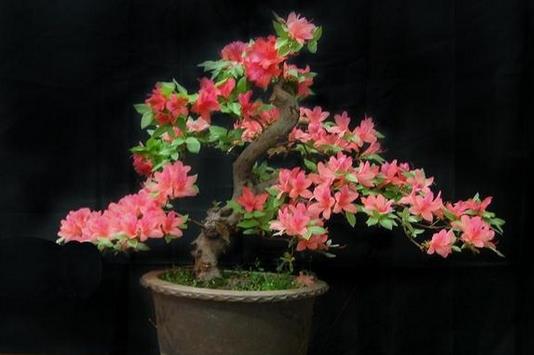
Making and Cultivating Azalea Bonsai
Key Points for Cultivating Azalea Bonsai
1. Collecting stumps: Although azaleas are a common variety, good stumps mostly grow in places that are relatively difficult to collect from, so they must be dug up carefully, keeping the root system intact, with the root ball slightly larger and carrying native soil (symbiotic fungi); collect around the flowering period.
2. Trimming the stump: Trim the slightly larger root ball down to the size needed for cultivation, and cut the branches and trunk to the final position in one go. The root ends and branch ends must be sealed to prevent shrinkage.
3. Planting: Disinfect the soil in advance, plant in loose, plain soil, preferably in the ground; after the root system is well established (about one year), plant in soil mixed according to its habits; place it according to its habits. Keep it alive the first year, build roots the second year, build the tree the third year, and pot it up the fourth year.
4. Fertilizer and water: No fertilizer the first year, use less fertilizer the second year depending on conditions, use fertilizer normally the third year, applying light fertilizer frequently. Maintain moisture management throughout.
Making and Cultivating Azalea Bonsai
Introduction: With the development of globalization, people increasingly know how to enjoy life, satisfying their spiritual world through all kinds of leisure activities. Nowadays people often also grow and cultivate bonsai, pruning, watering and fertilizing every day. Cultivation is divided into many types: there are simple potted plants, such as growing flowers and plants where daily fertilizing and watering are enough, and there is another, more complex kind of bonsai that requires pruning, shaping and other technical skills. Now the editor will introduce to you the key points of making and cultivating azalea bonsai.
Making
1. Pruning Generally, pot-grown rhododendrons are mostly kept for the purpose of flower viewing; if no attention is paid to shaping and they are allowed to grow naturally, the branches will be numerous and messy, which not only hinders growth but also affects flower quality. To keep the tree form graceful, necessary pruning should be carried out according to the shaping requirements, improving ventilation and light conditions, which can promote growth and improve flowering quality. For rhododendrons, after flowering each year, it is best to remove all the flower bases to reduce nutrient consumption. Branch pruning is done during the dormant period, cutting off crossing branches, upright branches, inverted branches, inward-facing branches, opposite branches, etc., to adjust the branch spread and display a graceful tree form.
2. Repotting Rhododendrons should be repotted once every 2-3 years, preferably after flowering; repotting in early spring or late autumn is also fine. When repotting, remove about 1/3 of the old soil, cut off a small amount of old roots, and replace with loose leaf mold or mountain soil. Place a small amount of chicken manure and soybean cake at the bottom of the pot as base fertilizer. Since most of the rhododendron's root system is distributed in the surface layer of the soil, the topsoil layer should be retained when repotting.
Key Points for Cultivation
1 Collecting stumps: Although azaleas are a common variety, good stumps mostly grow in places that are relatively difficult to collect from, so they must be dug up carefully, keeping the root system intact, with the root ball slightly larger and carrying native soil (symbiotic fungi); collect around the flowering period.
2 Trimming the stump: Trim the slightly larger root ball down to the size needed for cultivation, and cut the branches and trunk to the final position in one go. The root ends and branch ends must be sealed to prevent shrinkage. 3 Planting: Disinfect the soil in advance, plant in loose, plain soil, preferably in the ground; after the root system is well established (about one year), plant in soil mixed according to its habits; place it according to its habits. Keep it alive the first year, build roots the second year, build the tree the third year, and pot it up the fourth year.
4 Fertilizer and water: No fertilizer the first year, use less fertilizer the second year depending on conditions, use fertilizer normally the third year, applying light fertilizer frequently. Maintain moisture management throughout. IV. Key points of making: In the early stage, shaping is mainly done by bending and tying, with pruning as a supplement. During the peak growing season, cut back as appropriate to encourage side branches and dwarf the trunk and branches. Root exposure should not be rushed; carry it out in conjunction with repotting, once a year. Varying with the stump, highlighting the tree's style and individuality is the key to azalea bonsai shaping.
The above are the key points of making and cultivating azalea bonsai. I believe that after reading so much about the methods and key points of making azalea bonsai, you will certainly have gained some understanding of the daily pruning of azaleas. Azalea is also called rhododendron, and is one of China's famous top ten flowers. The daily care of azaleas is also extremely important; azaleas like moisture, so they should be watered frequently, but the amount of water each time should not be too large, as this is not good for the development of the azalea's root system. Azalea flowers are fragrant; interested readers can try making an azalea bonsai.
Azalea pictures, making azalea bonsai, how to grow azaleas
Azalea
Azalea, also known as Rhododendron pulchrum, belongs to the order Ericales, family Ericaceae, a semi-evergreen shrub. It likes a cool, moist and sunny environment. It is cold-resistant, afraid of heat, tolerant of partial shade, and not tolerant of long periods of strong direct sunlight. The suitable growth temperature is 15-28°C, and in winter it can withstand low temperatures of -8°C. The soil should preferably be fertile, loose, well-drained acidic sandy loam. It originates from China, but no wild specimens have been found to date. It is now distributed in Jiangsu, Fujian and other places.Azalea pictures
Azalea - Suitable for planting in masses; when in bloom, a riot of purple and red, it can add a natural landscape effect to gardens. It can also be planted in clumps beside rocks, by pond banks and at the edges of lawns, adding a garden atmosphere. Potted plants placed in hotels, homes and public places are dazzlingly brilliant.
Making Azalea Bonsai
1. Pruning Generally, pot-grown rhododendrons are mostly kept for the purpose of flower viewing; if no attention is paid to shaping and they are allowed to grow naturally, the branches will be numerous and messy, which not only hinders growth but also affects flower quality. To keep the tree form graceful, necessary pruning should be carried out according to the shaping requirements, improving ventilation and light conditions, which can promote growth and improve flowering quality. For rhododendrons, after flowering each year, it is best to remove all the flower bases to reduce nutrient consumption. Branch pruning is done during the dormant period, cutting off crossing branches, upright branches, inverted branches, inward-facing branches, opposite branches, etc., to adjust the branch spread and display a graceful tree form.
2. Repotting Rhododendrons should be repotted once every 2-3 years, preferably after flowering; repotting in early spring or late autumn is also fine. When repotting, remove about 1/3 of the old soil, cut off a small amount of old roots, and replace with loose leaf mold or mountain soil. Place a small amount of chicken manure and soybean cake at the bottom of the pot as base fertilizer. Since most of the rhododendron's root system is distributed in the surface layer of the soil, the topsoil layer should be retained when repotting.
How to Grow Azaleas
I. Environmental conditions : It is best to have both indoor and outdoor environments for cultivating rhododendrons. The indoor environment is used in winter. In the Yangtze River basin, as long as there is a certain amount of light and ventilation indoors, generally no heating is needed. In the north, where winters are extremely cold and dry, cultivation in a medium-temperature (around 15 °C ) greenhouse is suitable. The outdoor site is used in summer and autumn, preferably with a mud ground; avoid cement ground. The site should be spacious, ventilated and shaded, with a shade shed built above, covered with reed curtains or using the shelter of natural tree shade; a light transmission rate of about 30% is suitable, and exposure to the afternoon sun must be avoided.
II. Potting soil requirements : Rhododendrons like loose, highly permeable, well-drained acidic soil rich in humus, with a pH value of 5.0 - 6.0 . If clay or alkaline soil is used, hardly one in a hundred will survive. Especially for summer rhododendrons and Western rhododendrons, mountain soil is indispensable. The mountain soil also needs to be improved; at present, three kinds of prepared culture soil are commonly used. (1) Mix 7 parts mountain soil, 1 part dried sedge debris, 2 parts dry leaf mold, and 1 part dry fertilizer. (2) Layer 3 parts mountain surface soil ( topsoil ), 3 parts horse manure, 3 parts fallen leaves and weeds, and 1 part human and animal manure in layers to compost; after 1 - 2 years, sieve and set aside for use. (3) Mix 3 parts mountain soil, 3 parts leaf mold, 4 parts garden soil, and 2 parts sandy soil, and add 50 grams of sesame paste residue and bone meal per pot.
Is Azalea the Same as Rhododendron?
Yes. Azalea is rhododendron. Rhododendrons are evergreen or semi-evergreen shrubs, rarely trees. The genus has about 850 species, and China has about 560 species. The Chinese name comes from a myth: after his death, King Duyu of Shu (Emperor Wang) turned into a cuckoo (bird), and every spring he cried sadly, weeping blood without end. Later generations had the saying "where the cuckoo cries, blood becomes flowers," hence the flower and the bird share the same name.
Related Encyclopedia
Pocket scale non-woven bag rush pith bamboo shoot crab claw red rice note 3 ykk zipper ybs zipper large mountain cherry climbing rose wild senna wintersweet green pine wristwatch Omega Longines famous watch children's building blocks flint azalea orchid curling iron soursop