How to Grow Strawberries in Pots and Key Fertilizing Tips
Strawberries are among the fruits that both adults and children love to eat, and their appearance makes them especially appealing to kids! First, they are red and heart-shaped; second, one bite fills your mouth with the rich aroma of strawberry; and finally, not only is the flesh thick and juicy, but the sweet-and-sour taste is unforgettable. If you want to grow strawberries in pots, let me introduce potted strawberries to you.
Potted strawberries are perennial herbaceous plants. When growing potted strawberries, there are many points friends must pay close attention to, which greatly helps improve the fruit-setting rate of strawberries.
1. Choosing Containers for Potted Strawberries
You can use clay pots, porcelain pots or wooden boxes with a diameter of 21-33 cm; the size depends on the number of plants, and the bottom of the box should have drainage holes. Before planting, the flower pot should be soaked in water. Choosing varieties for potted strawberries: generally any cultivated variety can be chosen, but it is best to choose everbearing strawberry varieties that fruit in all four seasons.
2. Nutrient Soil for Potted Strawberries
Strawberries like sandy, well-aerated, fertile soil. Therefore, the ideal potting soil is humus soil from the surface layer of broadleaf forests. This soil contains much organic matter and many nutrients, is loose, and has good water absorption and drainage, which benefits the long-term growth of strawberries. You can also mix nutrient soil by hand, with the ratio of soil, fertilizer and sand at 1:1:1, that is, 1 part fertile garden soil, plus 1 part decomposed chicken, duck or sheep manure, and 1 part river sand; the manure, soil and sand are best crushed and sieved, then mixed with 2%-3% superphosphate. Before filling pots, the prepared nutrient soil can be disinfected with a 0.3% potassium permanganate aqueous solution. If conditions permit, an appropriate amount of cake fertilizer can be added.
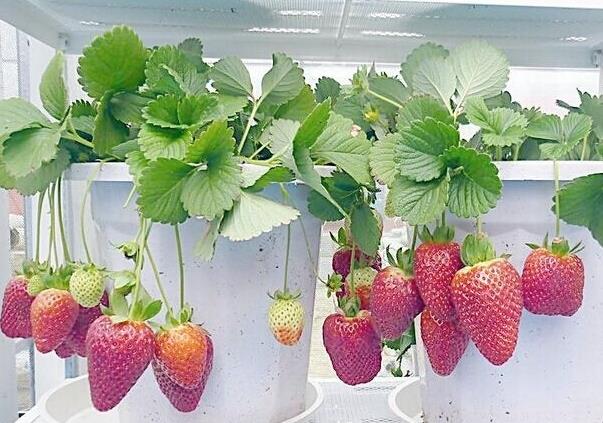
Fertilizer and Planting Methods for Potted Strawberries
3. Fertilizer and Water Management for Potted Strawberries
Strawberries have relatively high requirements for fertilizer and water, especially everbearing strawberries, which continuously form flower buds and bloom and fruit throughout the year and need repeated additional fertilization to meet their needs. To supplement fertilizer for potted strawberries, you can use compound granular fertilizer or slow-release flower fertilizer, or mix cake fertilizer with water, fully ferment and decompose it, and apply it together with watering, once every 10 days or so; apply little but often. If using chemical fertilizer, you can apply foliar spray such as 0.3% monopotassium phosphate in the morning or evening. For outdoor pots, the leaves are prone to wilting from lack of water, so water lightly once in the morning and once in the evening, and keep the soil moist regularly. In summer when it is hot, do not place the flower pot directly in the sun for exposure; it is best to place it in a ventilated, dry spot, and add one more watering at noon, but do not water with low-temperature well water or tap water.
4. Plant Management for Potted Strawberries
Potted strawberries should have strengthened plant management. First, thin buds, remove leaves and remove runners at the right time. That is, remove ineffective high-level flowers in appropriate amounts during the bud dispersal stage. Remove old leaves, damaged leaves, diseased leaves and excess runners to reduce nutrient consumption and improve fruit quality. Second, support the fruit and shape it. That is, use wire or bamboo skewers to make fruit supports of different shapes, place them in the flower pot to prop up the fruit clusters, promote ventilation and light penetration for the fruit clusters, even fruit coloring, prevent soil from contaminating the fruit, and reduce pest and disease damage. At the same time, runners can also be used for artistic shaping to increase ornamental value. Third, adopt corresponding integrated control measures for pest and disease prevention.
5. Repotting
After potted strawberries have fruited for 2 years, they should be repotted or have their potting soil changed after fruiting. When repotting, first take the plant out of the pot, cut off aged roots, dead roots and the lower aged rhizomes, then plant it into new potting soil.
6. Temperature and Humidity
Generally, potted strawberries require a temperature of 20-25°C, and the indoor temperature in winter should be kept above 15°C. The flower pot should be placed in a ventilated, sunny spot, and the potting soil should be kept moist regularly.
Fertilizer and Planting Methods for Potted Strawberries
Fruits that are usually popular include apples, snow pears, bananas, peaches, durians, watermelons and so on, and there is another fruit that children especially love to eat, namely strawberries. Why are strawberries liked by children? First, in appearance, they are red and heart-shaped; second, one bite fills your mouth with the rich aroma of strawberry; and finally, not only is the flesh thick and juicy, but the sweet-and-sour taste is unforgettable. If you want to grow strawberries in pots, Xiaotu will introduce potted strawberries to you.
Potted strawberries are perennial herbaceous plants. When growing potted strawberries, there are many points friends must pay close attention to, which greatly helps improve the fruit-setting rate of strawberries.
Choosing containers for potted strawberries: you can use clay pots, porcelain pots or wooden boxes with a diameter of 21-33 cm; the size depends on the number of plants, and the bottom of the box should have drainage holes; before planting, the flower pot should be soaked in water. Choosing varieties for potted strawberries: generally any cultivated variety can be chosen, but it is best to choose everbearing strawberry varieties that fruit in all four seasons.
Nutrient soil for potted strawberries: strawberries like sandy, well-aerated, fertile soil. Therefore, the ideal potting soil is humus soil from the surface layer of broadleaf forests. This soil contains much organic matter and many nutrients, is loose, and has good water absorption and drainage, which benefits the long-term growth of strawberries. You can also mix nutrient soil by hand, with the ratio of soil, fertilizer and sand at 1:1:1, that is, 1 part fertile garden soil, plus 1 part decomposed chicken, duck or sheep manure, and 1 part river sand; the manure, soil and sand are best crushed and sieved, then mixed with 2%-3% superphosphate. Before filling pots, the prepared nutrient soil can be disinfected with a 0.3% potassium permanganate aqueous solution. If conditions permit, an appropriate amount of cake fertilizer can be added.
Fertilizer and water management for potted strawberries: strawberries have relatively high requirements for fertilizer and water, especially everbearing strawberries, which continuously form flower buds and bloom and fruit throughout the year and need repeated additional fertilization to meet their needs. To supplement fertilizer for potted strawberries, you can use compound granular fertilizer or slow-release flower fertilizer, or mix cake fertilizer with water, fully ferment and decompose it, and apply it together with watering, once every 10 days or so; apply little but often. If using chemical fertilizer, you can apply foliar spray such as 0.3% monopotassium phosphate in the morning or evening. For outdoor pots, the leaves are prone to wilting from lack of water, so water lightly once in the morning and once in the evening, and keep the soil moist regularly. In summer when it is hot, do not place the flower pot directly in the sun for exposure; it is best to place it in a ventilated, dry spot, and add one more watering at noon, but do not water with low-temperature well water or tap water.
Plant management for potted strawberries: potted strawberries should have strengthened plant management. First, thin buds, remove leaves and remove runners at the right time. That is, remove ineffective high-level flowers in appropriate amounts during the bud dispersal stage. Remove old leaves, damaged leaves, diseased leaves and excess runners to reduce nutrient consumption and improve fruit quality. Second, support the fruit and shape it. That is, use wire or bamboo skewers to make fruit supports of different shapes, place them in the flower pot to prop up the fruit clusters, promote ventilation and light penetration for the fruit clusters, even fruit coloring, prevent soil from contaminating the fruit, and reduce pest and disease damage. At the same time, runners can also be used for artistic shaping to increase ornamental value. Third, adopt corresponding integrated control measures for pest and disease prevention.
Repotting: after potted strawberries have fruited for 2 years, they should be repotted or have their potting soil changed after fruiting. When repotting, first take the plant out of the pot, cut off aged roots, dead roots and the lower aged rhizomes, then plant it into new potting soil.
Temperature and humidity: generally, potted strawberries require a temperature of 20-25°C, and the indoor temperature in winter should be kept above 15°C. The flower pot should be placed in a ventilated, sunny spot, and the potting soil should be kept moist regularly.
The above are the growing methods for potted strawberries and their fertilizer and water management. Friends who want to grow potted strawberries should read what Xiaotu wrote carefully, and I hope it helps everyone grow potted strawberries. We all know that strawberries are not only delicious but also have many effects and functions, such as relieving cough, improving eyesight and nourishing the liver, promoting digestion, and preventing cancer; for women, eating them benefits both skin and hair. When buying strawberries, do not choose deformed ones; pick ones that feel relatively firm and have a glossy surface with fine fuzz, but do not choose overly large strawberries either.
How to Grow Potted Strawberries? Growing Methods for Potted Strawberries
How to grow potted strawberries? Have you mastered all the growing methods for potted strawberries? Next, let me introduce the growing methods for potted strawberries in detail, to help everyone grow strawberries better.
Growing Methods for Potted Strawberries:
1. Seed Selection and Potting Soil
For potted strawberries, seed selection and the use of potting soil are very particular. Generally, you should choose good varieties that can bloom and fruit multiple times throughout the year, choose soil with relatively high humus content as much as possible, and it is best to choose a ceramic pot with a diameter of 20-30 cm.
2. Planting Technique:
Potted strawberries are generally not limited by time and can be planted in all four seasons, but it is best to do it in autumn. Choose robust seedlings; when lifting the seedlings, bring more soil, remove old and damaged leaves, and trim the seedling roots to about 10 cm. Let the roots be planted well in the soil, and the planting depth only needs to avoid exposing the roots. After planting, water until thoroughly soaked, place in a shady spot for 3-5 days, then move to a place with plenty of light.
3. Fertilizer and Water Management
Fertilizer and water management for potted strawberries is generally simple, because they can bloom multiple times a year, so just keep fertilizer sufficient; generally, topdress once a week. For watering, it is best to use lukewarm water, and do not water with water that is too cold.
4. Planting Management
Potted strawberries must have good planting management: appropriately thin buds, remove leaves and remove runners. Keep good spacing between plants, do not block sunlight, and maintain good light transmission, so as to promote better growth of potted strawberries.
5. Repotting
Potted strawberries are generally repotted after fruiting for 2 years. When repotting, first take the plant out of the pot and cut off old, poor roots, then plant it into new potting soil.
6. Temperature and Humidity
Generally, the highest temperature for potted strawberries is 20-25°C, and in winter it is enough to keep the temperature at around 15°C. The flower pot should generally be placed in a ventilated, sunny place, and the potting soil should be kept sufficiently moist.