Fruit Tree Bonsai: How to Make and Care for Them, Bringing Nature Indoors
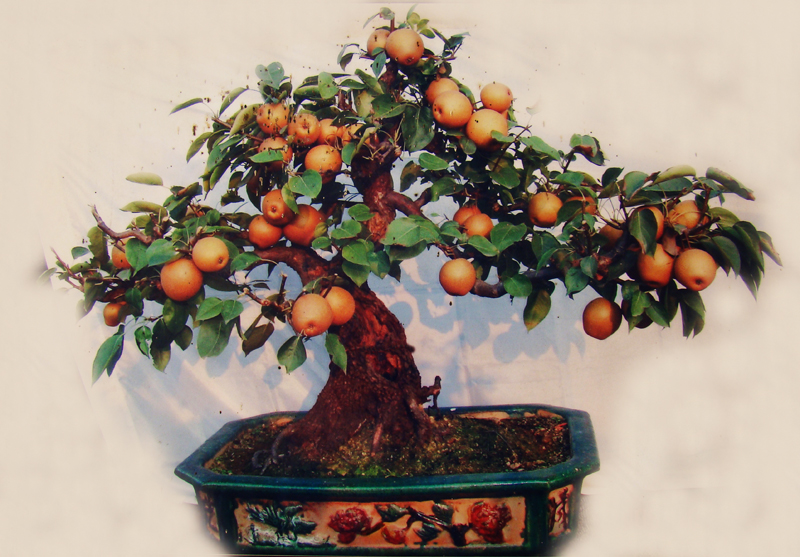
Fruit tree bonsai is a category of potted plants, referring to fruit trees planted in flower pots and placed indoors, bringing you closer to nature. Through special artistic processing, fruit tree bonsai displays the rustic and varied character of the fruit trunk, twisted and coiled exposed roots, and large, brightly colored fruit. It is a work of art with both ornamental and economic value. So, do you know how to make and care for fruit tree bonsai? If not, take a look.
I. Making Fruit Tree Bonsai
Fruit tree bonsai must be guaranteed to bear fruit and have an attractive appearance, and for a fruit tree to bear fruit it must be able to form flower buds. Trees that grow too vigorously or too weakly do not easily form flower buds, so the tree's vigor must be controlled at a level that is neither too strong nor too weak. Dwarfing technology is one of the main measures for achieving physiological balance, and of course there are also soil, fertilizer and water management measures.
II. Grafting Fruit Tree Bonsai
Taking advantage of the irreversibility of the phylogenetic stage of trees, flower-bearing branch groups are used as scions to promote early fruiting while also causing dwarfing. The fruiting branch groups are selected from mature fruit trees. In the previous year after flowering, healthy and beautifully shaped fruiting branches are selected, and excessively dense new branches, diseased and weak branches, crossing branches and parallel branches on the fruiting branches are pruned away, training them into a scalene triangular shape. The following spring, they are grafted onto rootstock that has been planted in a good pot, and in the same year or the next year they will flower, bear fruit and take shape.
Fruit Tree Bonsai: How to Make and Care for Them, Bringing Nature Indoors
III. Dwarfing Fruit Tree Bonsai
We all know that fruit trees are very tall. Without dwarfing treatment, the bonsai would appear extremely tall and inconvenient to place. Therefore, fruit tree bonsai must be dwarfed. To obtain extremely dwarf fruit trees, making full use of the dwarfing ability of dwarf rootstocks of various tree species so that the fruit trees are controlled and form dwarf fruit trees is one of the most effective methods. Dwarf rootstocks can make grafted seedlings bear fruit earlier, and early fruiting in turn inhibits tree growth and reduces tree construction.
IV. Pruning Fruit Tree Bonsai
To make a bonsai beautiful, you must learn to prune and shape it, and fruit tree bonsai is no exception. Pruning is an auxiliary means of dwarfing fruit trees. Pruning is mainly for controlling tree height and stabilizing tree shape, with emphasis on pruning during the growing season. Generally, the pruning method is to suppress the top and support the bottom, letting branches grow freely, reducing the nutrients consumed in building the tree body, and increasing the accumulation of organic matter in the lower part of the tree, which is beneficial to flower bud differentiation and fruit growth.
V. Caring for Fruit Tree Bonsai
1. Light
Northern fruit tree bonsai are mostly sun-loving tree species and require sufficient light during the growing season. For home care, they are mostly placed on a balcony or in a sunny spot below a window.
2. Watering
Fruit tree bonsai need more water than flowering plants, especially in high-temperature seasons. Water when the soil is dry, following the principle of "dry then wet," 1-2 times a day.
3. Fertilizing
The "flower fertilizer" sold at flower shops will do, applied once every 7-10 days in a "thin but frequent" manner.
4. Pruning and Shaping
According to personal preference, shaping, pulling or coiling are all acceptable. Pruning: it is best to prune when flower buds are identified, that is, when flower buds first appear. Prune evenly below the flowers, leaving the head and shape.
5. Pests and Diseases
Because this garden's pest and disease prevention and management system is strict, and after entering the home there are no sources of infection, you can generally care for them with peace of mind. For borers and red spider mites, garlic and chives can be mashed, soaked in 5-10 times their volume of water, and then sprayed on.
6. Placement
Place outdoors in a wind-sheltered, sunny spot and wrap the pot tightly with plastic film. If there is open ground, you can dig a pit, bury the pot firmly with soil, and water thoroughly.
Fruit Tree Bonsai Making and Care Tips
Fruit Tree Bonsai Making and Care Tips
Bonsai art itself is a singular splash of color in our country's traditional culture, and fruit tree bonsai rightly becomes an important part of bonsai art. Compared with traditional bonsai, traditional bonsai pursues an art that places too much emphasis on expressing the vigor and age of the tree body, and the techniques used are mostly pruning and shaping, so a piece of bonsai may take more than ten years to take shape, and some even several decades. Bonsai after taking shape also have high care requirements. Fruit tree bonsai is different: it combines form, color, bearing and charm in one, with high ornamental value. Therefore it easily enters the lives of ordinary people. Here, please enjoy pictures of fruit tree bonsai:
Fruit Tree Bonsai Pictures and Making Tips: 1. Soil:The soil used is a prepared nutrient soil, with the ratio appropriately adjusted and other raw materials added according to tree species, pot used and care environment. For example: peach roots have very poor waterlogging tolerance, so the potting soil needs to use loose, well-aerated nutrient soil. In this case, if glazed pots and purple clay pots are used, ordinary nutrient soil cannot satisfy the roots' need to breathe.
2. Watering:Watering is a task that tests your skill. We do it often, yet it is still not easy to master. When watering, you should follow the principles of "dry then wet" and "water thoroughly when you water." In brief, when we find the potting soil has dried and turned white, we water; this is the so-called "dry then wet." The so-called "water thoroughly when you water" means that after watering, when you check the potted tree, a small amount of water seeps from the drainage hole at the bottom of the pot. On the whole, the goal is to keep the moisture in the upper and lower potting soil consistent. Here the editor shows everyone pictures of fruit tree bonsai in good growing condition:
3. Fertilizing:In theory, when trees grow, flower, bear fruit and develop fruit, they need a great deal of nutrient supply. However, fruit tree bonsai have a small potting soil volume and weak, even almost nonexistent, soil nutrient reserve capacity, and nutrients are worn away as water drains, so the nutrients in the potting soil alone cannot satisfy the bonsai's growth. Therefore, under normal circumstances, we apply various nutrient elements during the growing season to ensure the potted tree can grow vigorously and flower and bear fruit. At this time, to prevent the danger of fertilizer burn from over-fertilizing, one should follow "thin fertilizer applied frequently."
Fruit Tree Bonsai Pictures and Care 1. Choosing the best grafting time:Fruit tree bonsai grafting includes early spring grafting, summer grafting and autumn grafting. Early spring grafting is carried out before the fruit tree bonsai buds; summer grafting is carried out after the scion buds mature; autumn grafting is carried out in late summer and early autumn.
2. Pruning branches and retaining rootstock:When pruning branches, remove the upper ones and keep the lower ones to reduce wounds; do not leave wounds on the main trunk or rootstock stubs. Retain stubs according to environmental conditions, control height and contract the crown. The number and length of retained stubs should be determined according to tree shape and tree age, retaining the lower main branches as rootstock stubs. Here the editor shows everyone pictures of fruit tree bonsai with relatively good shaping:
Conclusion:Fruit tree bonsai combines fruit tree cultivation techniques with traditional bonsai art. A single potted plant already encompasses multiple functions: enjoying flowers, viewing fruit and admiring the scenery. In spring the flowers are extraordinarily bright and beautiful; in summer it is full of vitality, and as you watch the fruit grow from small to large, you see the growth of your own achievements. Although the production and care of fruit tree bonsai require a certain level of skill and a great deal of effort, this is also its [charm]. After enjoying so many pictures of fruit tree bonsai, have you come to like fruit tree bonsai?
Fruit Tree Bonsai Making and Care: This Way the Bonsai Is More Splendid!
Fruit tree bonsai refers to planting fruit trees in a tiny pot and, through artistic processing, displaying the rustic and varied character of the fruit trunk, twisted and coiled exposed roots, and large, brightly colored fruit. It is a work of art with both ornamental and economic value. So, do you know how to make and care for fruit tree bonsai? If not, take a look.
(This article comes from a website, for more please visit (This article comes from a website, for more please visitI. Making Fruit Tree Bonsai
(This article comes from a website, for more please visit (This article comes from a website, for more please visitFruit tree bonsai must be guaranteed to bear fruit and have an attractive appearance, and for a fruit tree to bear fruit it must be able to form flower buds. Trees that grow too vigorously or too weakly do not easily form flower buds, so the tree's vigor must be controlled at a level that is neither too strong nor too weak. Dwarfing technology is one of the main measures for achieving physiological balance, and of course there are also soil, fertilizer and water management measures.
(This article comes from a website, for more please visit (This article comes from a website, for more please visitII. Grafting Fruit Tree Bonsai
(This article comes from a website, for more please visit (This article comes from a website, for more please visitTaking advantage of the irreversibility of the phylogenetic stage of trees, flower-bearing branch groups are used as scions to promote early fruiting while also causing dwarfing. The fruiting branch groups are selected from mature fruit trees. In the previous year after flowering, healthy and beautifully shaped fruiting branches are selected, and excessively dense new branches, diseased and weak branches, crossing branches and parallel branches on the fruiting branches are pruned away, training them into a scalene triangular shape. The following spring, they are grafted onto rootstock that has been planted in a good pot, and in the same year or the next year they will flower, bear fruit and take shape.
(This article comes from a website, for more please visit (This article comes from a website, for more please visitIII. Dwarfing Fruit Tree Bonsai
(This article comes from a website, for more please visit (This article comes from a website, for more please visitWe all know that fruit trees are very tall. Without dwarfing treatment, the bonsai would appear extremely tall and inconvenient to place. Therefore, fruit tree bonsai must be dwarfed. To obtain extremely dwarf fruit trees, making full use of the dwarfing ability of dwarf rootstocks of various tree species so that the fruit trees are controlled and form dwarf fruit trees is one of the most effective methods. Dwarf rootstocks can make grafted seedlings bear fruit earlier, and early fruiting in turn inhibits tree growth and reduces tree construction.
(This article comes from a website, for more please visit (This article comes from a website, for more please visitIV. Pruning Fruit Tree Bonsai
(This article comes from a website, for more please visit (This article comes from a website, for more please visitTo make a bonsai beautiful, you must learn to prune and shape it, and fruit tree bonsai is no exception. Pruning is an auxiliary means of dwarfing fruit trees. Pruning is mainly for controlling tree height and stabilizing tree shape, with emphasis on pruning during the growing season. Generally, the pruning method is to suppress the top and support the bottom, letting branches grow freely, reducing the nutrients consumed in building the tree body, and increasing the accumulation of organic matter in the lower part of the tree, which is beneficial to flower bud differentiation and fruit growth.
(This article comes from a website, for more please visit (This article comes from a website, for more please visitV. Caring for Fruit Tree Bonsai
(This article comes from a website, for more please visit (This article comes from a website, for more please visit1. Light: Northern fruit tree bonsai are mostly sun-loving tree species and require sufficient light during the growing season. For home care, they are mostly placed on a balcony or in a sunny spot below a window.
2. Watering: Fruit tree bonsai need more water than flowering plants, especially in high-temperature seasons. Water when the soil is dry, following the principle of "dry then wet," 1-2 times a day.
3. Fertilizing: The "flower fertilizer" sold at flower shops will do, applied once every 7-10 days in a "thin but frequent" manner.
(This article comes from a website, for more please visit (This article comes from a website, for more please visit4. Pruning and Shaping: According to personal preference, shaping, pulling or coiling are all acceptable. Pruning: it is best to prune when flower buds are identified, that is, when flower buds first appear. Prune evenly below the flowers, leaving the head and shape.
5. Pests and Diseases: Because this garden's pest and disease prevention and management system is strict, and after entering the home there are no sources of infection, you can generally care for them with peace of mind. For borers and red spider mites, garlic and chives can be mashed, soaked in 5-10 times their volume of water, and then sprayed on.
6. Placement: Place outdoors in a wind-sheltered, sunny spot and wrap the pot tightly with plastic film. If there is open ground, you can dig a pit, bury the pot firmly with soil, and water thoroughly.
(This article comes from a website, for more please visit (This article comes from a website, for more please visitBut traditional bonsai art demands too much of the tree body's vigor and age, often using heavy pruning and heavy shaping techniques, so that a single bonsai work often takes more than ten years to take shape. Fruit tree bonsai, however, is more convenient, so it is increasingly favored by many ordinary families.
(This article comes from a website, for more please visit (This article comes from a website, for more please visitThe above is the editor's introduction to making and caring for fruit tree bonsai. We hope it can help you. For more information about fruit tree bonsai, please continue to follow the Flowers Channel.
(This article comes from a website, for more please visit (This article comes from a website, for more please visit