Happy Tree Care Tips and Solutions for Yellowing Leaves
The Happy Tree (Radermachera sinica) is a large foliage houseplant commonly seen in living rooms and office settings. It can absorb harmful substances from the air and has a protective effect against radiation. To grow a Happy Tree well indoors, you must understand its growing environment, habits, place of origin, and more. However, many people do not know the cultivation methods and precautions for the Happy Tree. Only by understanding this information can we possibly grow it well indoors in the north. Below is a detailed explanation of the Happy Tree's cultivation methods and precautions. Let's learn together.
What are the precautions for growing a Happy Tree?
(1) Temperature
The Happy Tree likes a warm and humid environment, and temperature is the most important factor. The daytime temperature should be kept between 19°C-21°C, and the nighttime temperature between 18°C-20°C. These are the most suitable growing temperatures; too high or too low will both affect its growth. In the hot midsummer, try to keep the temperature below 27°C. When the ambient temperature is very high, shade it appropriately with a canopy. Increase ambient humidity to raise the moisture level on the leaf surface. In winter, the temperature must not fall below 8°C, and humidity must not be less than 5 degrees; otherwise, below this temperature it will suffer frost damage.
(2) Humidity
The Happy Tree prefers moist conditions in both its soil environment and indoor environment. Indoor humidity should be kept between 70-80%. In large banquet halls where humidity cannot be controlled, we spray the leaf surface once in the morning and once in the evening. If humidity is too low or the plant remains in a dry environment for a long time, the leaves will curl and turn yellow, affecting its ornamental value.
(3) Light
The Happy Tree is a plant that likes sunlight but is also shade-tolerant. Light is very important. The Happy Tree likes to grow in semi-shaded environments. In the north, we generally grow it indoors, so there is no problem with direct sunlight. What it does fear is being placed in a dark place for a long time, where neither direct light nor diffused light can reach it; after a long time, it will certainly drop its leaves. So in winter, it should be placed on a balcony or in front of a sunny window to get sufficient light.
(4) Watering
In summer, a potted Happy Tree should be watered once every 3 to 4 days, but this also depends on the individual situation. In winter, indoors in the north, the Happy Tree almost stops growing, and watering should be controlled so that the potting soil is simply not dry. If you water, water it thoroughly; if you don't water, do not pour a single drop into the pot. This is the principle. Please remember it.
(5) Pruning
The purpose of growing a Happy Tree is for ornament and to complement the indoor environment. If the tree shape grows irregularly, it will not be attractive, so it needs to be pruned carefully. Generally, it is pruned into a mushroom shape or a rounded mound shape. Cut away some old leaves and yellow leaves.
(6) Soil
When the Happy Tree is growing, soil is equally important. Choose a loose, breathable, well-draining, and nutritious soil. Usually, mix garden soil : leaf mold : decomposed organic fertilizer : river sand = 5:3:1:1. Persist in loosening the soil once a month during the growing season to ensure the root area always remains well aerated. If water accumulation is found in the pot, drain it as soon as possible, and after the potting soil has dried out, repot and change the soil to keep the Happy Tree growing better.
(7) Fertilizing
During the growing season, fertilize the Happy Tree diligently to ensure vigorous growth. Use compound fertilizer or NPK 20:10:10 or farmyard manure, etc. In winter, fertilization can be stopped.
(8) Pest and Disease Prevention
Common pests on the Happy Tree include scale insects, mites, and aphids. Use Jie Bi Si, methidathion, Man Jing, pyridaben, phoxim, omethoate, and deltamethrin for pest control. As long as you ventilate and exchange the air frequently, pests generally will not occur. The Happy Tree's disease resistance is quite strong. If the pest infestation is not severe, you can simply remove them by hand.
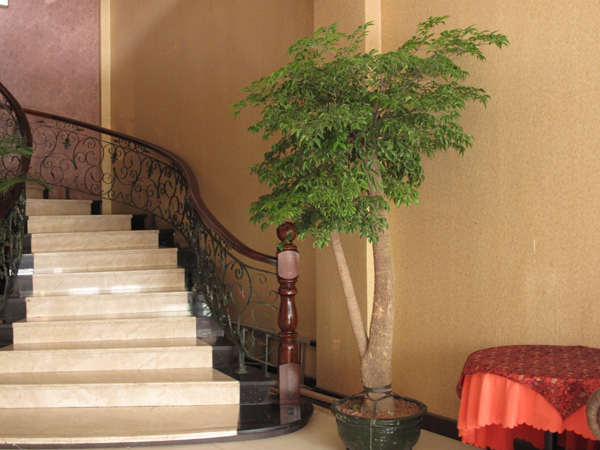
What are the precautions for growing a Happy Tree? What should you do if the Happy Tree's leaves turn yellow?
Causes of Yellowing Leaves on the Happy Tree
1. The Happy Tree may have no roots; it may have been freshly cut and placed in a pot (flowers bought from itinerant vendors are often like this).
2. Yellowing leaves caused by a sudden environmental change, where temperature, humidity, and light differ greatly from the care environment in the greenhouse, or by repotting that damaged the roots and requires a recovery period.
3. Heavy leaf drop on the Happy Tree may be related to watering, because if the plant's soil is too dry, the root system will be damaged to some extent. At this point, pouring in a large amount of water will suffocate the already damaged roots, obstructing respiration, causing further root damage, affecting absorption, and resulting in heavy leaf drop.
4. Caused by poor ventilation, with leaf tips turning withered and yellow; caused by dry indoor air; 5. Possibly caused by the plant being in too dark an environment with insufficient light.
6. Whether too much fertilizer was applied, whether the organic fertilizer used was fully decomposed, etc.
Solutions for Yellowing Leaves on the Happy Tree
1. Watering principle: look at the topsoil, water thoroughly when you water, and do not keep the frequency fixed for a long time.
Focus on understanding the five major watering precautions:
(1) Do not wait until the soil is completely dry before watering.
(2) Do not substitute spraying water for watering.
(3) Do not water a fixed amount.
(4) Do not water continuously over a short period.
(5) Do not keep the watering frequency fixed for a long time.
2. Rotate the pot so it receives sunlight from all directions, keep the air humidity moist, and promote coordinated, healthy growth.
3. Spray clean water on the leaves 2 to 3 times a day, which can effectively prevent the tips of newly emerging leaves from turning withered and yellow.
When watering, water thoroughly at one time. Do not think it is thoroughly watered just because the surface soil looks wet; be sure to water around the pot until water comes out of the drainage holes. In the hottest part of summer, watering once every three or four days is enough; do not water too frequently. If you water too little, the leaves will wilt, but they will not turn yellow. Rotate the pot often, and let the lower leaves receive sunlight too. If you feel it lacks fertilizer, apply some sauce residue or soybean cake fertilizer; these fertilizers last a long time and are mild, and will not harm the roots. Also, do not let the Happy Tree be exposed to cold wind. Now that the rainy season has arrived, move it farther away when the weather changes.
Causes of Leaf Drop on the Happy Tree
1. Temperature causes (temperature too high or temperature too low)
2. Light causes (excessive sun exposure or no light)
3. Moisture causes (too much water or too little water)
4. Soil causes (failure to loosen the soil regularly)
5. Fertilizer causes (failure to fertilize reasonably)
What to Do If the Happy Tree Drops Its Leaves
For indoor potted plants, this is caused by indoor light being too dim and ventilation being poor. If it is not the cold winter, you can move it to a balcony to let it get ventilation and light, and it will quickly send out new leaves. In winter, it should be placed on a sunny south-facing balcony or in front of a floor-to-ceiling window
Precautions for Growing a Happy Tree
Overall, indoors in the north it is best to create a tropical or subtropical environment, because wherever it originated, only in that kind of environment can it grow healthily!
Cultivation Methods and Precautions for the Happy Tree Cultivation Methods and Precautions for the Happy Tree What to Do If the Happy Tree's Leaves Turn Yellow and Drop?
The Happy Tree is a very good large foliage houseplant. In the north, it is generally grown indoors, but mostly in home and office environments. The Happy Tree can absorb harmful substances from the air and has a protective effect against radiation.
To grow a Happy Tree well indoors, you must also understand its growing environment, habits, place of origin, and more. However, many people do not know the cultivation methods and precautions for the Happy Tree. Only by understanding this information can we possibly grow it well indoors in the north. Below is a detailed explanation of the Happy Tree's cultivation methods and precautions. Let's learn together.
Cultivation Methods and Precautions for the Happy Tree
(1) Temperature
The Happy Tree likes a warm and humid environment, and temperature is the most important factor. The daytime temperature should be kept between 19°C-21°C, and the nighttime temperature between 18°C-20°C. These are the most suitable growing temperatures; too high or too low will both affect its growth. In the hot midsummer, try to keep the temperature below 27°C. When the ambient temperature is very high, shade it appropriately with a canopy. Increase ambient humidity to raise the moisture level on the leaf surface. In winter, the temperature must not fall below 8°C, and humidity must not be less than 5 degrees; otherwise, below this temperature it will suffer frost damage.
(2) Humidity
The Happy Tree prefers moist conditions in both its soil environment and indoor environment. Indoor humidity should be kept between 70-80%. In large banquet halls where humidity cannot be controlled, we spray the leaf surface once in the morning and once in the evening. If humidity is too low or the plant remains in a dry environment for a long time, the leaves will curl and turn yellow, affecting its ornamental value.
(3) Light
The Happy Tree is a plant that likes sunlight but is also shade-tolerant. Light is very important. The Happy Tree likes to grow in semi-shaded environments. In the north, we generally grow it indoors, so there is no problem with direct sunlight. What it does fear is being placed in a dark place for a long time, where neither direct light nor diffused light can reach it; after a long time, it will certainly drop its leaves. So in winter, it should be placed on a balcony or in front of a sunny window to get sufficient light.
(4) Watering
In summer, a potted Happy Tree should be watered once every 3 to 4 days, but this also depends on the individual situation. In winter, indoors in the north, the Happy Tree almost stops growing, and watering should be controlled so that the potting soil is simply not dry. If you water, water it thoroughly; if you don't water, do not pour a single drop into the pot. This is the principle. Please remember it.
(5) Pruning
The purpose of growing a Happy Tree is for ornament and to complement the indoor environment. If the tree shape grows irregularly, it will not be attractive, so it needs to be pruned carefully. Generally, it is pruned into a mushroom shape or a rounded mound shape. Cut away some old leaves and yellow leaves.
(6) Soil
When the Happy Tree is growing, soil is equally important. Choose a loose, breathable, well-draining, and nutritious soil. Usually, mix garden soil : leaf mold : decomposed organic fertilizer : river sand = 5:3:1:1. Persist in loosening the soil once a month during the growing season to ensure the root area always remains well aerated. If water accumulation is found in the pot, drain it as soon as possible, and after the potting soil has dried out, repot and change the soil to keep the Happy Tree growing better.
(7) Fertilizing
During the growing season, fertilize the Happy Tree diligently to ensure vigorous growth. Use compound fertilizer or NPK 20:10:10 or farmyard manure, etc. In winter, fertilization can be stopped.
(8) Pest and Disease Prevention
Common pests on the Happy Tree include scale insects, mites, and aphids. Use Jie Bi Si, methidathion, Man Jing, pyridaben, phoxim, omethoate, and deltamethrin for pest control. As long as you ventilate and exchange the air frequently, pests generally will not occur. The Happy Tree's disease resistance is quite strong. If the pest infestation is not severe, you can simply remove them by hand.
Causes of Yellowing Leaves on the Happy Tree
1. The Happy Tree may have no roots; it may have been freshly cut and placed in a pot (flowers bought from itinerant vendors are often like this);
2. Yellowing leaves caused by a sudden environmental change, where temperature, humidity, and light differ greatly from the care environment in the greenhouse, or by repotting that damaged the roots and requires a recovery period;
3. Heavy leaf drop on the Happy Tree may be related to watering, because if the plant's soil is too dry, the root system will be damaged to some extent. At this point, pouring in a large amount of water will suffocate the already damaged roots, obstructing respiration, causing further root damage, affecting absorption, and resulting in heavy leaf drop.
4. Caused by poor ventilation, with leaf tips turning withered and yellow; caused by dry indoor air; 5. Possibly caused by the plant being in too dark an environment with insufficient light.
6. Whether too much fertilizer was applied, whether the organic fertilizer used was fully decomposed, etc.
Solutions for Yellowing Leaves on the Happy Tree
1. Watering principle: look at the topsoil, water thoroughly when you water, and do not keep the frequency fixed for a long time.
Focus on understanding the five major watering precautions:
(1) Do not wait until the soil is completely dry before watering.
(2) Do not substitute spraying water for watering.
(3) Do not water a fixed amount.
(4) Do not water continuously over a short period.
(5) Do not keep the watering frequency fixed for a long time.
2. Rotate the pot so it receives sunlight from all directions, keep the air humidity moist, and promote coordinated, healthy growth.
3. Spray clean water on the leaves 2 to 3 times a day, which can effectively prevent the tips of newly emerging leaves from turning withered and yellow.
When watering, water thoroughly at one time. Do not think it is thoroughly watered just because the surface soil looks wet; be sure to water around the pot until water comes out of the drainage holes. In the hottest part of summer, watering once every three or four days is enough; do not water too frequently. If you water too little, the leaves will wilt, but they will not turn yellow. Rotate the pot often, and let the lower leaves receive sunlight too. If you feel it lacks fertilizer, apply some sauce residue or soybean cake fertilizer; these fertilizers last a long time and are mild, and will not harm the roots. Also, do not let the Happy Tree be exposed to cold wind. Now that the rainy season has arrived, move it farther away when the weather changes.
Causes of Leaf Drop on the Happy Tree
1. Temperature causes (temperature too high or temperature too low):
2. Light causes (excessive sun exposure or no light);
3. Moisture causes (too much water or too little water):
4. Soil causes (failure to loosen the soil regularly):
5. Fertilizer causes (failure to fertilize reasonably):
What to Do If the Happy Tree Drops Its Leaves
For indoor potted plants, this is caused by indoor light being too dim and ventilation being poor. If it is not the cold winter, you can move it to a balcony to let it get ventilation and light, and it will quickly send out new leaves. In winter, it should be placed on a sunny south-facing balcony or in front of a floor-to-ceiling window
Precautions for Growing a Happy Tree
Overall, indoors in the north it is best to create a tropical or subtropical environment, because wherever it originated, only in that kind of environment can it grow healthily!
Cultivation Methods and Precautions for the Happy Tree What to Do If the Happy Tree's Leaves Turn Yellow and Drop?
The Happy Tree is a very good large foliage houseplant. In the north, it is generally grown indoors, but mostly in home and office environments. The Happy Tree can absorb harmful substances from the air and has a protective effect against radiation.
To grow a Happy Tree well indoors, you must also understand its growing environment, habits, place of origin, and more. However, many people do not know the cultivation methods and precautions for the Happy Tree. Only by understanding this information can we possibly grow it well indoors in the north. Below is a detailed explanation of the Happy Tree's cultivation methods and precautions. Let's learn together.
Cultivation Methods and Precautions for the Happy Tree
(1) Temperature
The Happy Tree likes a warm and humid environment, and temperature is the most important factor. The daytime temperature should be kept between 19°C-21°C, and the nighttime temperature between 18°C-20°C. These are the most suitable growing temperatures; too high or too low will both affect its growth. In the hot midsummer, try to keep the temperature below 27°C. When the ambient temperature is very high, shade it appropriately with a canopy. Increase ambient humidity to raise the moisture level on the leaf surface. In winter, the temperature must not fall below 8°C, and humidity must not be less than 5 degrees; otherwise, below this temperature it will suffer frost damage.
(2) Humidity
The Happy Tree prefers moist conditions in both its soil environment and indoor environment. Indoor humidity should be kept between 70-80%. In large banquet halls where humidity cannot be controlled, we spray the leaf surface once in the morning and once in the evening. If humidity is too low or the plant remains in a dry environment for a long time, the leaves will curl and turn yellow, affecting its ornamental value.
(3) Light
The Happy Tree is a plant that likes sunlight but is also shade-tolerant. Light is very important. The Happy Tree likes to grow in semi-shaded environments. In the north, we generally grow it indoors, so there is no problem with direct sunlight. What it does fear is being placed in a dark place for a long time, where neither direct light nor diffused light can reach it; after a long time, it will certainly drop its leaves. So in winter, it should be placed on a balcony or in front of a sunny window to get sufficient light.
(4) Watering
In summer, a potted Happy Tree should be watered once every 3 to 4 days, but this also depends on the individual situation. In winter, indoors in the north, the Happy Tree almost stops growing, and watering should be controlled so that the potting soil is simply not dry. If you water, water it thoroughly; if you don't water, do not pour a single drop into the pot. This is the principle. Please remember it.
(5) Pruning
The purpose of growing a Happy Tree is for ornament and to complement the indoor environment. If the tree shape grows irregularly, it will not be attractive, so it needs to be pruned carefully. Generally, it is pruned into a mushroom shape or a rounded mound shape. Cut away some old leaves and yellow leaves.
(6) Soil
When the Happy Tree is growing, soil is equally important. Choose a loose, breathable, well-draining, and nutritious soil. Usually, mix garden soil : leaf mold : decomposed organic fertilizer : river sand = 5:3:1:1. Persist in loosening the soil once a month during the growing season to ensure the root area always remains well aerated. If water accumulation is found in the pot, drain it as soon as possible, and after the potting soil has dried out, repot and change the soil to keep the Happy Tree growing better.
(7) Fertilizing
During the growing season, fertilize the Happy Tree diligently to ensure vigorous growth. Use compound fertilizer or NPK 20:10:10 or farmyard manure, etc. In winter, fertilization can be stopped.
(8) Pest and Disease Prevention
Common pests on the Happy Tree include scale insects, mites, and aphids. Use Jie Bi Si, methidathion, Man Jing, pyridaben, phoxim, omethoate, and deltamethrin for pest control. As long as you ventilate and exchange the air frequently, pests generally will not occur. The Happy Tree's disease resistance is quite strong. If the pest infestation is not severe, you can simply remove them by hand.
Causes of Yellowing Leaves on the Happy Tree
1. The Happy Tree may have no roots; it may have been freshly cut and placed in a pot (flowers bought from itinerant vendors are often like this);
2. Yellowing leaves caused by a sudden environmental change, where temperature, humidity, and light differ greatly from the care environment in the greenhouse, or by repotting that damaged the roots and requires a recovery period;
3. Heavy leaf drop on the Happy Tree may be related to watering, because if the plant's soil is too dry, the root system will be damaged to some extent. At this point, pouring in a large amount of water will suffocate the already damaged roots, obstructing respiration, causing further root damage, affecting absorption, and resulting in heavy leaf drop.
4. Caused by poor ventilation, with leaf tips turning withered and yellow; caused by dry indoor air; 5. Possibly caused by the plant being in too dark an environment with insufficient light.
6. Whether the amount of fertilizer applied is too much, whether the organic fertilizer used is fully decomposed, and so on.
Solutions for yellowing leaves on the Happiness Tree (Radermachera sinica)
1. Watering principle: look at the surface soil, water thoroughly when you water, and do not keep the frequency fixed over the long term.
Focus on understanding the five main watering points to note:
(1) Do not wait until the soil is completely dry before watering.
(2) Do not use spraying water as a substitute for watering.
(3) Do not water in fixed amounts.
(4) Do not water repeatedly within a short period.
(5) Do not keep the watering frequency fixed over the long term.
2. Rotate the pot for all-round sunlight exposure, keep the air humidity moist, and promote coordinated, healthy growth.
3. You can spray clean water on its leaves 2 to 3 times a day, which can effectively prevent the leaf tips of newly sprouted leaves from turning yellow and drying up.
When watering, water thoroughly at one time; do not think it is thoroughly watered just because the surface soil looks wet. Be sure to water around the pot until water comes out of the drainage holes. In the hottest part of summer, watering once every three or four days is enough; do not water too frequently. If you water too little, the leaves will wilt, but they will not turn yellow. Rotate the pot often, and let the lower leaves get sunlight too. If you feel it lacks fertilizer, apply some sauce residue or soybean cake fertilizer; these fertilizers release nutrients slowly and are mild, so they will not damage the roots. Also, do not let the Happiness Tree be exposed to cold wind. It is the rainy season now, so move it farther away when the weather changes.
Reasons for the Happiness Tree dropping leaves
1. Temperature reasons (temperature too high or temperature too low):
2. Light reasons (excessive exposure to sun or no light);
3. Moisture reasons (moisture too high or moisture too low):
4. Soil reasons (failure to loosen the soil regularly):
5. Fertilizer reasons (failure to fertilize reasonably):
What to do if the Happiness Tree drops leaves
For indoor potted plants, this is caused by indoor light being too dim and ventilation being poor. If it is not the cold winter, you can move it to a balcony to let it get ventilation and light, and it can quickly grow new leaves. In winter, it should be placed on a south-facing balcony with ample light or in front of a floor-to-ceiling window
Points to note when growing the Happiness Tree
In general, indoors in the north it is best to create a tropical or subtropical environment, because that is where it originates, and only in that kind of environment can it grow healthily!