What to do when pothos leaves turn yellow? A few solutions for you
Pothos is a potted plant commonly seen in homes and office environments. Pothos is very easy to keep alive, but during cultivation, too much or too little water, too strong or too weak sunlight, or too much or too little fertilizer can all cause leaves to turn yellow. The yellowing situations differ, so you should carefully observe and analyze the cause. According to the different yellowing situations, different measures should be adopted to grow beautiful pothos. Below let us take a look together at the cause analysis and treatment methods for yellowing pothos leaves!
Cause analysis and treatment methods for yellowing pothos leaves
1. Sudden environmental changes cause pothos leaves to turn yellow:
The cause is sudden environmental changes, too great a sudden change in temperature, humidity and light, or repotting that damaged the roots and requires a recovery period, resulting in yellowing leaves.
Solution: There is no need to worry in this situation. You can take measures to reduce the degree of environmental change and wait for it to adapt.
2. Overwatering causes pothos leaves to turn yellow (water yellowing):
Tender leaves turn dull yellow and lose their luster, old leaves show no obvious change, stems become thin and yellow-green, and new shoots shrink and stop growing, indicating overwatering.
Solution: Take the pothos out of the pot and place it in a ventilated, cool place. Wait until the soil ball dries, then put it back in the pot.
3. Long-term lack of water causes pothos leaves to turn yellow (drought yellowing):
The yellowing from lack of water is different from the yellowing from too much water. The yellowing from lack of water shows withered and dried leaf tips or edges, old leaves turn yellow and fall off from bottom to top, but new leaves grow relatively normally.
Solution: Just pay attention to watering enough and watering thoroughly.
4. Direct sun exposure causes pothos leaves to turn yellow (scorch yellowing):
Strong direct sunlight easily causes pothos leaf tips and leaf edges to wither, and yellow spots appear on the sun-facing parts of the leaves.
Solution: Move it to a shaded, ventilated place.
5. Insufficient sunlight causes pothos leaves to turn yellow (light-deficiency yellowing):
When placed in a shaded environment for a long time, the leaves cannot get enough sunlight and cannot form chlorophyll, so the whole plant's leaves turn yellow and then fall off.
Solution: Move it to a place with relatively sufficient light.
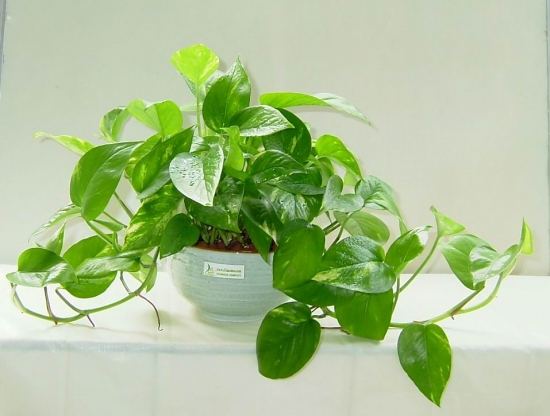
What to do when pothos leaves turn yellow? What are the solutions for yellowing pothos leaves?
6. Overfertilizing causes pothos leaves to turn yellow (fertilizer yellowing):
Yellowing caused by too much fertilizer or too high a concentration shows dry brown tips on new leaves. Generally the leaf surface is thick and lacks luster, and is uneven and not smooth, while old leaves turn scorched yellow and fall off.
Solution: Stop fertilizing immediately. In severe cases, flush out part of the fertilizer with plenty of clean water, or replace the growing soil.
7. Long-term lack of fertilizer causes pothos leaves to turn yellow (fertilizer-deficiency yellowing):
It shows the color of tender leaves becoming lighter, appearing yellow or light green, while old leaves are relatively normal or gradually turn from green to yellow.
Solution: Check the potting soil. If there is dry caking, replace the soil. Usually apply thin fertilizer frequently and water with some alum water at the appropriate time.
8. Root rot causes pothos leaves to turn yellow:
It shows the color of tender leaves becoming lighter, appearing yellow or light green.
Solution: Remove the rotten roots and place them in a ventilated place to dry. After the wounds heal, return them to the pot, and note that there must be no standing water in the pot.
Pothos care methods
1. If you want to remove yellowed leaves, note that you cannot pull them off directly. You can use scissors to cut from the middle of the leaf stalk, to avoid excessive water loss and adverse effects on pothos growth.
2. When newly planted, it must not be exposed to strong direct light. It can be placed in a position with weaker light. In about 20 days, the newly planted pothos will take root and grow.
Potted pothos cultivation experience
1. There should be at least 4 established seedlings in the pot. The potting soil should be loose, fertile and rich in organic matter, which is beneficial for shaping.
2. Pothos requires growth in an environment with relatively high temperatures (winter room temperature must not be lower than 10°C, otherwise yellow leaves and leaf drop easily occur) and relatively strong scattered light. If it is too dark for a long time, the internodes will become thin, long and weak, and the leaves will also become thinner, lighter and lose their luster.
3. In late spring and early summer (from April to August), cut 15-30cm branches and remove the leaves from the 1-2 basal nodes,
4. Use growing soil to pot them directly, 3-5 stems per pot, water thoroughly, plant in a cool and ventilated place, keep the potting soil moist, and in about one month they will take root and sprout, and in that same year they can grow into plants with ornamental value.
7 tips for handling yellow pothos leaves
Experience 1: Pothos bought back in winter has generally been frosted, so yellow leaves will quickly appear after being placed indoors. After these frost-damaged yellow leaves fall off, new leaves will grow again around the Spring Festival.
Experience 2: Generally, newly bought pothos has an adaptation period of about 1 month in the new environment. Yellow leaves at the bottom are normal, but remember: do not peel off yellow or dead leaves directly. Cut them from the middle of the leaf stalk. This avoids excessive water loss and added wounds caused by direct peeling, which would otherwise cause the upper leaves to also turn yellow.
Experience 3: Although pothos is not afraid of shade, a very dark environment can also cause yellow leaves. You can periodically move its position to a place with good light. At the same time, it must not be exposed to harsh sun. Excessive exposure under strong light will not only cause yellow leaves and leaf drop, but also cause the whole plant to die.
Experience 4: If the potting soil is too dry or too wet, both situations will cause abnormal metabolism and root damage, leading to yellow leaves and leaf drop.
Experience 5: Lack of fertilizer and malnutrition can also cause yellow leaves. At this time, fertilizer should be supplemented promptly.
Experience 6: Beer can be appropriately used for fertilizing. Method: mix beer with water at a 1:1 ratio and spray it on the stems and leaves.
Experience 7: Too much topdressing can also easily cause root burn, leading to yellowing and withering leaves. You can dilute the fertilizer with water so the nutrients flow away with the water.
What to do when pothos leaves turn yellow, Causes of yellowing pothos leaves, What to do when pothos leaves turn yellow?
?Editor's recommendations [Reading]:
?How to cultivate Pachira aquatica?How to cultivate crabapple flowers?Plants suitable for indoor growing?How to cultivate lilies
Pothos is a typical foliage plant and also a vine plant. Its vines and leaves are very developed and emerald green. Placing it in the living room, balcony, study and courtyard as indoor decoration has an excellent effect. Pothos can also be placed in the office. It can not only soothe tense nerves, but also relax tired eyes. Friends who have grown pothos may find that pothos leaves turn yellow relatively easily. Once the leaves turn yellow, it means there is a problem in how we are growing the pothos, and it needs to be corrected promptly. Below let us understand the causes of yellowing pothos leaves.
?Causes of yellowing pothos leaves
1. Water issues. Improper watering is one of the causes of yellowing pothos leaves. Pothos is very particular about water absorption. It is a vine plant that loves a humid growing environment. Although it likes humidity, the amount of water when watering needs to be appropriate. Both overwatering and not watering can cause pothos leaves to turn yellow. If the leaves are dull and lack luster, it is due to overwatering. If the pothos leaf tips or edges are withered and dry, it is caused by insufficient watering.
2. Light issues. This vine plant, pothos, generally prefers to grow in cool, shaded places. Harsh sun exposure or strong light irradiation will cause the plant's leaf tips and leaf edges to wither and yellow spots to appear on the leaves, greatly affecting its appearance. If placed in a dark environment for a long time, pothos leaves will also turn yellow because they cannot carry out photosynthesis. Therefore, when growing pothos, it is best to place it under appropriate light, such as an incandescent lamp.
3. Fertilizer issues. The amount of fertilizer during pothos cultivation is also one of the reasons determining whether the leaves turn yellow. If too much fertilizer is applied during pothos cultivation, or the concentration is too high or there is a lack of fertilizer, all of these situations may cause pothos leaves to turn yellow. When too much fertilizer is applied, the leaf surface of pothos will become thick, lack luster and feel uncomfortable, and old leaves will turn yellow and fall off. At this time, we need to reduce the fertilizer by flushing. When fertilizer is lacking, the leaf surface color of pothos will become lighter, appearing light green or yellow.
?What to do when pothos leaves turn yellow -- solutions
1. Pothos is a plant that loves a warm and humid growing environment, so the soil conditions during cultivation are very important. It is best to grow it in loose, fertile and well-drained soil to effectively reduce the probability of leaves turning yellow. When growing potted pothos, the point to note is to choose fertile, loose and well-drained leaf mold soil, and it is best if it is slightly acidic.
2. Because pothos is a type of vine plant that is very shade-tolerant, unsuitable light conditions can also cause pothos leaves to turn yellow. So what should be done when pothos leaves turn yellow? At this time, we need to provide suitable light conditions for pothos. Growing it in a sunny indoor spot is best. Remember that it must not be exposed to harsh sun or strong light irradiation, and it also must not have no light at all.
3. Pothos also has high water requirements. Unsuitable watering can also cause pothos leaves to turn yellow. Therefore, we need to water appropriately and not too much. We should achieve "water when dry, and water thoroughly when watering." The water quality is best if it is clean tap water. Do not casually pour leftover drinking water into the pot. Soil that is too wet will prevent the plant's roots from breathing, causing yellow leaves and rotten leaves.
4. To prevent pothos leaves from turning yellow, fertilize appropriately and in a timely manner. It is best to apply thin fertilizer frequently, in small amounts and multiple times. Remember not to apply too much fertilizer at once, otherwise it will cause excess nutrients, and the plant cannot fully absorb them, thus causing root burn, yellow leaves and other phenomena. When fertilizing, it is best to use more organic fertilizer. Beer can also be appropriately used for fertilizing. Mix beer with water at a 1 to 1 ratio and spray it on the stems and leaves of pothos.
Conclusion:Pothos is a typical foliage plant with very high ornamental value. Its vines and leaves are developed and emerald green. Placing it in the living room, balcony, study and courtyard as indoor decoration has an excellent effect, and it also has many benefits for the body. It can not only soothe tense nerves, but also relax tired eyes. The above is what the editor has brought to you about the causes of yellowing pothos leaves and what to do when pothos leaves turn yellow. I hope it can help friends who like pothos.
?Recommended reading
?Murraya paniculata bonsai ?Cultivation of Peperomia obtusifolia ?Ficus microcarpa bonsai pictures ?Four-piece duvet cover set ?Rainbow cross-stitch
?Cultivation of Cuban oregano?Appreciation of black-and-white paintings ?Mattress price introduction?Duvet cover fabric introduction?Benefits of silk quilts
What to do when pothos leaves turn yellow, What to do when hydroponic pothos leaves turn yellow
Causes of yellowing leaves in hydroponic pothos
Sudden environmental changes
Generally, newly bought pothos has an adaptation period of about 1 month in the new environment. Yellow leaves at the bottom are normal, but remember: do not peel off yellow or dead leaves directly. Cut them from the middle of the leaf stalk. This avoids excessive water loss and added wounds caused by direct peeling; otherwise the upper leaves will also turn yellow.
Unsuitable light and temperature
Pothos likes high temperature, high humidity and a semi-shaded environment. It is not cold-tolerant, and the overwintering temperature should not be lower than 10°C. It is sensitive to temperature, avoids direct sunlight in summer, and under strong light the leaves easily turn withered yellow and fall off. In winter, it can grow well under bright scattered light indoors, and during the growth period it has relatively high water requirements.
Poor water quality
Hydroponic pothos may also turn yellow because there are bacteria in the water. If it is grown in tap water, it may be due to a high content of bleaching powder in the water. Pothos itself is not tolerant of low temperatures. Long-term low temperature together with a large amount of water will cause root rot, leading to insufficient water supply from the root system. Finally, the leaves at the roots begin to turn yellow, and the leaves at the top lose their luster.
Solutions for yellowing leaves in hydroponic pothos
Sufficient sunlight
It should be placed in a place with sufficient scattered light, and during the growth period, water should often be sprayed on the leaf surface. Spraying 0.2% monopotassium phosphate can restore the variegation on the leaf surface to a vivid appearance. Use a relatively large cultivation container (water surface) as much as possible. If conditions permit, oxygen can be added to the water.
Fertilizing
Spraying 1% urea is also fine. Every living thing has a life cycle, and it may also already be aging. Let everything take its natural course. Only after it withers and turns yellow will new leaves grow. There is no need to worry.
Change the water frequently
Another point is to change the water once a week for hydroponics. If conditions permit, adding some maifan stone or small stones will effectively reduce the occurrence of yellow leaves. When changing the water, rinse the roots well and cut off diseased roots. Do not put in too much water; just enough to cover the roots. When growing in water, it is recommended to use cloth to wrap the pothos roots together with soil and sawdust, then place them in the water.