How to Grow Pothos and Tips for Keeping It Evergreen
This lovely potted plant, pothos, has a strong air-purifying ability, and just a touch of its fresh green can decorate a beautiful home. But have you paid attention to the easy-care methods and precautions for growing pothos? To keep your pothos evergreen at home, see what the editor has to say.
1. Pothos is afraid of sun. A colleague whose seat was by the window put the pothos by the window. In summer, sunlight fell on the pothos, and those leaves - the yellow was beyond words, they practically never were green.
Correct approach: keep it in a cool, ventilated place with indirect light indoors, avoiding direct sunlight. If the indoor light is dim, you can move it to a brighter spot for about one day every 10 days or so; otherwise photosynthesis is affected and growth suffers.
2. Winters in the north are cold, and getting pothos through the winter is difficult. It requires an environment of at least 10°C. To help pothos get through winter smoothly, you can move it to a completely enclosed balcony and let it get some sun appropriately, but not for too long, to avoid scorching the leaf surface.
3. A fellow was always worried the pothos would freeze, so he put it on the radiator, and the result... the leaves turned black.
Correct approach: when it turns cold, move it indoors. At night you can cover it with a plastic bag, avoid direct cold drafts, and also avoid being too close to heat sources.
4. Hydroponic pothos naturally does not need watering, but the water needs to be changed often, especially in summer, when it must be changed frequently. For changing the water, tap water left to sit for a few days is best.
5. Soil-grown pothos cannot do without water, and watering in winter and summer follows different principles. In winter you must water less; especially if there is no heating indoors, watering once every 20 days is no problem. When should you water in summer? Look at the potting soil. Too dry will cause the leaves to turn yellow, while too much watering and waterlogged potting soil will cause root rot and withered leaves.
6. Almost all flowers are the same: what they want is "don't water if not dry; when you water, water thoroughly." What they fear most is casual watering, just a little at a time. At the same time, in summer you can use a spray bottle to appropriately mist the leaf surface, washing dust off the leaves. If you add a moderate amount of foliar fertilizer, the leaves will be even thicker and more emerald green.
7. Fertilizing pothos is very important; organic fertilizer is best. Of course, manure in a glass bottle is certainly not attractive, so buy some liquid fertilizer on the market, or use overnight beer, water from rinsing yogurt bottles, rice-washing water, and so on; all are rich in nutrients.
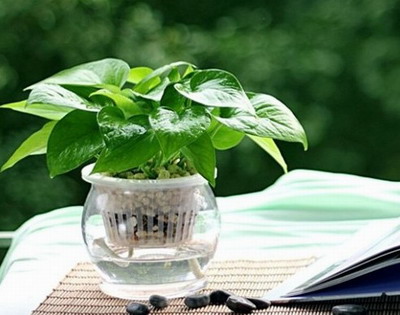
What are the methods for growing pothos? What are the tips for keeping pothos evergreen?
8. For hydroponic pothos, glass bottles are of course the prettiest, so nearly all colleagues in the office used glass bottles, but many people's pothos did not grow well.
Correct approach: when growing pothos in a glass bottle, it is best to have a light-blocking measure on the outside of the bottle, such as using a translucent cup, or wrapping a circle of rope around the outside, and so on.
9. Pothos has vigorous vitality. With proper care it grows very fast, and at this point it needs appropriate pruning. For overly long vines you can pinch off the tips. If there are too many branches, remove the extra forks so that the lengths are orderly and the density is appropriate. Sometimes pothos roots become so developed that in the end they no longer fit in the glass bottle. At this point you should trim appropriately, especially cutting away rotten roots, decayed roots, and shriveled roots with no vitality.
10. Another colleague's pothos could never stand up, like an incapable Adou. What to do? As in the picture, make a small support and it is ok.
How to Grow Pothos and Precautions
Pothos is a common green foliage plant, generally placed in homes and on the desks of office white-collar workers. Pothos is the most common plant grown, so the methods for growing pothos are very important. Below, based on my experience, I will describe orally the methods and precautions for growing pothos, so flower lovers can understand more easily and will not be looking at a theoretical article.Before talking about how to grow pothos, it is necessary for us to understand the basic information about pothos. Pothos is an evergreen climbing vine plant, and there are many ways to grow it: soil culture, hydroponics, or even putting a little water in a teacup and inserting a few cuttings. Below let us look at the growing habits of pothos; I will try to describe them simply.
I. Habits of pothos:
Pothos is a shade-loving plant, avoiding direct sunlight, liking scattered light, relatively tolerant of shade, liking warm, humid environments, and requiring loose, fertile soil with good drainage.
II. Methods for growing pothos
1) Soil culture
To grow flowers well, soil is very important. The reason many flower lovers cannot grow flowers well and keep losing them is that soil is a very important link. So when growing spider plants, if conditions allow, it is recommended to use nutrient soil, or your own soil with good water permeability.
Having covered soil, next let us talk about the care environment and watering. From the habits of pothos we can also see that pothos tolerates shade but avoids direct sunlight, so when choosing a care environment, a ventilated place with scattered light is best. Watering is a very interesting matter, and many flower lovers cannot get it right. Here it should be said that different soil, different pots, and different regions all have different amounts and frequencies of watering. Flower lovers should mainly judge whether to water based on the moisture of the soil. A little dryness is not scary, but do not let it be waterlogged every day.
2) Hydroponics
Actually there are two kinds of hydroponics: one is pure hydroponics, and the other is filling a pot or teacup with vermiculite and then filling it with water. Of these two, the vermiculite one is relatively simpler. There is no special trick; the main thing is the environment, and you can refer to soil culture. As for watering, that no longer exists, and flower lovers can water freely.
II. Precautions for growing pothos
Precautions are relatively hard to explain, because the most important precautions are the most basic. Here is a simple summary:
1) Soil: it is best to use soil with good air permeability; do not use garden soil dug from outside
2) Light: pothos avoids direct sunlight, so it can be in shade, but do not put it under the sun
3) Watering: flower lovers growing in soil can visually check or feel the soil with their hands, and water again if it is dry. Also, you should understand your own soil and see whether it tends to retain water or drains well; this will guide watering.
3) Fertilizing: fertilizing can make plants grow vigorously, but pothos is generally grown in small pots, so when fertilizing, be sure to use thin fertilizer and apply it more often.
4) Communication: actually, the main thing in growing flowers is not to keep it to yourself, but to constantly compare notes with other flower lovers; only then can you keep improving. Flower lovers can go to the Yuhuagu forum to communicate with other flower lovers.
How to grow ivy well, ivy growing methods, ivy pictures
Ivy is a large indoor potted plant, generally used to decorate spacious living rooms and studies. How to grow ivy well is what many friends care about. Next, Xiao Qi will tell everyone the growing methods and precautions for ivy.
Ivy growing methods
Ivy, a shade-loving vine plant, can generally be grown well in the climate of the south. It is often cultivated by roadsides, on house walls, in courtyards, and so on.
1. Temperature:Ivy relatively likes a warm environment. It is neither cold-tolerant nor heat-tolerant. So its most suitable temperatures are still spring and autumn, when it grows most vigorously in these two seasons. It is recommended to generally keep the temperature between 20°C and 25°C. Generally ensure the wintering temperature is above 10°C.
2. Light:Although it is a shade plant, it is rather unusual in that it also quite likes light on its leaves. So people who like growing flowers and plants generally grow it under semi-light conditions. Indoors, it is recommended to place it in a place with relatively sufficient light. In summer, provide appropriate shading. In spring and autumn, it is best to recommend morning and evening light, and then shade it during other periods.
3. Watering:Watering for humidity is the key to keeping ivy evergreen. First, make sure the soil it is grown in is neither too wet nor too dry. It is recommended to keep the soil neither dry nor wet. Water again when the flowers are dry.
4. Fertilizing:Ivy is not very particular about fertilizer. It is generally recommended to provide some fertilizer in the early growth stage for nutrients. In summer and winter, fertilizing is not recommended. After flowering, appropriate fertilizer can be provided for the nutrients needed for flowering the next year.
Precautions for growing ivy
Growing ivy can actually generally be done with rough, extensive care. However, to keep it evergreen, some things also need attention. During high summer temperatures, it is recommended not to place it in strong sunlight. During the day, place it in a ventilated spot and sprinkle some water on the leaves to lower the temperature. The most important thing is to avoid fertilizing, otherwise the leaves will turn yellow under the effect of high temperatures.
In seasons with a lot of rain, growing it in the south can easily cause waterlogging due to excessive watering. Generally in such seasons, reduce watering as much as possible. That way root rot can be avoided.
When there are small children at home, growing ivy requires attention. Ivy can be used as medicine, but its leaves and stems still have a certain toxicity. Small children have relatively weak resistance, which can cause numbness, respiratory diseases, and so on. It is recommended that when there are small children at home, it should be placed away from them.
Ivy propagation methods
1. Seed propagation
For ivy seed propagation, it mainly means harvesting when the fruit is ripe, stacking for after-ripening, soaking in water and rubbing, washing the seeds clean and drying them in the shade, and then they can be sown. They can also be stored in wet sand and sown in spring the following year. After sowing, cover with 1 cm of soil and cover with grass to preserve moisture. When seedlings emerge, build a shade frame for shading. In the second spring, transplant or after thinning, cultivate large seedlings.
2. Cuttage propagation
The cuttage propagation method for ivy is to use tender branches with aerial roots in the growing season; these are easiest to survive. After inserting, build a closed plastic film arched shed and shade it, maintaining a space humidity of 80%-90%, but the bed soil should not be too wet, so as to avoid rot of the cuttings. In about 30 d they can take root.
3. Layering propagation
Ivy layering propagation is done in spring and autumn, using the wavy layering method. After ring-barking the part to be buried in soil, it roots very easily. It is a relatively simple propagation method.
Uses of ivy
1. Ornamental and eye-pleasing
Ivy is most often planted on outdoor walls or in courtyards, or grown indoors in hanging baskets. No matter where they are, they have vigorous vitality, climbing like geckos and extending like spider webs. Every late spring and summer we see a stretch of emerald green. Its leaves are like maple leaves, and at each flowering period it also opens small pale yellow-white flowers, very beautiful and fresh. It has become a popular landscaping ornamental plant. Whether in outdoor environments or indoors, it can bring a stretch of emerald green and bring hope, especially indoors where it is a very eye-pleasing green plant that can play a role in decoration and beautification.
2. Freshening the air
It can improve the naturalness and freshness of the owner's living environment. Moreover, it is a very healthy and environmentally friendly ornamental plant. It can not only green the environment but also purify the air, absorb indoor exhaust gas, and release oxygen through photosynthesis, among many other effects.
3. Medicinal value
Ivy also has good medicinal value. The whole plant can be used as a Chinese herbal medicine. It can clear heat and reduce fire, has a good protective and nourishing effect on the human liver, relieves pain in body parts, and can also reduce swollen abscesses and has a good disinfection and sterilization effect. In addition, ivy also has a good cosmetic effect, able to firm the skin and reduce edema.
The above isivy growing methods and precautionsintroduced. Friends still troubled by growing ivy can save it.
Recommended reading:
① How to grow spider plants_Spider plant growing methods_What to do when spider plant leaves turn yellow
② Can pothos be placed in the bedroom? Pothos growing methods and precautions
③ Eight-treasure sedum growing methods_Eight-treasure sedum pictures_Medicinal value
④ How to grow asparagus fern_Asparagus fern growing methods and precautions_Propagation techniques
⑤ How to grow clivia so it looks good_Clivia growing methods and precautions