Kalanchoe Name Origin and Spring Care Methods Explained in Detail
Flower lovers generally keep a pot of "kalanchoe" at home. Kalanchoe not only has a beloved name, but its small blooms are also quite lovely and beautiful! Today we will learn about kalanchoe. Follow along with the editor to see why kalanchoe got its name and how best to care for it in spring?
In early spring the greenhouse gradually warms, so open windows for ventilation slowly. Open windows at noon and close them in the evening to prevent too great a temperature difference. When potted flowers first come out of the greenhouse, wait until the temperature is stable. Spring light is gentle and helps flowers grow, and even shade-loving flowers need sunlight. Newly out of the greenhouse, they fear dry wind, so on windy days do not forget to cover the greenhouse. When potted flowers are watered for the first time in spring, too much water easily "bursts" and ruins them. To promote sprouting, add nitrogen fertilizer, but avoid strong doses and prefer weak ones as the safest approach. If you want potted flowers to grow well, repotting in early spring is most important. Before flowers and trees wake from dormancy, do not delay transplanting and repotting.
Why did kalanchoe get its name? How is it best cared for in spring?
If the plant blooms in early spring, repotting should wait until the flowers fade. Stop watering before repotting so the potting soil is evenly moist and not easily crumbled. When repotting potted flowers, cut old roots and fibrous roots appropriately. Move flowers on a sunny day toward sunset, and planting on a cloudy day is ideal. Newly planted flowers and trees should not be fertilized, nor should they be given a large amount of water right away. If the soil is too wet during the recovery period, the roots easily rot and the whole plant dies. Do not delay pruning potted plants; remove all branches and leaves that "spoil the beauty." To promote early flower bud differentiation, stop applying nitrogen fertilizer and increase phosphorus and potassium. Eggshells, fish scales, and chicken and duck feathers, when decomposed and applied, are good for budding.
During the flower-forcing period, water carefully; too wet or too dry easily causes bud drop. Do not fertilize during flowering; keep the potting soil slightly moist and avoid heavy watering. When the plant approaches the budding stage, cuttings and grafting are most suitable. When ground temperature is stable and there is no frost, sowing flowers is just right. When sowing, cover with soil carefully, to about three times the depth of the seed. If you want seedlings to come up well, shading and moisture retention are most important.
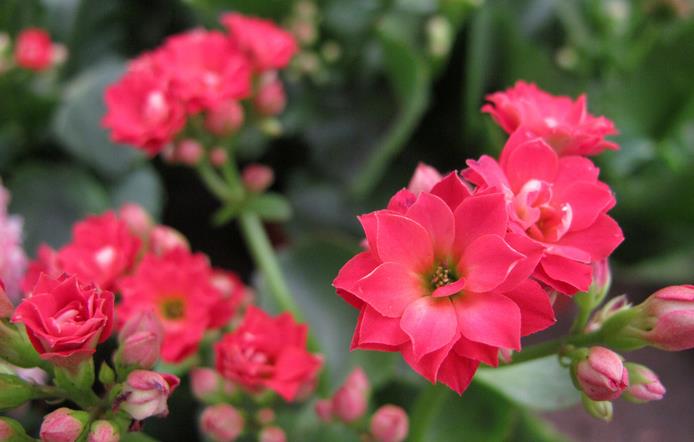
Kalanchoe is also known as Shouxing flower, dwarf kalanchoe, and Christmas kalanchoe. The stem is upright; the leaves are fleshy, opposite, elliptical-oblong, dark green and glossy, with edges slightly tinged red; the inflorescence is a paniculate cyme, and flower colors include crimson, peach red, orange red, yellow, and white; the flowers are small, tightly arranged and clustered into balls. The natural flowering period generally starts in late December and can last until early May of the following year, hence the name kalanchoe.
Kalanchoe is a short-day plant, and its flowering period can be advanced or delayed by regulating day length and temperature to achieve year-round flowering. There are many horticultural varieties. Commonly cultivated plants in the same genus include Yuhaitang, whose flowers are bright red and open in winter, making it an excellent indoor potted flower for winter; Yudiaozhong, whose leaves are variegated in yellow, green, and pink, making it a fine indoor foliage potted plant; and Huayechuanlian, whose pale yellow leaves bear brownish-purple spots. It produces yellow flowers in spring and summer.
Why did kalanchoe get its name? How is it best cared for in spring?
In early spring the greenhouse gradually warms, so open windows for ventilation slowly. Open windows at noon and close them in the evening to prevent too great a temperature difference. When potted flowers first come out of the greenhouse, wait until the temperature is stable. Spring light is gentle and helps flowers grow, and even shade-loving flowers need sunlight. Newly out of the greenhouse, they fear dry wind, so on windy days do not forget to cover the greenhouse. When potted flowers are watered for the first time in spring, too much water easily "bursts" and ruins them. To promote sprouting, add nitrogen fertilizer, but avoid strong doses and prefer weak ones as the safest approach. If you want potted flowers to grow well, repotting in early spring is most important. Before flowers and trees wake from dormancy, do not delay transplanting and repotting.
If the plant blooms in early spring, repotting should wait until the flowers fade. Stop watering before repotting so the potting soil is evenly moist and not easily crumbled. When repotting potted flowers, cut old roots and fibrous roots appropriately. Move flowers on a sunny day toward sunset, and planting on a cloudy day is ideal. Newly planted flowers and trees should not be fertilized, nor should they be given a large amount of water right away. If the soil is too wet during the recovery period, the roots easily rot and the whole plant dies. Do not delay pruning potted plants; remove all branches and leaves that "spoil the beauty." To promote early flower bud differentiation, stop applying nitrogen fertilizer and increase phosphorus and potassium. Eggshells, fish scales, and chicken and duck feathers, when decomposed and applied, are good for budding.
During the flower-forcing period, water carefully; too wet or too dry easily causes bud drop. Do not fertilize during flowering; keep the potting soil slightly moist and avoid heavy watering. When the plant approaches the budding stage, cuttings and grafting are most suitable. When ground temperature is stable and there is no frost, sowing flowers is just right. When sowing, cover with soil carefully, to about three times the depth of the seed. If you want seedlings to come up well, shading and moisture retention are most important.
Kalanchoe is also known as Shouxing flower, dwarf kalanchoe, and Christmas kalanchoe. The stem is upright; the leaves are fleshy, opposite, elliptical-oblong, dark green and glossy, with edges slightly tinged red; the inflorescence is a paniculate cyme, and flower colors include crimson, peach red, orange red, yellow, and white; the flowers are small, tightly arranged and clustered into balls. The natural flowering period generally starts in late December and can last until early May of the following year, hence the name kalanchoe.
Kalanchoe is a short-day plant, and its flowering period can be advanced or delayed by regulating day length and temperature to achieve year-round flowering. There are many horticultural varieties. Commonly cultivated plants in the same genus include Yuhaitang, whose flowers are bright red and open in winter, making it an excellent indoor potted flower for winter; Yudiaozhong, whose leaves are variegated in yellow, green, and pink, making it a fine indoor foliage potted plant; and Huayechuanlian, whose pale yellow leaves bear brownish-purple spots. It produces yellow flowers in spring and summer.
Why did kalanchoe get its name? How is it best cared for in spring? I hope everyone can gain something after reading this article! Everyone is welcome to keep following Succulent Garden to learn more about herbaceous flowers!
What are China's top ten famous flowers? The flower language of China's top ten famous flowers
What are China's top ten famous flowers? The flower language of China's top ten famous flowersChinese culture is broad and profound, and of course flower culture also runs through ancient and modern times. Today the editor will join everyone in exploring China's top ten famous flowers, enjoying them visually while also feeling the spiritual and cultural heritage they contain. Here we will tell youWhat are China's top ten famous flowers?and will listthe flower language and symbolic meanings of China's top ten famous flowers,and at the same time will also present a passage describingfamous poems and lines about China's top ten famous flowers, and I hope you like it.
The chief beauty among flowers - plum blossom
Among China's top ten famous flowers, the plum blossom,is a deciduous tree of the Rosaceae family, sometimes also referring to its fruit or flower. It originated in China and later spread to Korea, Japan, and other places.
Other names: spring plum, dried-branch plum, sour plum, dark plum.
Flower language: fortitude, elegance, unremitting self-improvement
Sparse shadows slant across the clear shallow water, and hidden fragrance floats in the dusk of the moon.
- Little Plum in the Mountain Garden, by Lin Bu
The plum blossom is elegant and uncommon, with an icy heart and jade-like nature, and a distinctive old fragrance. It symbolizes the spiritual qualities of perseverance, unyieldingness, courage to lead, and unremitting self-improvement. For thousands of years, its lofty qualities and steadfast integrity, braving frost and snow and giving fragrance in the cold, have encouraged generation after generation of Chinese people to fear no hardship or danger and strive to open new paths.
The king of flowers - peony
Among China's top ten famous flowers, the peony,is an important ornamental plant. It originated in the mountainous areas of the western Qinling and Daba Mountains in China, and wild single-petaled varieties still exist in this region today.
Other names: Shugu, Lujiu, Bairong, woody peony, Baiyujin, Luoyang flower, wealth flower
Flower language: wealth, auspiciousness, prosperity and flourishing
Only the peony is truly national beauty; when it blooms, the whole capital is stirred.
- Admiring the Peony, by Liu Yuxi
The peony is graceful and luxurious, magnificent and splendid, and has long had the fine names "national beauty and heavenly fragrance" and "king of flowers." In the minds of Chinese people, the peony symbolizes prosperity, wealth, and auspiciousness, so it is honored as the king of flowers.
Blooming beautifully through frost - chrysanthemum
Among China's top ten famous flowers, the chrysanthemum,according to cultivation forms, is divided into cultivation types such as multi-flowered chrysanthemum, single-stem chrysanthemum, large trained chrysanthemum, cliff chrysanthemum, artistic chrysanthemum, and desk chrysanthemum; according to the external form of the petals, it is divided into cultivation types such as round-incurved, recurved, reflexed, irregular, exposed-center, and flying-dance types. Chrysanthemums within different types are also named with various cultivar names.
The chrysanthemum is third among China's top ten famous flowers, one of the four noble plants (plum, orchid, bamboo, chrysanthemum), and also one of the world's four major cut flowers (chrysanthemum, rose, carnation, gladiolus), with production ranking first. Because the chrysanthemum has the character of enduring cold and braving snow, Tao Yuanming wrote the famous line "Picking chrysanthemums by the eastern fence, I gaze leisurely at the southern mountains." Chinese people have the custom of viewing chrysanthemums and drinking chrysanthemum wine on the Double Ninth Festival. In Tang dynasty poet Meng Haoran's "Passing by an Old Friend's Village": "When the Double Ninth Festival comes, I will come again for the chrysanthemums." In ancient myths and legends, the chrysanthemum was also endowed with meanings of auspiciousness and longevity.
Other names: Shouke, Jinying, Huanghua, autumn chrysanthemum, Tao chrysanthemum, Rijing, Nühua, Yannian, hermit flower
Flower language: integrity, nobility, longevity
The garden is full of chrysanthemums in rich golden yellow, among which one clump stands alone with a color like frost.
- Composing on White Chrysanthemums at the Double Ninth Banquet, by Bai Juyi
The chrysanthemum blooms in autumn, clear and cold and braving snow, so it is a symbol of autumn. People even call the ninth month "chrysanthemum month," because chrysanthemum is homophonous with "ju" and "nine" is homophonous with "jiu," so the chrysanthemum is also used to symbolize longevity or enduring time.
On the Double Ninth Festival, the ninth day of the ninth lunar month, picking chrysanthemums is of great significance. People often use them to make fine chrysanthemum tea, or soak chrysanthemums picked on this day in aged rice wine, or bathe with chrysanthemums, all taking the meaning of "longevity through chrysanthemum water."
The flower of gentlemen - orchid
Among China's top ten famous flowers, the orchid. Orchidaceae plants are commonly known as orchids, also called Hu Jihua, and are the largest and most diverse family of flowering plants, with about 736 genera and 28,000 species, plus more than 100,000 hybrids and varieties cultivated by horticulturists. All wild orchid plants are listed under the protection scope of the Convention on International Trade in Endangered Species of Wild Fauna and Flora.
Other names: Chinese orchid, spring orchid, orchid grass, orchid flower, secluded orchid, mountain orchid, national fragrance, valley fairy, ancestor of fragrance
Flower language: upright spirit and distant purity, lofty character and freedom from vulgarity
I know it has a clear fragrance that can dispel foulness, and I cherish even more its slender leaves that skillfully brave the frost.
- Guang Qun Fang Pu, by Liu Hao
People admire the orchid for associating with grasses and trees, not competing in beauty with other flowers, fearing no frost or snow, and possessing a firm and resilient character. The orchid has always been regarded by people as a symbol of nobility and elegance, and together with plum blossom, bamboo, and chrysanthemum it is called one of the "four noble plants."
The queen of flowers - Chinese rose
Among China's top ten famous flowers, the Chinese rose originated in central China in Guizhou, Hubei, Sichuan, and other places, and is now found throughout the world. It is the city flower of Beijing, Tianjin, Shijiazhuang, Nanyang, Changzhou, Huai'an, and Liuzhou, and the national flower of Iraq, the United States, and Luxembourg. Registration of cultivated species names in the genus Rosa is handled by the ICRA designated by ISHS, currently ARS.
Other names: Yueyuehong, Yueyuehua, Changchun flower, four-season flower, Shengchun
Flower language: love, sincere love
One tip has already split the rouge brush, and the four splits still wrap the emerald down.
- Chinese Rose Before the Twelfth Month, by Yang Wanli
New archaeological discoveries show that the Chinese rose was the totem plant of the northern branch of the ancestors of the Chinese people, equivalent to the legendary Yellow Emperor's tribe. As one of China's top ten famous flowers, it not only has a distant fragrance but also a spirit of unyielding resilience.
A profusion of flowers like brocade - rhododendron
Among China's top ten famous flowers, the rhododendron. Legend says that in ancient times there was a cuckoo bird that cried day and night until it coughed blood, dyeing the flowers all over the mountains red, and thus it got its name. Rhododendrons generally bloom in spring, with 2-6 flowers per cluster, funnel-shaped corollas, in colors such as red, pale red, apricot red, snow blue, and white, with abundant and gorgeous flower colors. They grow in open thickets or under pine forests in mountainous areas at altitudes of 500-1200 (-2500) m, and are typical acid-soil indicator plants in central-southern and southwestern China.
Other names: rhododendron flower, mountain azalea, mountain pomegranate, Yingshanhong, Zhaoshanhong, Tang rhododendron
Flower language: longing, joy of love
The rhododendron flower and the bird, how far apart are resentment and beauty.
One suspects it is blood from the mouth, dripping into flowers on the branch.
- Rhododendron Flower, by Cheng Yanxiong
The rhododendron is very ordinary. It has neither the grace and luxury of the peony, nor the solitary frost-defying pride of the chrysanthemum, nor the icy flesh and jade bones of the plum blossom. Its flowers bloom by mountain streams and beneath steep ridges, yet it has a yearning for prosperity and strength and a spirit that refuses to admit defeat.
The lotus of the water - lotus
Among China's top ten famous flowers, the lotus,is a perennial herbaceous emergent aquatic plant of the genus Nelumbo in the family Nelumbonaceae, also called lotus, lotus flower, or he, and in ancient times called furong, handan, or fuqu. The lotus originated in China, lives in water, and is usually planted in ponds. The flowers generally bloom in summer, so the lotus has also become a symbol of summer. The rhizome of the lotus is planted in the mud at the bottom of ponds or rivers, while the leaves rise above the water surface. Hence it is said that the lotus emerges from the mud unstained.
Other names: lotus, water hibiscus, lotus root flower, fuqu, water mushroom, water bloom, zezhi, Chinese lotus
Flower language: elegance, sanctity, purity
Blooming in turbid water, how pure is the nature it embraces!
- Handan Pavilion, by Su Zhe
The lotus is a flower of noble virtue: pure, noble, and modest. It also represents the qualities of steadfastness, purity, innocence, and uprightness, revealing elegance within understatement.
The delicate guest among flowers - camellia
Among China's top ten famous flowers, the camellia,also known as camellia flower, is a plant of the genus Camellia, belonging to evergreen shrubs and small trees. Its ancient name was sea pomegranate. It has other names such as Yuming flower and Naidong. In Japanese it is called tsubaki, and in Korean it is also called winter cypress flower. In South Korea's Haeundae District, Dongbaek Island is named after the camellia. It is also divided into East China camellia, Sichuan camellia, and late camellia. There are extremely many camellia cultivars. It is a traditional ornamental flower of China, ranking eighth among the "top ten famous flowers," and is also one of the world's precious flower trees.
Other names: camellia flower
Flower language: modesty, hope, ideal love
Early spring sends coy shyness, and brilliant colors sway in the wind.
Among the myriad greens, a pretty dimple remains, all the more charming and lovely.
- Bu Suan Zi: Ode to Camellia
The camellia defies wind and cold, braves frost and fights snow, and blooms proudly against the ice, adding warm color to severe winter and filling all things with the hope of spring. Coming into contact with it, one is influenced and inspired by its strong, upright, and noble character.
Fragrance spreading for ten li - osmanthus
Among China's top ten famous flowers, osmanthus,also known as "laurel" and "muxi," is an evergreen shrub or small tree; the leaves are opposite, mostly elliptical or oblong-elliptical, with smooth surfaces, leathery texture, and serrated leaf edges; it blooms in autumn, with flowers clustered in leaf axils, and the corolla splits to the base in colors such as milky white, yellow, and orange red, and it is extremely fragrant; the drupe turns purplish-black when mature. It is commonly seen in the south. In addition, osmanthus is easily confused with the Lauraceae tree cassia bark, so care must be taken when identifying it.
Other names: rock osmanthus, muxi, Jiulixiang, Jinsu
Flower language: nobility, auspiciousness, spirit of dedication
People are at leisure as osmanthus flowers fall, and the night is quiet as the spring mountain is empty.
The moon rises and startles the mountain birds, which call from time to time in the spring stream.
- Birds Singing in the Ravine, by Wang Wei
The osmanthus tree is a symbol of loftiness, chastity, honor, friendship, and auspiciousness. Whenever someone succeeds in official career and rises rapidly, it is called "plucking osmanthus."
The fairy on the waves - narcissus
Among China's top ten famous flowers, narcissus is a plant of the genus Narcissus in the family Amaryllidaceae. Narcissus has many other names: elegant garlic, heavenly scallion, Peiyuan, Liju, Nüshi flower, Yaonü flower, flower in the snow, Lingbo guest, golden cup, silver platform, Narcissus, and so on. The flower language of narcissus is purity; internationally the meaning of the narcissus flower is purity; while yellow narcissus represents the meaning that I hope there is love; as for the summer-blooming summer narcissus, it represents physical pleasure. There are many legendary stories about narcissus flowers.
Other names: fairy on the waves, golden cup silver platform, Luoshen fragrant concubine, jade exquisite, gold and silver platform, flower in the snow, heavenly garlic, etc.
Flower language: purity, auspiciousness, self-respect and self-love
Gaining water, it can become a fairy, a wonder bestowed by heaven, and its cold fragrance in solitude stirs the icy flesh.
- Narcissus Flower, by Liu Bangzhi
At New Year, narcissus symbolizes: longing, expressing reunion.
In the West, the flower language of narcissus is steadfast love, and by extension it is sincerity toward love.
In folk custom, giving narcissus means praising you for having a good heart and surely having good fortune, and wishing you auspiciousness, good luck, and that everything goes as you wish.