How do you cultivate and grow Bougainvillea and time its pruning?
Bougainvillea is what we commonly call the paperflower or red bougainvillea. Bougainvillea is an important ornamental flowering tree commonly used in urban landscaping, often planted on flower trellises or along walls to climb and grow. At the turn of winter and spring, it produces brilliant flowers in vivid reds and purples on its drooping, hanging branches, and it is very beautiful. In addition, it can also be planted as a flowering hedge, which is also very unique and elegantly beautiful. Below, let us take a look at the planting arrangements for bougainvillea and how to time its pruning!
What are the cultivation and growing methods for bougainvillea?
The flowers of bougainvillea are very small, borne in clusters of three, wrapped on the outside by three large colored bracts in purple, red, orange-red or white. The bracts look like leaves in shape but are very brightly colored, and if you do not observe carefully, you will often mistake them for petals. This is where the name bougainvillea comes from.
Bougainvillea likes a warm and humid climate and is not cold-tolerant. In the Yangtze River basin and northern regions, it can only be grown as a potted plant. Bougainvillea requires plenty of sunlight; in shady places it often does not bloom or blooms very little. In winter, it is best placed indoors on a sunny windowsill at 18-20 degrees. It is not strict about potting soil, and fertile sandy loam is relatively suitable. In early spring, it can be repotted and the soil changed. During the growing period, apply decomposed fertilizer water once every half month. After the weather warms in spring, the pot can be moved to a balcony or yard in a sunny spot. If there is insufficient sunlight and it is too shady, it will bloom very little or not bloom at all.
In North China, there are often dry, hot winds in May-June, which are very harmful to the growth of bougainvillea, and care should be taken to move it indoors. As the temperature rises, watering can gradually be increased. For potted bougainvillea in the north, May to June is the peak flowering period, when it needs more fertilizer; apply dilute decomposed liquid fertilizer once a week. In summer and autumn, attention should also be paid to shaping and pruning to keep the plant's shape attractive. In summer, pinching should also be done to control vegetative growth and promote flower bud formation.
In winter, if the room temperature is below 18 degrees, some leaves will drop. At this time, pay attention to moderating watering; excessive moisture easily causes root rot. If it is not used for indoor climbing or trailing, then after flowering it should be pruned to encourage many new branches and grow into a spherical crown, making the plant beautiful and graceful in shape.
Bougainvillea propagates very easily. In June, cut semi-lignified branches into 10-15 cm sections and insert them into a pot filled with plain sandy soil. At 25 degrees, they can root in about one month. At lower temperatures (18-20 degrees), rooting is slower. After rooting, the cuttings should be planted in a small pot and placed in a semi-shady place. After a period of recovery and resumed growth, they can gradually be exposed to light and given normal care.
In addition, layering can also be used for propagation. Mostly in May to June, select 1-2 year old branches at the lower part of the plant and layer them into a pot, or use another pot to layer the branch into the soil; the layered branch should be ring-barked, with the width of the bark removal reaching more than twice the diameter of the branch;
After layering, cover with soil and secure it, keeping the potting soil moist; roots can form in about a month, and after more than two months it can be cut off and potted. Although layering propagation is somewhat troublesome, the seedlings become established plants quickly, making it suitable for the needs of home flower growers who propagate only a small number.
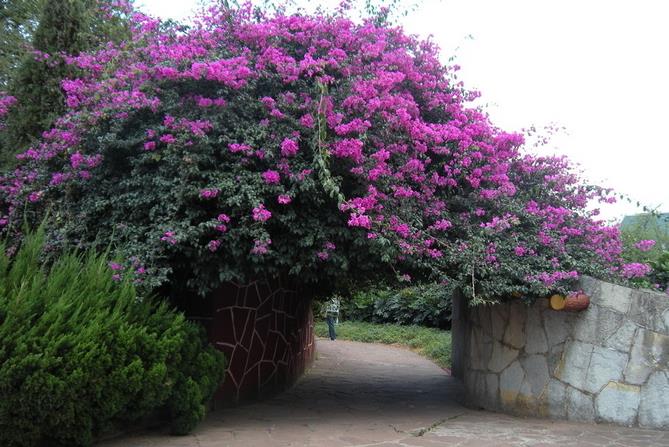
What are the cultivation and growing methods for bougainvillea? How should the pruning time for bougainvillea be determined?
Common bougainvillea varieties also include:
(1) Red bougainvillea: the bracts are deep red;
(2) Brick-red bougainvillea: the bracts are brick red.
(3) Orange-yellow bougainvillea: the bracts are orange-yellow.
(4) Purple bougainvillea: this variety is relatively cold-tolerant; kept indoors at 5 degrees in winter, it will not freeze.
Bougainvillea has very high ornamental value, and it is also a Chinese medicinal herb with the effect of dispersing blood stasis and reducing swelling.
How should the pruning time for bougainvillea be determined?
The pruning of bougainvillea is mainly to produce sturdiness, create space, create layers, create shape, and create the curvature of the trunk and branches. Cutting off weak branches and shortening and reducing long branches is actually to reduce consumption, so that the retained branches and newly grown branches become more robust. There is loss and gain; you must be willing to cut in order to obtain a sturdy potted flower or bonsai. A person should be humble, and a tree should be hollow; there must be space between branches for growth and for receiving sunlight. Therefore, a bonsai must have 3-5 layers, and inner branches should be removed as much as possible. To give bougainvillea a beautiful shape, the trunk and main branches must be thick and have a certain degree of bend and curvature. A certain degree of bend and curvature represents a kind of weathered antiquity, allowing the small to suggest the large, like a big tree, so that it basically has the feel of a bonsai.
Bougainvillea is generally pruned after sprouting in spring, when you can determine which branches are weak, which are sturdy, and which are dry. Of course, it can also be pruned at ordinary times. For example, after flowering it should be pruned moderately, cutting off the pedicels, shortening the flowering branches back by 1/3 of the branch, thinning out weak branches, short branches, and inner branches. In winter, pruning can be combined with changing the potting soil, etc. Bougainvillea pruning should be determined according to the tree, the style, and the pot, and applied flexibly. Small seedlings, small trees, potted flowers, bonsai, shaped and unshaped plants must all be treated differently.
Pot size determines the severity of pruning
A small pot cannot grow a large tree (soil nutrients and growing space are insufficient), and a large pot is not suitable for growing small seedlings (it wastes space). Generally, the pot height accounting for one third of the whole plant and the plant accounting for two thirds is relatively suitable. If the plant is too tall and too large, it appears top-heavy and unstable, so the pot size must be considered when pruning.
Pruning is divided into heavy pruning, medium pruning, light pruning and reduction:
1. Heavy pruning: basically cutting off all branches, leaving the stump and a few main branches; the few main large branches left should also be cut very short. In particular, unwanted branches and branches that ruin the plant shape must be completely cut off. Heavy pruning is generally used when changing the shape.
2. Medium pruning: lighter than heavy pruning; it only cuts off some dead branches and unwanted branches, and branches in good growing positions are merely shortened. The overall tree shape does not change much. Medium pruning is generally used on shaped potted flowers and bonsai.
3. Light pruning: merely shortening some weak branches slightly, cutting off diseased and dead branches, and slightly shortening healthy branches. It is generally used on seedlings, small plants, and small trees, preserving as many branches as possible to form a strong tree vigor for photosynthesis, so that the small seedlings grow quickly.
4. Reduction: cutting all branches short so that this year's tree shape is about the same size as last spring's tree shape, in order to free up space for the plant to grow and bloom, and to make new branches more robust and the flowers more beautiful and spectacular. The four pruning methods sometimes cannot be completely separated and must be organically combined.
Branches that must be pruned off:
Dead stumps and dead branches (to reduce places where pests and diseases can infect and hide).
Riding branches (branches that form a right angle with horizontally extending branches and grow upward).
Inner branches (weak branches growing inside the crown, also called shade branches).
Axillary branches (branches emerging below the base of the main branches).
Parallel branches (two branches growing close together and in parallel directions); the weaker one must be cut off.
Water sprouts (branches emerging from the base of the trunk that grow upward especially vigorously and ruin the plant shape).
For crossing branches, choose the weak branch and cut it off, and by the way wipe off unwanted buds.
Overlapping branches (two branches, one above and one below; cut off the weaker one).
Bougainvillea growing methods: home growing methods and precautions for bougainvillea
Soil selection for growing bougainvillea
The growing medium for bougainvillea is made by piling up and decomposing loam, cow dung, leaf mold, sand, etc., and adding an appropriate amount of bone meal when using. When planting, set the bougainvillea upright, fill in the growing medium firmly, and water thoroughly.
Mix garden soil: leaf mold: sand in a 5:3:2 ratio, or mix peat soil: leaf mold: sand: perlite in a 5:2:2:1 ratio.
Watering methods for growing bougainvillea
In spring, as growth vigor accelerates, it needs watering every day, and its leaves and surroundings should often be sprinkled with water to increase air humidity. If air humidity is insufficient, leaves easily drop.
In summer during the flowering period, water twice a day: spray water in the morning, and after 4 p.m., water once. Before bougainvillea blooms, water once, and then wait until the leaves or tender buds all droop before watering again.
In autumn, after the temperature becomes cool, just keep the potting soil moist. When the temperature is relatively low (around 10°C), water less, keeping the potting soil on the dry side. But if the indoor temperature remains above 15°C, water more to keep the potting soil moist.
In winter, control watering; do not water unless the potting soil is dry.
Fertilization methods for growing bougainvillea
Bougainvillea likes fertilizer. After the weather warms in spring, apply nitrogen fertilizer once every 10-15 days. During the growing period, apply cake fertilizer water once a week. During the flowering period, apply phosphorus fertilizer several more times. After autumn turns cool, reduce the amount of fertilizer, and stop fertilizing in winter. During the peak growing and flowering season, spray the leaves with 1000 times diluted monopotassium phosphate solution 2-3 times, or apply a general-purpose fertilizer once every 10 days.
Note: bougainvillea is very sensitive to urea. If fertilized improperly, it may produce the phenomenon of luxuriant branches and leaves but few flowers, so be especially cautious when applying urea.
Light and temperature requirements for growing bougainvillea
The suitable temperature for bougainvillea growth is 20-30°C. When the winter temperature is below 5°C, it is prone to freezing and leaf drop.
Bougainvillea likes light. Insufficient light during the growing season will cause the plant to weaken and affect flowering. In winter, it should be placed in a bright place, and daily light must not be less than 8 hours, otherwise a large number of leaves will drop.
Precautions for growing bougainvillea
Bougainvillea is not cold-tolerant and is easily frostbitten, and in severe cases can freeze to death, so be sure to pay attention to temperature changes. Generally speaking, if the temperature stays below 5°C for a long time, it may freeze to death. Even in the winter in the south, the lowest it can reach is only around 3°C.
Bougainvillea fears waterlogging, so potted bougainvillea must never have standing water in the pot.
Bougainvillea tolerates pruning well, so do not be afraid of pruning it badly; frequent pruning helps it bloom more.
Cultivation methods for bougainvillea
The scientific name of bougainvillea is Bougainvillea glabra, also known as three-leaf bougainvillea, hairy bougainvillea, lèdùjuān, triangular flower, etc. It is a vine-like shrub plant of the genus Bougainvillea in the family Nyctaginaceae, native to Brazil. In southern China it is planted in courtyards and parks as an ornamental plant, and in the north it is cultivated in greenhouses. It can also be used as bonsai, hedges, and pruned shapes. Now let us take a look at the cultivation methods for bougainvillea!
How much does bougainvillea cost?
The price of bougainvillea is generally set according to its height, crown width, and ornamental performance. Generally, a bougainvillea with a trunk diameter of 2 cm, a height of 200 cm, and a crown width of about 100 meters costs about 100 yuan per plant. Of course, generally for smaller saplings with a height of about 30 cm and a crown width of about 30 cm, the price is generally 10-20 yuan per plant.
Cultivation environment for bougainvillea
Bougainvillea is a tropical plant. It likes a climate environment of high temperature and high humidity, and is also relatively tolerant of dry heat. It is not cold-tolerant and avoids frost. South of the Tropic of Cancer in China, it can overwinter safely outdoors. In the vast areas from northern South China to Central China and North China, it is only suitable for potted cultivation, and in winter it should be moved indoors or into a greenhouse. Bougainvillea does not have high requirements for soil fertility; sandy soil or clay soil are both suitable. It can tolerate water and moisture, and is also relatively tolerant of drought. Potted bougainvillea enters a forced dormant state when the temperature drops to a certain level. During the non-dormant period, bougainvillea experiences abnormal flower drop due to insufficient light, and with sufficient water the flowers also fade early. In the dormant state, bougainvillea is not sensitive to light intensity, but because of low temperature it shows a longer lifespan, and because of less water it also shows a longer lifespan.
Cutting propagation of bougainvillea
Bougainvillea is commonly propagated by cuttings, and raising seedlings is easy. In May and June, cut mature lignified branches, cut 2-year-old branches into 10 cm long cuttings, and insert them into growing medium (use plain sandy soil plus one third humus or sawdust, add an appropriate amount of water and stir evenly), then seal well with plastic film after inserting. At a temperature of 20°C to 25°C, they can root in 25 days, and can be divided into pots in 2 to 3 months. If you want to obtain more ideal new plants, you should use the air layering method for propagation. This method does not affect the growth of the original plant, and can also produce complete new plants, so it is often used by home flower growers, and the method is simple, with a high survival rate, convenient later transplanting, and easy management.
Cultivation methods for bougainvillea
1. Choose growing medium: bougainvillea is not strict about soil, but fears standing water and does not tolerate waterlogging, so a loose growing medium with good drainage must be chosen. Generally, a growing medium prepared with 4 parts humus soil, 4 parts garden soil, and 2 parts sand can be used. Sun-dried pond mud mixed with some coal cake residue can also be used as potting soil. When potting, 30 grams of decomposed cake fertilizer should also be mixed in as base fertilizer.
2. Reasonable fertilization: bougainvillea is generally fertilized with liquid fertilizer once every 7-10 days during the vigorous growth period from April to July. Fertilizers such as 10-20% decomposed soybean cake or rapeseed cake water, or human manure water, can be used. From August onward, in order to promote flower bud formation, apply fertilizer mainly based on phosphorus fertilizer once every 10 days; 20% decomposed chicken, duck, and pigeon manure and fish scraps and other liquid fertilizers can be used. From October onward it enters the flowering period. From then until mid-November, apply fertilizer mainly based on phosphorus fertilizer once every half month, with a fertilizer water concentration of 30-40%. After that, after each flowering, an additional topdressing should be applied once, so that the flowering period is continuously supplemented with nutrients.
3. Water control before flowering: usually master the principle of “do not water unless dry, and water thoroughly when watering”, but for neat and abundant flowering, water control must be carried out before flowering. From September onward, control watering of bougainvillea. Each watering should wait until the potting soil is dry and the branches and leaves droop softly. Repeat this continuously for half a month, then after half a month restore normal watering. During the water control period, absolutely do not fertilize, so as to avoid fertilizer burning the root system. In this way, in about one month, buds will appear and flowers will bloom, and the flowers will open neatly and abundantly.
4. Loosen the soil and repot: due to long-term watering, fertilizing, and rain washing, the potting soil easily becomes compacted, so the soil must be loosened regularly, and weeds in the pot should be removed at the same time, to benefit the growth of bougainvillea. Otherwise, if the potting soil is compacted and water accumulates, it easily causes root rot or poor growth. In addition, bougainvillea grows relatively fast, has a developed root system, and has many fibrous roots, so it needs repotting once a year.