Is Pennywort Poisonous? A Complete Guide to Growing It
Pennywort is a type of potted plant for the home, and it is a perennial hygrophyte herbaceous crop. Its leaves are perfectly round and its vitality is extremely vigorous; whether grown in soil or hydroponically, its survival rate is very high. Its underground rhizomes grow rapidly, with new roots and leaves emerging from every node, and in summer and autumn it even produces small yellow-green flowers. The rhizomes, stems and leaves of pennywort can all be eaten as a vegetable, and it has the effects of clearing heat and removing dampness, promoting urination and detoxifying. Below, the editor gives you a detailed introduction to how to grow pennywort.
How do you grow pennywort?
1. Soil selection for growing pennywort
Pennywort is not strict about soil requirements; it can grow in yellow loam, red loam or black loam, and even in poor soil. However, its drought resistance is not strong, and it grows best in fine, slightly acidic, moist loam with low fertility.
Pennywort is suited to fertile, loose soil that absorbs a lot of water and holds moisture well; it can also be cultivated on moist riverbanks, in marshes, in grassland, or in low-hardness freshwater. The growing medium can be made by mixing leaf mold, river mud and garden soil in a ratio of 5:2:2.
2. Fertilizing methods for growing pennywort
Pennywort has a relatively high demand for fertilizer; during the vigorous growth stage, apply fertilizer once every 2 to 3 weeks. If grown in a pot or container, only a small amount of fertilizer is needed, such as the quick-acting fertilizer Hyponex No. 2, which can maintain its fertilizing effect in water for a relatively long time; just ensure the water quality is slightly acidic or neutral.
3. Watering methods for growing pennywort
Pennywort likes a relatively moist growing environment. Because it has many leaves and a high transpiration rate, in summer you should frequently spray the plant to maintain high air humidity, and the leaves should be kept clean to facilitate photosynthesis. In winter, the potting soil should preferably be on the dry side; watering follows the principle of preferring wet over dry, and waterlogging should be avoided, otherwise the roots rot easily.
Tap water in the north should be left in the sun to stand for 1 to 2 days before use. During the growing season, water once every 2 to 3 days to keep the potting soil moist. For water culture, change the water once every 7 to 10 days in spring and summer, and once every half month in autumn and winter.
If growing in water, be sure to change the water once a week and add a special nutrient solution for foliage plants. If growing in soil, be sure to retain moisture over the long term. Water once every morning, but do not overwater; water until it flows out of the bottom holes, just enough to soak the potting soil through.
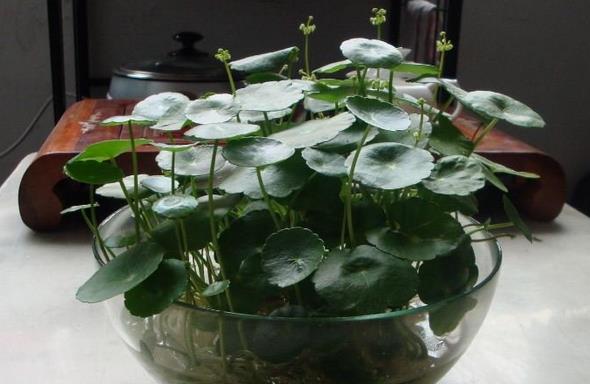
How do you grow pennywort? Is pennywort poisonous?
4. Temperature requirements for growing pennywort
Pennywort likes warm, humid environments but is not cold-tolerant. It grows well at temperatures of 10 to 25°C; when the summer temperature rises above 32°C, growth stops, and in winter the temperature must not fall below 5°C.
5. Light requirements for growing pennywort
Pennywort is shade-tolerant and does best in partial sun or shaded spots; it dislikes strong direct sunlight, and the more shaded the environment, the more easily the leaves rot. Pennywort does not compete for light, but if you let it receive 4 to 6 hours of scattered light each day, or give it 8 to 10 hours of artificial light, it will grow even better.
6. Pest and disease control methods for growing pennywort
Pennywort has very few pests and diseases. It has strong adaptability and needs no deliberate care. After being grown for a period, pennywort will fill the entire container. Frequently spray water on the leaves to wash them and keep them green and glossy. Once growth becomes dense, pay attention to ventilation, otherwise the plant easily turns yellow.
7. Precautions for growing pennywort
(1) It likes warm, high temperatures, and 80% sunlight is suitable; insufficient light or excessive shading will cause the stems to become leggy and the leaves to turn yellow and rot, so use a medium with good water retention and keep it moist at all times. The amphibious pennywort is commonly seen in aquatic ponds, wetlands and similar spaces, and water trays and aquariums suit it very well too.
(2) Pennywort generally does not need heavy pruning; when the leaves are too dense, promptly remove withered lower leaves and the outer layer of old and diseased leaves to improve light and ventilation. In spring, when the pot is full of roots, repot and divide and reshape the plant. If the plant grows too tall, prune it back to encourage new shoots from the base of the stems and leaves.
(3) Pennywort, which loves sunlight and water, can be grown hydroponically, in soil, or in a half-water half-soil setup. Its leaves are round and very cute, and it is very easy to grow; in short, you can do whatever you like with it. It does not compete for fertilizer, but it loves light and water, and as long as it has enough of both, it will be full of vitality.
(4) Pennywort does not need a very large pot; you can also plant it in a relatively large bowl, and a narcissus pot works too. When planting, you can lay it flat and cover the rhizomes so they are not visible, and be sure not to plant too deep. Then place it in partial shade for a week and wait for new leaves to grow before exposing it to sunlight.
(5) Pennywort sometimes develops yellow leaves, mainly caused by the following reasons, which should be avoided as much as possible. First, the potting soil is waterlogged or too dry for a long time, without watering as soon as it dries. Second, the roots were already frost-damaged in winter. Third, it was brought outdoors too eagerly in spring, and the pennywort could not adapt to the sudden change in climate. Fourth, it was kept for a long time in an environment with poor ventilation. Fifth, the leaves were not sprayed and washed for a long time, so dust accumulated and hindered photosynthesis.
(6) If you find that the new leaves are generally turning yellow, you can spray the leaves with a compound fertilizer based mainly on nitrogen. If water moss appears on the roots or in the water, wash it off and change the water immediately, otherwise it is bad for the plant's growth and affects its ornamental value. Usually pay more attention to whether there is enough water in the container, and avoid it drying up.
8. Propagation methods for growing pennywort
Hydroponic propagation: take a section of root with more than 2 nodes and soak it in clean water for 2 days; small root hairs will grow at the nodes of the pennywort, and sometimes small leaves too. Put a small amount of growing medium into a shallow pot, gently place the pennywort roots on the surface of the soil, cover with a thin layer of soil, then add some small gravel to keep the water clear. Water until it covers the small gravel; after about 4 days small plantlets grow. Be careful to replenish water often, moistening the gravel as the standard.
Is pennywort poisonous?
Quite a few flower lovers seem to have suddenly heard something like "pennywort is one of 52 plants that can cause cancer," and for a moment they were very shocked and simply could not believe it. Actually, that is not the case; the reason is that there is a plant called Jin Qian Cao (Lysimachia christinae), which is also known as Tong Qian Cao, Luo Di Tong Qian, and is a perennial herbaceous plant. Jin Qian Cao is not pennywort; it is only that they share the same alias. What is poisonous is Jin Qian Cao, not pennywort; these are two different plants. So we can grow pennywort with peace of mind. Pennywort is not only non-toxic, but the whole plant also has medicinal value and can be used as medicine, with a diuretic effect.
When growing pennywort, it is best not to use water culture alone; pure hydroponics generally does not work very well, while a half-water half-soil setup works better, just like growing water lilies and lotus, and this way it is very easy to grow. If using only water, add a hydroponic nutrient solution, and also use river sand, ceramsite or pebbles to weigh down the base. Pennywort is extremely fond of sunlight when growing, so it is best to place the water basin outdoors or by a window with plenty of light. If grown indoors, the daily sunlight exposure should be no less than 4-5 hours. Pennywort is generally propagated by division; in summer, use scissors to cut at the point where the stolon has rooted, and transplant the front plant into another water basin to propagate.
Is pennywort poisonous? Is pennywort suitable for growing indoors? The whole plant is non-toxic and it can be grown indoors.
Because pennywort can absorb formaldehyde and has high ornamental value, more and more people keep a few pots of it at home. Once it is grown indoors, people's health comes into question, because some plants are poisonous and some are not. So, is pennywort poisonous? Is it suitable for growing indoors? Below, the editor gives everyone a detailed answer.
Is pennywort poisonous?
1. Roots, stems, leaves, flowers / non-toxic
The roots, stems, leaves and small flowers of pennywort are all non-toxic; not only are they non-toxic, they also have high medicinal value. For example, its leaves can promote urination, its roots can clear heat, and its stems can relieve pain, and so on. Of course, do not take them casually without the guidance of a professional physician.
2. Scent, sap / non-toxic
In terms of scent and sap, is pennywort poisonous? The answer is non-toxic. The scent given off by pennywort is odorless and non-toxic; not only does it not release harmful substances, it can also absorb harmful gases from the air, such as formaldehyde, sulfur dioxide and so on, so it has an air-purifying effect. In addition, its sap is also non-toxic; if you touch the sap while growing it, it will not cause harm.
Conclusion: Both the tissues of pennywort and the sap within it are non-toxic. Some flower lovers mistakenly believe pennywort is poisonous because its name is very similar to Jin Qian Cao, and Jin Qian Cao is a poisonous plant, so many flower lovers think pennywort is poisonous too. In fact, this view is wrong; pennywort is a completely non-toxic plant.
Is pennywort suitable for growing indoors?
Since pennywort is a non-toxic plant, is pennywort suitable for growing indoors? The answer is that it can be grown indoors. There are many benefits to growing pennywort indoors: removing formaldehyde, purifying the air and its ornamental value are among its benefits. In addition, it can also create a relaxed atmosphere and relieve work stress, and it can be placed in many locations such as the living room and the study.
Methods for growing pennywort indoors
1. Light. Because pennywort loves direct sunlight, light is very easy to control when growing it indoors, but you should still try to let it see scattered light; for example, a position near a window or balcony is quite suitable. Do not let the light be too weak, otherwise the leaves will turn yellow.
2. Soil. Pennywort grown indoors is usually potted, so when choosing soil, give priority to fertile, loose soil. To make the soil more attractive, you can choose a mix of sandy soil and perlite. Of course, the health of the soil is the most basic requirement.
3. Fertilizer and water. Pennywort is not very drought-tolerant; when growing it indoors, be careful to keep the soil moist, and when watering do not let water accumulate in the pot. In addition, during growth it needs fertilizing once every 3-4 weeks, and do not let it develop premature leaf drop due to lack of fertilizer.
Pennywort - How to grow pennywort | How do you grow pennywort | Pennywort leaves turning yellow
Pennywort
Pennywort is a perennial creeping emergent or hygrophyte herbaceous plant, often curling into a clump; its stems are slender, rooting at the nodes, and grow densely. The stems are slender and root at the nodes. The leaves are round or kidney-shaped, densely covered on the underside with appressed T-shaped hairs, with entire margins; the corolla is bell-shaped and yellow. The flowering period is April. The fruiting period is July, with nearly spherical capsules. It is propagated by sowing and division, and its spreading ability is very strong, making it an excellent groundcover plant. Pennywort is robust, easy to plant and quick to propagate, and it can grow both in water and on land. Its runners are well developed, with roots and leaves growing from the internodes. The leaves are round and peltate, with long petioles and wavy margins, and in summer and autumn it produces small yellow-green flowers.How to grow pennywort
1. Water quality requirements for pennywort: ordinary tap water is fine. Change the water frequently. In summer, change the water once every 3-4 days, with the water level at half of the bottle. In winter, change the water once a week. In winter the leaves transpire less, so changing 1/3 of the water each time is enough.
2. Light requirements for pennywort: this plant relatively likes light. I generally place pennywort where sunlight can reach it, such as a windowsill. In summer the light duration can be longer. 4-5 hours is a must. If there is little light in winter, you can use a UV lamp or a fluorescent lamp instead of sunlight.
Pennywort leaves turning yellow
The reasons for pennywort leaves turning yellow are roughly the following:
1. Watering with "half water," that is, watering not thoroughly, without watering until seepage appears at the bottom of the pot.
2. Exposure to cold in winter; the roots have already been frost-damaged.
3. After overwintering, being brought outdoors too eagerly and placed in a warm spot to sunbathe, so it cannot adapt for a time to the sudden change in climate.
The uses of pennywort
The rhizomes, stems and leaves of pennywort can be used as a vegetable dish; they can also be used as a Chinese medicinal herb to dispel wind, secure the intestines, and clear the eyes and relieve summer heat, and so on.
Parts used: the whole plant can be used as medicine, and it has a diuretic effect.
Collection time: collected in summer and autumn.
Properties: slightly cold in nature, bitter and pungent in taste; clears heat and removes dampness, detoxifies and promotes urination. Aliases: Beng Da Wan, Ma Ti Cao, Lei Gong Gen, Han Ke Cao, Tong Qian Cao, Luo De Da.
How do you grow pennywort?
Pennywort is not strict about water quality and can be cultivated in low-hardness freshwater. It is highly adaptable to the pH of the water body, but it is best to keep it between 6.5 and 7.5, that is, it can grow well in water from slightly acidic to slightly alkaline. It has a relatively high demand for fertilizer; during the vigorous growth stage, apply fertilizer once every 2 to 3 weeks. After the plant differentiates flower buds, appropriately increase the application of phosphorus fertilizer. Jin Qian Cao likes an environment with sufficient light; in a shaded environment the leaves rot easily, so it is best to let it receive more than 4 hours of scattered sunlight each day. You can also use a special fluorescent lamp and give the plant 8 to 10 hours of artificial light per day, and it can still grow normally.
How to grow pennywort hydroponically
How do you grow pennywort hydroponically? It is recommended to choose one that has already rooted. For a half-soil half-water setup, take a leak-proof container, press the roots of the pennywort down with mud or pebbles, then add water to the container, drip in a few drops of hydroponic nutrient solution, and place it in a spot with good sunlight, and that is enough. Pennywort is very easy to grow.
Is pennywort poisonous?
Is pennywort poisonous? Can it be grown in the bedroom? Pennywort is non-toxic, the whole plant can be used medicinally, and pennywort can be grown in the bedroom. Pennywort blooming is even less toxic; its flowering period is around April, and it produces small white florets. Pennywort is one of the beautiful and easy-to-grow aquatic plants; it can be grown indoors in pots or hanging baskets, making the home look fresh and natural and making you feel relaxed and happy.
The flower language of pennywort
The flower language of pennywort: wealth rolling in!
The meaning of pennywort: according to our culture, which pays attention to implied meanings and homophones, pennywort has round leaves like mini lotus leaves, quite cute, and also like ancient copper coins, symbolizing reunion and continuous good fortune. Moreover, its name carries the two characters "tong" (copper) and "qian" (money), so its implied meaning is naturally different; a home with pennywort has wealth rolling in, so it is regarded as a symbol of wealth. Therefore, growing pennywort at home has symbolic meaning and also avoids the vulgarity of using golden copper coin decorations, while the special shape of pennywort also looks distinguished.
Pennywort blooming
Does pennywort bloom?
Pennywort does bloom, with small white-pink flowers; its flowering period is April, and it also bears fruit, with the fruiting period in July and nearly spherical capsules. It likes warmth and humidity, and is best cultivated in partial sun or shade; it dislikes direct sunlight. It is not particular about growing medium, and a soft, well-draining growing medium is best. The most suitable water temperature for pennywort is 22-28°C. It is shade-tolerant, moisture-tolerant, slightly drought-tolerant, and highly adaptable.
Related encyclopedia
Pocket scale non-woven bag lamp rush bamboo shoot crab claw Redmi Note 3 YKK zipper YBS zipper Sargent cherry creeping wall plum wild senna wintersweet green pine wristwatch Omega Longines famous watch children's building blocks flint Du Juan Lan rolling stick soursop