Caring for Peperomia obtusifolia: Precautions and Pest and Disease Control Methods
Peperomia obtusifolia grows over 25cm tall, with alternate leaves that are round to obovate-elliptic, rounded to slightly notched at the tip, wedge-shaped or abruptly narrowed at the base, spike-shaped inflorescences, and fruits with a sharply pointed curved beak. Peperomia obtusifolia is also known as pepper grass, emerald pepper grass, jasper, one-pillar incense, rock bean grass, bean grass, bean ruyi, and four-petal golden hairpin. It is an evergreen perennial succulent herbaceous flower of the genus Peperomia in the Piperaceae family, with thick, glossy, emerald-green leaves that stay green all year round. It is native to northern South America, the West Indian Peninsula, Panama, and other regions. At present, Guangzhou, Shenzhen, Zhuhai, and other regions already have batch production, and small potted Peperomia obtusifolia can be seen in flower markets everywhere.
What are the propagation methods for Peperomia obtusifolia?
1. Stem cuttings
This can be done from April to August. Select branches with a growing tip, cut cuttings 6-8cm long with 5-6 leaves, remove the lower two leaves, and make the cut at the base of the cutting at an angle. After the cut surface has dried, insert it directly into a sand bed or directly into a pot, then water thoroughly after inserting so that the cutting fits tightly with the medium. At a temperature of around 18°C, roots will form in 20-25 days.
2. Leaf cuttings
Carry out in May. Cut off mature leaves, which may include 1cm of petiole, and insert them upright or slightly slanting into a sand bed or pot, burying the petiole and cut end in the sand or potting medium. At a temperature of 20°C-25°C, adventitious roots and adventitious buds will grow in 25-30 days.
What precautions should be taken when growing Peperomia obtusifolia?
1. Soil
Peperomia obtusifolia has relatively strict soil requirements, requiring loose, fertile, and well-drained soil. The potting soil can be made by mixing peat soil, garden soil, sawdust, and perlite in a ratio of 3:2:1:0.5.
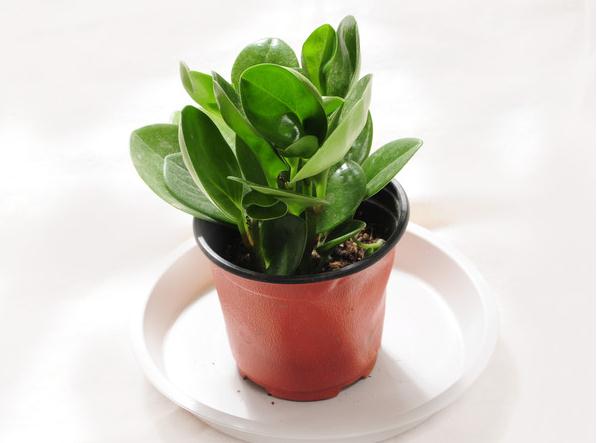
What precautions should be taken when growing Peperomia obtusifolia? How should its pests and diseases be controlled?
2. Pruning
When new seedlings grow to 6-8cm tall, perform the first pinching; when the side buds grow 3-4 true leaves, perform the second pinching. Repeat this several times until the plant form is full. For large plants, pruning is generally based on growth vigor: cut back leggy branches or cut off the whole plant, keeping 1-2 nodes at the lower part to sprout later.
3. Watering
Peperomia obtusifolia likes water and is not drought-tolerant. During the growing season, the potting soil should be kept moist. Watering should err on the side of less rather than more, and waterlogging in the pot must be avoided. In summer, spray water on the stems and leaves 1-2 times a day. When the temperature is below 25°C, water thoroughly only after the soil surface dries. When it is below 10°C, water thoroughly only after the soil has been dry for several days.
4. Fertilizing
About 1 month after potting, apply a 0.5% urea liquid fertilizer. During the growing season, apply a compound fertilizer water based mainly on nitrogen, phosphorus, and potassium, or decomposed soybean cake fertilizer water, once every 20-30 days. When the temperature is below 18°C or above 30°C, apply less or no fertilizer. Fertilize in small amounts and multiple times, with a dilute concentration. After fertilizing, be sure to spray water on the leaves to prevent leaf burn.
5. Light
It likes semi-shade or scattered light. Except in winter, when sufficient light is needed, slight shading is needed in the other seasons, especially during high summer temperatures, when a 90% shade net should be used. Peperomia obtusifolia placed in a shaded environment tends to become leggy; under semi-shade conditions, the leaf color is brighter and the gloss is better. Variegated varieties have slightly higher sunlight requirements.
6. Temperature
It likes a warm environment. The suitable growth temperature is between 20°C-30°C. The overwintering temperature is best kept above 10°C. Growth stops below 10°C, and it is prone to freezing damage below 5°C.
7. Humidity
It likes moisture. In a high-humidity environment, it grows luxuriantly and the leaf color is vivid. When the temperature is high or the air is dry, spraying water on the leaves should be strengthened to maintain relatively high air humidity. It can adapt to short periods of dry conditions. Humidity should generally be kept at 65%-70%.
How should the pests and diseases of Peperomia obtusifolia be controlled?
1. Diseases
① Ringspot virus disease. Infected plants become dwarfed and leaves become distorted. Before and after onset, spray 0.5%-1% Bordeaux mixture, once every 7-10 days, for 2-3 consecutive times.
② Leaf spot disease. It mainly harms leaves. Initially there are small yellowish-brown granular spots, which later gradually expand into concentric ring lesions that are light brown inside with slightly angular edges and differing shades. Spray 75% chlorothalonil, 50% captan 500-fold solution, or 1% Bordeaux mixture. Once a week, for 2-3 consecutive times.
③ Stem rot. In the early stage of the disease, the base of the seedling turns brown, the leaves lose their normal green color and droop slightly downward but do not fall off. The infected area spreads rapidly upward, until the whole plant dies. After onset, spray 65% dexon 600-800-fold solution, or potassium permanganate 1000-1200-fold solution. Once a week, for 2-3 consecutive times.
④ Anthracnose. Leaf spots are nearly round, brown to grayish-brown, with dark brown edges, and the boundary between diseased and healthy parts is clear. In the later stage, small black dots are scattered on the surface of the spots. The lesions easily rupture or fall off to form holes. In the early stage of the disease, spray 40% sulfur-multisulfide suspending agent or 30% mixed sulfur suspending agent 600-800-fold solution. Once a week, for 2-3 consecutive times.
⑤ Root and crown rot. During propagation or at the mature plant stage, it is easily infected by Phytophthora, causing rot of the stem base and leaves. This disease spreads very quickly under high temperature and high humidity conditions. In the early stage of the disease, spray 27% copper hydroxide suspending agent 600-fold solution, or 70% phosethyl-Al·mancozeb wettable powder 500-fold solution, or 69% dimethomorph-mancozeb wettable powder 1000-fold solution. Spray once every 7-10 days, for 2-3 consecutive times.
2. Insect pests
① Red spider mite. The nymphs often gather on the undersides of Peperomia obtusifolia leaves, sucking sap and damaging the plant, causing leaves to lose green color, leaf margins to curl upward, and eventually scorch and fall off; in severe cases the plant dies. Red spider mites reproduce very quickly under high temperature, high humidity, and poor ventilation. In the early stage of infestation, spray 50% malathion emulsifiable concentrate or 40% dimethoate emulsifiable concentrate 800-fold solution.
② Scale insects. Adults and nymphs gather on the branches and leaves of Peperomia obtusifolia, sucking sap, causing branches and leaves to wither, and even the whole plant to die, and they can also induce sooty mold. If scale insects are found on individual branches or leaves, they can be gently brushed off with a soft brush, or removed along with pruning by cutting off infested branches and leaves and burning them centrally. For chemical control, spray 50% dichlorvos 1000-fold solution or 2.5% deltamethrin 2000-2500-fold solution, once every 7-10 days, for 2-3 consecutive times.
How to grow Peperomia obtusifolia: growing methods and precautions / watering is crucial
We know that the effects and functions of Peperomia obtusifolia include ornamentation, reducing radiation, decorating the home, and so on, but to fully bring out these effects, it is still necessary to ensure that Peperomia obtusifolia grows healthily. Therefore, many flower lovers want to know how to grow Peperomia obtusifolia. Today the editor will introduce the growing methods and precautions for Peperomia obtusifolia.
Growth habits of Peperomia obtusifolia
Before understanding how to grow Peperomia obtusifolia, we need to know its growth habits, because different plants have different characteristics, so the growing methods also differ slightly. Peperomia obtusifolia is characterized by liking a semi-shaded environment, so the light cannot be too strong or too weak; in terms of temperature, Peperomia obtusifolia likes a warm environment.
Peperomia obtusifolia also likes a moist environment. It relatively likes water and is not drought-tolerant, and it fears waterlogging. It likes fertile, well-drained sandy soil. Its fertilizer requirements are not high, but basic nutrients must be sufficient. When growing it, try to create the conditions that Peperomia obtusifolia likes.
How to grow Peperomia obtusifolia
1. Temperature
Among the growing methods and precautions for Peperomia obtusifolia, the most suitable temperature for growth is 20-30°C. When the temperature is below 10°C, growth stops, and below 5°C it will suffer freezing injury. Therefore, in winter the temperature needs to be kept at around 10°C. Generally speaking, Peperomia obtusifolia is grown indoors, and as long as the room temperature is not too low, it can overwinter smoothly.
2. Light
Peperomia obtusifolia likes a semi-shaded environment. When growing it, it should be placed in a semi-shaded, ventilated environment, such as under scattered light. However, note that the environment should not be too shaded, otherwise the branches and leaves will become leggy and the leaf color will become dull and lack gloss. In winter, it can be placed in a bright place for care.
3. Humidity
In a moist environment, Peperomia obtusifolia grows most vigorously. When the air is relatively dry, water should be sprayed on the leaves to increase humidity. The ideal humidity is around 70%, but do not let the humidity become too high, otherwise pests and diseases will breed.
4. Soil
Peperomia obtusifolia likes loose soil containing humus and with good drainage. Heavy clay soil cannot be used. The most suitable soil is a mix of peat soil, perlite, and so on. Leaf mold, garden soil, river sand, and so on can also be used. During cultivation, some decomposed fertilizer can be added.
5. Watering
Watering is the most critical point among the growing methods and precautions for Peperomia obtusifolia, because Peperomia obtusifolia likes water, so how should it be grown in terms of watering? The soil should be kept slightly moist at ordinary times and must not be too dry, while also avoiding water accumulation in the pot.
6. Fertilizing
Fertilizing is equally important when growing Peperomia obtusifolia. Botanists recommend applying thin fertilizer frequently, that is, each fertilization should use dilute fertilizer water, not concentrated fertilizer or raw fertilizer. Nitrogen fertilizer should be the main type, with an appropriate addition of phosphorus and potassium fertilizer, which can make the leaves more deeply green and the gloss brighter.
7. Pruning
To ensure that the branches and leaves of Peperomia obtusifolia are not too dense, which would cause some leaves to be small and weak, timely pruning is needed during cultivation. For example, pinching is needed at the seedling stage and thinning is needed during the growing season. This can not only promote the sprouting of new buds but also maintain overall beauty.
How to grow Peperomia obtusifolia in winter
1. Reduce fertilizer and water
In winter, watering should be appropriately reduced according to the temperature. When the temperature is above 10°C, a small amount of water can be given to prevent the soil from becoming too dry. When the temperature is relatively low, watering can be stopped. In addition, fertilization should generally be stopped in winter.
2. Pest and disease control
Many insect sources hide in the soil and stems to overwinter, so in winter the dead leaves in the pot should be cleaned out. At the same time, take care to keep the ambient temperature where Peperomia obtusifolia is located from being too low, and keep humidity from being too low or too high.
How to grow Peperomia obtusifolia: growing methods and precautions
Peperomia obtusifolia is jade-green and delicate, small and lovely, and is a common indoor green plant. How do you grow Peperomia obtusifolia? Today we will tell you the growing methods and precautions for Peperomia obtusifolia.
Growing methods for Peperomia obtusifolia:
1. Soil: Peperomia obtusifolia can be grown in loose, fertile, well-drained sandy soil rich in humus.
2. Temperature: The growth temperature of Peperomia obtusifolia is between 20-30°C. Below 10°C, growth stops and it enters dormancy. Below 5°C, it is prone to freezing damage, so attention should be paid to adjusting indoor temperature.
3. Light: Peperomia obtusifolia likes a semi-shaded environment, fears high temperatures, and avoids direct sunlight. It is generally placed in a ventilated, cool place with scattered light.
4. Watering: Peperomia obtusifolia likes moisture and is not drought-tolerant. During its growing period, it should be watered more. When the air is dry, spray water into the air to increase air humidity, which is more conducive to the growth of Peperomia obtusifolia. In winter, the amount of watering can be reduced as appropriate.
5. Fertilizing: The fertilizing principle for Peperomia obtusifolia is small amounts and multiple times. It is best to use diluted fertilizer liquid instead of clear water for irrigation. The fertilizer should be mainly nitrogen fertilizer and potassium fertilizer, with phosphorus fertilizer secondary. Foliar feeding can also be done. When the temperature is below 18°C, apply less or no fertilizer. When the temperature is above 18°C, apply a small amount of fertilizer. When the temperature is above 30°C, it is best to apply less or no fertilizer.
6. Pests and diseases: During the growing period, Peperomia obtusifolia may develop ringspot virus disease, which can be controlled by spraying Bordeaux mixture.
Precautions for growing Peperomia obtusifolia in summer:
1. Strengthen air convection so that the heat inside the plant can be released;
2. Place it in semi-shade, or give it 50% shade;
3. Give it appropriate misting, 2-3 times a day.
Precautions for Peperomia obtusifolia in winter:
1. Move it indoors to a bright place for care;
2. Outdoors, it can be wrapped in plastic film to overwinter, but the film must be opened every two days at noon when the temperature is relatively high to let it breathe;
3. Light management: It fears strong direct light, so it needs to be kept in semi-shade, or given 70% shade. If kept indoors, place it in a bright place as much as possible, and every one or two months move it outdoors to semi-shade or shade for one month of care, so that it can accumulate nutrients and recover its growth vigor.
4. Fertilizer and water management: It has high fertilizer and water requirements, but it most fears improper fertilization, concentrated fertilizer, and one-sided application of nitrogen, phosphorus, and potassium fertilizers. It is required to follow the fertilization (water) principle of "light fertilizer applied frequently, small amounts and many times, complete nutrition": spring, summer, and autumn are its peak growing seasons. Fertilizer and water management follows the cycle order of "Huabao" - "Huabao" - clear water - "Huabao" - "Huabao" - clear water (at the very least, ensure two "Huabao" applications per week). The interval period is about: 1-4 days for outdoor care; shorter intervals on sunny days or during high temperatures, and longer intervals or no watering on rainy days or during low temperatures; 2-6 days for indoor care.
5. Winter: During the winter dormancy period, try to schedule watering at noon on sunny days when the temperature is relatively high.