How to grow potted roses? Learn how to make your potted roses fill the house with fragrance
As a plant with brilliant flowers and a rich, fragrant scent, the rose has extremely high ornamental value. At present, more and more people are starting to grow roses in pots, making them the best decorative and beautifying flowers in people's home life. So, how should potted roses be grown? Below, the editor will introduce a few methods for growing good potted roses for friends.
Tip 1: Potting time is very important
The first step in growing potted roses is to pot the roses. In general, the best time to pot roses is after leaf fall in early winter or before bud break in early spring. This is because this time period is favorable for the growth of the rose roots, and the survival rate is the highest. In addition, the composition of the potting soil for roses is also very important, with a mix of 70% garden soil, 10% river sand and 20% coal cinders as the potting soil being the best.
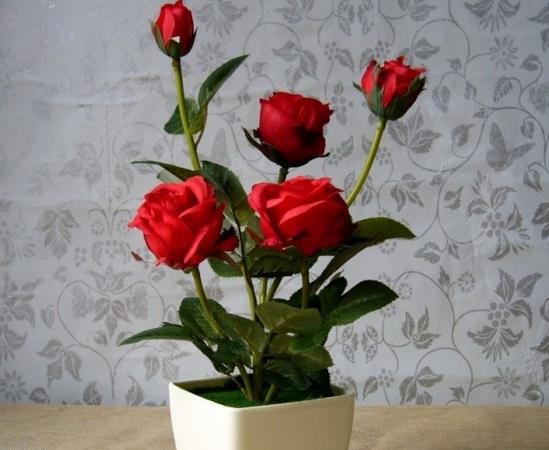
How to grow potted roses? Make your potted roses fill the house with fragrance
Tip 2: Light, fertilizing and watering are essential
Roses like sunlight, and proper light can make them grow more healthily and quickly. Roses like fertilizer. After potting the roses, it is best to apply an organic liquid fertilizer once every ten days, and during the bud stage, an appropriate amount of phosphorus, potassium and other elements should also be added to the organic liquid, so that the roses can bloom and grow better. Roses like water and tolerate waterlogging, and the sign for watering is when the potting soil looks dry. In addition, after the roses open, the spent flowers should be removed in time to avoid the loss of nutrients.
Tip 3: Do a good job of pest and disease control
During the growing process of roses, the most common disease is black spot. The best way to control black spot is to maintain the sanitation of the plant, that is, promptly clean up diseased leaves, pay attention to pruning crowded plantings, and appropriately spray chemicals, etc.
Plum blossom Prunus mume Plum blossom guide: how to grow plum blossom / how to propagate plum blossom
Plum blossom profilePlum blossom Prunus mume
Plum blossom cultivation methods and precautions Plum blossom introduction
Plum blossom is the flower of the plum tree, a plant of the subgenus Prunus in the Rosaceae family. It opens before the leaves in deep winter, with five petals, in various colors such as white, red and pink. The leaves are broadly ovate to ovate. It is a famous ornamental plant and is the city flower of Nanjing, Wuhan, Wuxi, Meizhou and other places. It is mainly divided into two categories: flower plums and fruit plums; it can be planted alone, in clumps, or in groups. It has good medicinal value: the flower buds can stimulate the appetite and relieve stagnation, promote fluid production and resolve phlegm, invigorate the blood and detoxify; the roots ground into powder can treat jaundice.
Plum blossom is also known as mei, spring plum, dry-branch plum, sour plum and dark plum. The leaves are ovate or elliptical. The plum originated in southern China and has a cultivation history of more than three thousand years. Whether for ornamental purposes or as a fruit tree, it has many varieties. Many types can not only be cultivated in the open field for ornamental purposes, but can also be grown as pot flowers and made into plum bonsai. Together with orchid, bamboo and chrysanthemum, it is called one of the "Four Gentlemen." It is also called one of the "Three Friends of Winter" together with pine and bamboo. In severe cold, the plum blooms before all other flowers, bringing spring to the world alone.
With its noble, strong and modest character, the plum inspires people to strive with determination. The flower language of the plum blossom is "strength, loyalty and elegance."
Morphological characteristics of the plum blossom
The plum blossom is a small tree, rarely a shrub, 4-10 m tall; the bark is light gray or tinged with green, smooth; the branchlets are green, smooth and hairless. The plant height is about 5-10 m, and the trunk is brownish purple with many longitudinal fissures. The branchlets are green. The leaves are broadly ovate to ovate, with fine serrations along the edges. Each node bears 1-2 flowers, stalkless or with a short stalk. The original species is pale pink or white, while cultivated varieties have flower colors including purple, red, variegated and pale yellow, opening before the leaves in early spring.
The leaves are ovate or elliptical, 4-8 cm long and 2.5-5 cm wide, with a caudate-acuminate apex, a broadly cuneate to rounded base, and leaf margins often with small sharp serrations, gray-green, with short pubescence on both sides when young, gradually falling off as they grow, or with short pubescence only in the vein axils beneath; the petiole is 1-2 cm long, hairy when young, falling off when old, often with glands. The flowers are solitary or sometimes 2 together in one bud, 2-2.5 cm in diameter, strongly fragrant, opening before the leaves; the pedicel is short, about 1-3 mm long, often hairless; the calyx is usually reddish brown, but the calyx of some varieties is green or green-purple; the calyx tube is broadly campanulate, hairless or sometimes with short pubescence; the sepals are ovate or nearly circular, with a rounded and blunt apex; the petals are obovate, white to pink; the stamens are short or slightly longer than the petals; the ovary is densely pubescent, and the style is short or slightly longer than the stamens.
Branches
The plum blossom is a deciduous small tree, up to 10 m tall, with branches often bearing thorns, and the crown is irregularly rounded. The branches and trunk are brownish purple with many longitudinal fissures, and the branchlets are green or green-based, hairless. The leaves are broadly ovate to ovate, with fine serrations along the edges.
Fruit
The drupe is nearly spherical, with a groove, about 1-3 cm in diameter, densely covered with short pubescence, sour in taste, green, and when the fruit ripens from April to June it mostly turns yellow or yellow-green, though some varieties are red, green, etc.; it is sour in taste, edible, and can be used to make preserved plums, plum sauce, huamei, sour plum drink, plum wine, etc., and can also be used as medicine. Plum wine is widely popular in Japan and South Korea. It is sweet in taste and has the function of regulating qi, and is an excellent fruit wine. Huamei is a very popular food in China. Huamei is made by pickling plums together with sugar, salt and licorice and then drying them in the sun. Huamei can also be used to make foods such as huamei candy.
The flesh is adherent to the pit; the pit is elliptical, with a rounded apex and a small pointed tip, gradually narrowing to a wedge shape at the base, slightly flattened on both sides, with a slightly blunt ventral edge, and obvious longitudinal grooves on both the ventral and dorsal edges, with a honeycomb-like pitted surface. The drupe is nearly spherical, with a groove, about 1-3 cm in diameter, densely covered with short pubescence, sour in taste, green, and when the fruit ripens from April to June it mostly turns yellow or yellow-green, though some varieties are red, green, etc.
Flowers
There are more than 300 total varieties of plum blossom. Ornamental plum varieties include Dahongmei, Taigemei, Zhaoshuimei, Lü'emei, Longyoumei and others. Ornamental plums are mostly white, pink, red, purple and light green. In southwestern China they bloom from December to January of the following year, in central China from February to March, and in northern China from March to April. From first bloom to full bloom is 4-7 days, and to final bloom 15-20 days.
Plum blossoms can be divided into the true plum series, apricot plum series, cherry-plum series, etc. Each node bears 1-2 flowers, stalkless or with a short stalk, 1-3 cm in diameter; the calyx tube is campanulate, with short pubescence, and the lobes are ovate; there are 5 petals, and the original species is pale pink or white, while cultivated varieties have flower colors including purple, red, variegated and pale yellow; the stamens are numerous and free, the ovary is densely pubescent, rarely 2-5 (apocarpous) or absent, the ovary is superior, and the style is long.
The plum blossom is a long-lived flower. Even when potted at home, it can often be grown for more than ten years. In Huangmei County, Hubei, there is a plum tree planted during the Jin Dynasty that is more than 1,600 years old and still gives off fragrance to this day.
Plum blossoms can be divided into series, classes and types. Such as the true plum series, apricot plum series, cherry-plum series, etc. Under the series are classes, and under the classes are types. The plum blossom is a deciduous small tree, with a gray-brown trunk, slender green hairless branchlets, ovate or round-ovate leaves, and fine teeth along the leaf margins. The flower buds are borne in the leaf axils of long branches, with 1-2 flowers per node, fragrant, with 5 petals, white to water-red, and there are also double-petaled varieties.
The flowering period is winter and spring, and the fruiting period is May-June (in northern China the fruiting period extends to July-August).
Ecological habits of the plum blossom
The plum blossom likes a warm climate and a humid climate, is not very cold-hardy, is relatively drought-tolerant, does not tolerate waterlogging, and has a long lifespan, reaching a thousand years; it is especially sensitive to climate change during the flowering period. The plum likes relatively high air humidity, but avoids heavy rain during the flowering period. The plum can grow well in areas with an annual rainfall of 1000 mm or slightly more. It is not strict about soil requirements and is relatively tolerant of poor soil. It is a heliophilous tree species and likes sufficient sunlight and good ventilation.
The plum blossom can grow relatively well under conditions of sufficient light and good ventilation. It is not strict about soil requirements, is tolerant of poor soil, cold-tolerant, and afraid of water accumulation. It is suitable for growing in moist soil with loose, fertile topsoil, good drainage and slightly clayey subsoil. Except for varieties of the apricot plum series, which can tolerate a low temperature of -25°C, it generally tolerates a low temperature of -10°C. It is heat-tolerant and can also grow at 40°C.
It grows and develops best in areas with an annual average temperature of 16-23°C. It is very sensitive to temperature and blooms when the average temperature in early spring reaches -5-7°C. If it encounters low temperatures, the flowering period is delayed, and if it encounters low temperatures during flowering, the flowering period can be extended. During the growing period, it should be placed in a place with sufficient sunlight and good ventilation. If it is in a shaded environment with insufficient light, it will grow weak and bloom sparsely. In winter, do not move it indoors too early; moving it indoors in late November is appropriate, so that the flower bud differentiation can fully go through the vernalization stage. In winter, it should be placed in a sunny place indoors, with the temperature maintained at around 5°C.
Cultivation techniques and planting methods for plum blossom
1. Planting. In the south it can be planted in the ground, and in the Yellow River basin cold-hardy varieties can also be planted in the ground, but in cold northern regions it should be potted and overwintered indoors. It can be planted after leaf fall and before bud break in spring. To increase the survival rate, damage to the root system should be avoided, and it should be transplanted with a soil ball. For ground planting, a sheltered, sunny place should be chosen. For potting, use a growing medium evenly mixed from 3 parts leaf mold, 3 parts garden soil, 2 parts river sand and 2 parts decomposed manure. After planting, water once thoroughly. Place it in a shaded place for care, and after it resumes growth, move it into the sun for normal management.
2. Light and temperature. It likes warmth and sufficient light. Except for varieties of the apricot plum series, which can tolerate a low temperature of -25°C, it generally tolerates a low temperature of -10°C. It is heat-tolerant and can also grow at 40°C. It grows and develops best in areas with an annual average temperature of 16-23°C. It is very sensitive to temperature and blooms when the average temperature in early spring reaches -5-7°C.
3. Watering and fertilizing. During the growing period, attention should be paid to watering, and the potting soil should often be kept moist and on the dry side. It should neither be waterlogged nor too wet or too dry, and watering should follow the principle of watering when dry and stopping when wet. Generally, water less on cloudy days and when the temperature is low, and otherwise water more. In summer, water twice a day, in spring and autumn water once a day, and in winter water thoroughly only when the soil has dried out. Fertilizing should also be reasonable. Apply base fertilizer before planting, and at the same time mix in a small amount of potassium dihydrogen phosphate. Apply potassium dihydrogen phosphate once more before flowering, and apply decomposed cake fertilizer once at flowering to supplement nutrients. In June, a compound fertilizer can also be applied once to promote flower bud differentiation. After leaf fall in autumn, apply an organic fertilizer once, such as decomposed manure.
4. Shaping and pruning. For ground-planted plum blossoms, shaping and pruning can be carried out within 20 days after flowering. Aim mainly for a natural tree shape, cutting off crossing branches, upright branches, dead branches, overly dense branches, etc., and shortening side branches to promote abundant flowers and lush leaves. Potted plum blossoms should be heavily pruned after potting to lay the foundation for making bonsai. Usually, plum stumps are used as the scenery and various forms of plum blossoms are grafted on. Maintain a certain temperature, and the plum blossoms can be seen in full bloom at Spring Festival. If you want them to bloom on "May Day," you need to maintain a temperature of 0-5°C and a moist environment, move them outdoors in early April, and place them in a sunny, well-ventilated place for care, and they will bloom around "May Day."
5. Flowering period control. Potted plum blossoms are generally for home viewing. After leaf fall in winter, place them indoors with the temperature maintained at 0-5°C. After New Year's Day, gradually raise the temperature to 5-10°C, and let them fully receive light every day, frequently spraying water on the branches, and the water temperature should be close to room temperature.
Leaf drop phenomenon
Generally, leaf drop only after Cold Dew is considered normal. If the plum blossom drops its leaves in summer and autumn, it has a great impact on flowering, and improper watering, especially excessive moisture, is the main cause of leaf drop.
When yellowing of leaves due to excessive moisture is found, besides stopping watering immediately, the soil should be loosened and an appropriate amount of dry soil should be mixed in to rescue it. During this period, water can be sprayed on the leaves to maintain a certain humidity; when loss of green color due to excessive dryness is found, first water lightly several times, and as the plant recovers its upright state, gradually increase the amount of watering until it is watered thoroughly. If a large amount of water is poured suddenly, causing a sudden change from too dry to too wet, it will cause even greater harm. [3]
Artificial cultivation
Grafting is commonly used for propagation, and the rootstock is mostly plum, peach, apricot, wild apricot and wild peach. For open-field cultivation of plum blossoms, a sunny slope or semi-sunny slope section should be used, with a plant spacing of 3-5 m. Usually, fertilizer is applied 3 times during the growing period, namely fertilizing in autumn to early winter, such as cake fertilizer, compost, manure, etc.; applying quick-acting fertilizer before budding; and after the new shoots stop growing (late June to early July), appropriately controlling water and applying fertilizer to promote flower bud differentiation. Plum blossoms are suitable for bonsai cultivation. Pot the plants after several years of ground cultivation. The potting soil should be soft, loose and fertile, and shaping and pruning should be done both before and after planting.
Potted plum blossoms bloom in spring
After winter has passed, the plum blossom awakens in spring. When the soil of the potted plum blossom is in a moist environment, watering it, and indiscriminately applying inorganic fertilizer and farmyard manure, and immediately moving it outdoors while it is still not warm, will not allow it to bloom in spring.
Starting 20 days before Spring Festival, gradually increase the temperature to 15-25°C, and there needs to be sufficient light and good air. Control watering, and do not water unless the potting soil is dry. Too much humidity easily leads to overly rapid growth and flower buds opening all at once, affecting the ornamental effect. Spray water on the branches and trunk 1-2 times a day to prevent dry tips. When the flower buds are still closed, according to need and the actual development of the flower buds, if they are opening too fast, they can be moved to a low-temperature place to control slow opening; if they are opening too slowly and cannot catch up with the time for use, the temperature can be appropriately increased to promote earlier opening.
The plum blossom has relatively poor drought resistance, so water should often be sprayed around the plant. If the humidity is insufficient, the leaves easily turn yellow and shrivel, directly affecting flowering. Fertilize at the right time. After the beginning of winter, Dendrobium should be fertilized less, and it is suitable to apply phosphorus and potassium fertilizers and an appropriate amount of nitrogen fertilizer, which can promote flowering.
Flowering period
The greatest characteristic of the plum blossom is that its flowering period is in the cold winter season. Whenever the plum blossoms bloom profusely, their petals are delicate and small, with red flower colors as brilliant as flames, white flower colors like pure white snow, and green flower colors like green jade on a white plate. A grove of plum blossoms seems like a fairyland on earth. Such delicate and gorgeous flowers seem in people's impressions to be a sight that only appears in spring when all things revive and a hundred flowers bloom. Yet there is actually a flower that can endure the piercing cold winter to bloom such splendid flowers for people, adding such a beautiful scene to the world.
Cultivation methods for plum blossom Potted plum blossom
Potted plum blossoms are mainly propagated by grafting, commonly using cut grafting and bud grafting. The rootstock is wild peach, mountain peach or apricot. Old apricot trunks have red bark, and when grafting red plum, the bark colors are coordinated. Cut grafting. Cut grafting mostly uses one- or two-year-old rootstock. At the end of March (in a cold room) or in early April (in the open field), cut off the upper part of the rootstock 3-5 cm above the ground. Use one-year-old robust branches as scions, cut them into 5-6 cm lengths, leaving at least 3 buds. On the outer sides of the lowest bud, make downward oblique cuts into a duckbill shape.
Open a 3 cm long cut on one side of the rootstock. Insert the scion into the cut of the rootstock so that the two are closely joined, then bind them with a plastic film strip. Or use a polyester tape to stick them tightly. Finally, cover the scion with a small plastic bag, with the bag opening tied below the joint, so it can often be checked through the film. After survival, remove the binding material. Bud grafting. Bud grafting is carried out in August-September, generally using the "T"-shaped grafting method. First make a horizontal cut 1-1.5 cm above the scion bud, then make a flat cut forward and downward from 1 cm below the bud, gently peel off the wood inside the bark layer of the cut bud (in recent years there has been bud grafting with a little wood attached) and hold it in the mouth. Make a horizontal cut on the rootstock 5 cm above the soil surface, then make a vertical cut downward from the center of the cut, forming a "T" shape, then gently peel open the bark layer and insert the prepared scion into the bark layer of the "T" opening. The grafted bud should fit firmly, with its upper end closely joined to the upper end of the "T" opening of the rootstock, and finally bind it well with a plastic film strip or polyester adhesive tape. Check the survival situation after one week. If the petiole falls off at a touch and the bud point is green and plump, it indicates survival. In the following spring, cut off the top of the rootstock 5-6 cm upward from the joint, and the scion will soon sprout. Afterward, pay attention to cutting off rootstock sprouts. When repotting or planting in a pot, it can be planted appropriately deeper, so that the joint is as low as possible, and bind according to the growth vigor, guiding it to form a graceful shape.
Watering
For potted plum blossoms, attention should be paid to three aspects: watering, light and fertilizing. Trace elements such as ferrous sulfate can be supplemented in an appropriate amount to prevent the symptom of yellowing leaves caused by iron deficiency in plum blossoms.
Watering should follow the principle of watering when dry and stopping when wet, not watering when not dry, and watering thoroughly when watering. On rainy days, tip the pot promptly to avoid water accumulation. When new branches grow to 20-25 cm, attention must be paid to appropriately withholding water, making the potting soil on the dry side, inhibiting new shoot elongation and promoting flower bud differentiation. Watering during the dog days is key; at this time, insufficient watering easily causes leaf drop and affects flower bud formation. During the vigorous growing period, water once a day. After autumn turns cool, the amount of watering should gradually decrease to help the branches become firm.
Temperature and light
The plum blossom likes an environment with sufficient sunlight and good ventilation, and does not tolerate long-term shade. Only by giving sufficient light so that it obtains the conditions for photosynthesis can it obtain sufficient nutrition, and thus grow robustly and produce abundant and large, bright flowers.
Fertilizing
The plum blossom does not like heavy fertilizer. When the new shoots grow to about 5 cm, apply once a dilute fertilizer water made of crushed bone and sesame paste to promote robust branch growth. When leaves emerge, fertilizer water should be sufficient, generally applying a dilute liquid fertilizer once a month to promote lush branches and leaves. When the branches grow to 20-25 cm, fertilizer and water should be moderated. At the end of summer and beginning of autumn, apply topdressing twice to promote flower bud differentiation. After each fertilizing, attention should be paid to timely watering and loosening the soil to keep the potting soil loose, which is beneficial to root development.
During the growing season, if yellowing of leaves caused by iron deficiency is found, a 0.1% ferrous sulfate solution can be applied along with watering.
Precautions for growing potted plum blossoms
1. For potted plum blossoms, tile pots and earthenware pots with better permeability are best, and purple clay pots are also acceptable. Place a layer of crushed charcoal blocks or crushed hard plastic foam blocks at the bottom of the pot. The substrate is best with fertile light clay soil. Old mountain soil, pond mud and garden topsoil can be mixed as the growing medium. When planting, mix a little bone meal and nitrogen-phosphorus-potassium compound fertilizer into the soil as base fertilizer. Planting should be shallow and not expose the roots; deep planting makes it difficult to bloom. After planting, place it in a semi-shaded place, water once thoroughly, and after 10 days transfer to normal management. Repot and change the soil once every 2-3 years after flowering.
2. Plum blossoms like moisture and fear waterlogging, so watering should be timely and appropriate. In winter and early spring during the flowering period, it is better to keep the potting soil always slightly moist. After the flowers have all faded, water once thoroughly. Do not water unless dry, and often spray water on the branches and leaves and the nearby ground in the evening. During the plum rain season, water must be strictly controlled, and water only when the edges of old leaves curl slightly and the tender branches wilt slightly. Repeat this several times to force the new shoots to stop growing, which is beneficial to flower bud differentiation; in the dog days, drain water on rainy days to prevent waterlogging, water once in the morning on sunny days, and water again in the evening if the soil is dry, to prevent excessive dryness and dehydration causing leaf drop; after September, gradually reduce the amount of watering, watering once in the afternoon every 1-2 days; in October, flower buds begin to develop into flower buds, the leaves have already fallen, and the water requirement is not large, so water again when the soil is dry. Slightly dry and slightly moist potting soil is enough.
3. Plum blossoms like fertilizer and are also tolerant of poor soil. Do not fertilize during the flowering period. After the flowers fade, apply a nitrogen-phosphorus-potassium compound fertilizer once to promote recovery. When new shoots grow 3-5 cm, if the growth is good, do not fertilize; if the growth is poor, apply a nitrogen-phosphorus-potassium compound fertilizer once. When new shoots grow to about 18 cm, stop fertilizing; in late June and early July, spray a 0.2% potassium dihydrogen phosphate solution once each time to promote flower bud differentiation. In late autumn after leaf fall and when buds appear, apply a nitrogen-phosphorus-potassium compound fertilizer or 0.2% potassium dihydrogen phosphate solution once to promote flower bud development and opening.
4. The plum blossom is a heliophilous plant and should be placed in a place with sufficient sunlight and good ventilation, and avoid placing it in a draft. It likes warmth and is cold-tolerant. In winter it needs low-temperature stimulation to have abundant flowers and lush leaves. In places where the lowest winter temperature is above -12°C, it does not need to be moved indoors to overwinter, and placing it in a sheltered, sunny place is enough. If you want it to bloom at Spring Festival, move it 20 days before the festival to a low-temperature room at 5-10°C, and place it inside a south-facing or west-facing windowsill to see more sunlight. After flowering, move it to a place at 0-5°C, where it can stay open for 1 month. Too high a temperature easily causes early fading.
5. Plum blossoms have strong budding and branching ability and tolerate pruning. Old trees easily rejuvenate. After flowering, shorten the branches that have bloomed, leaving only 2-3 buds at the base. Cut off all weak branches and diseased or dead branches. For crossing branches and overlapping branches, cut off one branch, and thin out overly dense areas. When new shoots grow to 20 cm, pinch off the growing tips to control their growth so that nutrients are concentrated for flower bud differentiation; if new shoots grow too long, flowers will instead be sparse. Through pruning, not only is the plant shape beautiful, but ventilation and light transmission are also good, making it less susceptible to pests and diseases. 6. During high temperature and drought in mid-to-late June, plum blossoms may develop anthracnose. In July, with high temperature, high humidity and poor ventilation, powdery mildew may occur. Attention to ventilation and light transmission can prevent both diseases. If diseased branches and leaves are found, cut them off and burn them, and spray with thiophanate or carbendazim for treatment. The main pest of plum blossoms is aphids, which can be killed by spraying a 1500-fold solution of 80% dichlorvos emulsifiable concentrate or by burying carbofuran in the soil so that the plant takes up the toxin to kill them. It is worth noting that plum blossoms are allergic to phosphorus-containing pesticides, and such pesticides should be avoided. It has poor resistance to toxic gases such as sulfur dioxide, and in places with serious air pollution, it grows poorly and may even die.
Propagation methods for plum blossom Sowing
Use fruit pits for direct sowing. Attention must be paid to collecting fully mature fruit from excellent mother plants with large fruit and small pits. Generally, sowing in autumn is better, and the specific time can be in late September. Water thoroughly and cover with fine soil or sand. In the following spring, when the seedlings grow to 10-15 cm, they can be transplanted from the seedbed. If propagated by sowing in spring, then after the seeds are washed and dried, they should be stratified and stored in moist sand, and taken out in early spring for drilling. Plum trees propagated from seed are drought-tolerant. They have strong growth vigor and are suitable for planting on hillsides. But the plum trees bred by this method have unstable heredity and great variation.
Grafting
In addition to using plum seedlings as rootstock, wild peach, mountain peach, plum and apricot can also be used as rootstock, with plum rootstock being the best. Splice grafting or cleft grafting can be carried out. So-called splice grafting is to cut the lower end of the scion and the upper end of the rootstock obliquely into a horse-ear shape with a sharp knife, then align one side with the green bark layer and tie them tightly together; so-called cleft grafting is to cut the lower end of the scion into a wedge shape, split the rootstock, insert the wedge-shaped scion, taking care to align one side with the green bark layer, and tie tightly. Both splice grafting and cleft grafting use the branch grafting method, usually carried out before sap flow in early spring. During the growing period of the plum tree, bud grafting can also be carried out on plum or apricot seedlings used as rootstock, that is, at the base of the rootstock stem, use a budding knife to cut a "T" shape deep to the xylem, gently lift open the bark layer, cut the bud eyes on the branches of the plum variety to be propagated, with a little wood attached, into shield-shaped bud pieces, quickly insert them into the "T"-shaped bark layer on the rootstock, and tie tightly. After 15-20 days, when the scion bud eyes have healed with the rootstock, the binding can be loosened. Regardless of branch grafting or bud grafting, after survival they should be cultivated in the nursery for 1-2 years, and then used for planting.
To quickly obtain large plum trees, wild [text unclear] can be used, [text unclear] (4-6 cm), and after transplanting and survival, heavily prune, and the following year graft the desired excellent plum varieties onto the newly sprouted branches. Using peach as rootstock, grafting survives easily and is currently widely used in production. A commonly used method is the root burial method. When peach is used to graft plum blossoms, growth is fast and flowering is early, but after three years the "large and small feet" phenomenon easily appears. You can first use peach rootstock to graft plum blossoms, and after one year of grafted growth, dig them all up. When planting, make the grafted part lower than the ground level, 4-7 cm into the soil, use a sharp blade to make several longitudinal cuts at the grafted part of the plum blossom, deep to the xylem, and use a 25 ppm ABT rooting powder No. 2 solution mixed with mud to wrap the wound. Then earth up 15-25 cm, taking care to preserve soil moisture. After one year of growth, the plum tree can develop roots. In this way, after the plum tree grows up, it can form two layers of roots: the upper layer is plum tree roots, and the lower layer is peach rootstock roots. When potting or planting in the ground for greening, the upper roots play a role, and the lower roots can be removed, so that the plum blossom can maintain normal growth.
Cutting
Propagating plum blossoms by cutting is simple to operate and the technique is not complicated. Treating cuttings with a quick dip in 500 ppm indoleacetic acid or 1000 ppm naphthaleneacetic acid aqueous solution increases the survival rate and can also promote rooting in varieties that are difficult to root. For plum blossom cuttings, November is better, because at this time the leaves have fallen and the branches store sufficient nutrients, making rooting and survival easy. Select one-year-old robust branches 10-12 cm long as cuttings. When cutting, bury most of the branch in the soil, leaving only two or three centimeters above the soil surface, and leave one bud outside. The cutting site is required to have loose soil and good drainage.
Disease control of plum blossom Diseases
There are many kinds of plum blossom diseases, the most common being powdery mildew, leaf curl and anthracnose.
(1) Powdery mildew
This disease often occurs in environments with high humidity, high temperature and poor ventilation. In early spring in March, when plum blossoms sprout, the tender buds and new leaves are easily infected by pathogens, and a very thin powdery layer appears on the affected parts, followed by black or yellow particles the size of needle heads on the powdery layer, and later the leaves turn yellow and die.
(2) Leaf curl
It can be controlled by spraying thiophanate or carbendazim, or by spraying 1% Bordeaux mixture once a week, and 3-4 times is enough to cure it.
(3) Anthracnose
In the early stage of the disease, spray 70% thiophanate 1000-fold solution or spray mancozeb 600-fold solution for control. When other various diseases are found, spraying the above two liquid medicines can also be effective.
Pests
There are more than ten kinds of pests harmful to plum blossom plants, the most common being plum caterpillars, aphids and scale insects.
Plum caterpillar. The plum caterpillar has a blue-gray head with two black spots, a yellow-white dorsal line on its back, 2 yellow stripes on each side of the body, and many long yellow-white hairs on its body, generally 5 cm long. The larvae often spin silk on small branches, eating and damaging the new buds and tender leaves of plum blossoms. After growing up, they disperse over the whole plant, nibbling the leaves, and in severe cases the leaves can be completely eaten. To control plum caterpillars, spray 1000-fold sumithion when they are young.
Aphids. Aphids mainly harm the tender stems and tender leaves of plum trees, sucking plant nutrients. The affected parts of plum trees often show sticky liquid, and the leaves discolor, shrivel, curl back and wither. In severe cases, the whole plant can die. They can be controlled by spraying a 1000-fold aqueous solution of 40% omethoate, or killed by spraying 80% dichlorvos diluted with 2000-fold water; spraying 2-3 times is enough to eliminate them.
Scale insects. Scale insects are also called scale bugs or globular scale insects. The adult body is nearly spherical. At first the scale is soft and yellow-brown, later becoming black-brown, and the body surface has many alternating yellow-white and black-brown transverse stripes. Scale insects begin activity in early spring, sucking plant sap. The affected plants have yellowing, withering and falling leaves. At the same time, the sugary liquid excreted by scale insects can also induce other diseases. They can be controlled by combining manual scraping with pesticide spraying. For the pesticide, 80% dichlorvos emulsifiable concentrate can be diluted with 1500-fold water and sprayed, or 60% wettable dimethoate powder can be diluted with 1200-fold water and sprayed.
Leaf drop phenomenon
Generally, leaf drop only after Cold Dew is considered normal. If the plum blossom drops its leaves in summer and autumn, it has a great impact on flowering, and improper watering, especially excessive moisture, is the main cause of leaf drop.
When yellowing of leaves due to excessive moisture is found, besides stopping watering immediately, the soil should be loosened and an appropriate amount of dry soil should be mixed in to rescue it. During this period, water can be sprayed on the leaves to maintain a certain humidity; when loss of green color due to excessive dryness is found, first water lightly several times, and as the plant recovers its upright state, gradually increase the amount of watering until it is watered thoroughly. If a large amount of water is poured suddenly, causing a sudden change from too dry to too wet, it will cause even greater harm.
Variety classification of plum blossom Classification by flower type and flower color
There are many varieties of plum blossom, with more than 30 major varieties and more than 300 subordinate minor varieties. The general flowering period is about 2-3 months. According to research by Professor Chen Junyu, there were already 231 varieties in 1962, and they are still constantly being innovated. According to variety, by branches and growth posture, they can be divided into the leaf plum class, straight-foot plum class, apricot plum class, zhaoshui plum class and longyou plum class.
By flower type and flower color, they can be divided into the palace pink type, red plum type, zhaoshui plum type, jade butterfly type, cinnabar type, bright red type, green calyx type and sprinkled gold type, etc. Among them, palace pink is the most common and has the most varieties, with pink flowers and dense, heavy flowering; the jade butterfly type has purple-white flowers and a distinctive charm; the green calyx type has white flowers and an extremely strong fragrance, with Chengdu's "Jinqian Lü'e" being especially good.
1. Pinzi plum type:
A typical variety with one flower and three fruits, namely pinzi plum.
2. Xiaoxi plum type:
Flowers small to extremely small, white, pale yellow or red, 7-22 mm in diameter, single-petaled, occasionally without petals, fruit small, leaf veins small. Plum varieties of the xiaoxi plum type include Beijing Xiaomei, Mushan Xiaomei, Meizhou Xiaomei, Huangjinmei, etc.
3. Jiangmei type:
Flowers single-petaled, in colors such as red, pink and white, with crimson-purple calyx or with a blush on a green background. The main varieties include Jiangmei, Xuemei, Liuban, Liubanhong, Xinghu Xiaohua, Changrui Danfen, Danfen, Danhanhong, Rihanhong, Fenhanhong, Fushoumei, Xueyuehua, Fangliuge, etc.
4. Palace pink type:
Flowers semi-double to double, in deep red or light pink. The main varieties include Dayu, Kouban Dahong, Laorenmei Dahong, Xiao'ou Gongfen, Fuban Xiao Gongfen, Fenpi Gongfen, Fenzhu, Fenyu, Fenyun Gongfen, Caishan Gongfen, Caoxi Gongfen, Chuanxi Xiaofen, Chongban Fenkou, Taige Gongfen, Fufen, Huangyan Fen, Huqiu Wanfen, Yulu Gongfen, Jindian Fen, Wanwan Gongfen, Qingming Wanfen, Dantao Fen, Longtan Fen, Chaotang Gongfen, Chongban Fenzhu, Hongyan Gongfen, Huanan Gongfen, Huanong Gongfen, Huanong Wanfen, Huizhou Taifen, Jiangsha Gongfen, Lianhu Fen, Lianhu Danfen, Lüzhii Gongfen, Quanzhou Gongfen, Xuehai Gongfen, etc.
5. Green calyx type:
Flowers single-petaled, semi-double or double, white or pale green when first opening, with green calyx, and young branches green without purple blush. The main varieties include Bian Lü'e, Taige Lü'e, Changrui Bian Lü'e, Er Lü'e, Fuban Lü'e, Liu Lü'e, Xiao Lü'e, Jinqian Lü'e, Midan Lü, Changrui Dan Lü, Danban Lü'e, etc.
6. Jade butterfly type:
Flowers semi-double or double, pure white. The main varieties include Beijing Yudie, Kouzi Yudie, Huanong Yudie, Huizhou Tanxiang, Zidi Bai, Subai Taige, Qingzhi Yudie, Xiao Yudie, Sanlun Yudie, Hehua Yudie, Huizhou Bai Yudie, Wuyang Yudie, Yutai Zhaoshui, Zidi Bai Zhaoshui, etc.
7. Cinnabar type:
Flowers single-petaled, semi-double or double, with purple-red flowers, sauce-purple calyx, and light dark purple-red xylem as their main characteristics. The main varieties include Wuyu Yu, Changshu Mo, Guli Hong, Wu Zhusha, Taige Zhusha, Huizhou Guhong, Tiegui Hong, Duo'e Zhusha, Fenhong Zhusha, Xizhi Zhusha, Qianban Zhusha, Nanjing Hongxu, Shui Zhusha, Baixu Zhusha, Jiangnan Zhusha, Danyun Zhusha, Guhong Zhaoshui, Zaozhong Zhusha, Danban Zhusha, Hongqianniao, Jiye Qinjue, Qiantai Zhusha, Taohong Zhusha, Yinbian Fei Zhusha, Yinbian Taige Zhusha, etc.
8. Yellow fragrance type:
Flowers semi-double or double, pale yellow or nearly white, with a slightly yellow flower center and crimson-purple calyx. The main varieties include Huangshan Huangxiang, Caowang Huangxiang, Danban Huangxiang, Nanjing Fu Huangxiang, etc.
9. Sprinkled gold type:
Flowers single-petaled, semi-double or double, with red, white or water-red striped and spotted flowers on one tree. The main varieties include Kunming Xiao Tiaozhi, Wan Tiaozhi, Fuban Tiaozhi, Danban Tiaozhi, Midan Tiaozhi, etc.
Classification by ornamental value
(1) Four major series: 1. True plum series, 2. Apricot plum series, 3. Cherry-plum series, 4. Mountain peach plum series. Plum blossoms bloom in splendid spring
(2) Six major classes: 1. Straight-branch plum class, 2. Weeping-branch plum class, 3. Longyou plum class, 4. Apricot plum class, 5. Cherry-plum class, 6. Mountain peach plum class (the first three classes belong to the true plum series, and the remaining classes each belong to their respective series)
(3) 19 type categories:
1. The straight-branch plum class is divided into the pinzi plum type, xiaoxi plum type, jiangmei type, palace pink type, green calyx type, jade butterfly type, cinnabar type, yellow fragrance type and sprinkled gold type
2. The weeping-branch plum class is divided into the pink-flowered weeping type, wubao weeping type, canxue weeping type, baibi weeping type and guhong weeping type
3. The longyou plum class is divided into the jade butterfly longyou type
4. Apricot Mei group is divided into the single-flowered apricot mei type and the spring-later type.
5. Cherry-plum mei group is divided into the Meiren Mei type.
6. Mountain peach mei group is divided into the mountain peach mei type.
Species-type classification
The species-type classification consists of the true mei species line, the apricot mei species line, and the cherry-plum mei species line. Under these, they are mainly further divided into five major categories according to branch posture.
The first category is called the upright-branch mei category. Branches grow straight up or slantingly. This is the category with the longest history and the most numerous members in the mei family, and it is further divided into 9 types including Pinzi Mei and Gongfen.
The second category is called the weeping-branch mei category. Branches naturally droop or hang slantingly, with 5 types including Pink-flowered Weeping Mei.
The third category is called the dragon-wandering mei category. Branches are naturally twisted like a wandering dragon, with only 1 category (dragon-wandering mei category) and 1 type (Yudie Dragon-Wandering type).
The fourth category is called apricot mei. It is an interspecific hybrid of mei and apricot (mountain apricot). Fan Chengda of the Song Dynasty first recorded it in the "Mei Pu". Its flowers, leaves and branches are intermediate between mei and apricot. The "apricot mei category" is unscented or slightly scented (not mei fragrance), and the receptacle is swollen. Under it are the single-flowered apricot mei type and the spring-later type.
The fifth category is the cherry-plum mei category, which is a man-made hybrid of purple-leaf plum and Gongfen mei, with purple leaves and red flowers, double-petaled and large, blooming in late spring, and extremely cold-resistant.
Subspecies and varieties
Thick-leaf mei (variety), wild mei
Leaves relatively thick, nearly leathery, ovate or ovate-elliptic; fruit ovoid-globose; pit nearly globose, obtuse and rounded at the base. Produced from western Sichuan to western Yunnan. This species is the wild species of mei, growing in mountain forests or by streams, at an altitude of 1700-3100 m.
Long-stalk mei (variety)
Leaves lanceolate, apex acuminate; pedicel 1 cm long, drooping when fruiting. Produced from western to northwestern Yunnan. Growing on mountain slopes, roadsides, by streams or under open forests, at an altitude of 1900-2600 m. Also distributed in northern Vietnam and northern Laos.
Mei cultivars are divided into two major categories: fruit mei and flower mei. According to Professor Zeng Mian's investigation and research in Zhejiang, the cultivated cultivars of fruit mei are roughly divided into three categories, briefly described as follows.
1. White mei cultivar group: fruit yellow-white, coarse in texture, bitter in taste, large pit and little flesh, used for making dried mei. Examples include Dabaotou and Taigongzhong. The ripening period is in early to mid-April.
2. Green mei cultivar group: fruit green or green-yellow, sour or slightly bitter and astringent in taste, medium in quality, mostly used for making candied fruit. Examples include Siyue Mei, Wuyue Mei and Baishui Mei. The ripening period is mid to late April.
3. Flower mei cultivar group: fruit red or purplish red, fine and crisp in texture with a slightly sour taste, excellent in quality, used for making dried tangerine-peel mei, split mei, etc. Examples include Ruantiao Mei, Zidi Mei, Daye Zhugan and Yanzhi Mei. The ripening period is from early to mid-May to June.
Due to long-term cultivation, flower mei cultivars have considerable variation and there are very many cultivars. According to Professor Chen Junyu's recent research, they are divided into the following four categories.
1. Upright-foot mei category (var. mume): branches upright or spreading obliquely, divided into the following seven types according to flower shape and flower color.
(1) Jiang Mei type (f. simpliciflora T.Y. Chen): flowers saucer-shaped, single-petaled, pure white, water-red, flesh-colored or peach-red, etc. There are 29 cultivars, such as Danfen, Danban Hong, Yang Guifei, Xiao Yudie and Bai Mei.
(2) Gongfen type (f. alphandii (Carr.) Rehd.): flowers saucer-shaped, semi-double to double, pink. 75 cultivars are currently known, such as Gongfen, Fen Zuizi, Qianye Hong, Nanjing Chun and Fenzhuang Taige.
(3) Dahong type (f. rubriflora T.Y. Chen): similar to the Gongfen type but with bright red flowers, blooming especially profusely, with a very strong sweet fragrance. There are 15 cultivars, such as Hong Mei, Dahong, Xiaohong, Hongxing and Tianxing Hong.
(4) Zhusha type (f. purpurea (Makino) T.Y. Chen): flowers saucer-shaped, single, semi-double or double, purplish red. There are already 47 cultivars, such as Baixu Zhusha, Jiangnan Zhusha and Guli Hong.
(5) Yudie type (f. albo-plena (Bailey) Rehd.): flowers saucer-shaped, double, white; calyx purplish red. There are 30 cultivars, such as Yudie, Fendie and Zidi Bai.
(6) Lü'e type (f. viridicalyx (Makino) T.Y. Chen): flowers saucer-shaped, single to semi-double, white; calyx green. There are already 13 cultivars, such as Lü'e, Danban Lü'e and Lihua Lü'e.
(7) Sajin type (f. versicolor T.Y. Chen et H.H. Lu): flowers saucer-shaped, single to double; on one tree bloom simultaneously flowers of nearly white, pink, and white with red stripes or white with red spots, which is rather unique. 9 cultivars are currently known, such as Sajin Hong, Wan Tiaozhi, Erqiao and Wubao.
2. Zhaoshui mei category (var. pendula Sieb.): branches drooping, forming a distinctive umbrella-like tree posture, which can be divided into the following six types.
(1) Single pink zhaoshui type (f. simplex T.Y. Chen): flowers saucer-shaped, single-petaled, pink or white. 3 cultivars are currently known, such as Danfen Zhaoshui and Danban Zhaoshui.
(2) Double pink zhaoshui type (f. modesta T.Y. Chen): flowers saucer-shaped, semi-double or double, pink. There are 2 cultivars, namely Lingyan and Dongyang Hong Zhaoshui.
(3) Guhong zhaoshui type (f. atropurpurea T.Y. Chen): flowers saucer-shaped, single-petaled, deep purplish red, such as Guhong Zhaoshui.
(4) Canxue zhaoshui type (f. albiflora T.Y. Chen): flowers saucer-shaped, semi-double, white, such as Canxue Zhaoshui.
(5) Baibi zhaoshui type (f. viridiflora T.Y. Chen): flowers saucer-shaped, single or semi-double, white; calyx green, such as Shuangbi Zhaoshui and Danbi Zhaoshui.
(6) Wubao zhaoshui type (f. marmorata T.Y. Chen): on one tree bloom simultaneously flowers of nearly white, pink, and white with red stripes or white with red spots, such as Wubao Zhaoshui.
3. Dragon-wandering mei category (var. tortuosa T.Y. Chen et H.H. Lu): branches naturally twisted like a wandering dragon; flowers saucer-shaped, semi-double, white, such as Longyou Mei.
4. Apricot mei category (var. bungo Makino): branches and leaves resemble mountain apricot; flowers semi-double, pink, such as Xingmei, Yangmei and Songchun cultivars. The flowering period is relatively late, and cold resistance is relatively strong; it may be a natural hybrid of apricot and mei.
Distribution range of mei flowers
China is the place of origin of mei, which is universally acknowledged and has been confirmed by ample facts. Mei is a specialty of our country; China is the world's center of wild distribution of mei and also the world's center of cultivation of mei. It originated in the provinces of southwestern China, Sichuan, Hubei, Guangxi, etc., and blooms in early spring. It is cultivated everywhere in China, but most abundantly in the provinces south of the Yangtze River basin; there are also a few cultivars in northern Jiangsu and southern Henan, and some cultivars have been successfully introduced to North China. It also occurs in Japan and Korea.
Natural distribution
Our country has a long history of literature on mei. However, records on the production of mei are much later than accounts of cultivated cultivars. In the 6th century AD, Tao Hongjing recorded in the "Bielu of Famous Physicians": "Mei fruit grows in the river valleys of Hanzhong." The "Hua Jing" contains records of the producing areas of wild mei, stating that mei originally came from places such as Luopiao, Hanji and Siming. The "Plant List of Taiwan Island" discusses wild mei specimens collected in Taiwan's Er'gui, Hehuan Mountain stream and Xinzhu, and Uehara Keiji recorded in the "Great Illustrated Guide to Trees" that there are wild mei trees in places such as the upper reaches of the Dajia River, the upper reaches of the Da'an River and Xuehua Keng in Taiwan, China.
In the early 19th century, the Englishman Clack collected mei tree specimens in the Guangdong region of China, and in the early 20th century, the Englishman E.H. Wilson collected wild mei specimens in western Hubei. From the 1930s to the 1980s, Chinese botanists successively obtained wild mei specimens in Guizhou, Fujian, Jiangsu, Zhejiang, Hubei, Guangdong and other provinces. Large numbers of wild mei specimens were also collected in many places in Yunnan and Sichuan provinces.
In recent years, Chinese horticulturists have conducted extensive investigation and research and found that wild mei is also concentrated in Eryuan, Songming, Deqin, Lushui, Jianchuan, Xiangyun, Yunlong, Ninglang, Binchuan and other counties and cities in Yunnan. In addition, natural distribution of mei has also been found in Luotian and Xianning in Hubei, Jingdezhen in Jiangxi, Huangshan in Anhui, Jiannanping in Yunnan, the Xing'an subdistrict and Napo mountainous area in Guangxi, Yugu in Shaanxi, and Wenxian and Kangxian in Gansu.
It can thus be seen that mei has a very wide natural distribution range in China, with the northern boundary being the southern slope of the Qinling Mountains, extending west from Tongmai in Tibet, and south to Yunnan and Guangdong; a total of 16 provinces or regions have natural distribution of mei. Within this range, the Hengduan mountainous area at the junction of Sichuan, Yunnan and Tibet is the center of natural distribution and variation of mei; in this region there are relatively many large tracts of wild mei forest, and there are relatively many variation types.
Cultivated distribution
The cultivated distribution range of mei is much larger than the natural distribution range. In addition to cultivation within the natural distribution area, mei is also cultivated in Beijing, Shandong, Henan and Lhasa, the capital of the Tibet Autonomous Region. In addition, mei is also cultivated in Hainan Province in China. The vast majority of northern cultivation areas mainly cultivate ornamental mei flowers. However, the area with the greatest concentration of mei appreciation in China is the Yangtze River basin. Within this region, many fine mei gardens have been built, and some mei gardens have a relatively long history, having already formed a certain influence at home and abroad, such as the Wuhan East Lake Mei Garden, Wuxi Mei Garden, Nanjing Meihua Mountain and Chengdu Du Fu Thatched Cottage. In recent years, with the continuous spread and popularization of mei culture, mei-viewing scenic spots in the north have gradually increased, and many mei gardens have been completed or are under preparation.
Medicinal dietary or medicinal value of mei flowers
The medical information and healthy dietary information on Huhua Web are for reference only and cannot be used as a basis for diagnosis or medical treatment. For any health problem, consult professional medical personnel, and for the treatment of any disease, please follow a doctor's advice.
Ultimate flower-protecting mission: to love yourself, start from reality and strictly follow a doctor's advice. Regarding illness, do not be careless, do not delay, do not give up hope, face it bravely, warm the silent world with love, and care for the flower field in your heart with your heart.
Medicinal value
The "Shennong Bencao Jing" first pointed out the medicinal value of mei: "Mei fruit is sour and neutral in nature; it mainly treats descending qi, removes heat and restlessness and fullness, calms the heart, stops pain of the limbs, hemiplegia and numbness, dead flesh, removes blue-black moles, and corrodes bad flesh." Because of different processing methods, the finished mei fruit is divided into white mei and black mei. Jia Sixie of the Later Wei recorded this processing method in the "Qimin Yaoshu". Method for making white mei: "When the mei fruit is sour and the pit has just formed, pick it, soak it in salt water at night, and sun-dry it during the day. After ten nights, ten soakings and ten sun-dryings, it is done." Method for making black mei: "Also pick when the mei fruit pit has just formed, put it in a basket, smoke it over a chimney, and let it dry, then it is done." Li Shizhen, a famous pharmacologist of the Ming Dynasty, believed that black mei can "astringe the lungs and astringe the intestines, stop chronic cough and diarrhea, relieve nausea and dysphagia, treat roundworm syncope and vomiting and diarrhea, reduce swelling and expel phlegm, kill worms, and neutralize fish poison, horse sweat poison and sulfur poison." White mei "treats stroke and convulsions, throat obstruction, phlegm syncope and stiff collapse; for those with lockjaw, take mei flesh and rub the gums, and when saliva comes out the mouth will open. It also treats diarrhea, dysentery, thirst, cholera with vomiting and diarrhea, and bloody stool and uterine bleeding."
It can thus be seen that the medicinal range of mei is very broad. Modern medical research shows that mei flower buds can appetize and disperse stagnation, promote fluid production and resolve phlegm, invigorate blood and detoxify; the root, ground into powder, can treat jaundice. The fruit, used as medicine, has the effects of reducing fever, relieving cough, expelling worms and stopping dysentery; the flowers and roots, used as medicine, can invigorate blood and detoxify, and soothe the lungs and resolve phlegm. Black mei flesh has the functions of astringing the lungs and astringing the intestines, killing worms and promoting fluid production, and has obvious inhibitory effects on Escherichia coli, Shigella dysenteriae, Salmonella typhi, Pseudomonas aeruginosa, Vibrio cholerae and others.
Mei flowers mainly contain volatile oil, benzaldehyde, isoeugenol and benzoic acid. Black mei mainly contains citric acid and sitosterol, and after ripening contains hydrocyanic acid.
The decoction has inhibitory effects on Staphylococcus aureus, Escherichia coli, typhoid, paratyphoid, dysentery, tuberculosis and other bacilli, as well as skin fungi, and can reduce the occurrence of death from protein anaphylactic shock in guinea pigs.
Edible value
Mei fruit can be eaten raw to promote fluid production and quench thirst, and can also be made into various preserved fruits such as huamei and dried mei, as well as mei jam and mei paste. The mei flower fruit is a drupe, sour in taste, edible, and can be used to make dried mei, mei jam, huamei, sour mei drink, mei wine, etc., and can also be used as medicine. Mei wine is widely popular in Japan and Korea. It tastes sweet and has the function of regulating qi, and is an excellent fruit wine. Huamei is a very popular food in China. Huamei is made by pickling mei fruit together with sugar, salt and licorice and then sun-drying it. Huamei can also be used to make foods such as huamei candy.
Mei is a traditional flower and fruit unique to China, with more than 3000 years of application history. The "Book of Documents" says: "If you make a harmonious soup, you need only salt and mei." The "Book of Rites, Nei Ze" records: "Peach pickles, mei pickles, egg salt." The "Book of Songs, Zhou Nan" says: "Dropping are the mei, seven are still on the tree!" In poems such as "Qin Feng, Zhong Nan", "Chen Feng, Mu Men" and "Cao Feng, Lu Jiu", mei is also mentioned. The records in the above ancient books show that in ancient times mei fruit was used as a condiment in place of fermented milk, and was an indispensable thing for sacrifices, cooking and gifts. At least as early as the Spring and Autumn period 2500 years ago, people had begun to introduce and domesticate wild mei to turn it into domestic mei - fruit mei.
In 1975, Chinese archaeologists discovered mei pits in a Shang Dynasty bronze ding at Yinxu in Anyang, which shows that as early as 3200 years ago, mei was already used as food.
Summary of the functions and uses of mei flowers
Mei flowers can be planted alone, in clumps or in groups in gardens, green spaces, courtyards and scenic areas; they can also be naturally arranged in front of houses, on slopes, among rocks and along roadsides. If evergreen trees or dark-colored buildings are used as a background, the jade-pure and ice-clear beauty of mei flowers can be set off even more. If pine, bamboo and mei are matched together, the hoary pine is the background,
Functions
the tall bamboo is the guest scene, and the mei flower is the main scene. In ancient times, emphasis was placed on "mei flowers surrounding the house" and "climbing the tower to view mei", all in order to obtain the best ornamental effect. In addition, mei flowers can be arranged into mei ridges, mei peaks, mei gardens, mei streams, mei paths, mei docks, etc. Mei flowers are ice-clear and jade-pure, pure and elegant, and are important flowers for viewing in winter and spring. They can be planted in patches and clumps, and can also be used as bonsai and cut flowers to beautify courtyards and other environments.
Mei fruit can be eaten raw to promote fluid production and quench thirst, and can also be made into various preserved fruits such as huamei and dried mei, as well as mei jam and mei paste. The fruit, used as medicine, has the effects of reducing fever, relieving cough, expelling worms and stopping dysentery; the flowers and roots, used as medicine, can invigorate blood and detoxify, and soothe the lungs and resolve phlegm.
Other uses of mei flowers
In addition, the fruit and bark can also be used to make dyes; the trunk has excellent material quality and fine grain, and is an important material for handicraft carving.
Landscape uses and horticulture of mei flowers
In gardens, green spaces, courtyards and scenic areas, they can be planted alone, in clumps or in groups; they can also be naturally arranged in front of houses, on slopes, among rocks and along roadsides. If evergreen trees or dark-colored buildings are used as a background, the jade-pure and ice-clear beauty of mei flowers can be set off even more. If pine, bamboo and mei are matched together, the hoary pine is the background, the tall bamboo is the guest scene, and the mei flower is the main scene. In ancient times, emphasis was placed on "mei flowers surrounding the house" and "climbing the tower to view mei", all in order to obtain the best ornamental effect. In addition, mei flowers can be arranged into mei ridges, mei peaks, mei gardens, mei streams, mei paths, mei docks, etc.
Social value
Mei flowers are ice-clear and jade-pure, pure and elegant, and are important flowers for viewing in winter and spring. They can be planted in patches and clumps, and can also be used as bonsai and cut flowers to beautify courtyards and other environments. Mei fruit can be eaten raw to promote fluid production and quench thirst, and can also be made into various preserved fruits such as huamei and dried mei, as well as mei jam and mei paste. The fruit, used as medicine, has the effects of reducing fever, relieving cough, expelling worms and stopping dysentery; the flowers and roots, used as medicine, can invigorate blood and detoxify, and soothe the lungs and resolve phlegm. In addition, the fruit and bark can also be used to make dyes; the trunk has excellent material quality and fine grain, and is an important material for handicraft carving.
Cultural background of mei flowers
Mei flowers have a cultivation history of more than 3000 years in China and are plants of great ornamental value and cultural symbolism. Since the 1980s, people have been actively promoting the designation of mei as the national flower of the People's Republic of China, and many regions have also designated mei as their city flower or county flower.
History of spread
Mei flowers originated in southwestern China. Wild mei first evolved into fruit mei, and ornamental mei is a branch of fruit mei. There are 4 secondary centers of wild mei distribution in China, namely the mountainous areas of eastern Sichuan and western Hubei; the mountainous areas of southeastern Hubei, northeastern Jiangxi and Anhui-Zhejiang; the mountainous areas of Guangdong-Guangxi and southern Jiangxi; and the Fujian and Taipei, China areas. It is a deciduous tree. Mei likes a warm climate, and the flowering period is especially sensitive to climate change. Mei likes relatively high air humidity, but the flowering period avoids heavy rain. Mei can grow well in areas with an annual rainfall of 1000 mm or slightly more, has no strict requirements for soil, and is relatively tolerant of poor soil. It is a sun-loving tree species and likes sufficient sunlight and good ventilation. It is a long-lived tree species. In the Yangtze River basin, the flowering period is from December to March of the following year. Wild mei is distributed in high-altitude areas such as Sichuan, Hubei and Guangxi. Cultivated mei flowers can safely overwinter in the open ground south of the Yellow River, and mei flowers bred through hybridization have been successfully overwintered in the open ground in Beijing. Mei flowers like a warm and slightly humid climate, like sun and are slightly shade-tolerant, are not afraid of cold, and the best soil quality is light loam or sandy loam rich in humus; when grown on medium clay loam, they tend to develop thorns. Chengdu in Sichuan has been famous for mei flowers since ancient times. The Song Dynasty poet Lu You wrote in "Ode to Mei Flowers": "In those years I rode a horse west of the Brocade City, and once got drunk as mud for mei flowers. For twenty li the fragrance never ceased, from Qingyang Palace to Huanhua Stream."
Mei is a deciduous tree of the genus Prunus in the rose family, and sometimes also refers to its fruit (mei fruit) or flower (mei flower); its scientific name is Prunus mume. Mei flowers originated in China, were later introduced to Korea and Japan, and then spread from Japan to Western countries. The scientific name of mei is actually a Japanese pronunciation, and this pronunciation is said to come from the pronunciation of the word for mei in the ancient Central Plains region of China.
In Japan, the flowering period of mei is in late winter, that is, late January and February, with flowers appearing before leaves. The flower has five petals and is 1-3 cm in diameter. The wild type of flower is white, and there are artificial varieties such as rose-red and deep red. Leaves emerge quickly after the flowers fall. The leaves are elliptic with an arrow-shaped tip. The fruit ripens in early summer, that is, June in Japan. Because the fruit ripening period coincides with the rainy season in Jiangnan, China, this period is also called the plum rain season. The fruit is round, with a shallow groove from the stalk to the tip. The fruit skin is green, gradually turns yellow after picking, and may show red, at which point it indicates that the fruit is ripe. The flesh is yellow.
Japan: introduced to Japan along with Chinese culture in the 4th century, and widely planted in Japan.
West: apart from a slight distribution in New Zealand, it is rarely cultivated in Europe and America.
Taiwan, China: most numerous in the Meiling Scenic Area of Nanxi Township, Tainan County, and Xinyi Township, Nantou County.
Cultivation history
Mei is a traditional flower and fruit unique to China, with more than 3000 years of application history. The "Book of Documents" says: "If you make a harmonious soup, you need only salt and mei." The "Book of Rites, Nei Ze" records: "Peach pickles, mei pickles, egg salt." The "Book of Songs, Zhou Nan" says: "Dropping are the mei, seven are still on the tree!" In poems such as "Qin Feng, Zhong Nan", "Chen Feng, Mu Men" and "Cao Feng, Lu Jiu", mei is also mentioned. The records in the above ancient books show that in ancient times mei fruit was used as a condiment in place of fermented milk, and was an indispensable thing for sacrifices, cooking and gifts. At least as early as the Spring and Autumn period 2500 years ago, people had begun to introduce and domesticate wild mei to turn it into domestic mei - fruit mei. In 1975, Chinese archaeologists discovered mei pits in a Shang Dynasty bronze ding at Yinxu in Anyang, which shows that as early as 3200 years ago, mei was already used as food.
The rise of ornamental mei flowers roughly began in the early Han Dynasty. The "Xijing Zaji" records: "In the early Han Dynasty, when the Shanglin Garden was being built, distant places each presented famous fruits and rare trees, including red mei and rouge mei." The mei cultivars at this time should have been dual-purpose cultivars that both flowered and bore fruit, probably belonging to the Jiang Mei and Guanfen types, with a red blush on one side of the mei fruit. In the late Western Han Dynasty, Yang Xiong wrote in the "Rhapsody on the Capital of Shu": "Covered with cherry and mei, planted with magnolia." It can be seen that about 2000 years ago, mei had already been used as a garden tree for urban greening.
By the Northern and Southern Dynasties (420-589 AD), the trends of cultivating mei, appreciating mei and chanting about mei became even more flourishing, and "mei from this time first became known to the world for its flowers" (Yang Wanli of the Southern Song, "Preface to Harmonizing Mei Poems"). The "Jinling Zhi" records: Princess Shouyang, daughter of Emperor Wu of Song (that is, Liu Yu, who reigned 420-422 AD), was lying one day under the eaves of Hanzhang Hall, and a mei flower fell on her forehead; when brushed it would not come off, and it was called mei flower makeup, and the palace ladies all imitated it. At this time, there were very many literati who chanted and wrote about mei, such as Bao Zhao of the Song Dynasty with the poem "Falling Mei", Xiao Gang (Emperor Jianwen) of the Liang Dynasty with "Rhapsody on Mei", He Xun with poems such as "Mei Flowers in Full Bloom at the Yangzhou Legal Officer's Residence", Yin Keng with poems such as "Chanting Mei in the Snow", and Su Ziqing of the Chen Dynasty and Yu Xin of the Northern Zhou, who also all had works chanting mei.
From the Sui (581-618 AD) and Tang (618-907 AD) to the Five Dynasties (902-963 AD) was a period when mei cultivation gradually flourished.
Traditional culture
Mei flowers are the spiritual symbol of the Chinese nation and China, with strong and universal appeal and motivating power. Mei flowers symbolize the spiritual qualities of firmness and unyieldingness, indomitability, courage to take the lead, and unremitting self-improvement. Blooming brightly in the snow and sending forth fragrance in the cold, their lofty quality of iron bones and ice heart and their steadfast integrity have encouraged generation after generation of Chinese people to brave dangers and hardships, forge ahead courageously, and create an excellent life and civilization. Some believe that the character and integrity of mei flowers almost portray the spiritual outlook of the Chinese people as "descendants of the dragon". From the highest officials to the common people throughout the country, people have deeply loved mei flowers for thousands of years. "In the history of literature and art, the number of mei poems and mei paintings is enough to make any kind of flower pale by comparison." When Chinese people appreciate flowers, they not only appreciate the appearance of the flowers, but also appreciate the personality implications and spiritual power contained in the flowers.
Mei, the warrior of severe winter, has been loved by literati and painters of all dynasties. For thousands of years, from the "Book of Songs" to modern prose, many excellent works praising mei have been handed down.
Mei blooms in winter and spring and is called the messenger of spring, blooming alone before all other flowers. In ancient poems there are many lines reflecting its early timing: "A few branches of mei at the corner of the wall, blooming alone in the cold. From afar I know it is not snow, because a subtle fragrance comes" (Wang Anshi, "Mei Flowers"). "Flying snow falls on the front village, on a thousand-fathom green ridge, one branch is fragrant and beautiful" (Yang Ji, "Youth Travel"). "Wind and snow send spring home, flying snow welcomes spring's arrival; already there are hundred-zhang icicles on the cliff, yet still there are lovely flowering branches. When the mountain flowers are in full bloom, she smiles among them" (Mao Zedong, "Bu Suan Zi - Ode to Mei"). Mei is both the flower that blooms in the last season of the year and the first flower to bloom in the spring of the following year; thus it is both one of the Three Friends of Winter and a beautiful messenger of spring.
Stories and legends
It is said that when Zhao Shixiong of the Sui Dynasty traveled to Mount Fuluo, at night he dreamed of drinking together with a plainly dressed woman. This woman had a fragrant scent, and there was also a boy in green clothes singing and dancing joyfully nearby. When dawn was about to break, Zhao Shixiong woke up and found that he had been sleeping under a large mei tree, on which kingfisher-like birds were singing joyfully. It turned out that the woman in the dream was the mei tree, and the boy in green was the kingfisher-like bird. By then the moon had already set and the stars in the sky were slanting. Zhao Shixiong was alone and filled with melancholy. Later this was used as an allusion to mei flowers.
The "Mei Pu" says that in the Shaoxing and Wuxing areas there is a kind of mei called moss mei: "Moss tendrils hang among the branches, sometimes several cun long; when the wind comes, the green threads flutter and are delightful to behold."
The "Wulin Jiushi" records that there are two kinds of moss mei: one with especially thick moss and especially many flowers; one with moss like fine threads, more than a chi long.
Red mei in the snow
It is said that during the Sui and Tang period, Master Zhang'an (561-632 AD), abbot of Guoqing Temple on Tiantai Mountain in Zhejiang, once planted a mei tree in front of the temple with his own hands. The famous Tang Dynasty minister Song Jing wrote "Rhapsody on Mei", with lines such as "walking alone in early spring, preserving its heaven-given nature". And Li (Bai), Du (Fu), Liu (Zongyuan), Bai (Juyi) and others also mostly had famous poems chanting mei. Judging from the records in poetry and prose, the mei cultivars of the Sui, Tang and Five Dynasties mainly belonged to the Jiang Mei type and Guanfen type. In Sichuan, the Zhusha type cultivar appeared beginning in the Tang Dynasty and was then called "red mei".
The "Quantang Shihua" records: "There are several red mei trees at the Shu Prefecture government pavilion."
Today's Chongqing County (that is, ancient Shu Prefecture) has many and excellent Zhusha type cultivars, which clearly has its historical roots. The 400 years of the Song and Yuan Dynasties (960-1368 AD) were a flourishing period of ancient Chinese mei cultivation. In addition to mei poetry and prose, mei paintings and mei books also appeared one after another. At the same time, the techniques of mei cultivation were greatly improved, and flower colors and cultivars increased remarkably. There were especially many mei poems in the Song Dynasty, so in Fang Hui's "Yingkui Lünsui" at the end of the Song Dynasty, "mei flowers" was listed as a separate category. There were also many excellent mei ci poems. Famous masters such as Lin Bu (Hejing) of the Northern Song lived in seclusion on Gushan in Hangzhou, planting mei and keeping cranes, and was known as "taking mei as wife and cranes as children". He had very many mei poems and ci, and the line "Sparse shadows slant across the clear shallow water, a subtle fragrance floats in the dusk of the moon" ("Little Mei in the Mountain Garden") is even more of a vividly expressive masterpiece.
Others such as Su Shi, Qin Guan and Wang Anshi of the Northern Song, and Lu You, Chen Liang and Fan Chengda of the Southern Song, all had many mei poems and ci handed down. Fan Chengda of the Southern Song wrote the "Mei Pu" (about 1186 AD), collecting 12 mei cultivars and also introducing propagation and cultivation methods, etc. This was the first specialized work on mei cultivation in China and also in the whole world. In addition to introducing the Jiang Mei type, Gongfen type and Zhusha type, the book also introduced the unprecedented "Yudie type" (that is, "Chongye Mei"), "Lü'e type", "Danxing type" (belonging to the apricot mei series and apricot mei category), yellow-fragrance type (that is, Baiye Xiang Mei, belonging to the yellow-fragrance mei category) and early mei type (with an especially early flowering period, now rarely seen in China), and so on.
In addition, Zhou Xu's "Luoyang Flowers and Trees Record" (1082 AD) recorded cultivars such as the Zhusha type (red mei). And Zhang Ci's (Gongfu) "Mei Pin" (1185 AD) and Song Boren's "Banghua Xishen Pu" (1239 AD) were monographs on mei appreciation and on poetry and painting related to mei.
In the Yuan Dynasty there was Wang Mian, who was addicted to loving, chanting and painting mei, and planted a thousand mei trees on Jiudan Mountain. His "Ink Mei" paintings and poems were famous far and near. Zhao Mengfu, Yang Weizhen, Xie Zongke, the monk Mingben and others all had famous poems chanting mei. At present, in Caoxi Temple on the opposite bank of Kunming Hot Spring there is a Yuan mei tree that grew more than 700 years ago; it is old and decrepit, twisted in ten thousand ways, yet still blooms and bears fruit every year.
During the Ming and Qing dynasties, the scale and level of mei cultivation continued to advance, and cultivars constantly increased. Wang Xiangjin of the Ming wrote the "Qunfang Pu" (1621 AD), which recorded as many as 19 mei cultivars and divided them into 3 major categories: white mei, red mei and unusual varieties. Liu Shiru's "Mei Zhu" and Wang Daixiao's "Mei Shi" both recorded mei flowers and had very abundant materials. The trend of chanting mei in the Ming Dynasty only increased; famous masters such as Yang Shen, Jiao Hong, Gao Qi and Tang Yin all had mei poems; Xu Wei, Yao Lai and Liu Ji all had mei prose and rhapsodies. Chen Haozi of the Qing wrote the "Hua Zhen" (1688 AD), recording 21 mei cultivars, among which the 'Taige' mei and 'Zhaoshui' mei were unprecedented new cultivars. At that time, places such as Suzhou, Nanjing, Hangzhou and Chengdu were famous for planting mei in groves. Gong Zizhen (1792-1841 AD) wrote in the "Record of the Sick Mei Hall": "Longpan in Jiangning, Dengwei in Suzhou, and Xixi in Hangzhou all produce mei." The "Revised Chengdu County Gazetteer" (1873 AD) recorded in great detail the 'early mei', white mei, Guanchun Mei, 'Zhaoshui' mei, 'Zhusha' mei, 'Lü'e' mei and others. At that time, books, prose and paintings chanting mei appeared competitively, and among the "Eight Eccentrics of Yangzhou", famous masters who chanted and painted mei, such as Jin Nong and Li Fangying, became known to the world.
Poetic lines describing mei flowers
1. In the ice and snow forest this body is placed, not mixing its fragrant dust with peach and plum.
Suddenly one night a pure fragrance is released, scattering as spring across ten thousand li of heaven and earth. "White Mei"
2. Not touched by the slightest speck of dust, content with a bamboo fence and thatched cottage.
Only because it was mistakenly known by Lin Hejing, it has made poets talk about it until today. "Mei"
3. I hear mei flowers split the dawn wind, snow piles filling all four mountains.
How can one transform into a thousand billion bodies, one mei tree to one Fangweng. "Quatrains on Mei Flowers"
4. North of the passes mei flowers are played on the Qiang flute, south of the Huai the cassia trees and the Xiaoshan lyrics.
Please do not play the tunes of the former dynasty; listen to the newly arranged Willow Branch Song. "Willow Branch Song"
5. Early mei blooms on tall trees, shining afar against the blue of the Chu sky.
The north wind carries night fragrance, heavy frost nourishes the dawn white. "Early Mei"
6. Around the road it stands gracefully and beautifully, out of season yet delicately fragrant.
The white goddess only favors the moon, the blue maid does not spare the frost. "Mid-November to the Fufeng Border"
7. Mei buds split before the twelfth month, mei flowers are many after the new year.
I know well how good spring's meaning is, but how can it best endure a traveler's sorrow? "River Mei"
8. Already I have seen the cold mei bloom, and again I hear the sound of crying birds.
With all my heart I watch the spring grass, fearing it will grow toward the jade steps. "Miscellaneous Chants"
9. Light snow has just melted from the half-moon pool, by the fence I see from afar two or three branches.
The pure fragrance conveys that the heart of heaven remains; it is not spoken of, yet ordinary plants and trees know it. "Painting Mei"
10. Ten thousand trees in the cold sky's colors, only the southern branch has flowers.
Fragrance is smelled where the flowing water is, its shadow falls on a rustic home. "Early Mei"
11. With a flourish of the brush the ink marks fall fresh on the paper, and a few dots of plum blossom are the most delightful of all.
I wish I could borrow the wind of heaven to blow them far, so that every household and every lane would all become spring. "Inscribed on a Painting of Plum Blossoms"
12. Its charm is best savored in leisure upon a Zen couch; its seclusion makes one love to walk where the garden gate is broken.
Gazing into the vast, vast sea of fragrant snow, on the slopes of my own mountain it is a fine place to inscribe one's name. "Yuan Mu in the Rain"
13. Gentle wind and rain dot the moss with patterns, and in the stillness one smells the faint lingering fragrance.
What gathers beneath the trees looks wholly like snow; what flies off over the ridge is half turned to cloud. "Fallen Plum Blossoms"
14. I do not seek the dew from the Bodhisattva's vase, but beg the widow Chang'e for the plum outside the rail.
Entering the world, I coldly pluck away the red snow; leaving the dust, I cut the fragrant purple cloud to bring back. "Visiting Miaoyu to Beg"
15. Green calyx adds adornment, melting the precious torch; the white-robed immortal, propped up drunk, steps across the fading red.
Look at it - how could this be an ordinary color? Let it be deep or pale, all within the ice and snow. "Ode to the Red Plum Blossom"
16. Too lazy to write of the white plum, I write of the red plum instead, which flaunts its brilliance and opens first to greet the drunken eye.
Its frozen face bears marks that are all its heart; its sour heart, though free of resentment, also turns to ash. "Ode to the Red Plum Blossom"
17. Sparse are the branches, brilliant are the flowers; girls in spring dress vie in extravagance.
In the idle courtyard and winding railings no snow remains; over the flowing water and empty hills there is a falling glow. "Ode to the Red Plum Blossom"
18. Breaking off a flower, I meet a courier and send it to the man at Long Mountain.
In Jiangnan I have nothing else; I can only gift you a branch of spring. "To Fan Ye"
19. A whole tree of cold branches like white jade strips, standing far off by the village road beside the stream bridge.
I did not know that flowers by the water bloom first; I took them for winter snow not yet melted. "Early Plum"
20. You have come from my hometown, so you must know the affairs of my hometown.
On the day you came, before the ornate window, had the cold plum blossom yet put forth flowers? "Miscellaneous Poem"
21. By the mountain's secluded valley, by the waterside village, its sparse flowers once broke a traveler's soul.
I still resent the east wind for its lack of feeling, blowing mist and rain to darken the dusk still further. "Ink Plum"
22. Its color changes in the empty air, its countenance returns unseen.
People do not notice the shifting scenery; already the plum in the back garden has bloomed. "Composed by Imperial Command on New Year's Eve"
23. Ten thousand trees are frozen to the point of breaking; only the lone root returns warmly on its own.
In the deep snow of the village ahead, last night a single branch opened. "Early Plum"
24. With light wine, whom would I invite to urge me on? Only you know my deep feelings. When spring comes to the East Stream, it would be good to return together.
Willows hang their shadows on the river; plum blossoms fall from the branches in the snow. "Immortals by the River"
25. A few branches of plum by the corner of the wall, blooming alone in the cold.
From afar I know it is not snow, for a subtle fragrance comes drifting over. "Plum Blossom"
26. Even at the edge of the world there is news of Jiangnan; when the plum breaks open, one knows spring is near.
Deep in the night, in the fine wind, its fragrance comes late; little did I know that by dawn it would have bloomed all along the southward branches. "Yu Meiren"
27. Everywhere is a realm of poetry; at every moment there is the splendor of things.
With no time even for social niceties, one whole ridge is plum blossom. "Ridge Plum"
28. Snow is like plum blossom, and plum blossom is like snow. Alike and unalike, both are wonder beyond compare.
Who understands this vexing charm? Pray ask the moon over the southern tower. "Treading on Grass"
29. What remains of waters and hills has no bearing; it is made into wind and moonlight by the sparse plum.
Two or three wild geese, too, are bleak and desolate. "Congratulations to the Bridegroom"
30. Beyond the post station, by the broken bridge, it blooms in loneliness with no master.
Already at dusk it grieves alone, and then comes wind and rain. "Bu Suan Zi: Ode to Plum"
31. When all other flowers have fallen, it alone blooms bright and lovely, claiming all the charm for the little garden.
Sparse shadows slant across the shallow, clear water; a subtle fragrance floats in the moonlit dusk. "Little Plum of the Mountain Garden"
32. Plum and snow contend for spring and will not yield; the poet lays down his brush, hard put to judge.
Plum must yield to snow by three parts of whiteness, yet snow loses to plum by a measure of fragrance. "Snow Plum"
33. The tree by my inkstone-washing pool, every flower blooming with faint traces of ink.
It does not need people to praise its fine color; it only leaves its pure spirit filling heaven and earth. "Ink Plum"
34. The sky stretches far, clouds hang low over the grass; the river is empty, snow covers the sand.
The wild plum cannot be burned away; now and then two or three flowers appear. "Old Garrison"
The Symbolic Meaning of Plum Blossom and Its Emotional Significance
Through the ages, poetry expresses aspiration, and in the poet's eyes all things in poetry take on color and are veiled in emotion; thus the material plum blossom is transformed into something spiritual and becomes a vessel for human feeling.
Symbol of longing
"In the world, parting makes the seasons easy; only the plum branch, do not long for it." (Jiang Kui, "Jiang Mei Yin") This is the poet's longing for an old friend far in another land. "The flute plays the three refrains, and the plum heart is startled open"; "One branch I break off, yet in the human world and heaven above, there is none to send it to" (Li Qingzhao, "Gu Yan Er"). The poet's longing for her husband is expressed to the fullest, moving one to tears.
Symbol of lofty purity and solitary pride
"One does not know where the plum's character lies; look instead at its green leaves and branches" (Su Shi, "Three Poems on River Plum"). The plum character Su Shi speaks of is surely lofty purity and solitary pride. "The plum branch's high charm excels" (Shi Ju'an, "Plum and Stone Questions on Poetry"); "Sparse shadows slant across the shallow, clear water; a subtle fragrance floats in the moonlit dusk" (Lin Hejing, "Little Plum of the Mountain Garden"). The plum is perhaps pure by nature, never blooming together with other flowers; perhaps it fears that it would stain its own subtle fragrance. "Do not resent that the fragrance fades as snow diminishes; you must believe that when traces are swept away, feeling remains. Where words fail, on a fine night with pale moonlight, its sparse shadow is still elegant" (Li Qingzhao, "Man Fang Ting"). What the poet praises is the noble spiritual character of the plum, which endures the torment of wind and frost yet remains aloof and proud, keeping faith in life. "It has no mind to strive bitterly for spring, and lets the many flowers envy as they will. Fallen and scattered, crushed into dust, only its fragrance remains as before" (Lu You, "Bu Suan Zi"). This, too, is a true portrait of the poet himself. Plum often grows by bridges, beyond post stations, on cliffs, and in rock crevices, so solitary and so pure; the poet Lu You was just such a person in character. "Thin clouds and pale moon face the lone fragrance. To whom shall it be entrusted? It leans there in vain, its clear fragrance undiminished; its elegance does not depend on being known" (Chao Chongzhi, "Han Gong Chun: Plum"). The poet must have been a person of lofty purity and solitary pride.
Symbol of friendship
"Breaking off plum, I meet a courier and send it to the man at Long Mountain; in Jiangnan I have nothing else, so I casually gift a branch of spring" (Lu Kai, "Jingzhou Ji"). Lu Kai and Fan Ye were close friends. From Jiangnan he sent a branch of plum blossom to Fan Ye, pouring deep friendship into a single branch of plum. One wonders whether Fan Ye, on receiving this plum, was moved by Lu Kai's gesture. "Hand in hand in the river village, plum blossoms drift onto our skirts. Feeling knows no bounds; everywhere the soul is enchanted" (Su Shi, "Xing Xiang Zi"). When seeking spring, the plum blossoms were just like snow, drifting onto their clothes; friendship was revealed beyond doubt. Standing in the long corridor, to its right is a pond, in the pond are jagged rockeries, and to the pond's right is a wintersweet, clusters of golden yellow proudly standing on the branches. The water in the pond had already turned to ice, the grass on the rockery had become broken roots. Approaching to look, I stroked its trunk; the hardness of that trunk could be known to the full, and I could not help but be moved by its unyielding strength. For a long time I stood beneath the tree, my thoughts drifting far. [5]
For plum blossom culture, one may refer to Cheng Jie's "Collected Essays on Plum Culture" (published by Zhonghua Book Company), "A Study of Chinese Plum Aesthetic Culture" (published by Bashu Press), and other books.
Tourism and Viewing of Plum Blossom
In the depths of winter, when the hundred flowers wither, only the plum blossom blooms in full glory. That bearing of defying frost and battling snow adds no small charm for visitors. China has many famous plum-viewing places; besides Nanjing's Plum Blossom Mountain, other famous ones include the following:
Chaoshan Plum Blossom
Chaoshan is located in Yuhang County, Zhejiang Province, and has long been known by the saying "Chaoshan's plum blossom is the wonder of the world." Among the plum groves, two ancient plum trees are especially precious.
Lingfeng Plum Blossom
Lingfeng is located within Qingzhiwu at the northeast corner of the Hangzhou Botanical Garden. It was once known together with Gushan and Xixi as the three great plum-viewing scenic areas of West Lake. Today it has gathered 45 varieties of rare plum from Jiangsu, Zhejiang, and Anhui, with a plum garden of 160 mu and a wintersweet garden of 20 mu, planting more than 6,000 plum trees, and has become a famous plum-viewing spot of West Lake.
Dianshan Plum Blossom
Dianshan Lake Plum Garden is the largest plum-viewing spot in Shanghai, covering 190 mu, planting more than 5,000 plum trees of over 40 varieties, many of them ancient plum trees over a hundred years old.
Moshan Plum Blossom
The Moshan Plum Garden at Wuhan East Lake is one of China's four great plum gardens and is also the site of the China Plum Research Center. Moshan Plum Garden encircles ridges and the lake, with a very beautiful environment; it plants more than 30,000 plum trees of 139 varieties.
Luogang Plum Blossom
The world-famous "Luogang Fragrant Snow," one of the Eight Sights of Yangcheng, is located at Luogang in the eastern suburbs more than 30 kilometers from Guangzhou. Luogang Mountain is surrounded by hills on all sides, and in the central valley over more than ten kilometers green plums and lychees are planted everywhere. Around the time of Minor Cold each year, the plum blossoms bloom in full, covering the hills and fields, as if one were placed within a "sea of plum."
In addition, there are Chengdu's Caotang Temple, Chongqing's Nan'an Nanshan, Kunming's Heilongtan, Shexian's Duojing Garden Meixi, western Fujian's Eighteen Caves, and others, all renowned plum-viewing spots.
The Four Great Plum Gardens
Nanjing's Plum Blossom Mountain Plum Garden, Shanghai's Dianshan Lake Plum Garden, Jiangsu's Wuxi Plum Garden, and Wuhan's East Lake Moshan Plum Garden are together called "China's Four Great Plum Gardens."
Plum Blossom Mountain Plum Garden
Plum Blossom Mountain is located south of Zhongshan outside Zhongshan Gate in Nanjing. First built in 1929, it covers a plum-planting area of more than 400 mu, with a total of 230 varieties and more than 13,000 plum trees. It is known as the "World of Plum Blossom" and called "China's First Plum Blossom Mountain" and "The World's First Plum Blossom Mountain," and ranks first among the four great plum gardens. Plum Blossom Mountain is famous for its unusual varieties. The "semi-double jumping branch" has as many as thirty or forty petals on a single flower, a trait unique to this mountain. A famous plum called "Clumsy Late Autumn" has flowers red tinged with white. There is also the "Cinnabar Plum" with branches full of crimson, the "Jade Butterfly Plum" plain, quiet, and elegantly pure, the "Palace Pink Plum" with profuse blooms, and the "Dragon Wandering Plum" stretching out gracefully. On the mountain stands the "Plum Viewing Pavilion"; climbing the pavilion to view the plum, one takes in the whole mountain of plum blossoms at a glance.
Dianshan Lake Plum Garden
The Plum Garden of the Grand View Garden at Dianshan Lake is the largest plum-viewing spot in Shanghai, covering 190 mu, planting more than 5,000 plum trees of about 40 varieties, many of them ancient plum trees over a hundred years old.
Wuxi Plum Garden
The Plum Garden is on Hushan southwest of Wuxi, facing Taihu Lake. First built in 1912, it covers 81 mu, with more than 4,000 plum trees and more than 2,000 potted plums. The garden designers, according to the height of the terrain and combining the characteristics of the plum trees, adorned the mountain with plum and adorned the plum with the mountain, creating a distinctive style. At present, the Plum Garden has expanded to 812 mu and more than 40 varieties. Famous among them are the plain white and pure Jade Butterfly Plum, the Green Calyx Plum with flowers like green jade and calyx like emerald, the Palace Pink Plum with pale red makeup, the "Fragrant Snow," Zhu Xuanxian's Cinnabar Plum with drop after drop of rouge, the Ink Plum rich and brilliant as ink, and the Dragon Wandering Plum with twisted branches and stems as agile as a swimming dragon. There are also plum stump artistic bonsai with elegant forms, twisted branches hanging upside down, old withered trunks, and sparse shadows slanting across.
East Lake Plum Garden
The Moshan Plum Garden at Wuhan East Lake is the site of China's Plum Research Center. Founded in 1956, it covers more than 700 mu, with 262 plum varieties and 5,000 plum trees, and has established the world's finest and most complete "China Plum Variety Resource Nursery," an important base for the international registration of plum varieties. It also has the country's only plum culture hall - the One Branch Spring Hall.
The Flower Language of Plum Blossom
The flower language of plum blossom: strength, elegance, and loyalty.
1. Spring alights on the plum branch
The ancients said the plum possesses four virtues: when the bud first forms it is yuan, when it blooms it is heng, when it bears seed it is li, and when it ripens it is zhen. Later generations had another saying: the plum blossom's five petals are the symbol of the five blessings. First is happiness, second is good fortune, third is longevity, fourth is smoothness, and fifth is peace, which we most desire. The five petals of the plum blossom each symbolize auspiciousness.
2. Plum is often used among the people as an auspicious symbol of announcing spring and reporting good news. Chen Zhisui's micro-poem "Plum Blossom" writes: "To keep those who struggle against the severe cold going, it reveals the news of spring to people." Plum blossom is one of the Three Friends of Winter and the first of the Four Gentlemen among flowers. Since ancient times, people have praised its spirit of defying snow and its solitary, pure beauty in not contending with the hundred flowers for spring. Therefore, it symbolizes:
1. The recluse Lin Bu has a poem - sparse shadows slant across the shallow, clear water; a subtle fragrance floats in the moonlit dusk.
2. The beauty of frost, the beauty of snow, the cold beauty - her home is by the cold stream's bend; plum blossoms mix with warm spring; she learns makeup like a little girl, gathering laughter and parting her red lips.
3. A person of noble character and high integrity - natural root and nature are different; all things are hard to match. Since ancient times it has received spring early, battling snow to bloom in deep winter.
3. Plum blossom is a spiritual symbol of the Chinese nation and has strong and widespread appeal and driving force. Plum blossom symbolizes the spiritual qualities of firmness and endurance, indomitability, courage to take the lead, and unceasing self-improvement. Folk legend says other flowers all bloom only in spring, but it is different: the colder it is, the more the wind bullies and the snow presses, the more spirited and elegant its blooms become. One ancient poem writes: A few branches of plum by the corner of the wall, blooming alone in the cold. From afar I know it is not snow, for a subtle fragrance comes drifting over. It is the flower of our Chinese nation's greatest backbone! For thousands of years, its lofty qualities and steadfast integrity - greeting the snow and pouring out splendor, fragrant in the cold, with iron bones and icy heart - have encouraged generation after generation of Chinese people to brave hardship and danger, press boldly forward, and create an excellent life and civilization. Some believe that the plum's character and integrity almost portray the spiritual bearing of us "descendants of the dragon." From the most eminent to the common people throughout the country, for thousands of years people have deeply loved the plum blossom. "In the history of literature and art, the quantity of plum poems and plum paintings is enough to leave any kind of flower far behind."
Plum blossom has noble character and high integrity. As the first of the twenty-four flower-signals, the plum blossom has icy branches and tender green, sparse shadows and elegant purity, beautiful and lovely flower colors, pleasant subtle fragrance, and the earliest blooming period. "Ten thousand flowers dare to come forth in the snow; one tree alone precedes all under heaven in spring." It is hailed as the chief of flowers. Its lofty character and steadfast integrity, as in "From afar I know it is not snow, for a subtle fragrance comes drifting over," symbolize the spirit of us descendants of the dragon. Pine, bamboo, and plum blossom are called the "Three Friends of Winter." Plum cultivation began in the Shang Dynasty, nearly four thousand years ago. Plum is the longevity star among flowers; in many regions of China there are still thousand-year-old ancient plum trees. Huangmei County in Hubei has a Jin Dynasty plum over 1,600 years old that still blooms year after year. In people's minds, the plum blossom's image of pouring out splendor in the snow, lingering fragrance in the cold, iron bones and icy heart, and noble character and high integrity encourages people to strive unceasingly and with firm endurance to welcome the coming of spring.
4. Plum blossom also has another characteristic: it symbolizes our national spirit. Plum blossom still blooms unyieldingly in deep winter, symbolizing that our nation's precious qualities of indomitability, tenacious struggle, and fearlessness of hardship are well embodied in it. In ancient times we already had poets chanting in praise of plum blossom: "A few branches of plum by the corner of the wall, blooming alone in the cold. From afar I know it is not snow, for a subtle fragrance comes drifting over." Plum blossom is also regarded as the flower of the greatest integrity. In addition, although the plum blossom's growing environment is harsh, it still blooms joyfully, expressing an optimistic character that welcomes hope.
1. Plum blossom is also called the "Five Blessings Flower." It symbolizes happiness, good fortune, longevity, smoothness, and peace. Using a fresh flower to imply a certain feeling is a common phenomenon among civilized peoples. But to use plum blossom to carry many kinds of thoughts and feelings is absolutely unique among the family of nations in the world.
2. Elegant, noble, not vulgar; it is an external manifestation of inner temperament. It describes a person's speech, bearing, and so on.
3. The five petals each represent five meanings: "happiness, luck, longevity, smoothness, and peace."
Plum Blossom Pictures
Peony Paeonia suffruticosa Peony Illustrated Guide: How to Grow Peony / How to Propagate Peony
Peony ProfilePeony Paeonia suffruticosa
Peony Cultivation Methods and Precautions Introduction to Peony
Peony originates from the mountainous areas of the Qinling and Daba Mountains in western China. It is a perennial deciduous small shrub with slow growth and a small plant type. Peony is a precious woody flower unique to China and is China's national flower, with thousands of years of natural growth and more than two thousand years of artificial cultivation history. Peony has long been known by the fine names "national beauty and heavenly fragrance" and "king of flowers."
Among cultivated types, they can mainly be divided into hundreds of varieties according to flower color. "Peony has many varieties and also many colors. Yellow, green, flesh red, deep red, and silver red are considered superior, with yellow and green especially precious. Peony flowers are large and fragrant, hence the name 'national beauty and heavenly fragrance.'"
In the Tang Dynasty, Liu Yuxi described the peony of the capital Chang'an: "The herbaceous peony before the courtyard is bewitching but lacks rank; the lotus on the pond is pure but short on feeling. Only the peony is truly national beauty; when it blooms, the whole capital is stirred." In the late Qing Dynasty, peony was once regarded as China's national flower. In May 1985, peony was rated second among China's ten famous flowers. It is a precious woody flower unique to China, with thousands of years of natural growth and more than 1,500 years of artificial cultivation history. It is widely cultivated in China and was long ago introduced throughout the world. The peony flower is hailed as the king of flowers, and the related cultural and painting works are very rich.
Overview of the Morphological Characteristics of Peony
Deciduous shrub. Stems up to 2 m tall; branches short and thick. Leaves usually two-pinnate with three leaflets, occasionally leaves near the branch tip with 3 leaflets; terminal leaflet broadly ovate, 7-8 cm long, 5.5-7 cm wide, 3-lobed to the middle, lobes unlobed or 2-3 shallowly lobed, surface green, glabrous, abaxially pale green, sometimes with white powder, sparsely short-pilose along the veins or nearly glabrous, petiolule 1.2-3 cm long; lateral leaflets narrowly ovate or oblong-ovate, 4.5-6.5 cm long, 2.5-4 cm wide, unequally 2-lobed to 3-shallowly-lobed or unlobed, nearly sessile; petiole 5-11 cm long, glabrous along with the leaf rachis. Flowers solitary at the branch tip, 10-17 cm in diameter; pedicel 4-6 cm long; bracts 5, oblong, unequal in size; sepals 5, green, broadly ovate, unequal in size; petals 5, or double, rose-colored, red-purple, pink to white, usually varying greatly, obovate, 5-8 cm long, 4.2-6 cm wide, apex irregularly wavy; stamens 1-1.7 cm long, filaments purple-red or pink, upper part white, about 1.3 cm long, anthers oblong, 4 mm long; disk leathery, cup-shaped, purple-red, apex with several sharp teeth or lobes, completely enclosing the carpels, splitting when the carpels mature; carpels 5, rarely more, densely soft-pilose. Follicles oblong, densely yellow-brown hirsute.
Plant Type
Because peony varieties differ, peony plants may be tall or short, clustered or single-stemmed, upright or slanting, gathered or scattered, each with its own differences. Generally speaking, according to their shape they are divided into five types:
Upright type: branches upright and tall, distributed compactly, with a small spreading angle; the angle between branches and the vertical line is mostly within 30°. Internodes are relatively long, and the annual growth of new branches is 10-15 cm. Generally a five-year-old plant is 40-50 cm tall, with taller ones reaching more than 1 m. Examples include "Shou An Hong," "Zi Er Qiao," and "Yao Huang."
Spreading type: branches mostly scattered, curved, and extending in all directions; plant spread is greater than plant height, forming a low, spreading plant shape. When branches spread, the angle with the vertical line is mostly more than 45°, and new branches are long and relatively soft. Examples include "Zhao Fen," "Shou Zhong Hong," "Shan Hua Lan Man," and "Qing Long Wo Mo Chi."
Open type: branches grow robustly and upright, extending obliquely in all directions, with an angle between the above two; the plant shape is full and upright, with moderate height. Annual growth of new branches is 6-8 cm. Generally a five-year-old plant is 30-40 cm tall. Examples include "Zhuang Yuan Hong," "Yin Hong Qiao Dui," and "Jin Yu Jiao Zhang."
Dwarf type: branches grow slowly, with short internodes and dense leaves; branch distribution is compact and short. Annual new branch growth is 2-4 cm. Generally a five-year-old plant is about 15 cm tall. Representatives include "Mei Ren Hong," "Luo Han Hong," and "Hai Yun Zi."
Single-trunk type: mostly artificially cultivated artistic forms, with an obvious trunk; trunk height varies, generally 20-80 cm. Several branches grow from the upper part of the trunk to form the crown (some have no crown), with an antique and elegant form much like a bonsai, growing relatively slowly; generally the forming period requires more than 8 years. Examples include "Shi Ba Hao."
Root System
The peony root system is well developed, with many deep-rooted fleshy main roots and lateral roots. The initial roots are white, gradually becoming yellow to brown; the fleshy part is white, occasionally red, and the center of the fleshy part becomes lignified, commonly called the "wooden heart." The fleshy part stores a large amount of nutrients and water for plant growth. Generally speaking, plants with deep roots have flourishing branches and leaves and are taller, while shallow roots mean short branches and a dwarf plant type. Because peony varieties differ, root type and number also differ, but they can broadly be divided into three categories:
Taproot type: this type has deep roots (a four-year-old peony's roots can enter the soil more than 80 cm), but the roots are sparse, with no obvious main root, only several dozen evenly thick and thin coarse "noodle roots." The roots are smooth, with white skin, and very few small roots branch from them. The root (after processing called "Dan Pi") has high yield and good quality. Examples include "Feng Dan," "Zhao Fen," "Er Qiao," and "Mo Kui." These peonies are mostly dual-purpose varieties for both medicinal and ornamental use.
Slope-root type: this type has roots of uneven thickness and length, with many branching lateral roots growing crosswise, commonly called "chicken-claw roots"; most enter the soil relatively shallowly and at a large slope angle. Examples include "Qing Shan Guan Xue," "Bai Yu," and "Huang Hua Kui." The quality and yield of Dan Pi from this type of peony are lower than those of the taproot type, and it is not suitable for medicinal cultivation.
Intermediate type: this type has moderate root density, no obvious main root, and produces many evenly thick and thin "noodle roots" with smooth root skin, with an average soil depth of 70-80 cm. Examples include "Zhong Sheng Hei" and "Yao Huang." It can be used both ornamentally and medicinally.
Petiole
Peony petioles also differ in thickness, hardness, and length; the longest can reach 40 cm, while the shortest is no more than 10 cm. The concave part of the petiole is mostly dark purple, purple-red, gray-brown, yellow-green, and other different colors. The length of the petiole, especially the size of the angle between the petiole and the branch, varies greatly by variety, and also has a great influence on the ornamental value of the flower. When the angle between petiole and branch is large, the leaf surface is flat or drooping and the leaves are also relatively sparse, as in "Mo Kui"; the flowers all grow above the leaf cluster, forming a beauty of flowers and elegance of leaves that brings out the best in each other. Conversely, when the petiole is shorter and the angle between petiole and branch is smaller, because the branches and leaves are dense, the flowers are often hidden within the leaf cluster, causing the phenomenon of "flowers hidden in leaves," greatly reducing ornamental value.
Buds
Peony buds are enclosed by 6-8 scales, so peony buds are also called "scale buds." Peony overwinters by means of scale buds. According to function and degree of differentiation, peony buds are divided into four kinds: flower buds, leaf buds, latent buds, and adventitious buds.
Flower buds: The flower buds of the tree peony are mixed buds, capable of producing shoots, growing leaves, and blooming. Those borne at the tips of branches are called "terminal flower buds"; on a branch that has already bloomed once, the flower stalk itself dries up and retracts a section. Flower buds borne in the leaf axils below the dried flower stalk are called "axillary flower buds" or "lateral flower buds". Flower buds are generally rather plump and full; when the scales are peeled away, the "flower embryo" (that is, the tiny young flower bud inside the scaly bud) can be seen.
Leaf buds: Leaf buds only produce shoots and grow leaves. Most are borne in the leaf axils below the flower buds, though some are borne at the tips of branches. They are smaller and thinner than flower buds, and after sprouting they develop into branches.
Latent buds: Latent buds are borne at the very lowest part of new branches, shrunken and small in shape, like grains of millet, commonly known as "dog ticks". They normally do not sprout; only after the flower buds, leaf buds, or branches are injured do they sprout. They live a long time, lasting as long as 10-15 years.
Adventitious buds: Buds borne at the root crown are called "adventitious buds". After emerging from the soil they grow into suckering shoots, commonly known as "earth buds". Adventitious buds have especially strong sprouting power and are the main source of scions, of renewing old branches (limbs), and of increasing new limbs. Adventitious buds do not bloom in the same year; in vigorous ones, flower buds can develop and differentiate at the tip within the same year and bloom the following year.
The buds of the tree peony differ in shape, color, and other respects according to variety, presenting a hundred forms, each with its own characteristics. Broadly there are conical, pearl-like, flat-round, long-conical, and hawk-beak types; among these shapes there are also differences in size, number of scales, and whether the bud tissue is shrunken or plump, solid or hollow; the colors also include blue-green, yellow-green, earth-red, earth-yellow, silver-gray, brown, and various degrees of purple-red; in addition there are flower colors and mixed colors, which are the main basis for distinguishing varieties in autumn. Therefore, it is very difficult to identify tree peony varieties by bud shape and color alone; only long-term, patient, and meticulous observation can master the characteristics of the scaly buds of each variety.
Branching
Because the internodes of the current year's effective branches differ in length, the number of buds borne and the sprouting strength of new branches also differ, and the branching habits show obvious differences, but branching falls into the following types:
Single-branch type: The current year's new branches have long internodes and bear fewer buds, with buds produced only at the 1st-2nd node positions at the base or at the 1st-3rd node positions, and among these new buds only one sprouts in the current year to become a current-year new branch. This type generally has tall plants and sparse branches, such as 'Yao Huang'.
Dense-branch type: The current year's new branches have short internodes and bear more new buds, generally 3-5, and the new buds have strong branching power; every new bud can put out a short branch in the current year, so the branches are numerous, rather dense, and clustered. Plants of this type of variety are generally shorter with dense branching. Such as 'Yingluo Baozhu', 'Danlu Hong', 'Zhi Hong', etc.
Leaves
The leaves of the tree peony are alternate, composed of the leaf blade and the petiole. Leaf shape, size, color, texture, and so on vary with variety and can be divided into the following categories:
Large round-leaf type: The whole leaf is large and round, more than 40cm long and more than 25cm wide; the leaflets are broad and large, round and blunt yet thick, broadly ovate or ovate; the lateral leaflets lack marginal notches; the leaf surface is mostly flat and spreading. Such as 'Wang Hong', 'Da Huhong', 'Mo Kui', 'Shou'an Hong', etc.
Large long-leaf type: The whole leaf is the same size as the previous, but the leaflets are narrower and longer, long-elliptic, thinner in texture, with few and pointed marginal notches; the leaves are rather sparse and flat or drooping, such as 'Yinfen Jinlin', 'Bingling Zhaohongshi', etc.
Small round-leaf type: The whole leaf is smaller, about 20-30cm long; the leaflets are short and thick, with few and round-blunt marginal notches. Such as 'Gejin Zi', 'Lantian Yu', 'Meiren Hong', etc.
Small long-leaf type: The whole leaf is the same size as above, but the leaflets are narrower, with pointed and upward-curling marginal notches. Such as 'Zhi Hong', 'Yanlong Zi', etc.
Medium leaf type: The whole leaf is medium-sized, about 30-40cm long; the leaflets are long-elliptic, with many rather pointed and upward-curling marginal notches; the leaves mostly slant outward. Such as 'Jia Gejin Zi', 'Zhuangyuan Hong', 'Da Zongzi', etc.
In addition, there are special leaf shapes. For example, 'Sanqi Jisheng' bears only three irregular round leaflets on each petiole, two-thirds fewer than ordinary varieties, being a bipinnate once-emergent compound leaf; and 'Rou Furong' and 'Da Zongzi' bear three groups of leaflets on each petiole, divided into five at the tip and six behind, eleven leaflets in all, two more than ordinary varieties.
The leaf color of the tree peony is mainly green and yellow-green; the leaves of a few varieties have purple tinges of varying depth; some leaf surfaces are also dotted with purple or yellow spots; the undersides of the leaves are mostly gray-green and light gray, and a few varieties (such as 'He Bai') have especially abundant down.
Petals
Tree peony flowers are large and brilliantly colored, with a great many varieties. Some varieties have complete floral organs, with sepals, stamens, and pistils developing normally, such as 'Si Helian', 'Fengdan Bai', etc.; but some varieties have stamens and pistils petalized or degenerated, forming varied and beautifully shaped flower forms and colorful blossoms.
According to the number of petal layers, flowers are traditionally divided into: single-petal (single-layer) class, double-petal (double-layer) class, and thousand-petal (thousand-layer) class. Within these three classes, the flowers are further divided by morphological characteristics into six flower forms: sunflower form, lotus form, rose form, hemisphere form, crown form, and hydrangea form (traditionally the crown form and hydrangea form are called "raised towers"). This classification method fairly intuitively reflects the various changing forms of the flowers.
Relevant tree peony experts and scholars, together with research personnel from the producing areas, combined traditional classification methods with years of field observation and anatomical observation of tree peony flowers; after clarifying the evolutionary laws of flower form and flower structure, they proposed a new flower-form classification, dividing tree peony flower forms into single-petal form, lotus form, chrysanthemum form, rose form, thousand-layer terrace form, osmanthus form, golden-ring form, crown form, hydrangea form, and tower terrace form.
Single-petal form: Petals in 2-3 whorls, 10-15 pieces, broad and flat; stamens 200-300, pistils 4-6; stamens and pistils develop normally and seed-setting ability is strong. This flower form is represented by varieties such as 'Yapian Zi', 'Shiliu Hong', 'Fengdan Bai', etc.
Lotus form: Petals in 4-5 whorls, 20-25 pieces; petals broad and large, similar in shape and size, clearly arranged; pistils develop normally and seed-setting ability is strong, but individual varieties occasionally show petalization of stamens or pistil stigmas. This flower form is represented by varieties such as 'Si Helian', 'Jinyun Hong', 'Yuban Bai', etc.
Crown form: Outer petals in 2-5 whorls, broad and flat; most or all stamens are petalized into finely fragmented, curled, and wrinkled petals, and the petal mass is dense and towering, shaped like a crown. Inner petals are irregularly arranged, often mixed among the petals with normal stamens or degenerating stamens, and anthers often remain among the petals; pistils degenerate or are petalized, occasionally setting seed. This flower form is represented by varieties such as 'Lantian Yu', 'Hu Hong', 'Yao Huang', 'Shou'an Hong', etc.
Hydrangea form: Stamens are fully petalized; inner and outer petals are similar in shape and size, crowded and raised, forming a spherical shape; pistils are basically or entirely degenerated or petalized, with no seed-setting ability. This flower form is represented by varieties such as 'Dou Lü', 'Lü Xiangqiu', 'Xue Ying Zhaoxia', etc.
Chrysanthemum form: Petals in more than 6 whorls; petal shapes similar, neatly arranged, with distinct layers, gradually becoming smaller from outside inward, and occasionally petalized; pistils 5-11, growing normally or degenerated and smaller. Some varieties show petalization of the stigma and have rather poor seed-setting ability. This flower form is represented by varieties such as 'Meigui Hong', 'Congzhong Xiao', 'Yinhong Qiaodui', 'Jinpao Hong', etc.
Rose form: Petals in many whorls, gradually becoming smaller from outside inward; some stamens are petalized into normal petals; pistils degenerate and become smaller or are petalized, and seed-setting ability is poor. This flower form is represented by varieties such as 'Zi Erqiao', 'Wujin Yaohui', 'Hongxia Zhenghui', etc.
Golden-ring form: Outer petals in 2-3 whorls, broad and flat; in the center of the flower some stamens are petalized into narrow, long, upright large petals, and between the central petals and the outer whorl of petals there is a ring of normal stamens forming a golden ring; pistils normal or slightly petalized, with poor seed-setting ability. This flower form is very rare, represented by varieties such as 'Bai Tian'e', 'Junyan Hong', 'Fenmian Taohua', 'Yu Meiren'.
Osmanthus form: Outer petals in 2-5 whorls, broad, large, and neat; some stamens are petalized into slender petals, with anthers or anther traces often remaining at the petal tips; among the petals are mixed normal stamens, irregularly and sparsely arranged; pistils normal or slightly petalized, with seed-setting ability. This flower form is represented by varieties such as 'Shunü Zhuang', 'Jiaohong', 'Xian'e', 'Sanbian Saiyu', etc.
Tower terrace form: The lower flower's stamens are rather fully petalized, similar in shape to normal petals, and the pistils are petalized into normal petals or colored petals; the upper flower's petals are slightly larger but fewer in number, the stamens are basically all petalized or degenerated; the pistils are petalized into normal petals or colored petals, and in some varieties degenerate and disappear. This flower form is represented by varieties such as 'Chilong Huancai', 'Sheng Danlu', 'Yulou Diancui', 'Zi Chonglou', etc.
Thousand-layer terrace form: The lower petals are in more than 4 whorls, neatly arranged, similar in shape, with no stamens or degenerated stamens mixed among the petals. Stamens are normal but few, or occasionally petalized; pistils degenerate and become smaller or are petalized; the upper petals are few, flat or upright, the stamens few and smaller, and the pistils degenerate and become smaller or are petalized. This flower form is represented by varieties such as 'Linghua Zhanlu', 'Zhi Hong', 'Shouxing Hong', etc.
Fruit and seed
Single-petal flowers bear follicle fruits with five angles, each fruit angle setting 7-13 seeds; the seeds are roundish. The outer pericarp is initially green and hairy, and when ripe is crab-yellow; the seeds are yellow-green, and when overripe the fruit angles split open and the seeds are dark brown. Each kilogram can yield 2400-3000 dry seeds. Double-petal flowers generally set 1-5 angles, but only some of the seeds are fertile, or none at all; the thousand-petal class sets neither fruit nor seed.
Differences between the tree peony and the herbaceous peony:
The most fundamental difference: the tree peony is a woody plant that can grow to 2m tall, while the herbaceous peony is a (perennial tuberous-rooted) herbaceous plant not taller than 1m.
The tree peony blooms earlier than the herbaceous peony. The tree peony generally blooms in mid-to-late April, while the herbaceous peony blooms in early-to-mid May. The difference in their flowering periods is about 15 days.
Tree peony leaves are broad, green with a slight yellow cast on the upper surface, while herbaceous peony leaves are narrow, dark green on both surfaces.
Tree peony flowers are borne at the tips of flowering branches, mostly solitary, with a flower diameter generally around 20cm; herbaceous peony flowers are mostly clustered at the branch tips, with a flower diameter around 15cm.
The tree peony is called the king of flowers. The herbaceous peony is called the prime minister of flowers.
Tree peony leaves tend toward gray-green, while herbaceous peony leaves are more glossy.
The tree peony has richer flower colors than the herbaceous peony.
Ecological habits of the tree peony
The tree peony likes warm, cool, dry, and sunny environments. It likes sunlight but also tolerates partial shade; it is cold-tolerant, drought-tolerant, and tolerant of mild alkalinity; it dislikes waterlogging, fears heat, and fears direct scorching sun. It is suitable for growing in loose, deep, fertile, high and dry, well-drained neutral sandy loam. It grows poorly in acidic or heavy clay soil.
Abundant sunlight is fairly beneficial to the growth of the tree peony, but it does not tolerate the scorching sun of summer; when the temperature is above 25°C the plant will enter a dormant state. The suitable temperature for flowering is 17-20°C, but before flowering it must undergo low-temperature treatment at 1-10°C for 2-3 months. It can withstand low temperatures down to -30°C, but in cold northern regions appropriate winter protection measures are needed in winter to avoid frost damage. The hot, humid weather of the south is extremely unfavorable to the growth of the tree peony; therefore, cultivating tree peonies in the south requires giving them specific environmental conditions before the wondrously beautiful tree peony flowers can be enjoyed.
Cultivation techniques for the tree peony
The tree peony has fleshy roots; it likes dryness and dislikes dampness, and likes high, open, sunny sites, and also benefits from one-sided (lateral) shade. In view of these growth characteristics of the tree peony, the following points should be noted when planting:
When planting the tree peony, adapt measures to local conditions; the planting site should be chosen in a high, dry, sunny place. In shady places the plant grows thin and weak and cannot bloom. It grows best where there is lateral shade. For the soil, choose loose, fertile, deep, and well-drained sandy loam or loam; the soil pH is best neutral, and slightly acidic or slightly alkaline is also acceptable.
When planting ornamental tree peonies, pay attention to the combination of varieties, flower colors, and flowering periods. Before planting, prune the roots appropriately, cutting away diseased roots and broken roots, then soak the roots in 0.1% copper sulfate solution or 5% lime water for half an hour to disinfect, then take them out, rinse with clean water, and proceed with planting. The planting depth should be such that the junction of root and stem is level with the soil surface. The planting time is best from mid-September to mid-to-late October. In northern regions it can be planted somewhat earlier, and in southern regions somewhat later; with a suitable planting time, the wounds heal easily after planting and roots form easily, which benefits growth and flowering in the following years.
1. Planting
Choose a sunny place that does not accumulate water, preferably a sunny slope, with fertile, well-drained sandy loam. Before planting, deeply dig the soil, and make the planting hole appropriately large; when the tree peony roots are placed in the hole they should spread out vertically, not be cramped into a ball. Planting must not be too deep; just barely covering the roots is best. Generally it is rarely grown in pots.
2. Light and temperature
Abundant sunlight is fairly beneficial to its growth, but it does not tolerate the scorching sun of summer; when the temperature is above 25°C the plant will enter a dormant state. The suitable temperature for flowering is 17-20°C, but before flowering it must undergo low-temperature treatment at 1-10°C for 2-3 months. It can withstand low temperatures down to -30°C, but in cold northern regions appropriate winter protection measures are needed in winter to avoid frost damage. The hot, humid weather of the south is extremely unfavorable to the growth of the tree peony; therefore, cultivating tree peonies in the south requires giving them specific environmental conditions before the wondrously beautiful tree peony flowers can be enjoyed.
3. Watering and fertilizing
Before planting, water thoroughly twice. Before winter begins, irrigate once to ensure it overwinters safely. After spring begins, supply water according to whether the soil is dry or moist, but do not water excessively. Generally fertilize 3 times a year: the 1st is pre-flowering fertilizer, applying a quick-acting fertilizer to promote large and fine blooms. The 2nd is post-flowering fertilizer, applying an organic liquid fertilizer. The 3rd is the autumn-winter fertilizer, mainly a base fertilizer, to promote growth the following spring. In addition, pay attention to intertillage and weeding; when there are no weeds, shallow cultivation to loosen the soil is fine.
4. Shaping and pruning
After the flowers fade, promptly remove the flowers and prune the branches. Cut according to the tree's natural growth and the shape you desire, and at the same time apply a callus and anti-decay film to the pruning cuts to protect the wounds and prevent the invasion and infection of pathogens. If you want a low plant with dense flower clusters, then cut back more heavily to inhibit branch expansion and the occurrence of root suckers; generally it is appropriate to keep 5-6 branches per plant.
5. Flowering period control
Potted tree peonies can be forced in winter to bloom at Spring Festival. The method is: 60 days before Spring Festival, select tree peony varieties with robust, plump scaly buds (such as 'Zhao Fen', 'Luoyang Hong', 'Sheng Danlu', 'Gejin Zi', 'Zhusha Lei', 'Dazi Huhong', 'Mo Kui', 'Wulong Pengsheng', etc.), lift them with soil, injuring the roots as little as possible, air-dry them in a cool place for 12-13 days, then pot them and carry out shaping and pruning, keeping 10 branches with plump terminal buds per plant, retaining the terminal buds and removing the rest. When potting, the pot size should match the plant to achieve a satisfactory plant shape. After watering thoroughly, manage normally. From 50-60 days before Spring Festival, move them into a greenhouse at about 10°C and spray water 2-3 times a day, keeping the potting soil moist. When the scaly buds swell, gradually raise the temperature to 25-30°C, with the night temperature not lower than 15°C; in this way flowers can be seen at Spring Festival.
How to grow the tree peony
It is commonly propagated by division and grafting, and can also be grown from seed and by cuttings. The suitable time for transplanting is late September to early October; it must not be too early or too late. It likes fertilizer and should be fertilized at least three times a year, namely "flower fertilizer", "bud fertilizer", and "winter fertilizer". After 2-3 years of cultivation, pruning and training should be carried out. For varieties with vigorous growth and strong branching ability, simply cut away the thin, weak branches and keep all the strong branches; the suckers at the base should be removed in time to maintain a beautiful plant shape. Bud removal is also an extremely important task: to make the plant bloom abundantly and brilliantly and to keep the plant robust, control the number of flowers according to the age of the plant. At the early bud stage, select and keep a certain number of plump, well-developed flower buds, and remove excess buds and weak buds as early as possible. Generally, for a 5-6 year old plant, keep 3-5 flower buds. For newly planted plants, all flower buds should be removed in the spring of the second year, not allowing them to bloom, so as to concentrate nutrients and promote the plant's development.
The tree peony is a deep-rooted deciduous shrub flower that likes sunlight, is cold-tolerant, loves a cool environment and dislikes high temperature and stuffiness, and is suitable for growing in semi-dry, semi-moist, loose, fertile, well-drained sandy soil. Therefore, the potting soil for growing tree peonies is generally a mixture of sandy soil and cake fertilizer, or a culture soil thoroughly mixed with fully rotted barnyard manure, garden soil, and coarse sand in a 1:1:1 ratio. If there is too much water in the growing soil, its fleshy roots rot easily. Therefore, when there is continuous rainy weather, drain in time and never let water accumulate at the roots. The tree peony does not tolerate high temperatures; when the weather is hot in summer, cooling measures should be taken in time. It is best to build a shade shed to shade it. Cover with straw mats or reeds before noon and remove them in the evening. If this measure is done in time, leaf drop can be prevented; if it is allowed to suffer heat and drop leaves, later flowering will be seriously affected. Because the tree peony has rather long roots and a rather large plant, it is suitable for ground planting; if you want to grow it in a pot, choose a large earthenware pot with good water permeability, with a pot depth of more than 30cm. It is best to use an earthenware vat 60-70cm deep. The tree peony can be propagated by sowing, division, and grafting.
Pest and disease control of the tree peony: leaf spot disease
Leaf spot disease: also called red spot disease; this disease is transmitted by fungi of the genus Pestalotia. The pathogen mainly infects leaves, and also infects new branches. The disease generally begins about 15 days after flowering, and from mid-July, as the temperature rises, it becomes increasingly severe. In the early stage there are brown spots the size of grains of millet on the underside of the leaves, with slightly darker edges, forming irregular concentric ring-patterned blighted spots that are dense outside and pale in the middle, which merge and connect with each other until the leaves wither, scorch, and fall. When the petiole is affected, a dark green fuzzy layer is produced; when the stem and stalk are infected, raised lesions are produced; the pathogen overwinters in the stems and leaves of diseased plants and in the soil.
Control methods:
Around early November (Start of Winter), sweep up the fallen leaves in the field, gather them, and burn them to eliminate the pathogen;
Before the disease occurs (in May), spray 1:1:160 Bordeaux mixture, once every 10-15 days, until the end of July;
In the early stage of the disease, spray 500-800 times dilution of thiophanate-methyl or carbendazim, once every 7-10 days, for 3-4 consecutive times.
Purple root rot
It is a fungal disease. It is transmitted through the soil. It occurs at the root crown and roots, and is more commonly seen at the root crown. The affected part has purple or white cottony mycelium, initially yellow-brown, later dark brown, commonly known as "black lump head". In mild cases, dot-and-patch-like spots form, no new roots grow, the branches become dry and thin, the leaves turn yellow, and the scaly buds shrink; in severe cases, the entire root crown and root system rot and the plant dies. This disease mostly occurs in the hot, rainy season from June to August; after September, as the temperature drops and the rain decreases, the lesions stop spreading.
Control methods:
Choose well-drained, high, dry plots for planting;
During the rainy season, cultivate in time to reduce soil moisture;
Rotate crops once every 4-5 years;
Select and breed disease-resistant varieties;
When dividing and planting, apply 500 times dilution of quintozene solution to the affected part before planting, or drench the roots with 1000 times dilution of 5% amobam; ⑥ Disinfect around diseased plants with lime or sulfur.
Sclerotinia disease
Also called stem rot. The pathogen is Sclerotinia sclerotiorum. When the disease occurs, water-soaked spots appear on the stem near the ground, gradually expand and rot, and a white cottony substance appears. It may also infect leaves and flower buds.
Control methods: choose well-drained, high, dry plots for planting; when diseased plants are found, dig them out in time and disinfect the soil; rotate crops once every 4-5 years.
Also commonly seen are anthracnose and rust. Anthracnose produces round or irregular light brown sunken lesions on the leaf surface, whose edges become purple-brown after expansion; rust produces yellow spore masses on the underside of leaves, causing leaf chlorosis, and in the later stage columnar hair-like structures grow on the diseased leaves. Control methods are the same as for leaf spot disease.
Yellow leaf disease
Diagnosis and treatment of yellow leaf disease in tree peonies? When the tree peony lacks phosphorus, the plant grows slowly and stunted, thin and weak, with small leaves that fall off easily, and the color is generally dark green or gray-green, lacking luster. It starts from the old leaves at the base of the stem and gradually spreads upward.
Deficiency of trace elements such as magnesium, manganese, boron, and copper can also cause yellowing, necrosis, and withered leaf tips in leaves. In combination with pesticide spraying, after the flowering period spray monopotassium phosphate and micro-element fertilizers to supplement nutrition. When the tree peony is diseased, the leaves may also show mottling of uneven color depth, alternating yellow and green, that is, "mosaic leaf". This is the most common symptom of viral disease and needs to be distinguished.
Tree peony cultivation sites are mostly fields cropped repeatedly or continuously for many years, in which there are many pathogens, especially the fungus Fusarium, which causes the roots and stem base of the tree peony to rot, thereby weakening the ability to absorb water and fertilizer, causing the lower leaves to gradually turn yellow, fall, or scorch from below upward, while the color of the new shoot tips and new leaves of the tree peony remains normal. This is the yellow leaf symptom shown when the roots rot during drought in the tree peony.
Variety classification of the tree peony
China is the birthplace of the world's tree peonies and the world's tree peony kingdom. According to differences in cultivation region and wild original species, Chinese tree peony horticultural varieties can be divided into 4 tree peony variety groups, namely the Central Plains variety group, the Northwest variety group, the Jiangnan variety group, and the Southwest variety group.
I. Central Plains tree peony variety group
1. Historical evolution
The Central Plains variety group has the longest cultivation history; the main cultivation center of Chinese tree peonies has always been located in the Central Plains (the middle and lower reaches of the Yellow River) region. This became the main thread in the formation of the Chinese tree peony horticultural variety system. The Central Plains is the birthplace of Chinese tree peony horticultural varieties.
2. Cultivation distribution
It is mainly distributed in the middle and lower reaches of the Yellow River, including Henan, Shandong, Hebei, Shanxi, and other provinces. The distribution centers are Heze in Shandong, Luoyang in Henan, and Beijing. In fact, the cultivation distribution of Central Plains tree peony varieties extends south to Shanghai and Hangzhou; east to Qingdao and Yantai; west to Lanzhou in Gansu; and north to anywhere south of the Great Wall they can bloom normally. Now, with winter protection, they can also be cultivated in the open ground and bloom normally in Harbin, Daqing, Mudanjiang, and Shangzhi in Heilongjiang, as well as as far as Xining in Qinghai; with a little winter protection they can overwinter safely. It can be seen that the Central Plains variety group has very strong adaptability to the environment. Abroad, they have already been introduced and planted in Japan, the Netherlands, the United Kingdom, France, Germany, the United States, Australia, Italy, Singapore, and other countries.
3. Wild original species
The main wild original species is the dwarf peony (Paeomia spontanea), such as Paeonia rockii; in recent years, Paeonia ostii has also participated in the formation of Central Plains tree peony varieties.
4. Main characteristics
(1) Plants of this variety group vary in height; under normal circumstances they are shorter than those of other variety groups. But a small number of varieties with Paeonia ostii blood are taller in plant type. This variety group has rather varied leaf shapes.
(2) Some varieties in the variety group have dark-colored spots or dark-colored halos at the base of the petals, showing that they carry the blood of Paeonia rockii. Among the 3 wild original species that formed the Central Plains variety group, only Paeonia rockii has a large ink-purple spot at the base of the petals, while the dwarf peony and Paeonia ostii have only a slight light purple halo at the base of the petals.
(3) It has the most complete range of flower forms.
(4) Flower colors are diverse and rich in variation. There are white, pink, red, purple, ink-purple, green, pale yellow, snow-blue, and other colors as well as bicolor, with rich variation in color intensity; among the 4 variety groups, its flower colors are the most abundant.
(5) There are as many as more than 500 varieties, the largest number among the 4 variety groups.
II. Northwest tree peony variety group
1. Historical evolution
The ornamental cultivation of Northwest tree peonies began around the Tang Dynasty. Tree peonies were already cultivated in the Tianshui area of Gansu. During the Ming and Qing dynasties, cultivation in the Northwest flourished increasingly. For example, the cultivation center Linfu was then known as "Little Luoyang".
2. Cultivation distribution
It is distributed in Tianshui, Gangu, Wushan, Longxi, and Jingning in the middle and upper reaches of the Wei River in Gansu; Xiahe, Linxia, and Hezheng in the middle and lower reaches of the Daxia River; Lintao and Kangle in the lower reaches of the Tao River, as well as Lanzhou, Yuzhong, and other places; Pingliang in eastern Gansu also has considerable cultivation. In addition, it is also distributed in Xining in Qinghai and areas to its east, in Xi'an in Shaanxi and areas to its west, and in the Guyuan area of Ningxia. The cultivation centers are Lanzhou, Linxia, Lintao, and other places.
3. Wild original species
The wild distribution areas of Paeonia rockii and the dwarf peony are mainly in the Loess Plateau and the Yellow River basin. From the main trait expressions of Northwest tree peony varieties it can be proven that the main wild original species of the Northwest tree peony variety group is Paeonia rockii, but it also carries the blood of the dwarf peony.
4. Main characteristics
(1) Plants are tall and large. The annual growth amount is rather large, leaf shape variation is relatively small, and the total petiole is long.
(2) The base of the petals has a large ink-purple or purple-red spot. Petals are thick and the floral fragrance is rich.
(3) The degree of flower-form evolution is lower than that of the Central Plains variety group. The number of terrace-flower varieties is relatively small.
(4) The number of varieties is relatively large. There are about more than 100 varieties. The flowering period is long.
(5) Cold-tolerant, drought-tolerant, and alkali-tolerant, vigorous in growth, with few pests and diseases, and can be planted across the vast cold, arid Northwest region.
III. Jiangnan tree peony variety group
1. Historical evolution
Since the Song Dynasty there have already been dozens of varieties with excellent traits. The shifts of its cultivation center through the ages are as follows: Hangzhou (Song Dynasty) -> Jiyang (Ming Dynasty, present-day Jiangyin in Jiangsu, one account says Zhuji in Zhejiang) -> Tongling, Ningguo, Hangzhou, Shanghai (Qing Dynasty) -> Tongling, Ningguo, Hangzhou, Shanghai (present).
2. Cultivation distribution
It is distributed in Anhui, Jiangsu, Zhejiang, and other provinces. Tongling, Ningguo, Hangzhou, Shanghai, and other places are cultivation centers. The main cultivation sites include Yancheng (Jiangsu), Lechang (Guangdong), Nanchang (Jiangxi), and others.
3. Wild original species
The main original species is Paeonia ostii.
4. Main characteristics
(1) The plants are tall. Annual branches are long, with few soil buds, strong branching ability, and abundant flowers, creating a magnificent sight.
(2) Early flowering, with the local flowering period from early to late April.
(3) Historically, there were numerous cultivars. For example, Ji Nan's "Peony Manual" (1890) collected 103 cultivars, and the Jiaxing area's peonies were renowned for a time.
(4) Shallow root system, tolerant of damp-heat, suitable for widespread planting in the vast southern regions of China.
IV. Southwest Peony Cultivar Group
1. Historical evolution
Tianpeng (present-day Pengzhou City, Sichuan Province) peonies began to be cultivated in the Tang Dynasty, with the main production area at Danjing Mountain, where many peonies were grown. By the Song Dynasty, Luoyang cultivars were introduced, and cultivation flourished greatly. Lu You's "Tianpeng Peony Manual" (1178) records: "Generally there are nearly a hundred flower varieties, of which forty are notable." By the late Qing Dynasty, Tianpeng peonies declined, and now they have recovered and developed again.
2. Cultivation distribution
Distributed in Sichuan, Yunnan, Guizhou, Tibet and other places. With Pengzhou and Chengdu as the cultivation centers, mainly cultivated in Dali, Lijiang, Zhaotong, Wuding, Guiyang, Lhasa and other places.
3. Wild original species
Tianpeng peonies were mainly formed after the introduction of Central Plains peonies and Northwest peonies, with those cultivars adapted to the local ecological environment surviving, and through generations of cultivation and selection together with local original cultivars. From this it can be seen that the wild original species of Tianpeng peonies should mainly be Paeonia rockii (purple-blotched peony) and Paeonia jishanensis (dwarf peony), or may have the bloodline of Paeonia ostii (Yangshan peony).
4. Main characteristics
(1) The plants are tall. Leaves are large, flower stalks are long, and the base of the petals has purple blotches or red halos. Branches and leaves are stout but relatively sparse. Lijiang cultivars have narrow and long leaves, shallow apical lobes, few indentations, and many basal shoots.
(2) Shallow root system, strong growth vigor.
(3) High degree of flower-form evolution, with many cultivars of the multiple-layered (tai-ge) flower type.
(4) Large flower diameter, relatively few flowers per plant, and a longer flowering period.
In summary: From the perspective of historical development, the Chinese peony horticultural cultivar system evolved from one main line and several secondary lines. The main line of development is the Central Plains cultivar group, and the secondary lines include the Northwest cultivar group, the Jiangnan cultivar group, and the Southwest cultivars, etc.
From the perspective of historical evolution, the various cultivar groups have been able to exchange and merge with one another. However, due to differences in the natural conditions and main wild species of origin in the locations of each cultivar group, distinct cultivar groups with their own characteristics have still formed. Therefore, in areas where cultivar groups are close to one another, there is often an obvious phenomenon of exchange between cultivar groups. For example, Yan'an peony cultivars show an obvious phenomenon of blending between the Central Plains cultivar group and the Northwest cultivar group.
Cultivar classification
(1) The 3 major classes of peonies: 1. Single-petal class; 2. Thousand-layer class; 3. Tower class.
(2) The 11 flower types of peonies:
1. Single-petal class is divided into: Single-petal type;
2. Thousand-layer class is divided into: Lotus type, Chrysanthemum type, Rose type, Tai-ge type;
3. Tower class is divided into: Golden-stamen type, Tuo-gui type, Golden-ring type, Crown type, Hydrangea type, Tai-ge type.
Main cultivars
At present, there are more than 300 cultivars produced throughout China with different flower colors (such as: red, purple, purplish-red, pink, white, blue, green, yellow, black and variegated, etc.), different flower types (such as: single-petal type, lotus type, crown type, tower type, hydrangea type, etc.) and with characteristics such as drought resistance, cold resistance, heat resistance, and moisture resistance, which can be planted in temperate, cold-heat and subtropical regions, as well as more than 100 cultivars from Japan, the United States and France. Native to China.
I. Peonies with rich flower color varieties
(1) Variegated class: Shi Yang Jin, Jiao Rong San Bian, Dou Yan, Er Qiao San Bian Sai Yu, Ma Nao He Hua, Cai Die, Hua Hu Die
(2) Green class
Lü Xiang Qiu, Chun Shui Lü Bo, Dou Lü, Lü Yu
(3) Yellow class
Yao Huang, Jin Gui Piao Xiang, Yu Xi Ying Yue, Huang Hua Kui, Jin Yu Jiao Zhang, Yu Yi Huang
(4) Ink-purple class
Guan Shi Mo Yu, Yan Rong Zi, Qing Long Wo Mo Chi, Mo Lou Zheng Hui, Wu Jin Yao Hui, Hei Hua Kui.
(5) Pink class
Zhao Fen, Lu Fen, Fen Zhong Guan, Tao Hua Fei Xue, Gui Fei Cha Cui, Xue Ying Tao Hua,
Ruan Yu Wen Xiang, Shu Nü Zhuang, Fen He Piao Jiang, Yin Lin Bi Zhu, Sheng Dan Lu, Qing Long Wo Fen Chi
(6) White class
Ye Guang Bai, Jing Yu, Xiang Yu, Jin Xing Xue Lang, Liu Li Guan Zhu, Xue Ta, Bai Yu, Xue Gui, Kun Shan Ye Guang, Yu Lou Dian Cui, Yu Ban Bai, Xue Lian, Shui Jing Bai, Bai He Yu, Feng Dan Bai, Shui Jing Qiu, Feng Dan Bai, Yu Ban Bai, Qing Xiang Bai
(7) Pink-blue (purple) class
Lan Tian Yu, Zi Lan Kui, Lan Bao Shi, Ling Hua Zhan Lu, Chui Tou Lan, Zhu Sha Lei, Xiu Tao Hua, Yu Hou Feng Guang, Cai Hui, Da Duo Lan, Si He Lian, Lan Fu Rong, Lu He Hong
(8) Purple class
Sheng Ge Jin, Wei Zi, Zhao Zi, Ge Jin Zi, Xiao Wei Zi, Zi Kui, Shen Hei Zi
(9) Purplish-red class
Hong Xia Zheng Hui, Hong Xia Ying Ri, Jin Pao Hong, Wu Long Peng Sheng, Cang Zhi Hong, Bai Yuan Hong Xia, Ying Jin Hong, Da Zong Zi, Shou An Hong, Zhuang Yuan Hong, Pan Zhong Qu Guo, Jin Xiu Qiu, Luo Yang Hong
(10) Red class
Shan Hu Tai, Cong Zhong Xiao, Chen Hong, Huo Lian Jin Dan, Jiao Hong, Ping Shi Yan, Jin Zhang Fu Rong, Ying Ri Hong, Shi Ba Hao, Ni Hong Huan Cai, Hong Bao Shi, Hong Tu, Shan Hua Lan Man, Zhi Hong, Ming Xing, Chun Hong Jiao Yan, Rou Fu Rong, Yu Ji Yan Zhuang, Fei Yan Hong Zhuang, Yin Hong Qiao Dui, Hu Hong, Hong Zhu Nü, Ying Luo Bao Zhu.
II. Northwest purple-blotched peonies with tall plants and extremely strong cold and drought resistance
(1) White class
Shu Sheng Peng Mo, Zi Ban Bai, Yu Hu Bing Xin, Yi Pian Dan Xin, Ju Hua Bai, Yu Die, Zhong Chuan Yu, Xiao Xue, Guan Yin Dou, He Yu Bai, Yun Zhong He, Hong Hai Wei Bo
(2) Yellow-green class
Huang Yun, Chu Feng Huan Chao, Fo Tou Qing
(3) Red class
San Zhuan, Hong Guan Yu Zhu, Da Hong Pao, Zui Yan Zhi
(4) Black class
Hei Rong Lian, Ye Guang Bei, Hei Feng Die, Zi Guan Yu Dai
(5) Purplish-red
Cha Tou Feng, Zi Die Ying Feng, Jiu Zhou Da Zi, Hong Lian, Ning An Hong, Ying Xiong Hong, Chong Ban Hong, Yu Lan Zi, Xi Qing, Hong Qiang Wei, Gu Cheng Xiang Hui, Jin Hua Zhuang Yuan
(6) Pink class
Su Fen Ling, Jin Cheng Fen, He Ping Er Qiao, Zi Ban Fen, Hong Yun, Fen Tian Xiang, Fen Qi Lin, Fen Mo Deng Chang
(7) Purple-blue class
Long Yuan Zhuang Shi, Hua He Shang, Da Han Feng Yun, Hui He, Lan He, He Ping Lan, Lan Die Ying Chun, Lan Hai Yin Bo.
Paeonia rockii (purple-blotched peony) is a plant unique to China and a precious flower germplasm resource. Propagation trials should now be actively carried out to promote its cultivation.
III. Foreign peonies with unusual flower colors
Fang Ji, Ri Yue Jin, Tai Yang, Xin Qi Fu Shen, Hua Wang
Ri Mu, Ba Qian Dai Chun, Wu Da Zhou, Lian He, Ri Ben Dao Jin
Mei Guo Gong Zhu, Jin Ge, Hua Yuan Zhu Bao, Jin Dao, Zheng Wu (Hai Huang)
Jin Huang, Hua Da Chen, Hei Guang Si, Chu Wu
The dietary therapeutic or medicinal value of peonies
The medical information and health dietary therapy information on Huahua Network is for reference only and cannot be used as a basis for diagnosis or medical treatment. Any health problems should be consulted with professional medical personnel, and treatment for any disease should follow a doctor's advice.
Ultimate flower-protecting mission: To love yourself, start from reality and strictly follow a doctor's advice. For illness, do not be careless, do not delay, do not give up hope, face it bravely, use love to warm the silent world, and use your heart to care for the flower field within.
Peonies not only have ornamental value but also have high medicinal value. Processing the roots of peonies into "Danpi" (moutan cortex) makes a precious Chinese herbal medicine. Its nature is slightly cold, its taste is pungent, and it is non-toxic. It enters the Heart, Liver and Kidney meridians, and has the effects of dispersing blood stasis, clearing blood, harmonizing blood, relieving pain and promoting menstruation. It also has the effects of lowering blood pressure, antibacterial and anti-inflammatory effects, and long-term use can benefit the body and prolong life. It nourishes blood and harmonizes the liver, disperses stagnation and removes blood stasis, and is suitable for facial chloasma and skin aging. Regular drinking activates qi and blood and benefits the lungs, gives a rosy complexion, improves menstrual irregularities and dysmenorrhea, and stops spontaneous sweating and night sweats.
Traditional Chinese medicines related to peonies
Shan Mu Dan (other names: Ge Teng, Die Da Wang, Teng Xu Duan, Bai Niu Teng, Bai Mian Shui Ji, Bai Bei Teng, Xuan Hua Teng, Huang Teng)
Medicinal material basis: The root bark or whole plant of the Convolvulaceae plant Argyreia acuta (white-flowered silver-back vine), a dicotyledonous medicinal plant.
Chou Mu Dan (other names: Da Hong Pao, Chou Ba Bao, Ai Tong Zi, Da Hong Hua, Ye Zhu Tong, Chou Feng Cao, Chou Zhu Tong, Ai Tong, Feng Xian Cao, Chou Deng Tong, Chou Shu, Chou Cao, Chou Huang Gen, Chou Mo Li, Chou Fu Rong, Chou Wu Tong)
Medicinal material basis: The stems and leaves of the Verbenaceae plant Clerodendrum bungei (stinking glory), a dicotyledonous medicinal plant.
Chou Mu Dan Gen (other name: Chou Feng Gen)
Medicinal material basis: The root of the Verbenaceae plant Clerodendrum bungei, a dicotyledonous medicinal plant.
Ye Mu Dan (other names: Zhu Mu Cao, Shan Shi Liu, Di Qie, Bao Ya Lang Mu, Huo Xue Dan, Gao Jiao Shan Luo Su, Tun Kou Ba, Zhan Zi Gan, Mao Zu Gan)
Medicinal material basis: The whole plant of the Melastomataceae plant Melastoma candidum (wild peony).
Ye Mu Dan Gen (other names: Wang Bu Liu, Li Ji Guan)
Medicinal material basis: The root of the Melastomataceae plant Melastoma candidum.
Xiu Ye Ye Mu Dan (other name: Da Ye Jin Shi Liu)
Medicinal material basis: The leaves of the Melastomataceae plant Melastoma imbricatum.
Xi Ye Ye Mu Dan (other names: Pu Di Ren, Shan Gong Liu, Shui She Ye Mu Dan)
Medicinal material basis: The whole plant of the Melastomataceae plant Melastoma intermedium.
Mu Dan Pi (Moutan Cortex)
Medicinal material basis: The root bark of the Paeoniaceae plant Paeonia suffruticosa (peony).
He Bao Mu Dan Gen
Medicinal material basis: The rhizome of the Papaveraceae plant Dicentra spectabilis (bleeding heart).
Distribution regions of peonies: Distribution in China
Main domestic production areas:
Heze, Shandong
Known as Caozhou in ancient times, it has long been called "a mighty and majestic prefecture." It is the "center of the world" in Sima Qian's writings and the hometown of the famous military strategists Sun Bin and Wu Qi and the talent-spotter Bo Le. Caozhou has several hundred years of peony cultivation history. In the Song Dynasty, peonies were mostly found in Luoyang, and from the Ming Dynasty onward the cultivation center shifted to Caozhou. Pu Songling wrote in his "Strange Tales from a Chinese Studio" that "Caozhou peonies are the finest in Qilu." The characteristics of Heze peonies are upright and well-proportioned branches, luxuriant and graceful leaves, and magnificent and noble flowers, and they are praised as the finest among ornamental peonies.
Heze is the world's largest peony production base, scientific research base, export base and ornamental base in terms of area and number of cultivars. There are currently more than 120,000 mu of cultivation area, nine major color series, and 1,237 cultivars. At the 1999 Kunming World Horticultural Exposition, it alone won 81 awards.
Heze's scientific research on peonies has produced abundant results. As early as the first National Flower and Grass Exposition, three scientific research achievements from Heze - new peony cultivar breeding, research on field forcing techniques for peonies, and new peony cultivars - won the National Science and Technology Progress Award, accounting for the largest number of peony research awards in the country. On January 14, 1997, Heze's peony research achievements passed national-level appraisal for the fourth time. In this one instance alone, seven achievements passed appraisal, including new peony cultivar breeding, soilless cultivation of desk peonies, screening of heat-tolerant peony varieties, application of grafted ornamental peonies from Fengdan seedlings in commercial production, research on peony bonsai, screening of cut-flower varieties of Chinese peony, and new peony cultivar breeding. This was the largest number of peony research achievements appraised at one time.
In 2000, Heze was named "Hometown of Chinese Peonies" by the China Flower Association. In 2006, Heze was rated as "China Peony City." The famous calligrapher Shu Tong once inscribed for Heze peonies, "Caozhou peonies are the finest under heaven." Mr. Pu Jie also left the calligraphy "Number One Fragrance under Heaven" for Heze peonies. On March 16, 2012, the China Flower Association officially named Heze the "Capital of Chinese Peonies," giving Heze peonies a better development platform. According to the "Measures for the Administration of Naming and Awarding by the China Flower Association," after application by the Heze Municipal People's Government and expert investigation and review organized by the China Flower Association, it was decided to name Heze City the "Capital of Chinese Peonies." The news documentary "North and South of Mount Tai" praised it highly: "Heze peonies are the finest under heaven; the world's peonies come from Heze." Every year in mid-April, when the peonies are in full bloom, Heze holds the "Heze International Peony Festival."
Luoyang, Henan
Luoyang peonies are rooted in the land of the Yellow River and Luo River. They began in the Sui Dynasty, flourished in the Tang Dynasty, and became the finest under heaven in the Song Dynasty. Legend says that on the first day of the twelfth lunar month in the second year of Tianshou, heavy snow fell in Chang'an, the western capital. Wu Zetian drank wine and composed poetry, and in a burst of excitement wrote a drunken imperial edict: "Tomorrow I shall tour the imperial garden; quickly inform spring. Flowers must bloom overnight; do not wait for the morning wind to blow." All the flowers, awed by this command, bloomed overnight, but only the peony did not violate the season and kept its buds closed. In great anger, Wu Zetian banished the peony from Chang'an and exiled it to Luoyang, and had it subjected to fire punishment. The peony suffered this calamity, its body like charcoal, yet its roots and branches did not scatter and it still stood upright in the severe cold. When the spring wind blew strongly the following year, its flowers bloomed even more brilliantly, and it was praised as the "charred-bone peony." Luoyang peonies thus became famous throughout the world and were called the "chief" of flowers, and the people of Luoyang increasingly made cultivating and viewing peonies a custom.
Emperor Xuanzong and Consort Yang were both greatly delighted and full of praise, and immediately had Li Guinian set it to music for the Pear Garden musicians to perform. A beautiful time, a beautiful scene, joyful events - only when the peonies bloom. The Tang Dynasty poets Liu Yuxi and Bai Juyi wrote poems recording this: "Only the peony is truly of national beauty; when it blooms, the whole capital is stirred" and "The flowers bloom and fall for twenty days; the people of the whole city are all crazed." The Song Dynasty writer Ouyang Xiu also wrote, "The land of Luoyang is most suited to flowers; the peony is especially the wonder of the world," praising Luoyang peonies. According to historical records, by the Song Dynasty Luoyang peonies already had more than one hundred cultivars, and there were many precious varieties. Among them, "Yao Huang" and "Wei Zi" were praised as the "king" and "queen" of peonies and were especially loved by people.
The main ornamental part of Luoyang peonies is the flower. Its flowers are magnificent and noble, rich and splendid, and have long had the reputation of "national beauty and heavenly fragrance" and "king of flowers." The good name "Luoyang peonies are the finest under heaven" has also spread through the world and is widely known. Luoyang peonies can be planted in special gardens in parks and scenic areas; they can also be planted on raised flower terraces in classical gardens and residential courtyards; and in garden green spaces they can be planted naturally as solitary specimens, in clumps, or in masses. They are also suitable for flower borders, flower beds, flower belts, and potted ornamental display, and their application is even more flexible, as flowering can be advanced or delayed to make them bloom in all four seasons. The root bark is used as medicine, and the petals can be used to make wine.
Luoyang peonies have many cultivars and very rich flower colors. To date there are 9 major color series including red, white, pink, yellow, purple, blue, green, black and variegated, with more than 1,100 cultivars, as well as ten flower types including single-petal type, lotus type, chrysanthemum type, rose type, Tuo-gui type, hydrangea type, crown type, golden-ring type, thousand-layer tai-ge type, and tower tai-ge type. Today Luoyang peony commodities have already reached scale, with more than 40,000 mu of commercial peony area in the whole city and more than 48 million plants, and the "Mangshan Ten-Thousand-Mu Peony Industry Belt" and the Luonan "Sui-Tang City Ruins Ten-Thousand-Mu High-Efficiency Agriculture Sightseeing Park" have been initially established. Peonies are found throughout the city's garden scenic spots, street flower beds, institutional courtyards and suburban gardens. Driven by scientific and technological progress, Luoyang peonies have achieved year-round flowering, and the peak flowering period continues to be extended. Luoyang peonies are continuously entering the international flower market.
On September 21, 1982, the Standing Committee of the Luoyang Municipal People's Congress passed a resolution naming the peony as the "city flower" of Luoyang, and each year according to the peony blooming situation the China Luoyang Peony Culture Festival is held from a certain day in April to a certain day in May. Since 1983, Luoyang has successfully held 30 consecutive Peony Festivals (as of 2012). Over these thirty years, the municipal party committee and municipal government have consistently implemented the guiding ideology of "using flowers as a medium, making friends widely, promoting Luoyang, and expanding openness," with "Luoyang setting up the stage and the whole province putting on the show," turning the Peony Festival into a large comprehensive economic and cultural activity integrating flower viewing and lantern viewing, tourism, and economic and trade cooperation and exchange.
"When spring comes, who is the master of youth? The one that leads all flowers is the peony." With its long cultivation history and numerous cultivars, massive production scale, rich wild resources, superb cultivation techniques, an increasingly perfected scientific theoretical system, and a peony culture with profound connotations, Luoyang peonies enjoy a lofty status in the international horticultural and cultural circles.
Wuhan, Hubei
To create the number one Jiangnan peony garden, the Huanhu Management Office of the East Lake Scenic Area spent nearly ten million yuan and, using the characteristics of a pseudo-classical building complex, created a brand-new Liyuan landscape. It also spent hundreds of thousands of yuan to bring in from Zhejiang a natural granite boulder weighing 99 tons and 12 meters high, creating a new landmark landscape in the garden - a marriage stone inscribed with the words "Number One Jiangnan Peony Garden." During this year's Peony Festival, the peony garden not only prepared for visitors a series of activities such as the Chinese Folk Food Festival, the Peony Matchmaking Culture Festival, the Peony Photographers Competition, a parent-child theme park, and performances of the classic opera "The Peony Pavilion," but also specially prepared Hubu Alley Han-style snacks, so that out-of-town visitors could enjoy authentic hot dry noodles, duck necks, soup dumplings, doupi and other Wuhan specialty snacks while viewing the flowers. At the same time, Wuhan also specially launched a Wuhan flower-viewing map.
The peony cultivar resources of the East Lake Peony Garden are extensive. It has ancient treasures such as Yao Huang, Wei Zi, Xiang Yu and Yan Long, as well as new cultivars such as Zhu Guang Mo Run, Ming Xing, Xue Ying Tao Hua, Zi Die Fei Wu and Jing Yu; it has Central Plains peonies from Heze, Shandong and Luoyang, Henan, Northwest purple-blotched peonies from Lanzhou, Gansu, and wild purple-blotched peonies from Baokang, Hubei, and also foreign cultivars such as Japan's Tai Yang with fiery red flowers, Hua Wang, Jin Li, the two-colored Dao Jin, and the black Wu Gui Jin, France's Jin Chi with yellow like brocade, Jin Ge with yellow edged in color, and the American-bred Hai Huang, totaling more than 200 species and more than 30,000 peony plants, covering 9 major color series and 10 major flower types. The peony "Chun Liu" has an especially long flowering period and green color, and can be called the greenest peony in the world at present.
According to the senior engineer of the East Lake Peony Garden, the peony garden also plants four other kinds of flowers: azaleas, peach blossoms, cherry blossoms and crabapple. If visitors come to the East Lake Peony Garden in early April, they can also enjoy the beautiful scene of "five flowers blooming together."
Pengzhou, Sichuan
Danjing Mountain in Pengzhou City is the birthplace of China's Tianpeng peonies. Since the reform and opening up, the peony has been designated the city flower of Pengzhou City, and Tianpeng peonies have rapidly recovered and developed. With Danjing Mountain as the base for developing traditional famous flowers, a scenic area featuring peony viewing has been built, known as the "Flower Mountain of Western China." The whole mountain has more than 3 million peony plants and more than 260 cultivars. Every year from early April to late May, peonies of various colors on the mountain and at its foot bloom in succession, astonishing visitors.
Luoyang, Heze, Hangzhou, Mudanjiang, Chengdu, Hangzhou, Wuhan, Jiangyin, Nanjing, Shanghai, Jiaxing, Pengzhou, Linxia, Lanzhou and others are all important cultivation bases. Chinese peonies have a history of about 1,650 years from being introduced from the wild into ornamental cultivation. Cultivated cultivars gradually evolved from single-petal flowers into double-petal, multi-petal and even tai-ge types. The main driving force promoting the evolution of peony cultivars toward multi-petal forms was good cultivation conditions. It is known that the excellent traits and branch variations of cultivars were fixed through grafting, and new cultivars emerged in large numbers.
Overseas distribution
Peonies are not only flowers loved by the Chinese people but are also cherished by people of all countries in the world. More than twenty countries, including Japan, France, Britain, the United States, Italy, Australia, Singapore and Canada, all cultivate peonies. Among them, Japan, France, Britain and the United States have the largest number of peony horticultural cultivars and cultivated quantities.
In fact, overseas peony horticultural cultivars all originally came from China. As early as 724-749 AD, Chinese peonies entered Japan, said to have been brought there by the monk Kukai. Between 1330 and 1851, France carried out large-scale breeding of introduced Chinese peonies and cultivated many horticultural cultivars. In 1656, the Dutch East India Company introduced peonies to the Netherlands, and in 1789 Kew Gardens in Britain introduced peonies, thus spreading Chinese peonies throughout Europe, with more than 100 horticultural cultivars. In 1880, the French bred China's wild yellow peony, and in 1980 selected a group of yellow-series cultivars, which were later introduced to Japan and other countries.
The United States did not introduce Chinese peony cultivars and wild species from China until 1820-1830, and later bred a black-flowered peony cultivar. In the United States, many national forest parks have peonies and Chinese peonies planted in them.
Kew Gardens in Britain is one of the specialized gardens collecting more peony cultivars from around the world, including many ancient Chinese cultivars and many horticultural cultivars newly bred by countries around the world today.
The country with the widest peony cultivation area and the largest quantity overseas should be neighboring Japan. Japan is one of the countries most influenced by Chinese culture in the world, and the Japanese cherish peonies second only to the Chinese. Therefore, peonies are widely planted in many Japanese towns and cities, such as Tokyo's Abe Peony Garden, Nara's Hase-dera and Shoko-ji, Sukagawa Peony Garden, Okayama Peony Garden, Shin-Nishii Daishi Peony Garden, the Peony Garden of the Faculty of Horticulture at Chiba University, and Shimane's Chinese Peony Garden, more than 20 places in total, with more than 300 local horticultural cultivars. These include Jin Ge, Jin Di, Jin Huang, Jin Yang, Hua Wang, Tai Yang, Chu Dao, Bai Yu Shi Zi, Hua Da Chen, Fu Shi Zhi Feng, Lian Tian Teng, Ba Qian Dai Zi, Ri Mu, and so on. According to the book "Peonies and Chinese Peonies" by Somei Takateru, Japan currently has 312 cultivars, of which 211 are improved Japanese varieties. In particular, the "winter peony" bred in Japan that blooms in winter astonished the world horticultural community.
Mr. Yu Heng wrote in his book "Peony Flowers": "Peonies are also used for garden planting abroad. The plant height can reach 2 m, and the flower diameter reaches 20-30 cm. Every late spring, the flowers bloom, enormous beyond compare, with a delicate fragrance spreading all around, ranking first among all flowers. Although far from their homeland, they still have the air of a 'king of flowers.'"
The cultural background of peonies
The peony is hailed as the king of flowers, and there is a rich body of cultural and painting works about it. It is a flower native to China, and is China's national flower, with thousands of years of natural growth and more than 2,000 years of cultivation history. Its flowers are large, beautiful in form, brilliant in color and rich in fragrance, praised by people of all dynasties, and it has high ornamental and medicinal value. Since the Qin and Han dynasties, when it was recorded as a medicinal plant in the Shennong Bencao Jing (Divine Farmer's Materia Medica), it has appeared in various ancient texts of successive dynasties, and writings about it are plentiful. This has formed peony culturology, encompassing multiple disciplines including botany, horticulture, pharmacology, geography, literature, art and folklore. It is a component of Chinese national culture and folklore, a cell in the complete organism of Chinese national culture. Through it, one can discern the general characteristics of Chinese national culture - this is the phenomenon of "cultural holography."
As for the origin of peony culture, if we count from the appearance of the peony in poetry in the Shijing (Book of Songs), it has a history of about 3,000 years. In the Qin and Han dynasties, the peony was recorded as a medicinal plant in the Shennong Bencao Jing, and the peony had already entered pharmacology. During the Northern and Southern Dynasties, Yang Zihua of the Northern Qi painted peonies, and the peony had entered the field of art. Historical records state that Emperor Yang of Sui built the Western Garden in Luoyang and ordered rare stones and flowers to be presented from throughout the realm; Yizhou presented twenty boxes of peonies, which were planted in the Western Garden. From then on, the peony entered imperial gardens and became involved in horticulture. In the Tang dynasty, peony poems appeared in large numbers. Liu Yuxi's line "Only the peony is truly of national beauty; when it blooms, the season stirs the capital" is widely admired; Li Bai's line "The clouds bring to mind her garments, the flowers her face; the spring breeze brushes the railing, the dew is rich and bright" is an enduring masterpiece. Beginning in the Song dynasty, in addition to a large number of peony poems and ci, monographs on peonies also appeared, such as Ouyang Xiu's Luoyang Mudan Ji (Record of Luoyang Peonies), Lu You's Tianpeng Mudan Pu (Register of Tianpeng Peonies), Qiu Jun's Mudan Rongru Zhi (Treatise on the Honor and Disgrace of Peonies), and Zhang Bangji's Chenzhou Mudan Ji (Record of Chenzhou Peonies); there were more than a dozen in the Song dynasty. In the Yuan dynasty, Yao Sui wrote Xu Mudan (Preface to Peonies); in the Ming dynasty, Gao Lian wrote Mudan Hua Pu (Register of Peony Flowers), Wang Xiangjin wrote Qunfang Pu (Register of the Multitude of Flowers), and Xue Fengxiang wrote Bozhou Mudan Shi (History of Bozhou Peonies); in the Qing dynasty, Wang Hao wrote Guang Qunfang Pu (Expanded Register of the Multitude of Flowers), Su Yumei wrote Caonan Mudan Pu (Register of Caonan Peonies), and Yu Peng wrote Caozhou Mudan Pu (Register of Caozhou Peonies), among others. Peony poems, ci and prose scattered throughout miscellaneous works and collected writings of successive dynasties, peony legends and stories spread throughout folk flower-growing villages, and peony cultural phenomena in sculpture, carving, painting, music, drama, clothing, daily life and food are numerous and commonplace.
Peony culture is compatible with many sciences, and its composition is very broad. It includes all cultural fields such as philosophy, religion, literature, art, education, customs and folkways. The cultural information provided by peony culture can reflect the basic outline of national culture and conforms to the "holographic law" of the universe.
Peony culture is part of national culture. Compared with other types of culture, peony culture has the following:
A relatively strong biological character
A relatively strong pharmacological character
A relatively strong horticultural character
A relatively strong aesthetic character
A relatively strong literary character
A relatively strong local flavor
A strong sense of wealth and honor
A strong aftertaste of life
A strong atmosphere of daily life
A strong travel and tourism atmosphere, among other characteristics.
Peony culture is a product of the combination of spiritual civilization and material civilization. From the history of peony development in ancient and modern times, at home and abroad, this is indeed so. Peony development flourishes in prosperous times; in times of peace and prosperity people love peonies, and so it is with peony culture. "When the nation's fortunes prosper, the flower's fortunes prosper" - history has once again proven this profound philosophy.
Historically, the peonies of the ancient capital Luoyang were the most numerous and the best. There were two traditional famous varieties: one with yellow flowers called Yao Huang, and another with purple flowers called Wei Zi, both of which have been passed down to this day. "Luoyang peonies are unmatched in the world." The peony has been designated the city flower of Luoyang, and April 11 to May 5 each year has been set as the "Luoyang Peony Flower Festival." During the flower festival, Chinese and foreign tourists gather in crowds to admire the king of flowers together. In addition, the peony is known in China as the wealthy and honored one among flowers.
The peony garden of Shanghai Botanical Garden has collected hundreds of peony cultivars, including Central Plains cultivars, Northwest cultivars, Southwest cultivars, Jiangnan cultivars, Japanese cultivars, European and American cultivars, and so on. Around "Guyu" (Grain Rain) each year, the peonies bloom one after another, with brilliant colors and rich flower forms, delighting the eye and the heart. To satisfy the many peony enthusiasts, Shanghai Botanical Garden regularly introduces popular peonies every year. At the same time, work on breeding cultivars is also continuously advancing. At present, peony researchers at Shanghai Botanical Garden have obtained two new peony cultivars, making a contribution to the peony cause.
Painting
Because peony flowers are beautiful in form and brilliant yet elegant in color, they are a subject often depicted by contemporary painters, such as Yu Zhizhen and Wu Yuyang.
Poetry
Peony by Xue Tao
Last spring they fell and scattered at dusk, tears soaked the red paper, grieving parting. I always fear we shall scatter like the Wu Gorge clouds; why then should there be another meeting at Wuling?
conveying feelings, each time through fragrance; though speechless, we should still know each other. I only wish to set a mat by the railing, and deep in the night leisurely speak of longing together.
Peony by Li Xiaoguang
Wealth and elegance surpass all peers; the hundred flowers bow their heads and worship its fragrant dust. Painted railings and embroidered canopies surround the red jade; cloud brocade and rosy garments glide over the green cushion.
Heaven has given it the power to stand above the world; among the nation's flowers none can be its neighbor in color. A famous flower is also difficult to cultivate; it rightly consumes a thousand measures of spring from Heaven's work.
Qingping Diao by Li Bai (Tang)
A branch of red brilliance, dew congealed with fragrance; the clouds and rain of Wu Mountain are vainly heartbreak. May I ask, among the Han palace ladies, who could compare? Pitiable Feiyan leans on her red adornment.
Inscription on the Imperial Brush Peony by Wang Guowei (Qing)
Moluo of the Western Regions competes in fashionable adornment; the cherry blossoms of the Eastern Sea boast of national fragrance. Having seen all the spring worlds of the great thousand realms, the peony is, from ancient times to the end, the king of flowers.
White Peony by Wei Zhuang (Five Dynasties and Ten Kingdoms)
In the boudoir, do not envy the newly made-up woman; on the road, the powdered young man feels ashamed before it. Last night the moon shone deep as water; upon entering the gate, one only feels a courtyard full of fragrance.
Pitying the Peony by Bai Juyi (Tang)
Melancholy before the steps, the red peony; by evening only two branches remain. Tomorrow morning the wind will rise and should blow them all away; at night I pity the fading red and hold a torch to look.
Planting Peonies by Lu You (Song)
Hoe in hand in the courtyard beneath the green moss, dark purple and red I planted with my own hands. This old man, doddering, has passed eighty; before death, how many more times will I see them bloom?
Peony by Pi Rixiu, Tang
After all the fading reds have fallen, it first sends forth fragrance; its fine name is called the king of the hundred flowers. All vie in praising the unmatched beauty under heaven; it stands alone as the first fragrance in the human world.
Appreciating the Peony by Liu Yuxi, Tang
The herbaceous peony before the courtyard is bewitching but lacks dignity; the lotus on the pond is pure but lacks feeling. Only the peony is truly of national beauty; when it blooms, the season stirs the capital.
Red Peony by Wang Wei, Tang
Green brilliance, leisurely and quiet; red garments, pale and then deep. The flower's heart grieves as if about to break; how could spring's colors know its heart?
Peony Flower by Luo Yin, Tang
It seems to have a special bond with the east wind; crimson silk high-rolled cannot bear the spring.
If it could understand speech, it would overthrow a city; even if it were heartless, it would still move people.
The herbaceous peony serves as your close attendant; where can the hibiscus avoid its fragrant dust?
Pity that after Lord Han achieved success, he disappointed this lush splendor and passed his life thus.
Laughter Among the Flowers
Petals soft and tender, layer upon layer of love; fragrant stamens downy, blazingly blooming. Among the flowers it smiles in the sun, embracing all the spring colors.
The Peony Pavilion by Tang Xianzu, The Peony Pavilion
Ask you what you desire, ask you what you seek; to die beneath the peony flowers, even as a ghost one is still romantic!
You also desire nothing, you also seek nothing; do not let a lonely woman enter the bed-curtain to dispel a thousand sorrows!
The Legend of the Peony by Xu Shuxin (contemporary)
Driven out of the Western Capital and banished to Luoyang, lofty in heart and lovely in form, it presses down all other flowers. The absurd affair of cutting its roots and scorching its bones has led poets to speak of Empress Wu.
Four Poems in Praise of the Peony by Dai Zhaoyang
First
Three mornings after Guyu the fragrance sways; its radiance seems to fill the clouds. Having endured snow and frost, its spirit remains; in one night of spring wind it puts forth Erqiao.
Second
Like crisp light rain, is there none near the steps? The peony holding its buds has a naturally distinctive appearance. Wait until next year when the spring colors are good; when the flowers bloom, fragrance will fill the new wine jar.
Third
In spring the peony blooms, greeting the wind and sending forth tender buds. Heavenly fragrance rises from time to time; today it has come to my home.
Fourth
By the water, gazing to the horizon, the wild geese in the vast sky come again. The spring wind blows the rain green, and first brings the peony into bloom.
The flower language of the peony
1. Its flower form is broad and generous, and it is called the king of the hundred flowers, with meanings of completeness, deep affection, wealth and honor, and dignified elegance.
2. Life, expectation, faint love, wholehearted giving.
3. Noble and pure, dignified and elegant, with myriad graceful bearing, national beauty and heavenly fragrance, and a person who keeps promises.
Peony pictures