A Detailed Guide to the Cultivation Methods and Precautions for Strelitzia reginae
Strelitzia reginae, also known as the bird of paradise or paradise bird flower, is a monocotyledonous plant native to South Africa. The editors at Yiqizhuangxiu.com remind you that when cultivating Strelitzia reginae, you must first master some relevant knowledge. Below, let the editors at Yiqizhuangxiu.com give you a detailed introduction.
Cultivation Methods and Precautions for Strelitzia reginae
Propagation Methods for Strelitzia reginae
1. Division propagation
Division propagation of Strelitzia reginae is generally best done from April to June. Choose robust mature plants with more than 5 to 6 root suckers and no pests or diseases. Division can be done either by keeping the mother plant or by not keeping it. Plant the divisions in fertile, well-ventilated, slightly acidic sandy loam or a special growing medium, and do not plant them too deep. The crown of the leaf clump must be exposed above the ground, but the fleshy roots must not be exposed. After planting, water thoroughly immediately and protect the plants with a shade net for a few days. Only after the seedlings begin to sprout new leaves can normal management resume.
2. Seed propagation
Strelitzia reginae seeds are hard and black like peas, with orange-red fuzz attached to the tip. They need to be soaked in water at 15°C for 4 to 5 days. After fully absorbing water, sow them in clay pots or hard plastic trays, with the medium temperature preferably reaching 18 to 22°C. Cover the container with glass to prevent damage from mice. Spray water to maintain moisture; seedlings emerge in about 20 days and need shading. When the seedlings grow to 5 to 7 cm, they can be transplanted into clay pots. A mix of 4 parts garden soil, 3 parts orchid soil, 2 parts sandy soil and 1 part mountain soil is ideal. Water thoroughly. After July, apply diluted soybean cake fertilizer or 1% nutrient solution once every half month to promote growth; monopotassium phosphate compound fertilizer at a 1:250 dilution can also be used. Starting in September, control watering to avoid excessive moisture. Throughout the entire growth process, avoid direct sunlight and excessive drought. In the same year, 4-5 leaves can be produced, reaching a height of about 20 cm. Repot and add soil every year; when 12 to 14 leaves have grown, the plant shifts from the seedling stage to the flowering stage.
3. Tissue culture propagation
For tissue culture propagation of Strelitzia reginae, use leaf stalks or shortened stems as explants, rinse them in 70% alcohol for 5 minutes, then sterilize them in a 0.3% mercuric chloride solution for 15 minutes, and finally rinse them with sterile distilled water. Use MS liquid culture medium, adding 2.5 mg/L indolebutyric acid, 1.0 mg/L naphthaleneacetic acid, 5 mg/L kinetin and 0.5 mg/L 2,4-D. Apical buds, inflorescence axes and stem nodes can also be used as explants.
Cultivation Methods for Strelitzia reginae
1. Temperature management: Strelitzia reginae likes warm, humid, semi-shaded environments. The suitable growing temperature is 12°C to 25°C, and the indoor temperature in winter should be kept above 5°C. It is suited to loose, deep humus soil. Its natural flowering period is autumn and winter; if temperature, light, fertilizer and water are suitable, it can bloom in all four seasons, and each flower can remain open for more than a month.
2. Watering management: Generally speaking, water when the soil is dry and let it dry out between waterings. In summer, watering should be ample. In spring and summer, also frequently spray water on the leaves and sprinkle water on the ground around the flower pot to increase air humidity and create a cool environment, which benefits its growth and development. After late autumn, reduce watering; in winter, control watering and keep the potting soil on the drier side.
3. Fertilization management: During the growing period, Strelitzia reginae requires a dilute fertilizer solution once every half month. For home cultivation, it is best to water with fermented rice-washing water or soybean soak liquid. From flower stem formation to full bloom, 0.5% superphosphate can be added to the fertilizer solution, which will make the flower colors more brilliant.
4. Potting soil management: Strelitzia reginae has thick fleshy roots, so a mixture of 5 parts leaf mold or peat soil, 3 parts garden soil, 1 part decomposed manure soil and 1 part coarse sand can be used. If the prepared growing soil has poor permeability and too much water is given, root rot is very likely. Strelitzia reginae has a well-developed root system and grows quickly, so it needs timely repotting.
5. Sowing and planting: Strelitzia reginae usually does not set seed, but if hand-pollinated, it can set seed. The seeds mature in three months and should be sown immediately after collection. Under a temperature of 25°C to 30°C, the seeds germinate in 2 to 3 weeks, and seedlings grown from seed can bloom only after three years.
6. Home cultivation: Division propagation is generally used, and it can be done in both spring and autumn. The method is to turn the pot upside down and cut from the crown with a knife, applying plant ash to the cut to prevent rot. In division propagation, each division should retain 2 to 3 buds, and it can bloom in the same year.
Precautions for Cultivating Strelitzia reginae
Strelitzia reginae likes a warm, humid climate and a sunny, humid environment. It fears strong direct sunlight and is not cold-tolerant. It has fleshy roots, fearing both waterlogging and drought. If the potting soil is waterlogged and wet for a long time, root rot easily occurs. Therefore, watering should alternate between dry and wet. Apart from ample watering in summer and during the flowering period, watering should be appropriately reduced in early spring, and in winter when indoor temperatures are low, watering must be controlled even more.
In summer, spray water on the leaves and sprinkle water on the surrounding ground 1 to 2 times a day to increase air humidity and lower the temperature. Provide appropriate shading to avoid direct strong light, otherwise the leaves will be scorched. The suitable growing temperature is 18 to 24°C; when it exceeds 32°C, spray water to cool it down.
Division propagation is currently the best propagation method for Strelitzia reginae. Strelitzia reginae is quite popular on the market, mainly because its flower shape is unique, its flowering period is long, and its ornamental effect is very good. Using it to decorate an environment gives people a feeling of elegance and freshness.
Cultivation Methods and Precautions for Strelitzia reginae
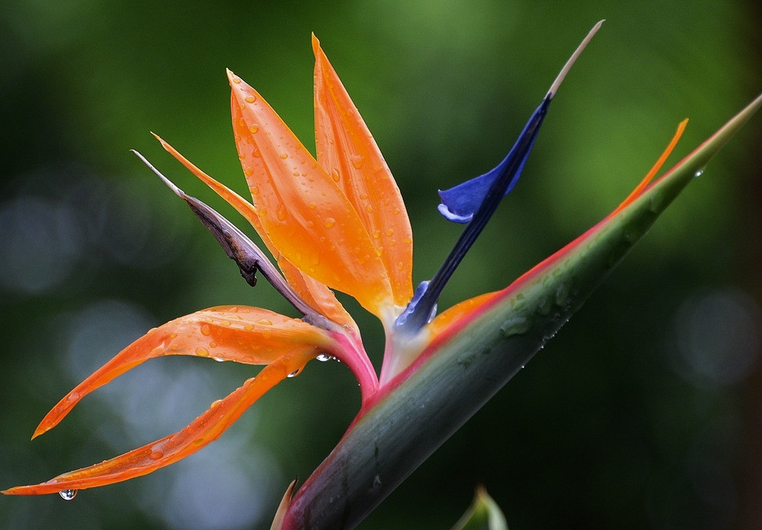
The scientific name of Strelitzia reginae was chosen to commemorate Queen Charlotte, wife of King George III of England. The flower stems are taller than the leaves, and the inflorescence extends horizontally. The outer petals are orange-yellow, the inner petals are bright blue, and the stigma is pure white. Its shape resembles a crane holding its head high and gazing into the distance, hence the name. The leaves are oblong-lanceolate. Because of its unique flower shape, brilliant colors, and its ability to last 20 days in water in summer and about 50 days in winter, it is known as the "king of fresh cut flowers." The leaves are large and graceful, and the flower shape is unique. Potted Strelitzia reginae is suitable for decorating conference rooms and halls, giving a sense of freshness and elegance. When planted in courtyards in the south, it adds much natural charm. Other names for Strelitzia reginae: bird of paradise flower, paradise bird flower, bird of paradise. Place of origin: South Africa. The flowering period of Strelitzia reginae is between summer and autumn, and the flowering period lasts as long as two months. Strelitzia reginae likes ample sunlight but cannot tolerate harsh sun exposure. In weak light it grows spindly, produces few shoots, and blooms abnormally or not at all. Strelitzia reginae likes warmth in winter and coolness in summer. Strelitzia reginae likes growing soil rich in humus and with good drainage and aeration. Although Strelitzia reginae likes moisture, it is afraid of drought and hates waterlogging; if the potting soil accumulates water, root rot is easily caused.
Key care points for Strelitzia reginae:
Strelitzia reginae has thick fleshy roots, so a mixture of 5 parts leaf mold or peat soil, 3 parts garden soil, 1 part decomposed manure soil and 1 part coarse sand can be used. If the prepared growing soil has poor permeability and too much water is given, root rot is very likely. Strelitzia reginae has a well-developed root system and grows quickly, so it needs timely repotting. Generally, during the seedling stage it should be repotted once a year. After flowering, mature plants can be repotted once every 1 year. When repotting mature plants, choose deep cylindrical pots, because this kind of pot has a large internal space, which is good for root development in all directions.
Strelitzia reginae prefers fertilizer and needs sufficient nutrient supply. During growth and development, apply a dilute soybean cake fertilizer solution once every 2 weeks. From flower stem formation to full bloom, 0.5% superphosphate can be added to the fertilizer solution, which will make the flower colors more brilliant. After the flowers fade, if you do not plan to keep seeds, promptly cut off the spent flower stems to reduce nutrient consumption. Stop fertilizing after mid-October. In northern regions, move the plant indoors in mid-to-late October and stop fertilizing during the winter. Keeping the indoor temperature above 10°C is enough for it to overwinter safely.
In water management, maintain an appropriate amount. The amount of watering should vary with seasonal changes, plant growth conditions and the actual dryness or wetness of the soil. Generally speaking, water when the soil is dry and let it dry out between waterings. In summer, watering should be ample. In spring and summer, also frequently spray water on the leaves and sprinkle water on the ground around the flower pot to increase air humidity and create a cool environment, which benefits its growth and development. After late autumn, reduce watering; in winter, control watering and keep the potting soil on the drier side.
Strelitzia reginae should be given ample light in winter, spring and autumn. If light is insufficient, the plant grows thin and weak, and blooms poorly or not at all. In summer, shade is needed; it is best placed under a shade shed or the shade of a large tree, or kept indoors in a well-ventilated spot with bright scattered light. Strelitzia reginae likes warmth and fears cold. The suitable growing temperature is 18-24°C from March to October and 13-18°C from October to March of the following year; in winter it must not fall below 8°C. In southern China it can be cultivated in the open field, while areas north of the Yangtze River basin are cultivated in greenhouses. The suitable temperature for flower buds is 23-25°C, and during flower bud differentiation the temperature should be kept stable and rise slowly.
[Strelitzia reginae pictures] Cultivation methods and precautions for Strelitzia reginae
✤
The flower stems of Strelitzia reginae are taller than the leaves, and the inflorescence generally extends horizontally. The outer petals of this flower are orange-yellow, the inner petals are bright blue, and the stigma is pure white. The colors are varied and very eye-catching, and the flower shape is just like a crane holding its head high and gazing into the distance, hence the name Strelitzia reginae. The leaves of Strelitzia reginae are oblong-lanceolate, and the flower shape is unique and the colors are brilliant. It can last 20 days in water in summer and about 50 days in winter. It is a plant suitable for water culture and has the reputation of being the king of fresh flowers.
Strelitzia reginae is a perennial herbaceous plant without a stem. Its leaves are about 25 to 45 cm long and about 10 cm wide, pointed at the tip, rounded or wedge-shaped at the base, with wavy lower edges. Strelitzia reginae is an evergreen perennial herbaceous perennial flower with a plant height of about 1 to 2 m. The stem is extremely short and inconspicuous. The leaves are large and graceful, and the flower shape is unique. It is often placed as a potted plant in conference rooms, halls and other places, expressing a feeling of freshness and elegance. In the south it is often planted in courtyards, adding natural charm.
✤ Cultivation methods for Strelitzia reginae andprecautions
1. Temperature conditions. The suitable growing temperature for Strelitzia reginae is 18-24°C. In summer, temperatures above 40°C will hinder growth, and in winter, temperatures below 0°C and lower will also cause freezing damage. In general cultivation, the winter nighttime temperature should not be lower than 10°C, and when the daytime temperature is around 20°C it can still bloom. When Strelitzia reginae grows within the suitable temperature range, flower buds can form in every leaf axil and flower stems can emerge and bloom. Therefore, controlling temperature well is the key to increasing the flower quantity of Strelitzia reginae.
2. Light conditions. Strelitzia reginae likes to grow in an environment with ample sunlight, but in summer it fears harsh sun exposure, so appropriate shading treatment should be done when cultivating it in summer. The suitable light intensity during the growing period of Strelitzia reginae is 30000Lx. In summer, if exposed to excessive sun, the leaves will curl inward and growth will slow. In winter, insufficient sunlight can also cause leaf overgrowth or thin, weak and bent leaf stalks, making it difficult to bloom. Therefore, when cultivating Strelitzia reginae, ensure it is not shaded in winter and not exposed to harsh sun in summer; otherwise, the yield of cut flowers will be affected.
3. Soil conditions. Strelitzia reginae has fleshy roots and fears water accumulation, so when the soil for cultivating Strelitzia reginae is too wet and poorly aerated, root rot can occur. Generally, ample water should be supplied during the flowering period and in summer, while watering should be appropriately reduced in early spring and after flowering. In order to increase air humidity and ensure that Strelitzia reginae can fully absorb water, the aboveground parts of the plant also need timely spraying so that the air humidity during the growing period remains at 60% to 70%.
4. Fertilizer conditions. During the growing period, Strelitzia reginae needs topdressing about once every 20 days, preferably with decomposed cake fertilizer solution. From flower stem formation to full bloom, apply a compound fertilizer mainly of phosphorus and potassium 2 to 3 times. In autumn, appropriately reduce the amount of nitrogen fertilizer to prevent excessive stem and leaf growth from affecting flower bud development and cold resistance. In summer, because the plant is in a semi-dormant state, reduce the amount of fertilizer solution; remember to stop fertilizing in winter. Loosen the soil by weeding and hoeing to increase aeration.
Conclusion:Strelitzia reginae is a flower with extremely high ornamental value, and its flower shape is just like a crane holding its head high and gazing into the distance, graceful in form, and loved by many friends. Strelitzia reginae can not only be grown as a potted plant, making it a great helper for home decoration, but can also be placed in a courtyard for freer cultivation, achieving both ornamental and air-purifying effects. The above is the introduction brought to you by the editor about appreciation of Strelitzia reginae pictures, cultivation methods and precautions. We hope it is helpful to everyone.