How to grow azaleas? Teach you to easily master the cultivation methods
Azaleas have elegant plant shapes and diverse flower colors, making them highly ornamental home plants, and they even have the reputation of being the "Xishi among flowers." So what exactly should you do when growing azaleas? Are there any methods, tips, or tricks? Below, let's take a detailed look together with the editor of Yiqizhuangxiu.com.
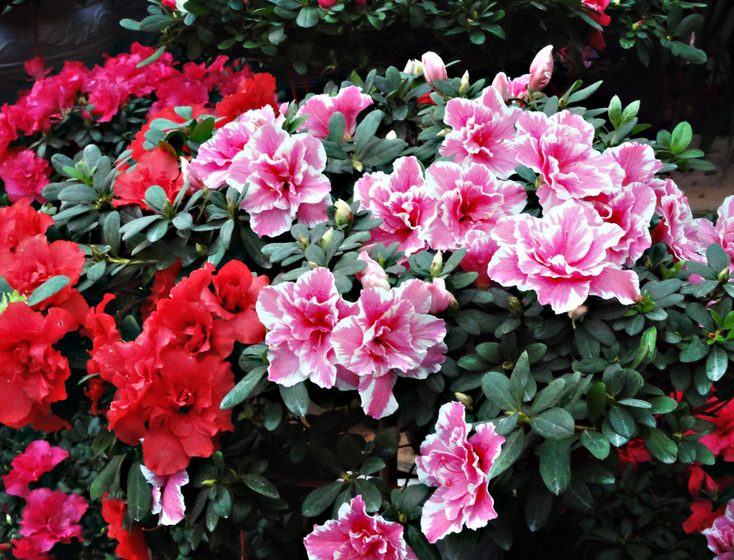
Azalea cultivation methods - easily grow azaleas
Azalea cultivation methods
1. Selection of flower pots for azalea cultivation
(1) Requirements for pot material: You can use clay pots, plastic pots, porcelain pots, ceramic pots, etc.
(2) Pot size: The pot size for planting azalea seedlings should match the crown diameter of the seedling; the pot size for planting azaleas at the middle seedling stage should be 3/4 of their crown diameter; the pot size for azaleas at the mature seedling stage should be 1/2 of their crown diameter.
2. Preparation of potting soil for azalea cultivation
Azaleas prefer acidic (pH 4.5-5.5), loose, well-drained soil. They avoid alkaline soil containing lime and avoid clayey soil. For home cultivation, the following formulas can be used: Belgian azalea: leaf mold soil : peat soil : sand = 5:2:3; spring-summer azalea: garden soil : peat soil : sand = 3:5:2. Mix in an appropriate amount of bone meal and stir evenly.
3. Temperature and light requirements for azalea cultivation
Potted azaleas are generally potted in spring from March to April, and can also be potted in autumn. When potting, they need to be transplanted with soil; after planting, water thoroughly and place in a shaded area.
Potted azaleas in the north are generally moved indoors for overwintering in early to mid-October, and after being brought indoors, they are placed in a sunny spot. In the early period after being brought indoors, attention should be paid to frequently opening windows for ventilation. The indoor temperature in winter should be around 10°C, and it should not be too high; otherwise, the plant's physiological activity will increase, consuming a large amount of nutrients and affecting flowering and growth the following year; at the same time, sufficient light should be provided. After mid-to-late April of the following year, they can be moved outside. At this time, the sunlight is relatively soft, and appropriate shading should be provided around noon. After summer begins, they must be moved to a cool, ventilated place for care. Since azaleas belong to shade-loving flowers, they need to be cared for under a shade shed in spring, summer, and autumn. Especially in summer, being under strong sunlight for a long time can easily cause yellowing and drying of branches and leaves, arrested growth, and death of the whole plant. In autumn, the daily light exposure time should gradually increase, and by late autumn, shading should be stopped.
4. Watering methods for azalea cultivation
During the growing period, keep the potting soil moist. From April to June during the flowering period, the water demand is relatively high. In the high-temperature season from July to August, water should be sprayed on the ground and leaves to keep the air moist. After September, as the temperature gradually cools, the moisture in the potting soil should be gradually reduced. In winter, when the plant enters dormancy, watering should be reduced.
Because azaleas have a shallow root system, they are both afraid of drought and afraid of waterlogging. Improper watering can cause leaf drop in mild cases and death in severe cases. Therefore, watering is one of the key measures for growing azaleas well. Watering should be determined according to the plant's season and growth stage. In spring during bud formation and flowering, water consumption is relatively high, so watering should be timely; if the pot becomes dehydrated, the flowers will wither and the flowering period will be shortened. During this period, it is best to keep the potting soil moist. In summer, azalea branches and leaves grow vigorously, the temperature is high, and water evaporates quickly. In addition to watering thoroughly once a day, water should also be replenished at any time. If there is even a slight negligence and the potting soil becomes too dry, the leaves will turn yellow, the leaf centers will curl, and the plant may even dry up and die.
Since azaleas like humidity, in summer clean water should be used to spray the leaf surfaces and water should be sprinkled on the ground around the flower pot to increase air humidity and lower the temperature; in autumn, flower buds have already formed, the temperature gradually drops, and the weather turns cooler. At this time, it is enough to keep the potting soil from drying out; in winter, the temperature is low, and azaleas are in a dormant or semi-dormant state, so water consumption is low. Therefore, watering should be strictly controlled, as too much water can easily cause root rot. However, during this period, every 5-7 days, clean water close to room temperature should be used to spray and wash the branches and leaves once, so as to keep the plant fresh. When watering azaleas, pay attention to water quality. Rainwater is more suitable. If tap water is used, it must first be stored in a container for 1-2 days before use.
5. Fertilization methods for azalea cultivation
Azalea roots are shallow and fine, and their absorption capacity is weak. Therefore, when fertilizing, the principle of "light fertilizer applied frequently" must be mastered. If the fertilizer is too concentrated or if undecomposed raw fertilizer is applied as a top dressing, it can easily cause root rot, scorched leaves, and even death. Especially for 1-2 year old small seedlings, even more attention should be paid to the amount of fertilizer, otherwise fertilizer damage can easily occur.
In February to March before spring azaleas bloom, a phosphorus-based liquid fertilizer should be applied once every 10-15 days to promote larger and more colorful flowers; in March to April, applying the same fertilizer to summer azaleas can make the flowers larger, the color better, the petals thicker, and the flowering period longer. Fertilization should be stopped during the flowering period; otherwise, flowers are likely to drop and leaves to grow, affecting the ornamental effect; after the flowers fade, apply a nitrogen-based fertilizer once every 10 days or so to promote new branches. After late July, it is exactly the period of azalea flower bud differentiation, so a phosphorus-based liquid fertilizer should be applied once every 10-15 days to promote flower bud differentiation. During the winter dormant period, no fertilizer is needed, and top dressing should be stopped.
6. Pruning methods for azalea cultivation
Azaleas have strong sprouting ability, with many and dense branches. After flowering, overly dense branches, thin and weak branches, dead branches, diseased branches, residual branches, crossing branches, and leggy branches should be cut off to facilitate ventilation and light penetration. Do not shorten the branches that are retained. This is because azalea leaves mostly cluster at the tips of branches. After flowering, a section of new branch grows and a cluster of new leaves appears, the old leaves then fall off, and then the terminal buds begin flower bud differentiation, becoming the flowering branches for the following year. If this section of branch is cut off, it will affect the number of flowers the next year.
[Azalea] Detailed explanation of azalea cultivation methods
Azalea is also called yingshanhong or shanshiliu, and is an evergreen or semi-evergreen shrub plant. A long time ago, it was said that a cuckoo bird cried day and night, then coughed up blood, causing all the flowers on the mountain to be dyed red, so it was called azalea. Azaleas generally bloom in summer. Each cluster of flowers has 2-6 blooms, and the corolla is funnel-shaped, with colors including red, light red, apricot red, snow blue, white, and so on. The flower colors are very numerous and also relatively brilliant. Azaleas generally grow in mountain open shrublands or under pine forests at an altitude of 500-1,200 m, and are a particularly distinctive acid-soil plant of central-southern and southwestern China. Many people like azaleas but do not know the cultivation methods for azaleas. Below, the editor will introduce to everyone a detailed explanation of azalea cultivation methods.
[Growth habits of azaleas]
Azaleas are cultivated in China in Anhui, Suzhou, Jiangxi, Zhejiang, Taiwang, Hubei, Fujian, Hunan, Guangdong, Sichuan, Guangxi, Guizhou, Yunnan, and many other regions. They grow in mountain open shrublands and under pine forests at an altitude of 500-1,200 m, and they prefer to grow in acidic soil. Azaleas like to grow in cool, ventilated, semi-shaded, humid, and sunny environments. They are plants that are both afraid of intense heat and afraid of severe cold, suitable for growing at temperatures of 12-25°C. In summer, the climate must not be higher than 35°C, otherwise new leaf growth will be very slow and the plant will be in a semi-dormant state. In summer, shading and sun protection treatment is needed, while in winter, cold protection and warmth measures should be taken. They are plants that avoid exposure to strong sunlight and like to grow under scattered light. If the light is too strong, it will scorch the tender leaves and may even cause the plant to die. Among ornamental azaleas, the cold resistance of Western azaleas is very weak, and a temperature of 0°C can cause freezing damage.
[Azalea cultivation methods]
Azaleas generally use propagation methods such as cuttings, grafting, layering, and so on, with cuttings being the main propagation method. Under full sunlight, rooting is fastest and the survival rate is very high. Cuttings are generally taken in spring and autumn. After cutting, the soil should be kept moist, and appropriate shading treatment should be carried out.
1. Pot selection: When cultivating azaleas, clay pots, porcelain pots, ceramic pots, plastic pots, and purple sand pots are generally selected. Clay pots and purple sand pots have very good air permeability and water permeability, and are also very antique and beautiful, making them suitable for use. The pot size for seedlings should be similar to the crown diameter, while the pot size at the seedling stage is 3/4 of the crown diameter, and after azaleas become mature seedlings, the pot size is 1/2 of the crown diameter.
2. Growing conditions: Azaleas are suitable for cultivation in indoor and outdoor environments. Indoor environments are suitable for growth in winter, while outdoor environments can be used in spring and summer. Soil is generally used, but concrete ground should be avoided. They need to grow in a relatively spacious, ventilated, and cool environment. Some shed-building protective measures can be taken, and a light transmittance of 30% is generally most suitable.
3. Soil: Azaleas grow best in acidic soil that is loose, has good permeability, good drainage, and is rich in humus, with a pH between 5.0-6.0, and clay soil and alkaline soil should be avoided. If they are summer azaleas and Western azaleas, they are suitable for growing in mountain soil, but the mountain soil should be properly prepared.
4. Watering: When watering azaleas, it is best to use pond water, rainwater, or river water for irrigation. If tap water is used, it is best to let it sit for a period of time so the chlorine volatilizes before use. You can also add 0.2% ferrous sulfate to the water, and irrigate once a week to maintain the acidity of the soil.
5. Fertilization: Azaleas like to grow in cool and humid environments, and need a large amount of water when the flowers are blooming. In winter, they enter dormancy and do not need too much water. You can apply fertilizer water once a week, and afterward apply fertilizer water around noon.
6. Shading: If azaleas are cultivated outdoors, they should receive sufficient sunlight before the flowering period, but during the flowering period they should be shaded, with a light transmittance of 30%.
7. Pruning: Azaleas grow very slowly. Pruning is generally carried out after the flowering period. Leggy branches, diseased and weak branches, damaged branches, deformed branches, and so on should be cut off to make the shape more lush and reduce the consumption of water and nutrients.
8. Pest and disease prevention: The pests and diseases commonly encountered by azaleas include the azalea lace bug. When encountering this pest, you can use 40% omethoate 1,500-times solution, spraying once a week for 2-3 consecutive times. Leaf roller insects may appear on the terminal bud area and can be caught manually, or killed by spraying 40% omethoate 1,500-times solution and dichlorvos 1,500-times solution.
More related information: What do tulips represent What is guava Tea oil tree cultivation Camphor tree prices How to grow pothos
How to grow azaleas - complete collection of azalea cultivation methods
Azalea is also called shanshiliu or yingshanhong, and is an evergreen plant. The cuckoo cried blood and dyed the flowers all over the mountain red, so it was named azalea. The colors of azaleas are mainly deep red and light red, while purple and white are also relatively common. When azaleas bloom, the whole mountain is very bright and beautiful, and they are called the Xishi among flowers. How to grow azaleas better? Let's take a look below at the complete collection of azalea cultivation methods.
How to grow azaleas Complete collection of azalea cultivation methods1. How to grow azaleas——SoilPotted azaleas are a commonly used method for growing azaleas at home. The soil mixing for azaleas needs to focus on looseness and air permeability, so soil with strong air permeability and drainage capacity is best. At the same time, azaleas like light fertilizer, so it is suitable to use acidic soil plus some humus material.
2. How to grow azaleas——LightDuring the growth process, azaleas require long-day sunlight, needing at least six hours of sunlight exposure for half the day, but avoiding being exposed outside all day. During the flowering season, azaleas should be properly shaded and protected, and using special shade cloth for covering is more appropriate. Azaleas are not suitable for exposure to strong sunlight during the flowering stage.
3. How to grow azaleas——WateringAzalea roots are fine, so their water absorption capacity is not very strong. Therefore, azaleas should be watered frequently to ensure a moist soil environment. Except during the winter dormant period, azaleas should be watered appropriately so that the flowers develop better.