How to grow Lucky Bamboo in water? Causes of yellowing leaves and solutions
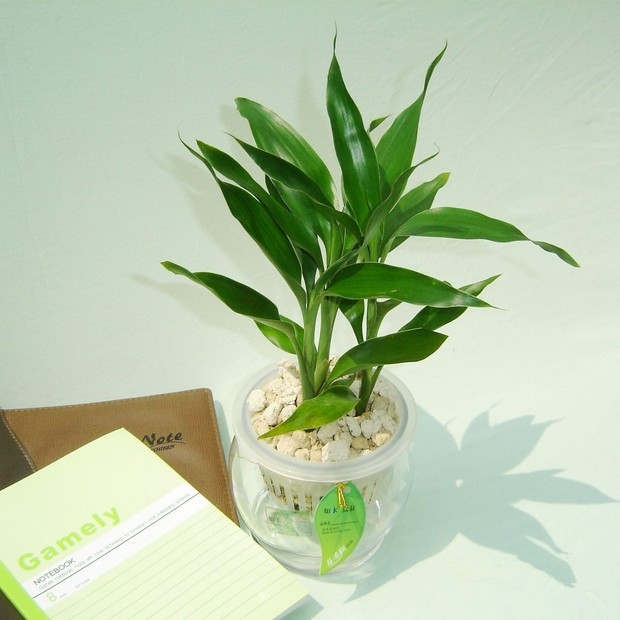
How to grow Lucky Bamboo in water: What to do when Lucky Bamboo grown in water has yellowing leaves
For growing Lucky Bamboo in a vase with water, the following key points should be mastered:
1. Before placing in the vase, remove the leaves from the base of the cuttings, and cut the base into a slanted opening with a sharp knife; the cut should be smooth to facilitate the absorption of water and nutrients. Change the clean water once every 3-4 days, and do not move the position or change the direction within 10 days; after about 15 days, silvery-white fibrous roots can grow.
2. After rooting, it is not suitable to change the water; only add water promptly after evaporation reduces the water level. Frequent water changes easily cause yellow leaves and withered branches.
3. After rooting, apply a small amount of compound fertilizer promptly, and the leaves will be glossy green and the stems thick and strong. If no fertilizer is applied for a long time, the plant grows weak and the leaf color easily turns yellow. However, too much fertilizer should be avoided, so as not to cause "root burn" or excessive leggy growth. In spring and autumn, apply compound fertilizer once a month. According to references, to prevent leggy growth in water-grown Lucky Bamboo, do not apply chemical fertilizer; it is best to add a few drops of brandy into the vase about every 3 weeks, plus a small amount of nutrient solution, which can keep the leaves emerald green.
4. Do not place Lucky Bamboo next to a television or in places where air conditioners or electric fans often blow, so as to avoid drying and withering of leaf tips and leaf edges.
If yellowing leaves appear, the cause can be sought from the following two aspects:
First, check the water quality, mainly to see whether the root system is fresh. If the root system rots due to water quality reasons, then switch to cooled boiled water.
Second, check the light conditions of the placement location. If the light is too dim, the place is stuffy and poorly ventilated, or the air is dry, all of these can cause yellowing leaves; but if the placement location has too strong light, it can likewise cause yellowing and dullness of the leaves.
What should be done for Lucky Bamboo with yellowing leaves? If it is caused by light, first cut off the yellow leaves, and also cut off the rotten roots, then create a clean, suitably warm, cool, moist environment with good scattered light for it. If the root rot is caused by unclean water quality, first cut off the yellow leaves. When the symptoms are not serious, it is advisable to change the water frequently and place it in a ventilated position with relatively sufficient sunlight for restorative care; when the symptoms are serious, appropriately spray pesticide or add a small amount of fungicide to the water tray.
It is an evergreen woody plant, preferring high temperature and high humidity environments, and also tolerating shade and waterlogging, with a certain cold resistance. When the winter temperature is below 10°C, the leaves will turn yellow and fall off.
What to do when Lucky Bamboo grown in water has yellowing leaves: What to do when Lucky Bamboo grown in water has yellowing leaves
●▂●More exciting content ?Wintersweet
?What is wall coating
?What to do when pothos leaves turn yellow
?What is the flower language of cornflower
If you want to learn more information, please click to enter >>>Soft furnishing design
......................................................................................................
Lucky Bamboo symbolizes great fortune and prosperity. People take the auspicious meaning of Lucky Bamboo and plant it at home. The more common Lucky Bamboo varieties are 4 kinds, namely golden-center Lucky Bamboo, silver-center Lucky Bamboo, silver-edge Lucky Bamboo, and golden-edge Lucky Bamboo. Usually Lucky Bamboo has two cultivation methods, soil culture and water culture; water culture looks more beautiful and is more convenient to cultivate, so many households choose water culture. In the process of cultivation, the problem easily encountered is what to do when Lucky Bamboo grown in water has yellowing leaves.
There are many kinds of yellowing leaves in Lucky Bamboo, but they are nothing more than problems in the three aspects of water, light, and fertilization. Since the issue is solving what to do when Lucky Bamboo grown in water has yellowing leaves, naturally first consider whether the water amount is appropriate; too much or too little water can cause yellowing leaves. Overwatering causes new leaves to be dull yellow and lusterless, while old leaves remain normal and unchanged, the stems are yellow-green, and the growth of new leaves and tender buds is poor; this is caused by overwatering. At this time, take the Lucky Bamboo out and place it in a ventilated and cool place, and after it has dried appropriately, put it back into the container, noting that the amount of water in the container should not be too much.
Yellowing caused by lack of water is different from yellowing caused by overwatering. Lack of water causes old leaves to wither and yellow from bottom to top, then fall off, but the growth of new leaves is less affected and they can grow almost normally. At this time, pay attention to watering promptly, and note that watering should be sufficient and thorough. If it is not a water amount problem, then it is necessary to consider whether it is a light problem; strong sun exposure and insufficient light can both cause yellowing leaves.
Lucky Bamboo is a shade-loving plant, and strong direct sunlight easily causes its leaf tips and leaf edges to wither and turn yellow. When yellow spots are found on the sun-facing part of the leaves, promptly move it to a cool and ventilated place; being shade-loving does not mean Lucky Bamboo does not need sunlight. Being in a shady environment for a long time with insufficient light can also cause yellowing leaves and thus leaf fall; when this happens, promptly move it to a place with suitable light. The problems causing what to do when Lucky Bamboo grown in water has yellowing leaves are diverse; for example, excessive or insufficient fertilization can also cause yellowing leaves.
Summary:When encountering the problem of what to do when Lucky Bamboo grown in water has yellowing leaves, one should not analyze only one cause unilaterally, but should analyze from multiple angles. Sometimes the placement location is wrong, affecting both light and water evaporation, thereby affecting the water amount; furthermore, the specific cause should be judged according to the color type and location of the yellowing leaves, and it should not be handled arbitrarily, otherwise the problem of what to do when Lucky Bamboo grown in water has yellowing leaves cannot be solved at all.
▓ Recommended reading
?Growing sunflowers ?Couple accessories ?Types of combs ?Meaning of four-leaf clover ?Green Light Forest cross-stitch
?Aloe for acne ?White balsam ?Aquarium fish tank ?Activated carbon crafts ?How to grow Phalaenopsis orchids
Lucky Bamboo water culture methods: What to do when Lucky Bamboo grown in water has yellowing leaves
Lucky Bamboo is a very good indoor decorative plant. Lucky Bamboo can be grown in pots or in water. Today Xiao Qi will talk with everyone about Lucky Bamboo water culture methods and what to do when Lucky Bamboo grown in water has yellowing leaves.
Lucky Bamboo water culture methods
1. Before placing in the vase, remove the leaves from the base of the cuttings, and cut the base into a slanted opening with a sharp knife; the cut should be smooth to facilitate the absorption of water and nutrients. Change the clean water once every 3-4 days, and do not move the position or change the direction within 1 day; after about 15 days, silvery-white fibrous roots can grow.
2. After rooting, it is not suitable to change the water; after water evaporation decreases, only add water promptly. Frequent water changes easily cause yellow leaves and withered branches.
3. After rooting, apply a small amount of compound fertilizer promptly, and the stems will grow thick and strong and the leaves glossy green. If no fertilizer is applied for a long time, the plant grows weak and the leaf color turns yellow. However, too much fertilizer should be avoided, so as not to cause root burn or excessive leggy growth. In spring and autumn, apply compound fertilizer once a month. To prevent leggy growth in water-grown Lucky Bamboo, do not apply chemical fertilizer; it is best to add a few drops of brandy into the vase about every 3 weeks, plus a small amount of nutrient solution, which can keep the leaves emerald green.
4. Do not place Lucky Bamboo next to a television or in places where air conditioners or electric fans often blow, so as to avoid drying and withering of leaf tips and leaf edges.
What to do when Lucky Bamboo grown in water has yellowing leaves
During the growth process of Lucky Bamboo, yellowing leaves often appear, but the yellowing situations differ; the causes should be carefully observed and analyzed, and corrected.
1. Water yellowing
Tender leaves are dull yellow and lusterless, old leaves show no obvious change, stems are thin and yellow-green, and new shoots shrink and stop growing, indicating overwatering. Take the plant out of the pot and place it in a ventilated and cool place to let the soil ball dry by itself, then put it back into the pot.
2. Drought yellowing
Yellowing due to lack of water is different from yellowing due to too much water. Yellowing due to lack of water means leaf tips or edges wither and dry, old leaves wither, yellow, and fall from bottom to top, but new leaves grow relatively normally. Just pay attention to watering sufficiently and thoroughly.
3. Scorch yellowing
Strong direct sunlight shining on some shade-loving flowers (such as spider plants, hostas, etc.) easily causes the leaf tips and leaf edges to wither, and yellow spots appear on the sun-facing part of the leaves. Move them to a shady place.
4. Light-deficiency yellowing
Being placed in a shady environment for a long time, the leaves cannot get enough sunlight and cannot form chlorophyll, so the whole plant's leaves turn yellow and then fall off. Supplementing light can prevent this problem.
5. Fertilizer yellowing
Flower yellowing caused by too much fertilizer or too high concentration is shown by dry brown tips on new leaves; generally the leaf surface is thick and lusterless, and uneven and not smooth, and old leaves scorch, yellow, and fall off. Immediately stop fertilizing; in serious cases, use a large amount of clean water to flush out part of the fertilizer.
6. Fertilizer-deficiency yellowing
It is shown by the color of tender leaves becoming lighter, appearing yellow or pale green, while old leaves are relatively normal or gradually turn from green to yellow. Check the potting soil; if there is hardening, change the soil. Usually apply thin fertilizer frequently and water timely with some alum water (Lucky Bamboo is a foliage plant and should be given fertilizer mainly based on nitrogen fertilizer).
The above isLucky Bamboo water culture methodsandwhat to do when Lucky Bamboo grown in water has yellowing leaves, friends who like water-grown Lucky Bamboo should read carefully.