Honeysuckle Bonsai: Photo Appreciation and a Detailed Guide to Growing Techniques
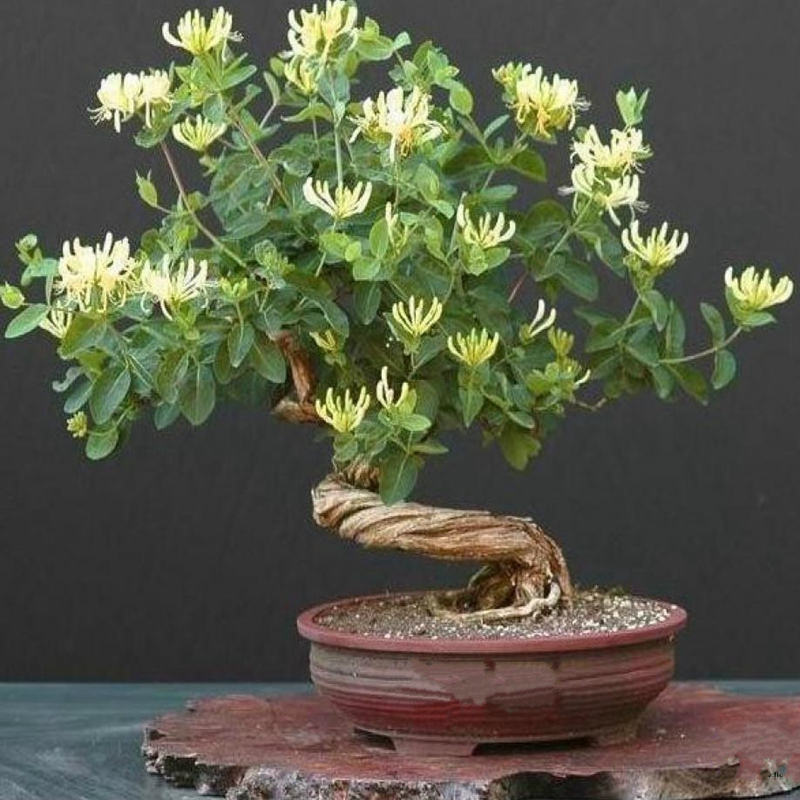
Honeysuckle Bonsai Photos and Honeysuckle Bonsai Growing Techniques
Honeysuckle has a well-developed root system and extremely strong adaptability; it is not demanding about soil and is easy to keep alive. Grown in pots it is basically free of pests and diseases, tolerant of drought and waterlogging, cold and high temperatures, poor soil and salinity-alkalinity. But it likes a warm, humid climate, and likes sunlight and fertilizer; sufficient sunlight and fertile soil allow honeysuckle to grow and develop luxuriantly with a robust plant shape, thereby increasing the number of branches and flowers. Besides being planted in the ground, honeysuckle is also a rare and excellent material for bonsai grown for its flowers and trunks. Because its branches and trunks are relatively large, although the trunk form is vigorous and antique, the branches and trunks are extremely brittle and easily broken or rotted; with larger branches and trunks, do not easily change their shape and angle, and even less should you twist the shape and angle of the main trunk and main branches the way you would when making other deciduous-tree bonsai.
1. Determine the planting time:
In fact, honeysuckle bonsai can be planted in all four seasons, and planting in late autumn and early winter is best. In order to make the honeysuckle bonsai grow well, you can plant honeysuckle that has already been propagated by cuttings into an ornamental pot of a size suited to the stump in late autumn and early winter, then cultivate it with prepared fertile humus loam, lay green moss on the surface, and water it right away to help it survive.
2. Ensure it has sufficient water and nutrients:
Because honeysuckle bonsai is limited by its growing container, it often needs supplementary water and nutrients. Especially during the growing season, fertilization should be based mainly on phosphorus and potassium fertilizers, applying decomposed cake fertilizer once a week to promote thick, sturdy branches and vines and lay a good foundation for the next year's growth.
3. Before budding, it must be pruned and shaped:
From winter until before the following year's bud break, planting and pruning for shaping can be carried out. According to the needs of the bonsai design, generally keep 3-5 main branches, keep 2-3 buds on each branch, and cut away all other branches and vines; this is the key to ensuring rapid shaping.
4. Bud removal and pinching back are crucial:
According to the growth characteristics of honeysuckle and the needs of the design, bud removal must be carried out several times each year. Especially when buds sprout in early spring, every node of the honeysuckle is covered with uneven shoots; at this time you must be good at identifying them. First, promptly remove the water-sprout buds that will grow vigorously later, are twining in nature, and would disturb the tree's form; during the growth process, water-sprout buds especially must be firmly controlled. Second, remove the thin, weak branch buds that will have no ability to bloom later, so as not to affect ventilation and light penetration. Third, keep only the buds of ordinary vegetative branches that can bloom normally later; generally, after they become branches, cut them back at about 20cm, and most of the branches can bear flowers, and bear many of them.
5. Pay attention to fertilizer and water management during the growing period:
Honeysuckle can develop and grow normally only under conditions of sufficient fertilizer and water, but it must not be allowed to grow unchecked. During this period, depending on its growth, you should flexibly and promptly withhold water, control the tree shape, increase the number of flowers, prevent excessive vegetative growth, and encourage the stems and vines to mature, the internodes to shorten, and the plant shape to become dwarfed. Generally, besides applying decomposed cake fertilizer once a week, you should also spray the foliage 2-3 times with a 0.2% potassium dihydrogen phosphate solution.
How to Make Honeysuckle Bonsai, Honeysuckle Bonsai Photos
❤
The flowering period of honeysuckle is from May to October each year. The flowers are white when they first open, but after 3 days they turn golden yellow, and they also give off a light, fresh fragrance. Honeysuckle bonsai also has very high ornamental value when placed indoors. Its vines twine around each other. It does not wither through the winter, and the winter leaves are slightly red. When old honeysuckle is made into bonsai, its vines hang down and its posture is classical, truly with a distinctive flavor. Below, the editor will take everyone to see how to make honeysuckle bonsai.
Honeysuckle Bonsai Photos
[Honeysuckle Bonsai Making Process]
Step 1: Control water and fertilizer.Honeysuckle grown in pots must have its vine growth restricted, its tree shape controlled, and its flower count increased. In spring, shelter it from rain, reduce watering, prevent excessive vegetative growth, and encourage the stems and vines to mature, the internodes to shorten, and the plant shape to become dwarfed. Before flower buds form, apply little or no nitrogen fertilizer, and apply more phosphorus and potassium fertilizer to promote flower bud formation and increase the number of flowers.
Step 2: Repot at the right time.Generally, potted flowering plants are repotted once every one or two years, while honeysuckle bonsai is repotted once every three or four years. Because repotting is infrequent, the root system's absorption function is weakened, which promotes plant aging, inhibits excessive vegetative growth, moderates tree vigor, and encourages thick, sturdy stems and vines, dense internodes, a dwarfed plant shape, and abundant flowers.
Honeysuckle Bonsai Photos
Step 3: Control shoots with growth inhibitors.When honeysuckle branches have sprouted about 5cm, spray or drench with 700 to 1000ppm paclobutrazol, or 2000 to 4000ppm B9, or 1000 to 2000ppm chlormequat chloride, for several consecutive times, to inhibit vigorous vine growth and dwarf the tree shape.
Step 4: Dwarfing, shaping and pruning.Begin dwarfing, shaping and pruning from the time of potting, to cultivate a thick trunk and short branches. During the growing season, remove vigorously growing buds and pinch back strong branches early. Through shaping and pruning, encourage the transition from a twining vine type to a dwarf shrub-type stump specimen with short branches and a low trunk, evenly and densely distributed branches, and distinct tiers. Therefore, honeysuckle bonsai should be placed in a spot with sufficient sunlight, ideally with direct sunlight all day, to encourage thick, short branches, lush leaves and abundant flowers, and to extend the flowering period.
Honeysuckle Bonsai Photos
[Notes on Making Honeysuckle Bonsai]
Honeysuckle has a relatively well-developed root system, and its adaptability is also relatively strong. It is not very strict about soil and is relatively easy to keep alive. Potted honeysuckle has almost no diseases. It likes a warm, humid climate and likes sunlight. Sufficient sunlight can make honeysuckle grow more luxuriantly with a robust plant shape. The branches and trunks of honeysuckle are relatively large, so it is very suitable for making into honeysuckle bonsai.
Honeysuckle Bonsai Photos
Conclusion:The branches and trunks of honeysuckle are relatively large; although the trunk form is vigorous and antique, the branches and trunks are extremely brittle and easily broken or rotted. With larger branches and trunks, do not easily change their shape and angle, so you cannot twist the shape and angle of the main trunk and main branches the way you would when making other deciduous-tree bonsai. The price of honeysuckle bonsai is also not very expensive. It is generally around 30-80 yuan. The above is what the editor introduced to everyone this time about honeysuckle bonsai; if you want to know more about honeysuckle, please continue to follow our Aiyouwo decoration information.
Honeysuckle Bonsai Photos and Honeysuckle Bonsai Making Methods
Honeysuckle is also a plant we are relatively familiar with. Its flowering season is from May to October each year; the flowers are white when they first open and turn golden yellow after 3 days, and they are fragrant and very beautiful, and it also has high medicinal value. The honeysuckle vines twine around each other and do not wither through the winter, and the winter leaves are slightly red; in spring and summer it blooms without pause, first white and then yellow, white and yellow setting each other off, with both color and fragrance, beautiful in both flower and leaf. Old stumps and old vines are used to make bonsai, with the trailing vines drawn downward, giving an antique and elegant posture, unique in style and of very high ornamental value. Below, Ailianshuo will take everyone to appreciate honeysuckle bonsai photos and learn about honeysuckle bonsai making techniques as well as the current market prices of honeysuckle bonsai.Complete Collection of Honeysuckle Bonsai PhotosMaking Honeysuckle Bonsai
1. Selection for making honeysuckle bonsai
Although there are all kinds of stumps of honeysuckle in nature, not too many are suitable for making bonsai, so you should try to select tree stumps with a well-developed root system, a thick, sturdy and antique trunk form, with curvature and variation, a short and compact tree shape, thick, short and dense internodes, and natural tapering transitions.
2. Honeysuckle bonsai making techniques
1. Control water and fertilizer
Honeysuckle grown in pots must have its vine growth restricted, its tree shape controlled, and its flower count increased. In spring, shelter it from rain, reduce watering, prevent excessive vegetative growth, and encourage the stems and vines to mature, the internodes to shorten, and the plant shape to become dwarfed. Before flower buds form, apply little or no nitrogen fertilizer, and apply more phosphorus and potassium fertilizer to promote flower bud formation and increase the number of flowers. During the period when branches stop growing and during bud formation, apply an appropriate amount of nitrogen fertilizer so the flowers open larger and more brightly colored.
2. Repot at the right time
Generally, potted flowering plants are repotted once every one or two years, while honeysuckle bonsai is repotted once every three or four years. Because repotting is infrequent, the root system's absorption function is weakened, which promotes plant aging, inhibits excessive vegetative growth, moderates tree vigor, and encourages thick, sturdy stems and vines, dense internodes, a dwarfed plant shape, and abundant flowers.
3. Control shoots with growth inhibitors
When honeysuckle branches have sprouted about 5cm, spray or drench with 700 to 1000ppm paclobutrazol, or 2000 to 4000ppm B9, or 1000 to 2000ppm chlormequat chloride, for several consecutive times, to inhibit vigorous vine growth and dwarf the tree shape.4. Dwarfing, shaping and pruning
Begin dwarfing, shaping and pruning from the time of potting, to cultivate a thick trunk and short branches. During the growing season, remove vigorously growing buds, pinch back strong branches early, and when pruning, cut the long and keep the short. Through shaping and pruning, encourage the transition from a twining vine type to a dwarf shrub-type stump specimen with short branches and a low trunk, evenly and densely distributed branches, and distinct tiers. Long-day treatment: honeysuckle is a light-loving long-day plant. If the environment has poor ventilation and light penetration, and is shady and damp, the stems and vines will grow excessively, the branches will be thin and weak, the leaves will easily turn yellow and drop, and there will be few flowers. Therefore, honeysuckle bonsai should be placed in a spot with sufficient sunlight, ideally with direct sunlight all day, to encourage thick, short branches, lush leaves and abundant flowers, and to extend the flowering period.
Training: For the shaping of honeysuckle, wiring and bending is the main method, combined with pruning. By wiring and bending, the main branches are wound around each other and woven into a trunk so that they grow into one body, and then further processing is done. Small branches are generally processed by the pruning method.
Tree forms: mainly the slanting-trunk style, the curved-trunk style, and the cascade style, with the roots gradually exposed. Small branches are mostly made into a hanging form to express its natural characteristics. In addition, honeysuckle can also be made into a root-over-rock style bonsai.
3. Notes on making honeysuckle bonsai
Honeysuckle has a well-developed root system and extremely strong adaptability; it is not demanding about soil and is easy to keep alive. Grown in pots it is basically free of pests and diseases, tolerant of drought and waterlogging, cold and high temperatures, poor soil and salinity-alkalinity. But it likes a warm, humid climate, and likes sunlight and fertilizer; sufficient sunlight and fertile soil allow honeysuckle to grow and develop luxuriantly with a robust plant shape, thereby increasing the number of branches and flowers. Because its branches and trunks are relatively large, although the trunk form is vigorous and antique, the branches and trunks are extremely brittle and easily broken or rotted; with larger branches and trunks, do not easily change their shape and angle, and even less should you twist the shape and angle of the main trunk and main branches the way you would when making other deciduous-tree bonsaiHoneysuckle Bonsai Prices
Many people want to know the price of honeysuckle bonsai, but there is no fixed price on the market. The price of ordinary honeysuckle bonsai is about 30-80, and in addition, many factors such as tree age, styling, local consumption levels, distance of transport, supply and demand, wholesale, retail, and so on will all cause relatively large price differences in honeysuckle bonsai. You can go to your local flower market to find out.
That is all for the introduction to honeysuckle bonsai photos, honeysuckle bonsai making techniques, prices and related content. Honeysuckle has high ornamental value and good medicinal value, so it is loved by many people. If you also like honeysuckle, you can learn more about it. For more related information, please follow the Flowers section of Ailianshuo Flower Network.
(Editor: Ailianshuo Flower Network)