How to Grow Stromanthe sanguinea and Photo Appreciation
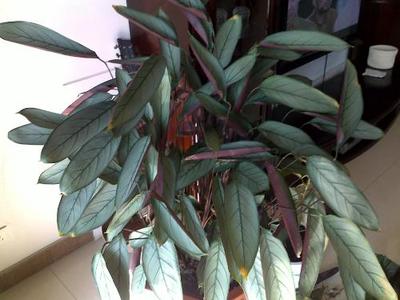
Perennial herb, plant height 30 cm to 80 cm, up to 1.5 m at most.
Leaves clustered at the base, with short petioles, leaf blades long elliptic to broadly lanceolate, leaf length 30 cm to 40 cm, width 8 cm to 12 cm, leaf surface dark green, glossy, leaf underside purplish brown.
Flowers bisexual, asymmetrical, often borne in pairs in bracts, forming a terminal spicate inflorescence, sepals 3, free; corolla tube short or long, lobes 3, the outer one usually large and more or less hood-shaped; staminodes 4-2, the outer whorl 1-2 (sometimes absent) petaloid, larger, of the inner whorl 2, one is cucullate, enclosing the style, one is hard and leathery; fertile stamen 1, petaloid, anther 1-locular, borne on one side; ovary inferior, 3-1-locular; each locule with 1 ovule; style deflexed, curved, widened, stigma 3-lobed. Fruit a capsule or berry-like; seeds 1-3, hard, with endosperm and aril.
Division
Marantas are generally propagated by division; propagation is most ideal in spring when the temperature is around 20°C, but as long as temperature and humidity are suitable, it can also be done year-round. When propagating, use a sharp knife to cut apart the root tuber with stems and leaves or leaf buds; for small-scale propagation, the cut root tuber with stems, leaves and leaf buds can be placed directly in a clay pot; for large-scale propagation, it should be placed on a seedbed; when temperature and humidity cannot meet the requirements, cover with plastic film; be sure to bring the temperature inside the film to 20-28°C and the humidity to above 80%.
Cuttage
Cuttage propagation generally uses tender shoot tips; the cuttings are 10-15 cm long, and depending on leaf size, one third or one half of the leaf is retained; the cuttings are treated with 500 ppm naphthalene acetic acid for 2-3 seconds, or can be treated with indoleacetic acid, indolebutyric acid and ABT rooting powder. After treatment, the cuttings are inserted into the seedbed, with a spacing of 5×10 cm being best. Cover with a plastic film arched shed above; the management method is the same as for division propagation. Cuttage propagation can be carried out at any time when the temperature is not lower than 20°C. The cuttings root in 30-50 days; however, the survival rate of cuttage is not as high as that of division propagation; generally around 50%.
Marantas have underground rhizomes or tubers, and the leaves are solitary and relatively large. Apart from the open leaf sheath at the base of the leaf, at the junction of the leaf blade and petiole there is also a noticeably swollen joint called the "pulvinus", which contains water-storing cells and functions to adjust leaf orientation, that is, at night when water is sufficient the leaf stands upright, and during the day when water is insufficient the leaf spreads out; this is a characteristic of plants in the family Marantaceae. In addition, some marantas also have "sleep movement", that is, the leaves spread out during the day and fold up at night, which is very peculiar.
Stromanthe sanguinea likes a moist environment, and avoids waterlogging and drought. When the potting soil is slightly dry, it should be watered promptly; if the ground can be sprinkled with water frequently to increase air humidity, it will grow very well; if air humidity is low and the potting soil is dry, the leaf edges will turn yellow and scorched, and direct sunlight will also cause the leaf edges to turn yellow and scorched. http://cache.baidu.com/c?word=%D7%CF%3B%B1%B3%3B%D6%F1%D3%F3&url=http%3A//www%2E20t%2Enet/user/1122/index%2Ephp%3Flangtype%3Dcn%26pageid%3Dcn%5F5%26add%3Dview%26id%3D139&b=0&a=1&user=baidu Camellia originates from the provinces south of the Yangtze River in our country and requires a warm and humid climate; it is unsuitable when too hot or too cold. It is suitable for growing in fertile, moist, well-drained acidic soil; if the soil is alkaline, the leaves will turn yellow and even die; it prefers a somewhat shaded environment and cannot tolerate scorching sun exposure. During the cultivation of camellia, the problem of yellowing leaves is often encountered; the author has summarized the following causes for reference. 1. Because camellia is a flowering plant, some growers only focus on applying phosphorus and potassium fertilizer, resulting in insufficient nitrogen supply in the plant body; the symptom is often that the leaf surface of the lower old leaves gradually becomes lighter and turns yellow. Solution: apply decomposed soybean cake water once a month or use a 0.1% urea solution. 2. Camellia is a plant that likes acidic soil and requires a pH of 5.5 to 6.5; if the soil is too alkaline or lacks trace elements such as iron and sulfur, the chlorophyll in the plant body will be incomplete, so that the mesophyll of new leaves turns yellow and whitish, but at this time the veins are still green, which is called iron deficiency. Solution: if yellowing has just occurred, water with ferrous sulfate solution once every 2 weeks. If the yellowing is relatively severe, at this time the absorption function of the plant's root system is greatly reduced, so foliar application by spraying is better. 3. During cultivation, if the growing medium has too much water and the potting soil remains too wet for a long time, the plant root system is deprived of oxygen for a long time, causing leaves to turn yellow and fall off. 4. During cultivation, if the growing medium is too dry, in summer high temperatures, if water supply is insufficient or untimely, it will also cause leaves to turn yellow. 5. Although camellia is an evergreen plant, during the leaf-growing period from April to May, a small number of basal leaves will turn yellow and fall off; this is normal metabolism and there is no need to worry.
Is Stromanthe sanguinea toxic? How to grow Stromanthe sanguinea, the flowering period of Stromanthe sanguinea
Stromanthe sanguinea is a perennial herbaceous plant of the family Marantaceae, genus Stromanthe, and is an indoor shade-loving foliage plant. So what exactly is Stromanthe sanguinea? What makes it so charming, and how should it be grown? Today the editor will explain this knowledge in detail for everyone.
.....
.....
Introduction to Stromanthe sanguinea
The whole Stromanthe sanguinea plant is about 1 m, upright. Leaves are long ovate or lanceolate. Its branches and leaves grow densely and the plant form is full, thickly leathery, the leaf surface is dark green and glossy, the midrib is light-colored, and the leaf underside is blood-red, forming a striking contrast with the leaf blade, very beautiful. Spicate inflorescence, bracts and calyx bright red, petals white. The back is purplish red.
.....
.....
The growing environment of Stromanthe sanguinea
Stromanthe sanguinea originates from Central America and Brazil, and is cultivated in many provinces and regions in southern China. It likes a warm and humid climate and grows in shaded environments; the optimum temperature for growth is 20-30°C, it needs more water, and is not tolerant of drought. It is relatively heat-tolerant and slightly cold-tolerant, and can overwinter safely above 5°C.
.....
.....
How to grow Stromanthe sanguinea
Stromanthe sanguinea is mainly propagated by division. During cultivation, several points must be ensured. Soil: Stromanthe sanguinea likes fertile, loose, moist, well-drained acidic soil; for potting, leaf mold soil and river sand can be evenly mixed, with a small amount of base fertilizer added as the potting soil. Ensure the nutrition and aeration of the potting soil. During the growing season, apply liquid fertilizer 1-2 times a month to ensure what it needs for growth and promote lush branches and leaves. In addition, repot once every 1-2 years.
.....
.....
Key care points for Stromanthe sanguinea
Light: Stromanthe sanguinea is an excellent indoor shade-loving foliage plant; in hot summer, prevent exposure to the sun and shade 70%-80% of the light, otherwise damage is likely; the leaves will fade and lose their luster; but it also cannot be placed in a dark and poorly ventilated place for a long time, so as to avoid leaves turning yellow and falling off.
.....
.....
Watering: Stromanthe sanguinea is not drought-tolerant, so during the growing period sufficient water must be ensured, the potting soil kept moist, and the leaves sprayed with water frequently; especially in summer and autumn high-temperature seasons, when the air is dry, the leaves and surroundings must also be sprayed with water frequently to maintain relatively high air humidity. Be careful not to let the potting soil become waterlogged, so as to avoid affecting root aeration and causing poor growth or root rot; after late autumn, when the temperature is relatively low, watering should be controlled at this time, keeping the potting soil slightly moist.
Pest and disease control: Common diseases of Stromanthe sanguinea mainly include leaf spot and leaf blight. In the early stage of the disease, spray with Bordeaux mixture 2-3 times about every 15 days. It can also be controlled by spraying with zineb wettable powder liquid. Common pests mainly include scale insects, which are prone to occur when ventilation is poor.
.....
.....
Introduction to the flowering period of Stromanthe sanguinea
Stromanthe sanguinea is mainly a foliage plant. Basically, if the temperature is kept above 25°C for about a year, it will bloom, but its flowers are somewhat inferior to its colorful leaves, which is also the reason many people are unclear about whether Stromanthe sanguinea will bloom.
.....
.....
Introduction to the toxicity of Stromanthe sanguinea
Stromanthe sanguinea is non-toxic. It is mainly made into potted plants for indoor decoration and is an excellent indoor shade-loving foliage plant that can be enjoyed for a long time. It not only adds a touch of vitality, but also brings a good mood.
.....
.....
Editor's summary
That is all the editor has to introduce about Stromanthe sanguinea. This plant is especially suitable for potted cultivation. Friends who like it can plant one themselves and put it at home or in the office; it is great either way! To learn more about flowers, you can click the link below!
How to Grow Stromanthe sanguinea and Precautions, Stromanthe sanguinea Photo Appreciation
Branches and leaves grow densely, the plant form is full, thickly leathery, the leaf surface is dark green and glossy, the midrib is light-colored, and the leaf underside is blood-red, forming a striking contrast; spicate inflorescence, bracts and calyx bright red, petals white, back purplish red; it has relatively high ornamental value and is an excellent indoor foliage and flowering plant. So what are the growing methods and precautions for Stromanthe sanguinea? Let us understand:
Stromanthe sanguinea photos
Basic information about Stromanthe sanguinea:
Stromanthe sanguinea, perennial herbaceous plant. Family Marantaceae, genus Stromanthe. Aliases: red-backed Stromanthe, red-backed maranta, Stromanthe, is an excellent indoor shade-loving foliage plant. It is an excellent foliage and flowering plant, used to decorate bedrooms, living rooms, offices and other places, appearing quiet and dignified, and can be enjoyed for a relatively long period. Native to Brazil.
Stromanthe sanguinea photos
How to grow Stromanthe sanguinea:
1. Soil:Stromanthe sanguinea likes loose, fertile, moist and well-drained acidic soil. For potting, equal amounts of leaf mold soil, garden soil and river sand can be mixed with a small amount of base fertilizer as the growing soil; the soil is required to be nutrient-rich, loose and aerated.
2. Watering:Stromanthe sanguinea is not drought-tolerant; during the growing season sufficient water must be given, the potting soil kept often moist, and attention paid to spraying water on the leaves; especially in summer and autumn when the temperature is relatively high and the air is dry, the leaves and surroundings must also be sprayed with water frequently to maintain relatively high air humidity. However, note that the potting soil should not be waterlogged, so as to avoid affecting root aeration and causing poor growth or root rot; after late autumn, when the temperature is relatively low, watering should be controlled, keeping the potting soil slightly moist.
3. Light:Stromanthe sanguinea likes shade and avoids direct sunlight; it must not be placed in the sun, otherwise the leaves will fade and lose their luster, and in severe cases sunscald will occur; but it also should not be placed in a dark and poorly ventilated place for a long time, so as to avoid leaves turning yellow and falling off.
4. Fertilizing:During the growing season, apply liquid fertilizer 1-2 times a month to ensure it grows robustly with lush branches and leaves.
5. Pests and diseases:Common diseases of Stromanthe sanguinea mainly include leaf spot and leaf blight. In the early stage of the disease, spray with 200-fold Bordeaux mixture 2-3 times every half month. It can also be controlled by spraying with 65% zineb wettable powder 600-fold liquid. Common pests mainly include scale insects, which are prone to occur when ventilation is poor. During the nymph stage, spray with 50% fenitrothion emulsifiable concentrate 1000-fold liquid to kill them.
Stromanthe sanguinea photos
Precautions for growing Stromanthe sanguinea:
1. Stromanthe sanguinea is an excellent indoor shade-loving foliage plant; in hot summer, prevent exposure to the sun and shade 70%-80% of the light, otherwise damage is likely;
2. If air humidity is low and the potting soil is dry, the leaf edges will turn yellow and scorched, and direct sunlight will also cause the leaf edges to turn yellow and scorched;
3. For Stromanthe sanguinea, note repotting once every 1-2 years.
Stromanthe sanguinea photos
Propagation methods of Stromanthe sanguinea:
Vigorous plants can be divided once every 1-2 years. Division is best done after the temperature warms up in spring; along the growth direction of the underground rhizome, cut the clustered plant into several clumps, then plant them separately in pots, place them in a relatively shaded place for care, and after roots develop, manage them by conventional methods. In addition, elongated stemmed leaves with nodes can also be used for cuttage propagation.
Stromanthe sanguinea is used to decorate bedrooms, living rooms, offices and other places, appearing quiet and dignified, and can be enjoyed for a long time. If you like it, you might as well try growing and caring for it to beautify your home. That is all for sharing the growing methods and precautions for Stromanthe sanguinea with everyone; for more information, please continue to follow us.