Black Prince rubber plant pictures, care methods and precautions
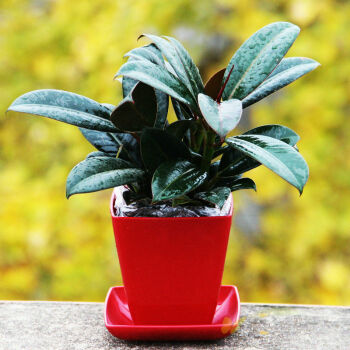
Black Prince rubber plant pictures: care methods and precautions for the Black Prince rubber plant
1. Fertilizing. Fertilizing the Black Prince rubber plant should be mainly nitrogen-based, with a small amount of phosphorus and potassium fertilizer. You can use fermented soybean water or soybean cake water, diluted and poured at the roots; a concentration of 20% is generally sufficient. You can also use inorganic fertilizers such as urea, but apply little and often, do not apply concentrated fertilizer, and avoid burning the roots.
2. Soil. When potting the Black Prince rubber plant, it is best to use 1 part leaf mold, 1 part garden soil and 1 part river sand, plus a small amount of base fertilizer, mixed into a growing medium. It grows very fast in a hot and humid environment, producing one leaf every 5-10 days, and during this period adequate fertilizer and water must be ensured.
3. Light. The Black Prince rubber plant likes strong sunlight; throughout the growing season from spring to autumn it should be placed in sunlight for cultivation, and in winter it should also be placed in a brighter spot; but it can also tolerate shade, and grows fairly well when cultivated indoors in low light.
4. Temperature. The suitable growing temperature for the Black Prince rubber plant is between 20-30°C, and it grows most luxuriantly at 25-30°C. Below 10°C growth is poor, and below 0°C it is prone to frost damage. Indoors, if the Black Prince rubber plant is exposed to cold drafts, yellowing and leaf drop will occur.
5. Watering. The Black Prince rubber plant likes water, but does not tolerate waterlogging; when waterlogging occurs, the roots cannot get oxygen, and yellowing and leaf drop will result. Watering should follow the principle of "water when dry, dry out between waterings"; do not water too frequently. In winter it should overwinter indoors, generally watered once a week; in summer it should be decided according to the weather and the moisture of the potting soil!
6. Pruning. To make the Black Prince rubber plant grow evenly and maintain a good plant shape, when the seedling reaches a height of 50-80 cm it should be pinched back to encourage side branches to sprout; after the side branches grow, select 3-5 branches, then shorten the side branches once a year; after 2-3 years you can obtain a larger plant with a complete, rounded and full shape.
7. Pest control. Under normal care, the Black Prince rubber plant has very few pests and diseases; only when cared for indoors in winter will red spider mites and scale insects appear, and these can be controlled by spraying specific pesticides, such as dicofol (red spider mites) and methidathion (scale insects).
Black Prince rubber plant pictures: care methods for the Black Prince rubber plant
The Black Prince rubber plant is a new variety derived from the rubber plant. It is a common foliage plant, deeply loved by gardening enthusiasts and consumers alike; it can often be seen in homes, hotels, halls and other places. So how do you care for this Black Prince rubber plant? Below, the editor will explain the care methods for the Black Prince rubber plant.Introduction to the Black Prince rubber plantThe Black Prince rubber plant has graceful and substantial leaf form, is robust by nature, and can grow all year round. The name "Black Prince" sounds somewhat masculine, but its red leaf sheaths are like a shy young girl, bright red as if about to drip, revealing charm within its masculinity.
Care methods for the Black Prince rubber plant1. Fertilizing. Fertilizing the Black Prince rubber plant should be mainly nitrogen-based, with a small amount of phosphorus and potassium fertilizer. You can use fermented soybean water or soybean cake water, diluted and poured at the roots; a concentration of 20% is generally sufficient. You can also use inorganic fertilizers such as urea, but apply little and often, do not apply concentrated fertilizer, and avoid burning the roots.2. Soil. When potting the Black Prince rubber plant, it is best to use 1 part leaf mold, 1 part garden soil and 1 part river sand, plus a small amount of base fertilizer, mixed into a growing medium. It grows very fast in a hot and humid environment, producing one leaf every 5-10 days, and during this period adequate fertilizer and water must be ensured.3. Light. The Black Prince rubber plant likes strong sunlight; throughout the growing season from spring to autumn it should be placed in sunlight for cultivation, and in winter it should also be placed in a brighter spot; but it can also tolerate shade, and grows fairly well when cultivated indoors in low light.4. Temperature. The suitable growing temperature for the Black Prince rubber plant is between 20-30°C, and it grows most luxuriantly at 25-30°C. Below 10°C growth is poor, and below 0°C it is prone to frost damage. Indoors, if the Black Prince rubber plant is exposed to cold drafts, yellowing and leaf drop will occur.5. Watering. The Black Prince rubber plant likes water, but does not tolerate waterlogging; when waterlogging occurs, the roots cannot get oxygen, and yellowing and leaf drop will result. Watering should follow the principle of "water when dry, dry out between waterings"; do not water too frequently. In winter it should overwinter indoors, generally watered once a week; in summer it should be decided according to the weather and the moisture of the potting soil!6. Pruning. To make the Black Prince rubber plant grow evenly and maintain a good plant shape, when the seedling reaches a height of 50-80 cm it should be pinched back to encourage side branches to sprout; after the side branches grow, select 3-5 branches, then shorten the side branches once a year; after 2-3 years you can obtain a larger plant with a complete, rounded and full shape.7. Pest control. Under normal care, the Black Prince rubber plant has very few pests and diseases; only when cared for indoors in winter will red spider mites and scale insects appear, and these can be controlled by spraying specific pesticides, such as dicofol (red spider mites) and methidathion (scale insects).
How do you care for the Black Prince rubber plant? Care methods and precautions for the Black Prince rubber plant!
The Black Prince rubber plant is actually a very good office green plant and indoor home greenery decorative flower, with high ornamental value, much loved by people, and very widely used. Today the editor of Huinongwang will tell you about the care methods and precautions for the Black Prince rubber plant, and hopes it will be of some help to you!
In the process of caring for the rubber plant, the biggest problem you may encounter is probably its shape. It is always twisted this way and that, leaning east and west, and you do not know how the rubber plant should be pruned, or why it inexplicably drops leaves. So today the editor of Huinongwang will talk about the care techniques for the rubber plant.
I. Brief introduction to the rubber plant
If you want to grow a potted plant well, you must first understand this potted plant's background, where it comes from, and its temperament.
The rubber plant is also called the Black Prince rubber plant, or rubber tree, and belongs to the evergreen large trees. Its hometown (place of origin) is Brazil, and it is now widely cultivated in subtropical regions. The rubber plant likes a hot, humid environment with plenty of sunlight, but avoids direct strong light; the rubber plant can also tolerate shade, so many people grow the rubber plant indoors.
The rubber plant likes slightly acidic, fertile soil, and avoids clay soil. The rubber plant has a prominent trunk and rarely branches naturally; its leaves are thick and leathery, and it has a certain tolerance for dry air
II. Care methods for the rubber plant
As for the care methods for the rubber plant, the editor of Huinongwang still follows 5 steps.
1. Potting soil:
The rubber plant avoids clay soil; when potting, choose a loose, breathable, slightly acidic humus soil, which can be prepared with garden soil : leaf mold : river sand at 2:2:1. For balcony growers, garden soil may be harder to obtain, so you can use peat : leaf mold : perlite at 2:2:1, adding a small amount of organic fertilizer as base fertilizer. Many people like to spread stones or moss on the surface of the flowerpot; the editor of Huinongwang personally does not recommend top dressing, especially for beginners, who already have trouble judging watering, and after covering the pot surface it becomes even harder to observe the dryness and moisture of the potting soil, while the covering also has a fairly large impact on the wet-dry cycle of the potting soil. It is still best to choose carefully.
2. Placement (light):
The placement of the rubber plant directly affects its form. Many flower lovers like to keep the rubber plant indoors under bright scattered light, and after a period of time they find that the rubber plant's branches are very long, tend to fall over, and are not upright enough. This is often due to leggy growth caused by insufficient light. The rubber plant likes an environment with plenty of sunlight; although it tolerates shade, growing it long-term in an environment without direct light will cause the rubber plant to become leggy, with sparse leaves and softened branches. It is just like us people who sit in offices long-term; we certainly have less strength than people who work outdoors, and the principle is actually the same. Without direct sunlight, light is insufficient, the branches of the rubber plant do not lignify enough and so are relatively soft, prone to drooping and leaning. It is best to keep the rubber plant in a position toward the inner part of a south-facing balcony, so that there is both slanted direct light and avoidance of the strong direct light at noon, which lets the rubber plant grow robustly, with dense, deep green leaves.
3. Water and fertilizer management:
The rubber plant grows vigorously in spring, summer and autumn; along with watering, apply a liquid fertilizer once every 10-15 days, alternating pure nitrogen fertilizer with nitrogen-phosphorus-potassium compound fertilizer. This can promote the growth of the rubber plant. After the beginning of autumn, increase the application of phosphorus and potassium fertilizer to improve the plant's resistance and prepare for safe overwintering. When watering, you must not do it arbitrarily, watering whenever you feel like it; during the growing season it is best to keep the potting soil moist, and if you cannot judge it well, then wait until the surface of the potting soil is dry before watering, and water thoroughly each time. In winter, keep the rubber plant's potting soil on the dry side, otherwise it is prone to freezing to death.
4. Temperature:
The rubber plant can grow well even at temperatures above 30°C, so in spring, summer and autumn you do not need to worry about the effect of temperature; in summer just be careful not to expose it to scorching sun. If it is really too hot and you feel sorry for it, then give it some air conditioning. The main issue is winter; the rubber plant, like other indoor foliage plants, is not cold-tolerant, and in winter requires above 5°C. Alas, with so many pots of non-cold-tolerant green plants, how will the editor of Huinongwang get through winter, alas!
Actually, although it is said to require above 5°C, the editor of Huinongwang personally feels that as long as water is controlled well, a short period of cold can also be survived, though of course there is some difficulty. The editor of Huinongwang once successfully overwintered the extremely non-cold-tolerant bougainvillea in an environment of -10°C for a continuous week, and the secret was controlling water.
Personally, I suggest that if your home is relatively cold in winter, you should try to keep the potting soil dry, and take some insulation measures at night; if it is really too cold and there is no heating, then you can only buy it again next year.
5. Pruning:
The rubber plant is a child with very poor self-control; if you do not manage it, the possibility of it branching and flourishing on its own is very small. Therefore, during its growth process, it must be managed. Pinch back and prune it according to the trunk height you want, to encourage branching.
Some flower lovers cannot bear to prune at first, and only reluctantly prune after it has grown very, very tall. The editor of Huinongwang suggests that you pinch back and prune the rubber plant promptly when it grows to a height of 1 m, because the rubber plant's leaves are very large, and if it branches after growing too tall, the future trunk will bear a great deal of pressure. Of course, if you want a shorter plant shape, you can also pinch back at the height you want.
In addition to pinching back to encourage branching, for established plants you should also carry out full pruning in spring, cutting away the branches inside the crown; dead branches and thin, weak branches should also be cut away, and at the same time overly vigorous shoots that stick out their heads should be shortened, to maintain the plant shape.
Furthermore, throughout the entire growth process, you should also cut away overly dense branches at any time, and shorten leggy branches.
III. Precautions for caring for the rubber plant
In the process of caring for the rubber plant, the main things to pay attention to are the following 4 points:
1. Appropriate light: if it does not get sunlight for a long time, the rubber plant's branches will become weak and leggy, and the shape will not look good.
2. Timely pruning: during the growing season, pinch back promptly to encourage branching, and for established plants promptly cut away inner branches to increase the plant's airiness.
3. Overwintering: control water and keep warm. The rubber plant is not cold-tolerant, and in winter it must be kept warm, preferably maintained above 5°C. Strictly control watering.
4. Disease control: the rubber plant is prone to anthracnose in summer, so pay attention to good ventilation of the environment; in summer, during the season of high anthracnose incidence, you can use fungicides such as thiophanate-methyl and zineb for control.
The above are the care methods and precautions for the Black Prince rubber plant. Friends who like growing flowers, be sure to save this!