How to Grow Clivia nobilis? Detailed Care Methods and Tips
How to Grow Clivia nobilis
Clivia nobilis is suited to soil rich in humus. This kind of soil has good air permeability and good water permeability, and the soil is fertile with a slightly acidic pH of 6.5. Mixing about 20% sand grains into the humus soil is beneficial for root growth. When cultivating, use pots that gradually increase in size as the plant grows. For growing one-year-old seedlings, a 3-inch pot is suitable. In the second year, switch to a 5-inch pot, and thereafter repot into a pot one size larger every 1-2 years. Repotting can be done in spring and autumn.
Planting
Use small offset seedlings and plant them in early spring from February to May into pots filled with nutrient soil. Generally, a flower pot with a diameter of 25 cm holds only 1 plant. If the seedling does not have a well-developed bulb, first plant it in sandy soil, and after the root system is well developed, transplant it into a pot. This is because planting it directly into the prepared final pot is not good for rooting. If you cannot find sandy soil, you can also plant it directly into the pot, but it will just take a little longer. Bulbs sown generally sprout 20-25 days after sowing; for seeds, first soak the seeds in warm water at about 40°C for about 24 hours. Sow the seeds 0.5-1 cm below the surface, placing the seeds with the seed hole facing down and the dorsal-ventral side facing up. After watering thoroughly, it is best to cover with plastic film or glass to help raise the soil temperature and promote seed germination. If the temperature is too low, the seeds may not emerge for a long time and are prone to rotting. At a temperature of about 20°C, they sprout in about 60 days. Seedlings grown from seed must be cultivated for 3-5 years before they can bloom.
Fertilizing
Clivia nobilis likes fertilizer, but too much fertilizer can cause root rot. In addition to applying base fertilizer, topdressing for Clivia nobilis should follow the method of "light fertilizer, frequent application." Apply base fertilizer when repotting. In spring and autumn, apply fermented solid fertilizer once a month, and apply liquid fertilizer once a week. It is best not to topdress, and the whole plant can rely on the nutrients accumulated in spring and autumn to grow slowly. When applying solid fertilizer, pull back the potting soil and bury it 2 cm deep into the soil; do not let it directly touch the roots to avoid burning them. When applying liquid fertilizer, for small seedlings a fertilizer-to-water ratio of 1:40 is better, and for large and medium plants 1:20 is better. The best time to fertilize is early morning, and avoid splashing it onto the leaves. After applying liquid fertilizer, water once promptly, but the water does not need to be too much. On one hand, it dissolves the fertilizer; on the other hand, it can rinse the newly grown fleshy roots to prevent damage to new roots. Depending on the season, the type of fertilizer should be emphasized differently. In winter and spring, apply more phosphorus and potassium fertilizers, such as bone meal; in autumn, apply more nitrogen fertilizer, such as soybean cake water; in summer, foliar feeding is commonly used, spraying the leaves with 0.1% monopotassium phosphate or superphosphate. Foliar feeding can be carried out in all four seasons.
Light
Throughout the entire cultivation process, try not to let the plant receive direct sunlight. About four hours a day under diffused sunlight is enough. Too strong light will make the leaves narrower. In summer, Clivia nobilis avoids high temperatures and intense sunlight, so it should be placed in an environment with higher air humidity and shade, with attention to ventilation. In winter, Clivia nobilis fears cold, so it should be moved indoors to a well-lit position; a room temperature of about 5°C is enough for it to overwinter safely. If conditions permit, it is best to keep the ambient temperature stable between 15-25°C.
Temperature
The suitable temperature for Clivia is 15-20°C. Above 25°C, the plant grows poorly, often showing excessive leaf growth that affects flower bud differentiation; at this time, pay attention to ventilation and cooling. Below 10°C, growth is slow; below 0°C, the plant will freeze to death. In summer, pay attention to cooling, which can promote flower bud differentiation. A large day-night temperature difference is beneficial to the growth of Clivia, generally 6-10°C is suitable.
The leaves grow diagonally upward to both sides and are arranged in a fan shape. During care, you can adjust the direction of light so that the direction in which the leaves extend is parallel to the direction of the light, that is, make the tips of the leaves on one side point toward the light source, or toward the window indoors, and rotate the pot 180 degrees every week so that the tips of the leaves on the other side point toward the window. In this way, the continuously growing leaves can be arranged neatly, looking like an open fan from the front and like a line from the side. You can also, after the sown seedlings have grown for one year, bend wire into a shaped frame and place the leaves inside it for control, then remove the wire frame after one year. This can prevent the leaves from growing crooked. If afterward a few individual leaves still lean, you can make a paper sleeve from black paper and cover them with it, and they will naturally straighten within 10-15 days.
The editor tells everyone that the main value of Clivia nobilis is that it is elegant and solemn, with long narrow leaves; the flower stalk is slightly shorter than the leaves, and the orange-yellow flowers droop downward in a barrel shape when open. It is a potted flower used to decorate venues during the Spring Festival, adorn hotels, and beautify the home environment.
Clivia nobilis Clivia nobilis Lindl. Clivia nobilis illustrated guide: how to grow Clivia nobilis / how to propagate Clivia nobilis
Clivia nobilis profileClivia nobilis Clivia nobilis Lindl.
Aliases:
Classification: Orchidaceae flowers
Family and genus: Plantae, Angiosperms, Monocotyledons, Asparagales, Amaryllidaceae, Clivia
Full bloom period: winter, spring
Clivia nobilis (scientific name: Clivia nobilis Lindl.) is a plant of the genus Clivia in the Amaryllidaceae family. It is distributed in southern Africa and in Hubei Province and other areas of mainland China, and has been introduced and cultivated artificially. The plant grows 38 cm tall, with drooping orange-yellow flowers tinged with a bit of pale green, long narrow leaves, and a flower stalk slightly shorter than the leaves. The leaf color is deep green, and its appearance is elegant and solemn.
Cultivation methods and precautions for Clivia nobilis Introduction to Clivia nobilis
Clivia nobilis (scientific name: Clivia nobilis Lindl.) is a plant of the genus Clivia in the Amaryllidaceae family. It is distributed in southern Africa and in Hubei Province and other areas of mainland China, and has been introduced and cultivated artificially. The plant grows 38 cm tall, with drooping orange-yellow flowers tinged with a bit of pale green, long narrow leaves, and a flower stalk slightly shorter than the leaves. The leaf color is deep green, and its appearance is elegant and solemn.
Morphological characteristics of Clivia nobilis
Clivia nobilis is a perennial herb. The roots are fleshy and grayish white.
The persistent leaf bases at the stem base of Clivia nobilis are bulb-like. There are about a dozen basal leaves, thick, dark green, glossy, strap-shaped, 25-40 cm long, 3-3.5 cm wide, with rough edges.
The flower stalk of Clivia nobilis emerges from the leaf cluster and is slightly shorter than the leaves; the umbel is terminal, with about 10-30 small flowers, each small flower having 6 petals, 6 stamens, and 1 pistil.
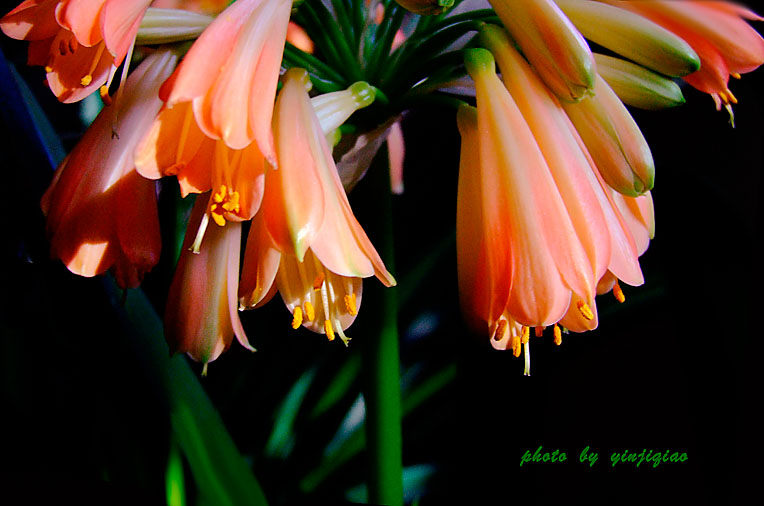
The flower colors of Clivia nobilis include orange-yellow, orange-red, deep red, and so on. It is many-flowered, and the flowers droop slightly when blooming; the perianth is narrowly funnel-shaped and orange-red, with the inner whorl tepals lighter in color; the stamens are nearly as long as the perianth; the style is long and slightly extends beyond the perianth.
The flowering period of Clivia nobilis is from December to May of the following year, and the flowering period lasts as long as 30-50 days. Cross-pollination; the berry and fruit are green when immature, and the seeds take 8-9 months to mature.
Ecological habits of Clivia nobilis
Clivia nobilis likes a warm and cool environment. It needs sufficient sunlight in winter and slight shading in summer. It requires loose, fertile leaf mold soil. When the winter room temperature is below 5°C, growth stops, or when the summer temperature is above 30°C, the flowering time is short and the color is pale.
Clivia nobilis requires air humidity of 70%-80% and soil moisture content of 20%-30%. Too much soil moisture easily causes root rot.
Cultivation techniques for Clivia nobilis Propagation
Propagation by division and sowing. For division, after flowering each spring, remove the offsets beside the mother plant and plant them separately. If the offset has no fleshy roots, first insert it into sand, and pot it after it has rooted.
For sowing, sow in pots indoors in winter; the room temperature must be above 20°C, otherwise the seeds easily rot. They sprout 20-25 days after sowing, and seedlings grown from seed must be cultivated for 4-5 years before they can bloom.
Soil
Clivia nobilis is suited to soil rich in humus. This kind of soil has good air permeability and good water permeability, and the soil is fertile with a slightly acidic pH of 6.5.
Mixing about 20% sand grains into the humus soil is beneficial for root growth. When cultivating, use pots that gradually increase in size as the plant grows. For growing one-year-old seedlings, a 3-inch pot is suitable.
In the second year, switch to a 5-inch pot, and thereafter repot into a pot one size larger every 1-2 years. Repotting can be done in spring and autumn.
Planting
Use small offset seedlings and plant them in early spring from February to May into pots filled with nutrient soil. Generally, a flower pot with a diameter of 25 cm holds only 1 plant.
If the seedling does not have a well-developed bulb, first plant it in sandy soil, and after the root system is well developed, transplant it into a pot.
This is because planting it directly into the prepared final pot is not good for rooting. If you cannot find sandy soil, you can also plant it directly into the pot, but it will just take a little longer.
Bulbs sown generally sprout 20-25 days after sowing; for seeds, first soak the seeds in warm water at about 40°C for about 24 hours. Sow the seeds 0.5-1 cm below the surface, placing the seeds with the seed hole facing down and the dorsal-ventral side facing up. After watering thoroughly, it is best to cover with plastic film or glass to help raise the soil temperature and promote seed germination; if the temperature is too low, the seeds may not emerge for a long time and are prone to rotting. At a temperature of about 20°C, they sprout in about 60 days. Seedlings grown from seed must be cultivated for 3-5 years before they can bloom.
Fertilizing
Clivia nobilis likes fertilizer, but too much fertilizer can cause root rot. In addition to applying base fertilizer, topdressing should follow the method of "light fertilizer, frequent application." Apply base fertilizer when repotting.
In spring and autumn, apply fermented solid fertilizer once a month, and apply liquid fertilizer once a week. It is best not to topdress, and the whole plant can rely on the nutrients accumulated in spring and autumn to grow slowly. When applying solid fertilizer, pull back the potting soil and bury it 2 cm deep into the soil; do not let it directly touch the roots to avoid burning them. When applying liquid fertilizer, for small seedlings a fertilizer-to-water ratio of 1:40 is better, and for large and medium plants 1:20 is better. The best time to fertilize is early morning, and avoid splashing it onto the leaves. After applying liquid fertilizer, water once promptly, but the water does not need to be too much. On one hand, it dissolves the fertilizer; on the other hand, it can rinse the newly grown fleshy roots to prevent damage to new roots.
Depending on the season, the type of fertilizer should be emphasized differently. In winter and spring, apply more phosphorus and potassium fertilizers, such as bone meal; in autumn, apply more nitrogen fertilizer, such as soybean cake water;
In summer, foliar feeding is commonly used, spraying the leaves with 0.1% monopotassium phosphate or superphosphate. Foliar feeding can be carried out in all four seasons.
Light
Throughout the entire cultivation process, try not to let the plant receive direct sunlight. About four hours a day under diffused sunlight is enough. Too strong light will make the leaves narrower.
In summer, Clivia nobilis avoids high temperatures and intense sunlight, so it should be placed in an environment with higher air humidity and shade, with attention to ventilation.
In winter, Clivia nobilis fears cold, so it should be moved indoors to a well-lit position; a room temperature of about 5°C is enough for it to overwinter safely.
If conditions permit, it is best to keep the ambient temperature stable between 15-25°C.
Temperature
The suitable temperature for Clivia is 15-20°C. Above 25°C, the plant grows poorly, often showing excessive leaf growth that affects flower bud differentiation; at this time, pay attention to ventilation and cooling. Below 10°C, growth is slow; below 0°C, the plant will freeze to death.
In summer, pay attention to cooling, which can promote flower bud differentiation. A large day-night temperature difference is beneficial to the growth of Clivia, generally 6-10°C is suitable.
The leaves grow diagonally upward to both sides and are arranged in a fan shape. During care, you can adjust the direction of light so that the direction in which the leaves extend is parallel to the direction of the light, that is, make the tips of the leaves on one side point toward the light source, or toward the window indoors, and rotate the pot 180 degrees every week so that the tips of the leaves on the other side point toward the window.
In this way, the continuously growing leaves can be arranged neatly, looking like an open fan from the front and like a line from the side.
You can also, after the sown seedlings have grown for one year, bend wire into a shaped frame and place the leaves inside it for control, then remove the wire frame after one year. This can prevent the leaves from growing crooked. If afterward a few individual leaves still lean, you can make a paper sleeve from black paper and cover them with it, and they will naturally straighten within 10-15 days.
Watering
Potted plants should not be watered too much; just keep them moist. During the plum rain season in May-June, prevent rain from washing over them, so as to avoid root and leaf diseases and rot.
During the high-temperature period in summer, pay attention to spraying water to cool down. In autumn, topdress appropriately to promote leaf growth. In winter, heating and keeping the soil moist are beneficial for flowering.
Pest and disease control for Clivia nobilis
The main diseases of Clivia nobilis include soft rot, anthracnose, leaf spot, and southern blight, and the main pests are scale insects.
Blight spot disease
It mainly harms the leaves. Initially, light reddish-brown, elliptical elongated spots appear, with a clear boundary between diseased and healthy tissue, and the surrounding tissue turns yellow.
Remove diseased leaves promptly when found; appropriately increase potassium fertilizer and avoid excessive watering that leaves water standing on the leaves; in the early stage of the disease, spray with 50% carbendazim wettable powder at 1000 times dilution.
Root rot disease (soft rot)
During cultivation, tools and substrate must be strictly disinfected; in the early stage of the disease, drench the roots with 400-600 μg/L penicillin or streptomycin.
In severe cases, cut off all the rotten parts, soak the remaining parts in potassium permanganate solution for 1 hour, then wash them clean with clear water and replant.
Sunscald
The leaves all turn yellow, caused by long periods of strong direct light in summer. Shaded cultivation should be adopted, and leaves that have already turned yellow can be cut off.
Anthracnose
This disease mostly occurs in rainy and humid seasons, and the lesions are mostly at the edges of the middle and lower leaves. In the early stage of the disease, moist brown small spots appear on the leaves, which then gradually expand into elliptical lesions, and concentric ring patterns form on the lesions. In the later stage, the lesions dry up, and many small black dots are scattered on them.
For control methods, first, in late autumn or early spring, remove dead branches and fallen leaves and promptly cut off diseased branches, and burn them together;
second, before the disease occurs, spray with 65% zineb at 600 times dilution for protection;
third, fertilize and water reasonably, and pay attention to ventilation and light transmission;
fourth, in the early stage of the disease, spray with 50% carbendazim diluted 500-800 times, or 50% thiophanate liquid, or 75% chlorothalonil liquid diluted 600-800 times.
"Jiajian" disease
During cultivation, Clivia nobilis often shows the phenomenon that after forming buds it cannot send out the flower scape and cannot bloom, which is called "jiajian."
This is related to temperature and fertilizer. The main cause of jiajian is unsuitable temperature.
The flowering period of Clivia nobilis is mostly from December to March of the following year. If the room temperature at this time is below 14°C and the day-night temperature difference is also very small, the flower scape grows slowly after emerging, causing the jiajian phenomenon.
The solution is: when the flower scape shows its head, immediately raise the room temperature to above 20°C, and at night the room temperature is best around 12°C, so that the day-night temperature difference reaches above 18°C, which can prevent jiajian.
You can also pour warm water at 25°C into the soil to urge the scape. When the room temperature is too low, you can make a frame from plastic film and cover it over the flower pot, place it in the sun, to increase the temperature and urge the "scape."
Improper fertilizer and water management can also cause the "jiajian" phenomenon, so sufficient fertilizer should be applied before flowering to promote the growth of flower buds and flower scapes with enough nutrients.
When the flower scape is growing, it needs enough water to elongate quickly, so from when the flower scape shows its head until before flowering, the soil should be kept moist and a small amount of liquid fertilizer should be applied.
Scale insects
Manual control can be used, using bamboo sticks, small wooden sticks, small soft brushes, etc., to gently brush off the insects and sooty mold, then wash clean with clear water. During the nymph stage, spray with jiemanling emulsion at 40-100 times dilution.
Distribution area of Clivia nobilis
Clivia nobilis is native to southern Africa.
Clivia nobilis is planted most in Beijing and nearby areas in China. It is mostly introduced and cultivated for ornamental purposes.
Uses and purposes of Clivia nobilis
Clivia nobilis is elegant and solemn, with long narrow leaves; the flower stalk is slightly shorter than the leaves, and the orange-yellow flowers droop downward in a barrel shape when open. It is a potted flower used to decorate venues during the Spring Festival, adorn hotels, and beautify the home environment.
Flower language of Clivia nobilis
Clivia nobilis represents nobility and the demeanor of a gentleman.
The thick, smooth leaves of Clivia nobilis stand upright like swords, symbolizing a noble character of strength, fortitude, and unyielding dignity.
The full flower appearance and gorgeous colors of Clivia nobilis symbolize wealth and good fortune, prosperity, and happiness, so people cultivate it widely.
In China, in recent years, more than 160 precious Clivia varieties have been cultivated, and it is a common flower variety in ordinary households.
Clivia nobilis pictures
How to grow Clivia nobilis, cultivation methods, pest and disease control
Clivia nobilis is a plant of the genus Clivia in the Amaryllidaceae family. It is distributed in southern Africa and in Hubei Province and other areas of mainland China, and has been introduced and cultivated artificially. Below, the editor will explain how to grow Clivia nobilis, and present the cultivation methods and pest and disease control of Clivia nobilis.
Introduction to Clivia nobilis
Clivia nobilis (scientific name: Clivia nobilis Lindl.) is a plant of the genus Clivia in the Amaryllidaceae family. It is distributed in southern Africa and in Hubei Province and other areas of mainland China, and has been introduced and cultivated artificially. The plant grows 38 cm tall, with drooping orange-yellow flowers tinged with a bit of pale green, long narrow leaves, and a flower stalk slightly shorter than the leaves. The leaf color is deep green, and its appearance is elegant and solemn.
I. Morphological characteristics
Clivia nobilis is a perennial herb. The roots are fleshy and grayish white.
The persistent leaf bases at the stem base of Clivia nobilis are bulb-like. There are about a dozen basal leaves, thick, dark green, glossy, strap-shaped, 25-40 cm long, 3-3.5 cm wide, with rough edges. The flower stalk of Clivia nobilis emerges from the leaf cluster and is slightly shorter than the leaves; the umbel is terminal, with about 10-30 small flowers, each small flower having 6 petals, 6 stamens, and 1 pistil. The flower colors of Clivia nobilis include orange-yellow, orange-red, deep red, and so on. It is many-flowered, and the flowers droop slightly when blooming; the perianth is narrowly funnel-shaped and orange-red, with the inner whorl tepals lighter in color; the stamens are nearly as long as the perianth; the style is long and slightly extends beyond the perianth.
The flowering period of Clivia nobilis is from December to May of the following year, and the flowering period lasts as long as 30-50 days. Cross-pollination; the berry and fruit are green when immature, and the seeds take 8-9 months to mature.
II. Ecological habits
Clivia nobilis likes a warm and cool environment. It needs sufficient sunlight in winter and slight shading in summer. It requires loose, fertile leaf mold soil. When the winter room temperature is below 5°C, growth stops, or when the summer temperature is above 30°C, the flowering time is short and the color is pale.
Clivia nobilis requires air humidity of 70%-80% and soil moisture content of 20%-30%. Too much soil moisture easily causes root rot.
How to Grow Clivia nobilis
I. Cultivation methods
1. Propagation
Propagation by division and sowing. For division, after flowering each spring, remove the offsets beside the mother plant and plant them separately. If the offset has no fleshy roots, first insert it into sand, and pot it after it has rooted.
For sowing, sow in pots indoors in winter; the room temperature must be above 20°C, otherwise the seeds easily rot. They sprout 20-25 days after sowing, and seedlings grown from seed must be cultivated for 4-5 years before they can bloom.
2. Soil
Clivia nobilis is suited to soil rich in humus. This kind of soil has good air permeability and good water permeability, and the soil is fertile with a slightly acidic pH of 6.5.
Mixing about 20% sand into the leaf mold helps promote healthy root growth. During cultivation, the pot size should be increased gradually as the plant grows; for one-year-old seedlings, a 3-inch pot is suitable.
In the second year, repot into a 5-inch pot, and thereafter repot into a pot one size larger every 1-2 years. Repotting can be done in spring or autumn.
3. Planting
Plant small offset seedlings into pots filled with nutrient soil in early spring from February to May. Generally, a pot with a diameter of 25 cm holds only 1 plant.
If the seedlings do not have well-developed bulbs, plant them in sandy soil first, and transplant them into pots after a good root system has developed.
This is because planting them directly into the prepared permanent pot makes rooting difficult. If sandy soil is not available, they can also be planted directly into the pot, though it will take a little longer.
Bulbs sown generally sprout 20-25 days after sowing; for seeds, first soak them in warm water at about 40°C for about 24 hours, then sow the seeds 0.5-1 cm below the soil surface, placing them with the seed pore facing downward and the dorsal side facing upward. After watering thoroughly, it is best to cover with plastic film or glass to help raise the soil temperature and promote seed germination; if the temperature is too low, the seeds may fail to emerge for a long time and are prone to rotting. At a temperature of about 20°C, they germinate in about 60 days. Seedling plants must be grown for 3-5 years before they can bloom.
4. Fertilizing
The weeping clivia (Clivia nobilis) loves fertilizer, but too much fertilizer can cause root rot. In addition to applying base fertilizer, topdressing should follow the method of "light fertilizer, frequent application." Apply base fertilizer when repotting.
In spring and autumn, apply fermented solid fertilizer once a month, and apply liquid fertilizer once a week. It is best not to topdress in winter; the whole plant can rely on the nutrients accumulated in spring and autumn for slow growth. When applying solid fertilizer, pull back the potting soil and bury it 2 cm deep into the soil, without directly touching the roots to avoid burning them; when applying liquid fertilizer, for small seedlings a fertilizer-to-water ratio of 1:40 is better, and for large and medium plants 1:20 is better. The best time to fertilize is early morning, and avoid splashing it onto the leaves. After applying liquid fertilizer, water once promptly, but not too much water; on the one hand it dissolves the fertilizer, and on the other hand it can rinse the newly grown fleshy roots to prevent damage to the new roots.
The type of fertilizer varies by season. In winter and spring, apply more phosphorus and potassium fertilizers, such as bone meal; in autumn, apply more nitrogen fertilizer, such as soybean cake water.
In summer, foliar topdressing is commonly used, spraying the leaves with 0.1% potassium dihydrogen phosphate or superphosphate. Foliar topdressing can be done in all four seasons of the year.
5. Light
Throughout the cultivation process, try to keep the plant out of direct sunlight; about four hours a day in diffused sunlight is sufficient. Too much light will make the leaves narrower.
The weeping clivia fears high temperatures and direct sun in summer. It should be placed in an environment with higher air humidity and shade, with attention to ventilation.
In winter, the weeping clivia is sensitive to cold. It should be moved indoors to a brightly lit position; a room temperature of about 5°C is enough for it to overwinter safely.
If conditions permit, it is best to keep the ambient temperature stable between 15-25°C.
6. Temperature
The suitable temperature for clivia is 15-20°C. Above 25°C, the plant grows poorly, often with leggy leaves, affecting flower bud differentiation; at this time, pay attention to ventilation and cooling. Below 10°C, growth slows; below 0°C, the plant will freeze to death.
In summer, pay attention to cooling, which can promote flower bud differentiation. A large temperature difference between day and night is beneficial to clivia growth, generally 6-10°C is suitable.
The leaves grow obliquely upward to both sides and are arranged in a fan shape. During care, the direction of light can be adjusted so that the direction in which the leaves extend is parallel to the direction of light, that is, so that the tips of the leaves on one side point toward the light source, and indoors toward the window, and turn the pot 180 degrees every week so that the tips of the leaves on the other side point toward the window.
In this way, the continuously growing leaves can be arranged neatly, looking like an open fan from the front and like a line from the side.
Alternatively, one year after the sown seedlings have grown, a frame bent from galvanized wire can be used to clip the leaves inside for control, and after another year the wire frame can be removed. This can prevent the leaves from growing crooked. If individual leaves later lean to one side, a paper sleeve made of black paper can be used to cover them, and they will naturally straighten within 10-15 days.
7. Watering
Potted plants should not be watered too much; just keep the soil moist. In the plum rain season from May to June, prevent rain from washing over them, so as to avoid root and leaf rot.
During the high-temperature period in summer, pay attention to spraying water to cool down. In autumn, apply appropriate topdressing to promote leaf growth. In winter, warming and keeping the soil moist are beneficial to flowering.
II. Disease Control of the Weeping Clivia
The main diseases of the weeping clivia include soft rot, anthracnose, leaf spot, and southern blight, while the main pests are scale insects.
1. Blight spot disease
It mainly harms the leaves. Initially, light reddish-brown, oval elongated spots appear, with a clear boundary between diseased and healthy tissue, and the surrounding tissue turns yellow.
Remove diseased leaves promptly when found; appropriately increase potassium fertilizer, avoid excessive watering and water accumulation on the leaves; in the early stage of the disease, spray with 50% carbendazim wettable powder at 1000 times dilution.
2. Root rot disease (soft rot)
During cultivation, tools and substrate must be strictly sterilized; in the early stage of the disease, irrigate the roots with 400-600 μg/L penicillin or streptomycin.
In severe cases, cut off all the rotten parts, soak the remaining part in potassium permanganate solution for 1 hour, then wash it clean with water and replant.
3. Sunscald
The leaves all turn yellow, caused by long periods of strong direct light in summer. Shade cultivation should be adopted, and leaves that have already turned yellow can be cut off.
4. Anthracnose
This disease mostly occurs in rainy and humid seasons, and the spots are mostly on the edges of the middle and lower leaves. In the early stage of the disease, moist brown small spots appear on the leaves, then gradually expand into oval spots, and concentric rings form on the spots. In the later stage, the spots dry up and many small black dots are scattered on them.
Control methods: first, in late autumn or early spring, remove dead branches and fallen leaves and promptly cut off diseased branches, and burn them together;
second, before the disease occurs, spray with 65% zineb at 600 times dilution for protection;
third, fertilize and water reasonably, and pay attention to ventilation and light transmission;
fourth, in the early stage of the disease, spray with 50% carbendazim diluted 500-800 times, or 50% thiophanate liquid, or 75% chlorothalonil liquid diluted 600-800 times.
5. "Flower arrow pinching" disease
During cultivation, the weeping clivia often fails to send out the flower scape after budding and cannot bloom; this phenomenon is called "flower arrow pinching."
This is related to temperature and fertilizer. The main cause of flower arrow pinching is unsuitable temperature.
The flowering period of the weeping clivia is mostly from December to March of the following year. If the room temperature at this time is below 14°C and the temperature difference between day and night is also small, the flower scape grows slowly after emerging, causing the flower arrow pinching phenomenon.
The solution is: when the flower scape shows its head, immediately raise the room temperature to above 20°C, and at night the room temperature is best around 12°C, so that the temperature difference between day and night reaches above 18°C, which can prevent flower arrow pinching.
You can also pour 25°C warm water into the soil to urge the arrow. When the room temperature is too low, a frame can be made of plastic film to cover the outside of the pot and placed in the sunlight to increase the temperature and urge the "arrow."
Improper fertilizer and water management can also cause the "flower arrow pinching" phenomenon, so sufficient fertilizer should be applied before flowering to ensure that the flower buds and flower scape have enough nutrients for growth.
When the flower scape grows, sufficient water is needed for it to elongate quickly, so from when the flower scape shows its head until before flowering, the soil should be kept moist and a small amount of liquid fertilizer applied.
6. Scale insects
Manual control can be used: with a bamboo stick, small wooden stick, small soft brush, etc., gently brush off the insect bodies and sooty mold, then wash clean with water. During the nymph stage, spray with jiemanling emulsifiable concentrate at 40-100 times dilution.