What to Do When Cyclamen Leaves Turn Yellow? Cause Analysis and Solutions
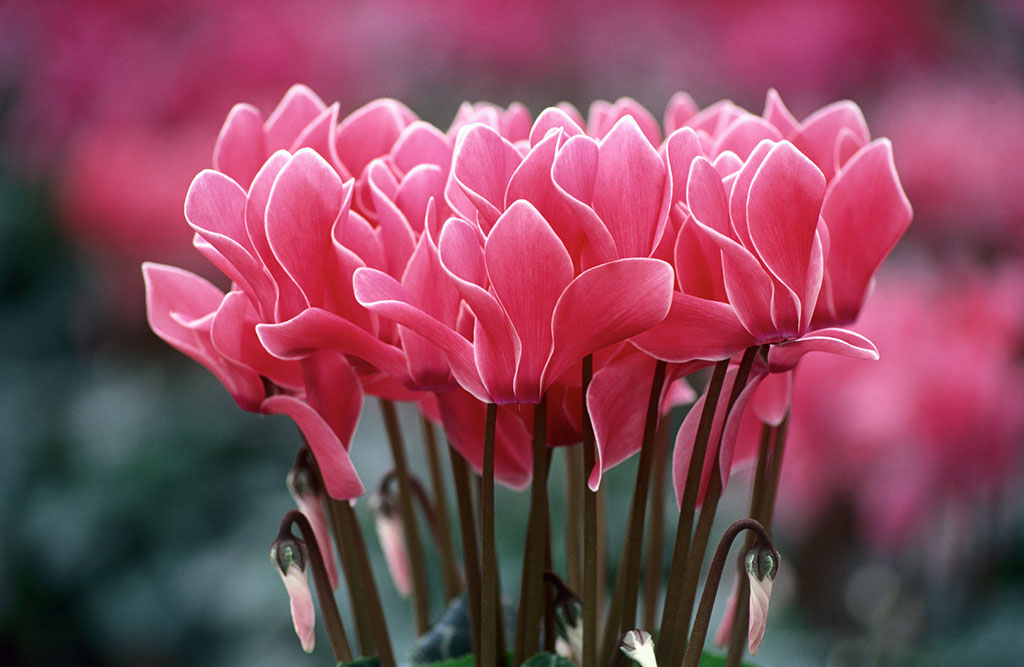
Causes and Solutions for Cyclamen Leaves Turning Yellow
Cyclamen likes light but fears strong light; weak light exposure each day is sufficient. Letting it bake in direct sun will cause the leaves to turn yellow. When cyclamen flowers become paler as they bloom, it is related to insufficient light and insufficient fertilization. Fertilizer must be a specialized fertilizer, otherwise it can also cause leaves to turn yellow. Below we will specifically analyze and solve the problem of cyclamen leaves turning yellow.
7 Possible Reasons for Cyclamen Leaves Turning Yellow
1. Long-term nutrient deficiency:
If nitrogen fertilizer has not been applied for a long time or the pot has not been repotted or the water changed, and the water lacks nitrogen and other nutrients, the branches and leaves become weak, and the leaves become thin and yellow. It is necessary to promptly replace with fresh culture water and gradually increase the application of dilute decomposed liquid fertilizer or compound flower fertilizer.
2. Excessive fertilization:
Too much fertilizer will cause new leaves to be thick and fleshy, with many bumps and uneven surfaces, while old leaves dry at the tips, turn scorched yellow, and drop. Fertilization should be stopped immediately, water replacement increased to leach out the fertilizer, or the plant should be immediately removed from the pot, the bulb rinsed with water, and then replanted in the pot.
3. Hot and high temperatures:
If narcissus is placed in a high-temperature location exposed to direct strong light, it is very likely to cause the tips and edges of young leaves to scorch, or the leaves to turn yellow and drop. It should be promptly moved to a well-ventilated, cool place.
4. Excessive shade:
If narcissus is kept in a shaded place or a place with insufficient light for a long time, the branches and leaves will turn yellow.
5. Alkaline soil and water:
If the growing environment lacks absorbable soluble iron and other elements, the leaves will gradually turn yellow. When planting, choose acidic soil and water, and frequently water with alum fertilizer water during the growing period.
6. Dense and poorly ventilated:
If too much nitrogen fertilizer is applied, the branches and leaves grow excessively lush, and with no pruning for a long time, the inner branches and leaves receive insufficient light, which easily causes leaves to turn yellow and drop. Fertilization should be reasonable and pruning strengthened to allow ventilation and light penetration.
7. Dry air:
When indoor air is excessively dry, narcissus often shows dry leaf tips or scorched leaf edges. Attention should be paid to measures such as misting and covering with plastic film to increase air humidity.
Specific Cases of Cyclamen Leaves Turning Yellow
1. Cyclamen leaves curling and turning yellow
Solution: It is lacking nutrients. Fertilize promptly. Buy specialized fertilizer at a flower shop. Do not over-supplement nutrients to the plant. Usually, a small amount of cooked soybeans, cooked peanuts, bean cake, spoiled steamed buns, etc. can be buried in the pot, so there is no need to worry about nutrient deficiency.
2. Cyclamen flower stems rotting, flowers and leaves turning yellow
Solution: Too much watering. Stop watering, and wait until it heals and the soil dries before watering again.
3. Leaves turn yellow from too much watering; newly grown flower buds wither from too little watering. Solution: In summer, temperatures are high, and cyclamen goes dormant. During dormancy, water as little as possible, just keeping the soil moist, to prevent the roots from rotting due to excess water. When planting, it is best to leave one-third of the bulbous root exposed above the soil surface. When watering, pour directly into the pot, and try not to get water on the leaves and flowers, because cyclamen leaves are round with a concave center that easily holds water, and if not handled properly, water marks remain after evaporation. Over time, the leaf surface cannot breathe well and easily dries and turns yellow, affecting its ornamental value, so it is best to wipe with a soft cloth. When watering, water only when dry and water thoroughly at one time; do not water every day, because cyclamen has a bulbous root with water-storage capacity, and too much water easily causes bud drop. If leaves turn yellow, in spring when the weather is dry, water once every three days; in autumn, watering about once every five days is sufficient.
4. Leaves yellow and dry
Solution: Cyclamen turning yellow and drying out is mainly caused by poor soil aeration and overly dry potting soil. When the temperature is 15-25°C, the soil can be replaced with one that has better aeration, and watering should supply water from the bottom. Water only when the potting soil is dry, and the water temperature should be close to room temperature.
Cyclamen Care (Essential Basic Knowledge)
1. Light: Cyclamen should be placed in well-lit places such as windows and balconies, and the pot position should be changed frequently. Sufficient light makes the flowers more vivid and the leaves more glossy. Although cyclamen belongs to the relatively shade-tolerant Primulaceae family, long-term insufficient light easily causes cyclamen leaves to turn yellow.
2. Water: Watering should be properly controlled; too much water causes root rot. Water again when the flowers and leaves are slightly wilted. Watering can be done by soaking water from the bottom of the pot, and do not pour too much water on the leaf surface.
3. Ventilation: Cyclamen likes ventilation. Smoke, dust, and stale air will cause the petals to dry and wither, but it should not be placed directly in a draft.
4. Temperature: A room temperature above 5°C allows cyclamen to grow normally. When room temperature is on the low side, cyclamen can maintain a longer flowering period, but flowering is slow; when room temperature is on the high side, flowering is faster but the flowering period is shorter.
5. Humidity: Humidity should be maintained at 60%-70%. Too little humidity makes the flowers smaller; too much humidity causes gray mold and other fungal diseases on the petals and leaves. Never spray water on the petals, otherwise the petals will rot.
6. Fertilizer: Fertilize twice a month. Imported or domestic compound fertilizer can be used, 5-8 granules each time, placed 2 cm deep in the substrate.
Causes of Cyclamen Leaves Turning Yellow Solutions for Cyclamen Leaves Turning Yellow
What is going on when cyclamen leaves turn yellow? What methods can solve it? Cyclamen leaves turning yellow is a common problem during cyclamen cultivation, so what are the causes of cyclamen leaves turning yellow? Below, let us look at the causes of cyclamen leaves turning yellow, the solutions, and the correct cultivation methods.
I. Introduction
Also known as radish begonia, rabbit ear flower, rabbit flower, first-rank crown, bonfire flower, and folded-petal lotus, it is a perennial herbaceous plant in the genus Cyclamen of the family Primulaceae. Cyclamen is a commonly grown flower. Cyclamen cultivation methods are suitable for indoor pots, and greenhouse cultivation is required in winter. Some cultivated varieties of cyclamen have a rich fragrance, while others have a faint or no fragrance.
II. Habits
Cyclamen prefers ample sunlight and a warm, humid environment, dislikes heat, and fears waterlogging. The most suitable temperature is 20°C; around 20°C is fine. Above 30°C it easily sheds leaves and goes dormant, and below that the corm is prone to frost damage, so the best cultivation environment for cyclamen in winter is greenhouse growth, requiring loose, fertile soil with good drainage.
III. Causes of Cyclamen Leaves Turning Yellow
Cause 1 of cyclamen leaves turning yellow: Pesticide spray too concentrated. Cyclamen suffering phytotoxicity shows this performance and should be promptly sprayed with clean water to alleviate it.
Cause 2 of cyclamen leaves turning yellow: Sunburn when moved outdoors for ventilation. If the previous care environment had weak or slightly poor light, a sudden change in light conditions will make it unadapted, especially when outdoor temperatures are high (it will go dormant); if the air is also dry, it very easily scorches and yellows.
Cause 3 of cyclamen leaves turning yellow: Caused by drought. When placed outdoors for ventilation, the water in the potting soil is not sufficient. The outdoor high temperature plus overly good ventilation makes the plant lose water quickly.
Cause 4 of cyclamen leaves turning yellow: It does not need repotting now. If it is not given dormancy in summer, repotting should wait until autumn.
IV. Solutions for Cyclamen Leaves Turning Yellow
1. At a temperature of 17°C-18°C, watering cyclamen once every 3 days is sufficient. Wait until the soil dries completely before watering. In addition, to avoid cyclamen leaves turning yellow, be careful not to spray water on cyclamen leaves and flowers.
2. It is recommended that flower lovers who grow cyclamen use purified water or boiled water that has been left to cool for a day to water the flowers after buying cyclamen, and apply specialized fertilizer once every half month. This can effectively prevent cyclamen leaves from turning yellow.
3. After cyclamen leaves turn yellow, the corm can be taken out of the pot and placed in a plastic bag, then put in the refrigerator, but the temperature should not be below 0°C. After the Beginning of Autumn, take out the corm, remove old roots and dead leaves, and replant it in the pot. When new leaves begin to sprout, gradually resume normal water and fertilizer management.
V. Cyclamen Cultivation Methods
Cyclamen light: Cyclamen likes sunlight and should be placed in a sunny place for care. Sufficient light is very beneficial to its growth, but it fears direct strong light in summer.
Cyclamen fertilization: Cyclamen is a fertilizer-loving plant. Each spring and autumn, apply 2‰ potassium dihydrogen phosphate once each. Do not apply nitrogen fertilizer during the flowering period, otherwise it will cause excessive growth of branches and leaves and shorten the life of the flowers.
Cyclamen temperature: Cyclamen is not tolerant of high temperatures. Too high a temperature will cause it to enter a dormant state. Above 30°C the plant stops growing and enters dormancy; above 35°C it easily rots and dies. In winter during the flowering period, the temperature must not be lower than 10°C. If the temperature is too low, the flower color becomes dull and the flowers easily drop. The suitable growth temperature is 15-20°C.
Cyclamen watering: Cyclamen likes moisture and fears waterlogging. Do not water too much; excessive watering causes root rot and death. Just keep the soil moist every day.
Cyclamen pests and diseases: Cyclamen has more diseases than pests. The main diseases are gray mold and soft rot, mostly caused by bacterial infection. The diseased parts show soft rot. Apply thiophanate-methyl or chlorothalonil for prevention.
The above is the relevant introduction in this article. I believe after reading it you also have a simple understanding of this. If needed, you can continue to follow Yihao Home Network to learn more information.
Causes and Treatment Methods for Cyclamen Leaves Turning Yellow, What to Do When Cyclamen Leaves Turn Yellow
Cyclamen Leaves Turning YellowWhat is the cause, and what should be done when cyclamen leaves turn yellow? Below, let us look at the causes and treatment methods for cyclamen leaves turning yellow.
Cyclamen prefers a cool, humid, and sunny environment. The suitable temperature for growth and flower bud differentiation is 15-20°C, with humidity 70%-75%; in winter during the flowering period, the temperature must not be lower than 10°C. If the temperature is too low, the flower color becomes dull and the flowers easily drop; if the summer temperature reaches 28-30°C, the plant goes dormant, and if it reaches above 35°C, the corm easily rots. Seedlings are slightly more heat-tolerant than older plants. It is a day-neutral plant. The suitable light intensity during the growing season is 28000 Lx; below 1500 Lx or above 45000 Lx, the photosynthetic intensity decreases significantly. It requires loose, fertile, humus-rich, well-drained slightly acidic sandy loam. The flowering period is from October to April of the following year.
Cyclamen likes light but fears strong light; weak light exposure each day is sufficient. Letting it bake in direct sun will cause the leaves to turn yellow. When cyclamen flowers become paler as they bloom, it is related to insufficient light and insufficient fertilization. Fertilizer must be a specialized fertilizer, otherwise it can also cause leaves to turn yellow. Below we will specifically analyze and solve the problem of cyclamen leaves turning yellow.
7 Possible Reasons for Cyclamen Leaves Turning Yellow
1. Long-term nutrient deficiency:
If nitrogen fertilizer has not been applied for a long time or the pot has not been repotted or the water changed, and the water lacks nitrogen and other nutrients, the branches and leaves become weak, and the leaves become thin and yellow. It is necessary to promptly replace with fresh culture water and gradually increase the application of dilute decomposed liquid fertilizer or compound flower fertilizer.
2. Excessive fertilization:
Too much fertilizer will cause new leaves to be thick and fleshy, with many bumps and uneven surfaces, while old leaves dry at the tips, turn scorched yellow, and drop. Fertilization should be stopped immediately, water replacement increased to leach out the fertilizer, or the plant should be immediately removed from the pot, the bulb rinsed with water, and then replanted in the pot.
3. Hot and high temperatures:
If narcissus is placed in a high-temperature location exposed to direct strong light, it is very likely to cause the tips and edges of young leaves to scorch, or the leaves to turn yellow and drop. It should be promptly moved to a well-ventilated, cool place.
4. Excessive shade:
If narcissus is kept in a shaded place or a place with insufficient light for a long time, the branches and leaves will turn yellow.
5. Alkaline soil and water:
If the growing environment lacks absorbable soluble iron and other elements, the leaves will gradually turn yellow. When planting, choose acidic soil and water, and frequently water with alum fertilizer water during the growing period.
6. Dense and poorly ventilated:
If too much nitrogen fertilizer is applied, the branches and leaves grow excessively lush, and with no pruning for a long time, the inner branches and leaves receive insufficient light, which easily causes leaves to turn yellow and drop. Fertilization should be reasonable and pruning strengthened to allow ventilation and light penetration.
7. Dry air:
When indoor air is excessively dry, narcissus often shows dry leaf tips or scorched leaf edges. Attention should be paid to measures such as misting and covering with plastic film to increase air humidity.
Specific Cases of Cyclamen Leaves Turning Yellow
1. Cyclamen leaves curling and turning yellow
Solution: It is lacking nutrients. Fertilize promptly. Buy specialized fertilizer at a flower shop. Do not over-supplement nutrients to the plant. Usually, a small amount of cooked soybeans, cooked peanuts, bean cake, spoiled steamed buns, etc. can be buried in the pot, so there is no need to worry about nutrient deficiency.
2. Cyclamen flower stems rotting, flowers and leaves turning yellow
Solution: Too much watering. Stop watering, and wait until it heals and the soil dries before watering again.
3. Leaves turn yellow from too much watering; newly grown flower buds wither from too little watering
Solution: In summer, temperatures are high, and cyclamen goes dormant. During dormancy, water as little as possible, just keeping the soil moist, to prevent the roots from rotting due to excess water. When planting, it is best to leave one-third of the bulbous root exposed above the soil surface. When watering, pour directly into the pot, and try not to get water on the leaves and flowers, because cyclamen leaves are round with a concave center that easily holds water, and if not handled properly, water marks remain after evaporation. Over time, the leaf surface cannot breathe well and easily dries and turns yellow, affecting its ornamental value, so it is best to wipe with a soft cloth. When watering, water only when dry and water thoroughly at one time; do not water every day, because cyclamen has a bulbous root with water-storage capacity, and too much water easily causes bud drop. If leaves turn yellow, in spring when the weather is dry, water once every three days; in autumn, watering about once every five days is sufficient.
4. Leaves yellow and dry
Solution: Cyclamen turning yellow and drying out is mainly caused by poor soil aeration and overly dry potting soil. When the temperature is 15-25°C, the soil can be replaced with one that has better aeration, and watering should supply water from the bottom. Water only when the potting soil is dry, and the water temperature should be close to room temperature.
4. Cyclamen leaves have curled
Light: Cyclamen should be placed in well-lit places such as windows and balconies, and the pot position should be changed frequently. Sufficient light makes the flowers more vivid and the leaves more glossy. Although cyclamen belongs to the relatively shade-tolerant Primulaceae family, long-term insufficient light easily causes cyclamen leaves to turn yellow.
Water: Watering should be properly controlled; too much water causes root rot. Water again when the flowers and leaves are slightly wilted. Watering can be done by soaking water from the bottom of the pot, and do not pour too much water on the leaf surface.
Ventilation: Cyclamen likes ventilation. Smoke, dust, and stale air will cause the petals to dry and wither, but it should not be placed directly in a draft. Temperature: A room temperature above 5°C allows cyclamen to grow normally. When room temperature is on the low side, cyclamen can maintain a longer flowering period, but flowering is slow; when room temperature is on the high side, flowering is faster but the flowering period is shorter.
Humidity: Humidity should be maintained at 60%-70%. Too little humidity makes the flowers smaller; too much humidity causes gray mold and other fungal diseases on the petals and leaves. Never spray water on the petals, otherwise the petals will rot.
Fertilizer: Fertilize twice a month. Imported or domestic compound fertilizer can be used, 5-8 granules each time, placed 2 cm deep in the substrate.
5. Why do cyclamen flowers have yellow and dry leaves?
Cyclamen turning yellow and drying out is mainly caused by poor soil aeration and overly dry potting soil. When the temperature is 15-25°C, the soil can be replaced with one that has better aeration, and watering should supply water from the bottom. Water only when the potting soil is dry, and the water temperature should be close to room temperature.
Cyclamen - Care and Management
Because its flower shape resembles rabbit ears and also looks like a monk's cap, cyclamen is also called rabbit ear flower and monk's cap flower. It is a perennial herbaceous plant of the family Primulaceae. The corm is fleshy, flattened round tuberous or spherical, purple-black. The leaves are fleshy, growing in clusters, mostly heart-shaped. The flowers are solitary. During the flower bud development stage, the buds droop, and when opening they gradually raise up and become upright. There are many flower colors, including single colors and bicolors; the flowering period is long, generally from December each year to May of the following year.
Cyclamen prefers a sunny, humid, and cool environment, but fears waterlogging. The substrate needs loose, breathable, well-drained, slightly acidic soil. In general cultivation, a mixed substrate of peat and perlite is used. A mixture of leaf mold and furnace slag ash can also be used. When cultivating, the substrate must be disinfected and sterilized to prevent damping-off, root rot, and other diseases.
Cyclamen likes a warm environment and is not tolerant of high temperatures or severe cold. The maximum temperature must not exceed 30°C, otherwise it will enter a dormant state, and high temperatures around 35°C easily cause rot and necrosis. In winter, it is best to keep it between 10-20°C. Below 5°C, growth is inhibited, leaves curl, and flowers open poorly with dull colors. In summer, place it in a humid, ventilated place, keep the potting soil somewhat dry, and let it fully dormancy through the summer.
It likes a humid environment and is not tolerant of dryness. During the growing period, humidity needs to be maintained at 60-70%, which can make the leaf color dark green and glossy. In winter, it must not be placed where it is directly exposed to heating or air conditioning, to prevent wilting and drying from draught. When misting, avoid the flowers to prevent them from withering early. The water temperature should be close to room temperature.
During the growing period, sufficient light is needed for long-lasting flowering and vivid flower colors. Placing it in semi-shade can only be for brief enjoyment, and shaded environments must be avoided even more; otherwise, both leaf color and flower color will fade, the plant will weaken, and in severe cases it will be difficult to recover, until it declines and dries up.
Cyclamen likes water but also dislikes moisture. The potting soil needs to remain moist, but water accumulation or waterlogging must be strictly prevented; otherwise, once the root system rots, the entire plant will quickly die. Because the whole cyclamen plant is fleshy, it is also not drought-tolerant. If water supply is not timely, the leaves will quickly turn yellow and wilt. Even after supplementary watering, many leaves will still turn yellow and need pruning, seriously affecting the appearance and growth of the whole plant.
When cyclamen is generally enjoyed at home, it has already entered the flowering period, so basically no fertilization is needed; otherwise, the flowering period will be noticeably shortened, or even flowers and buds will drop. Fertilization is generally carried out during the vegetative growth period, requiring a balance of nitrogen, phosphorus, and potassium. During the flower bud development period, the application rate of phosphorus and potassium fertilizer needs to be increased, but concentrated fertilizer, harsh fertilizer, or raw fertilizer must absolutely not be applied; otherwise, fertilizer damage is very likely to occur and the whole plant will die. If applying liquid fertilizer, it should be poured slowly from the edge of the pot, not from the top of the plant, and the leaf surface should be rinsed with clean water after fertilization.
At home, cyclamen generally does not need to be propagated by oneself, but once a year after the dormancy period, after new buds sprout, a pot and soil change can be carried out. When changing the pot and soil, care should be taken to leave 2/3-1/2 of the corm exposed above the soil surface, to prevent the corm from rotting in the soil due to excessive moisture.
Summer Care and Management
1. Control of water, fertilizer, light, and temperature before summer. Entering late May, the temperature rises to below 28°C, and light gradually intensifies, especially in greenhouses where light and temperature increases occur earlier. Under these conditions, cyclamen will show lower leaves scorching yellow, heart leaves shrinking, and petioles becoming soft and drooping, but this is not caused by lack of water or fertilizer, so do not water heavily or apply concentrated fertilizer, otherwise the corm will very easily rot. In late May, ventilation and shading measures should be taken in a timely manner to reduce light and temperature, reduce watering, keep the potting soil half dry and half moist, and gradually lower temperature and humidity. For large-scale production, a greenhouse plus shade net can be used. If growing at home, move the pot to a cool place to let cyclamen enter the summer dormancy state. However, small corms of the current year should be allowed to grow normally and must not go dormant.
2. Care during the dormancy period. From mid-June to mid-August is the summer dormancy period of cyclamen. A ventilated and cool environmental condition should be maintained. There is no need to take the corm out and place it together; it can remain in the original pot. During dormancy, spray the pot surface once with 500 times diluted Bordeaux mixture or carbendazim in mid-June. The soil should remain moist in the upper half. Spray water on the pot surface once every 3 days. At the same time, prevent insects, rodents, and artificial squeezing of the corm buds. In daily care, use weak light treatment. No fertilizer needs to be applied. Regularly check whether the corm is shriveled or has pests or diseases, and take timely measures if problems are found.
Autumn Care and Management
1. Entering late August, the temperature drops, and the buds at the top of the cyclamen corm begin to stir, and the leaf buds change color and elongate. At this time, measures such as repotting, fertilizing, watering, and exposure to light should be taken. Repotting generally does not increase the pot size, but large corms can be moved up one size. Generally, a corm about 3 cm can use a 16 cm pot. The culture soil uses 3 parts leaf mold, 1 part organic fertilizer, and 1 part river sand, making the culture soil loose, fertile, and well aerated. When changing soil, remove the original soil without damaging the fibrous roots, remove dead leaves, place the corm in the center of the pot, and bury it to a depth of 1/2-1/3 of the corm; burying the whole corm or leaving it floating on top are both bad. After watering thoroughly, straighten the plant appropriately, fill in soil so that 1/2-1/3 of the corm is exposed above the soil surface, first place it in a cool place for 5-7 days, then gradually expose it to light and increase humidity. [2]
2. When the cotyledons grow to 1 cm, foliar fertilizer can be applied or liquid fertilizer watered on. For foliar fertilizer, use urea and ammonium dihydrogen phosphate at 0.1% each alternately sprayed, and it can also be watered into the soil, but it must not be splashed on the corm. When flower buds appear in late October, liquid fertilizer is best. Applying ammonium dihydrogen phosphate 2 cm around the corm also works very well and is beneficial for flower bud formation and strengthening.
3. Care before flowering is also very important. If the leaves do not grow well, good flowers cannot bloom. However, applying too much nitrogen fertilizer in November can also easily cause excessive growth. If there are only leaves and no flowers, or many leaves and few flowers, when this phenomenon occurs, the three factors of water, fertilizer, and light must be adjusted in time: first, water only when dry and water thoroughly, mainly by misting the leaves and spraying the ground; second, apply sufficient phosphorus and potassium fertilizer and appropriately apply nitrogen fertilizer; third, provide sufficient light; fourth, when removing excessive central leaves, small leaves, and surplus leaves, the leaves can also be pulled outward to let light reach the center of the corm, so as to facilitate rapid flower bud formation and ensure concentrated flowering.
Cyclamen has more diseases than pests. Common ones in home care include:
① Gray mold. The main symptom is water-soaked small spots 1-2 mm in diameter at the diseased area, which later gradually expand and become brown rot. When the petiole or flower stalk is infected, the leaf or flower bends and breaks, and there is a gray mold layer at the diseased area, which later becomes earthy yellow mold. The cause is excessively high humidity and poor ventilation. For control: first, ventilate promptly to reduce air humidity; second, promptly remove diseased leaves to reduce sources of infection; third, spray broad-spectrum fungicides such as zineb and carbendazim.
② Soft rot. It is mostly caused by bacterial infection. The diseased part shows soft rot, and the site of occurrence is mostly the corm. It is mainly due to incomplete or absent substrate disinfection, and it easily occurs under high temperature or high humidity. For control, spray agricultural streptomycin or carbendazim, etc.
Cyclamen - Disease Prevention
I. Fusarium wilt
Cyclamen is highly prone to disease and should be planted in a clean, well-drained place. The main disease is Fusarium wilt. The pathogen often lurks on seedlings until disease begins after transplanting. During transportation, attention must be paid to temperature and humidity management, strict disinfection is required, and soil and flower pots must also be disinfected. Throw away yellowed seedlings. In the 5th week after transplanting the seedlings, apply thiophanate-methyl or chlorothalonil for prevention.
II. Wilt disease
After seedling transplanting, stems and leaves develop poorly, black fungus appears at the leaf edges, and light red lesions appear in the vascular bundle system of the petioles and corm; large patches of light orange spores appear on the remains of the organs. This disease spreads rapidly. Remove diseased plants and apply thiophanate-methyl or chlorothalonil for control.
III. Soft root disease
The symptoms are sudden wilting of the plant, followed by lodging, and the corm becomes small. The main causes are burying the corm too deep, excessively high temperature, and excessively high humidity. Avoid watering by overhead spraying during high-temperature seasons.
IV. Gray mold
Soft rot appears on flowers and leaves, with spots and gray mold on the flowers. Lower the temperature, increase ventilation, increase the spacing between seedlings, and be careful that the nighttime temperature does not drop too low. A fungal fungicide can be applied for control.
V. Spot wilt fungus disease
The symptoms are yellow or brown rings on the petioles, deformed flowers, and halted plant growth. This disease is mostly spread by thrips, so controlling the insects can control the disease.
VI. Cyclamen mites
They cause leaves to deform and curl, some flowers to lose color, and flower stems to twist and deform. Control is the same as for other pests.
In addition, common diseases of cyclamen also include soft rot and leaf spot. Soft rot occurs during the high-temperature season from July to August, causing the entire corm to soften, rot, and die. It is mainly caused by poor ventilation. Before onset, Bordeaux mixture at the same concentration can be sprayed 1 to 2 times. Leaf spot occurs most often from May to June, with brown spots appearing on the leaf surface, gradually expanding, and finally causing the leaves to dry up. Diseased leaves must be removed promptly. Nematodes often harm the corm; affected plants grow slowly and their leaves wilt and turn yellow, often caused by overly wet potting soil. During the growing period, aphids and leaf-roller moths also harm the leaves and flowers, and can be killed by spraying 40% omethoate emulsifiable concentrate at a 1000-fold dilution.