Hosta undulata Picture Gallery and Growing Methods
Hosta undulata Pictures Hosta undulata Cultivation
Distribution and Habits
Native to the Yangtze River basin in China, it is distributed everywhere except the northwest region; it is also distributed in Japan. It prefers deep, fertile loam with good drainage, and a shady spot is best. Direct sunlight is taboo; too strong light or too dry soil will make the leaf color turn yellow and even dry out the leaf margins.
Cultivation Techniques
Hosta undulata is generally propagated by division. Because Hosta undulata sprouts late, division is usually carried out in mid-to-late May. Shade work must be done well during the division period; hosta is a shade plant, and exposure to strong sun will cause poor growth.
Cultivation and Management Methods
1. Management Methods in Spring
Because Hosta undulata has just completed the division process, it needs some time to adapt to the new environment. During this period it is best not to fertilize, and to keep the substrate moist. After about 3-5 days, routine management can begin. Hosta undulata is a typical low-maintenance variety, and routine management is very simple. Setting up a shade net: hostas all like shady spots with dappled sunlight. Summer light is very strong, so a shade net needs to be set up manually in advance. When setting up the shade net, first dig holes 50 cm deep in the ground according to the row and column spacing, then plant the prepared poles in the dug holes. After burying all the poles, fix wire to a sturdy building beside the poles, such as a wall. Pull the fixed wire to each pole to form a rectangular or round wire frame. Wrap the wire end at the top of each pole firmly with burlap, and fix it well to prevent the shade net from being torn. The size of the shade net is generally custom-made according to need. When setting it up, roll one side with a bamboo pole and fix it at the wire end, then pull the net until it covers the entire wire frame, and fix it well. In this way the shade net is set up. Watering: after Hosta undulata has gone through the adaptation period, a wet-dry cycle can be carried out. That is, water according to the moisture level of the substrate at the seedling roots. Tap the seedling out of the flower pot and check the root substrate. If the color is dark brown, and when you touch the substrate with your finger it feels sticky and slippery and the substrate is a complete clump, it means watering is not yet needed. If the surface soil color becomes lighter, and when you touch the substrate with your finger loose granules fall off, it means the substrate has become dry and watering is needed immediately. Fertilizing: at this time Hosta undulata generally does not need fertilizing for 2-3 months.
2. Management Methods in Summer
In clear, dry summer weather, Hosta undulata should be watered once a day. Water thoroughly once before 10 a.m. every day, and after 4 p.m. check the moisture situation of the hosta again. If the leaves are found to be wilting, water again; if only individual plants have wilting leaves, then watering can be carried out in a targeted way. The amount of watering is controlled according to the specific condition of the plants. On rainy days, it can be handled according to the wet-dry condition of the substrate. The flowering period of most hostas is in summer. Hosta undulata is no exception. Around early June, Hosta undulata enters its flowering period. Management during the flowering period: 10-15 days before the flowering period arrives, a water-soluble compound fertilizer with a nitrogen, phosphorus and potassium ratio of 10:30:20 needs to be applied, at a concentration of 200-250 ppm. Hosta undulata has a raceme inflorescence, with many flowers on one inflorescence. The flowers are funnel-shaped, in colors such as white and purple, mostly cool tones, very suitable for summer viewing. The flowering period lasts as long as two months, from June to August. Around late June, Hosta undulata enters full bloom. In summer, besides watering more, Hosta undulata also needs attention to pest and disease control. Pest and disease control: Hosta undulata is prone to insect pests in summer, such as cabbage caterpillars. It can be sprayed with the insecticide Haoniandong at 500-1000 times dilution.
Horticulture
Planted under trees, it can serve as a flowering ground cover; arranged on the north side of buildings and in garden green spaces with insufficient sunlight, it gives off a delicate fragrance when in bloom; it can be potted to decorate indoors, and its leaves and flowers are commonly used materials for cut flowers.
Hosta undulata Growing Methods, Hosta undulata Habits, Hosta undulata Pictures
Hosta undulata
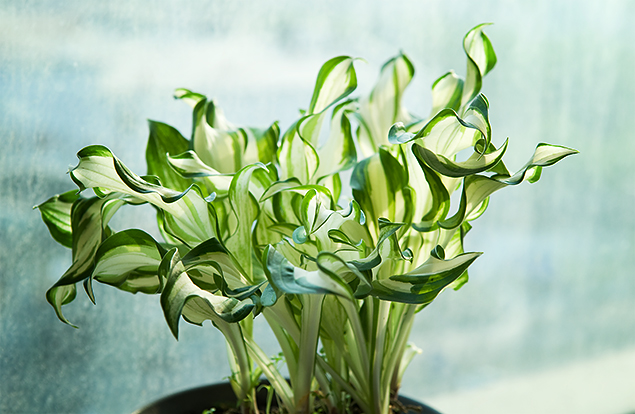
Hosta undulata (Hosta undulata Bailey), also known as wavy-leaved hosta, is a perennial herbaceous plant in the genus Hosta of the Liliaceae family. The plant grows 20-40 cm tall, with leaves arising in a clump from the base; the leaf blades are long-ovate, with slightly wavy margins, deep green. The center of the leaf surface has creamy-yellow and white longitudinal streaks and patches, very beautiful. The terminal raceme emerges on a scape above the leaves, bearing 5-9 flowers; the corolla is 6 cm long, dark purple. The flowering period is from late July to mid-August.Hosta undulata Growing Methods
Hosta undulata prefers deep, fertile loam with good drainage, and a shady spot is best. Direct sunlight is taboo; too strong light or too dry soil will make the leaf color turn yellow and even dry out the leaf margins.
Hosta undulata is generally propagated by division. Because Hosta undulata sprouts late, division is usually carried out in mid-to-late May. Shade work must be done well during the division period; hosta is a shade plant, and exposure to strong sun will cause poor growth.
When dividing Hosta undulata, plants sprouted from 2-3 year old old roots are generally chosen. Because the old root clump of Hosta undulata is relatively large, cutting is needed during division, and a sharp kitchen knife is generally used as the cutting tool. First choose the dividing point, then cut. Some hard tools can be used to assist the division. When dividing after sprouting, be especially careful to avoid bruising the sprouted buds. To ensure that the grown Hosta undulata has a full plant form, each division needs 3-5 buds. After division, Hosta undulata needs to be disinfected immediately. Soak the divided Hosta undulata in 1000 times dilution of Previcur disinfectant for disinfection, for 10-15 minutes. After 15 minutes, take out the disinfected Hosta undulata and dry it in the shade. At this point, it can be potted up.
Hosta undulata Habits
Hosta undulata is a perennial herbaceous plant, one of the hosta varieties, with a compact clump; the leaves are ovate to heart-shaped, with yellow streaks, and it blooms with blue-purple flowers in summer. There are very many cultivated varieties, with great differences in leaf shape, leaf color and plant form. Large Hosta undulata plants can reach 1 m in both height and crown spread, while small ones, three-year-old plants, have a crown spread of only 20 cm; different varieties are equally beautiful. The green ones are emerald, the blue ones deep and quiet, like mist or gauze, elegant and refined; the brilliantly colorful leaves show magical gradient colors.
Distribution and Habits
Native to the Yangtze River basin in China, it is distributed everywhere except the northwest region; it is also distributed in Japan. It prefers deep, fertile loam with good drainage, and a shady spot is best. Direct sunlight is taboo; too strong light or too dry soil will make the leaf color turn yellow and even dry out the leaf margins.
Hosta undulata Pictures
Hosta flowers are named because their buds are delicate and lustrous like jade and shaped like a hairpin. The large-flowered hosta, with emerald leaves, elegant and upright, and pure white flowers, gives off an even richer delicate fragrance at night. Literati of past dynasties often chanted about it. The Northern Song poet Huang Tingjian even called it "the first flower of Jiangnan." Hosta literally means the jade hairpin used by ancient women, and the plant Hosta undulata happens to look very much like this jade hairpin; even when the plant's flowers are fully open, they still have the beauty of a half-open bud. At first there were only pure white flowers, growing in clusters, pure and beautiful; later, with changes in technology and ecology, other colors appeared, but afterward, whether pink or purple, none could replace the elegance of the white Hosta undulata.
Hosta undulata Price
The wholesale price is about 0.2-0.3 yuan per plant, and the retail price is about 2 yuan per plant.
Related Encyclopedia
Pocket scale Non-woven bag Lamp wick Bamboo shoot Crab claw Redmi Note 3 YKK zipper YBS zipper Prunus sargentii Climbing rose Wild senna Winter plum Green pine Wristwatch Omega Longines famous watch Children's building blocks Flint Rhododendron lancifolium Curling iron Sweetsop
Hosta undulata Growing Methods Hosta undulata Habits
Hosta undulata (Hosta undulata Bailey), also known as wavy-leaved hosta, is a perennial herbaceous plant in the genus Hosta of the Liliaceae family. The plant grows 20-40 cm tall, with leaves arising in a clump from the base; the leaf blades are long-ovate, with slightly wavy margins, deep green. The center of the leaf surface has creamy-yellow and white longitudinal streaks and patches, very beautiful. The terminal raceme emerges on a scape above the leaves, bearing 5-9 flowers; the corolla is 6 cm long, dark purple. The flowering period is from late July to mid-August.
Hosta undulata Growing Methods
Hosta undulata prefers deep, fertile loam with good drainage, and a shady spot is best. Direct sunlight is taboo; too strong light or too dry soil will make the leaf color turn yellow and even dry out the leaf margins.
Hosta undulata is generally propagated by division. Because Hosta undulata sprouts late, division is usually carried out in mid-to-late May. Shade work must be done well during the division period; hosta is a shade plant, and exposure to strong sun will cause poor growth.
When dividing Hosta undulata, plants sprouted from 2-3 year old old roots are generally chosen. Because the old root clump of Hosta undulata is relatively large, cutting is needed during division, and a sharp kitchen knife is generally used as the cutting tool. First choose the dividing point, then cut. Some hard tools can be used to assist the division. When dividing after sprouting, be especially careful to avoid bruising the sprouted buds. To ensure that the grown Hosta undulata has a full plant form, each division needs 3-5 buds. After division, Hosta undulata needs to be disinfected immediately. Soak the divided Hosta undulata in 1000 times dilution of Previcur disinfectant for disinfection, for 10-15 minutes. After 15 minutes, take out the disinfected Hosta undulata and dry it in the shade. At this point, it can be potted up.
Hosta undulata Habits
Hosta undulata is a perennial herbaceous plant, one of the hosta varieties, with a compact clump; the leaves are ovate to heart-shaped, with yellow streaks, and it blooms with blue-purple flowers in summer. There are very many cultivated varieties, with great differences in leaf shape, leaf color and plant form. Large Hosta undulata plants can reach 1 m in both height and crown spread, while small ones, three-year-old plants, have a crown spread of only 20 cm; different varieties are equally beautiful. The green ones are emerald, the blue ones deep and quiet, like mist or gauze, elegant and refined; the brilliantly colorful leaves show magical gradient colors.
Distribution and Habits
Native to the Yangtze River basin in China, it is distributed everywhere except the northwest region; it is also distributed in Japan. It prefers deep, fertile loam with good drainage, and a shady spot is best. Direct sunlight is taboo; too strong light or too dry soil will make the leaf color turn yellow and even dry out the leaf margins.
Hosta undulata Pictures
Hosta flowers are named because their buds are delicate and lustrous like jade and shaped like a hairpin. The large-flowered hosta, with emerald leaves, elegant and upright, and pure white flowers, gives off an even richer delicate fragrance at night. Literati of past dynasties often chanted about it. The Northern Song poet Huang Tingjian even called it "the first flower of Jiangnan." Hosta literally means the jade hairpin used by ancient women, and the plant Hosta undulata happens to look very much like this jade hairpin; even when the plant's flowers are fully open, they still have the beauty of a half-open bud. At first there were only pure white flowers, growing in clusters, pure and beautiful; later, with changes in technology and ecology, other colors appeared, but afterward, whether pink or purple, none could replace the elegance of the white Hosta undulata.
Hosta undulata Price
The wholesale price is about 0.2-0.3 yuan per plant, and the retail price is about 2 yuan per plant.