How to cultivate a Black Bone Tea (Black Bone Fragrance) bonsai? With pictures for appreciation
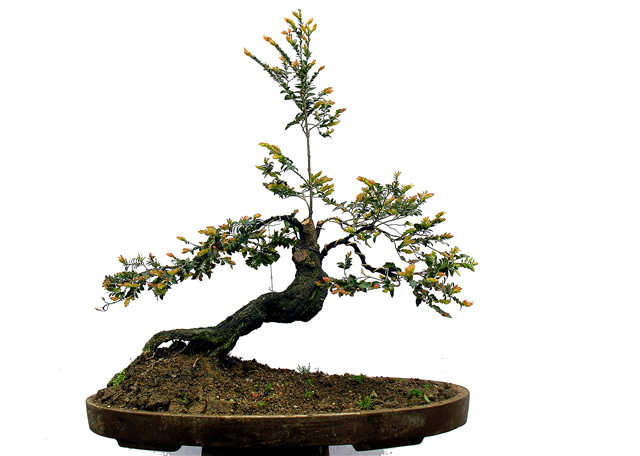
Appreciation of Black Bone Tea bonsai pictures and cultivation methods
Black Bone Tea grows slowly and is the slowest-growing tree species in Lingnan bonsai, even slower than boxwood. Therefore, when selecting stumps, special attention should be paid to choosing ones with accompanying grafted supports, preferably stumps with young branches. If the cut wound exceeds 3 cm, it will be very difficult to cultivate a matching branch support. The best time to collect Black Bone Tea is after the Spring Equinox and before Grain in Ear.
Black Bone Tea has strong sprouting ability and roots quickly, so the trunk, supports, and roots can basically be cut into place in one go. After the stump is cut, soak it in clean water for 24 hours, then plant it in river sand, place it in half shade, and keep the trunk moist. After 20 days, black liquid secretion can be seen at the cut wound. After a few days, it sprouts, and after 60 days, new roots can be seen. The survival rate is extremely high.
After Black Bone Tea survives, it can be moved to a sunny and ventilated place and given dilute fertilizer water to promote strong roots and vigorous branches. After the Autumn Equinox, supports can be fixed according to shaping needs, and all unnecessary branches should be cut off so that nutrients concentrate on the shaping branches. After the root system of Black Bone Tea becomes strong and vigorous, it likes fertilizer, so the proportion of fertilizer water can be appropriately increased, with water and fertilizer once every 7 days. Apply decomposed farmyard manure on the pot surface for a long time so that nutrients slowly dissolve each time it is watered, which helps the stump absorb them.
Watering should achieve thorough drying and thorough wetting: do not water when dry, and water thoroughly when watering. Stop fertilizing after Light Snow, completing the management of one growth cycle. It is worth noting that throughout the entire growth cycle, growth retardation should not occur because of a shortage of fertilizer water. With such management, one growth cycle can cultivate a branch diameter of 0.6 cm, and two growth cycles can cultivate a branch diameter of 1.2 cm. Generally, this can match the original stump support, which means the first section can be obtained in two years.
Black Bone Tea bonsai stays green all year round and sprouts new shoots once each season. Therefore, pruning can be done in all four seasons; each pruning should be done only after the new shoots mature, but spring and autumn are best. Black Bone Tea does not easily lose branches, so single-branch pruning can be carried out. After sprouting, select and keep strong buds, one main and one secondary, and use wire to bend the buds so that the branches grow horizontally. If new sprouts are allowed to grow freely, they will all grow upward, and it will be very difficult to meet the requirement of horizontally spreading branches. This is something to pay attention to.
Black Bone Tea bonsai does not have many fibrous roots, so it can be repotted and the soil changed once every 5 years. Even if it is the sandy soil used when growing the stump, as long as sufficient farmyard manure is applied, it is not too late to repot after 5 years. Repeat the management of the previous growth cycle every year until the work is basically formed.
Medium-sized stumps generally undergo 5 years of branch cultivation and maintenance, and newly cultivated branches generally already have three sections. Around Qingming, they can be repotted and the soil changed, and placed in a display pot for detailed shaping management. After Qingming, heavily prune the entire stump, remove leaves, lift the stump out, trim the root system, choose a suitable pot, and replant with a screened mixed soil of 3 parts sand and 7 parts mud. After normal growth resumes, return to the previous management.
Black Bone Tea bonsai grows slowly, so a combination of pruning and wiring can be used to speed up the formation of the work. Pruning: heavy pruning before Qingming is best. Wiring: in the evening after strong sunlight, when the branches are soft and mature, wrap metal wire around the branches and bend them according to shaping needs. Pay attention to the rhythmic changes of the branches, the interchange of stiffness and softness, and the alternating use of long and short spans, so that the shaping branches have beautiful curves. Remove the terminal buds at any time to promote side buds until the tree shape is full and the work is formed.
After the work is formed, it enters the viewing period. To keep the work from deforming, the amount of fertilizer water applied can be reduced, just enough to maintain normal growth of the work. Remove messy buds at any time. Once a year before Qingming, carry out a "taking off clothes and changing brocade" leaf removal. After 30 days, when the new buds show red, it is the best viewing time. Black Bone Tea is shade-tolerant. After one thorough watering, place it indoors and it does not need watering for 20 days. When the mud soil turns white, water it thoroughly again. It can be kept indoors for 50 days before returning to normal outdoor management. Among Lingnan bonsai, it is one of the tree species that can be displayed indoors the longest. Black Bone Tea has few diseases and pests, with only a small amount of leaf roller damage, which can be sprayed with a 0.2 percent concentration of 80% dichlorvos emulsion.
Appreciation of Black Bone Tea bonsai pictures and cultivation methods
Black Bone Tea bonsai is a bonsai form that has risen in popularity in recent years. Because its growing range is relatively limited, its growth is slow, it is not easy to care for, and it is artificially cultivated, rarity makes it precious. Thus it has attracted people's attention and become the latest ornamental favorite and collection object.Black Bone Tea bonsai has small, alternate, heart-shaped, leathery, deep green leaves. New shoots and leaves are tender red. It is a shrub type. The bark and roots are black. The wood is hard. Growth is slow, branches tend upward, and it mostly appears in clump form or with connected roots, and fine clump specimens can often be found. Finished large tree-form works have only been seen in bonsai magazines from Taiwan, China. Below, the editor will take everyone to appreciate a group of Black Bone Tea bonsai pictures and look at the cultivation methods of Black Bone Tea.
Cultivation methods of Black Bone Tea bonsai: the stump selection and breeding stageBlack Bone Tea grows slowly and is the slowest-growing tree species in Lingnan bonsai, even slower than boxwood. Therefore, when selecting stumps, special attention should be paid to choosing ones with accompanying grafted supports, preferably stumps with young branches. If the cut wound exceeds 3 cm, it will be very difficult to cultivate a matching branch support. The best time to collect Black Bone Tea is after the Spring Equinox and before Grain in Ear.Black Bone Tea has strong sprouting ability and roots quickly, so the trunk, supports, and roots can basically be cut into place in one go. After the stump is cut, soak it in clean water for 24 hours, then plant it in river sand, place it in half shade, and keep the trunk moist. After 20 days, black liquid secretion can be seen at the cut wound. After a few days, it sprouts, and after 60 days, new roots can be seen. The survival rate is extremely high.
Cultivation methods of Black Bone Tea bonsai: management during the branch cultivation stageAfter Black Bone Tea survives, it can be moved to a sunny and ventilated place and given dilute fertilizer water to promote strong roots and vigorous branches. After the Autumn Equinox, supports can be fixed according to shaping needs, and all unnecessary branches should be cut off so that nutrients concentrate on the shaping branches. After the root system of Black Bone Tea becomes strong and vigorous, it likes fertilizer, so the proportion of fertilizer water can be appropriately increased, with water and fertilizer once every 7 days. Apply decomposed farmyard manure on the pot surface for a long time so that nutrients slowly dissolve each time it is watered, which helps the stump absorb them.Watering should achieve thorough drying and thorough wetting: do not water when dry, and water thoroughly when watering. Stop fertilizing after Light Snow, completing the management of one growth cycle. It is worth noting that throughout the entire growth cycle, growth retardation should not occur because of a shortage of fertilizer water. With such management, one growth cycle can cultivate a branch diameter of 0.6 cm, and two growth cycles can cultivate a branch diameter of 1.2 cm. Generally, this can match the original stump support, which means the first section can be obtained in two years.Black Bone Tea bonsai stays green all year round and sprouts new shoots once each season. Therefore, pruning can be done in all four seasons; each pruning should be done only after the new shoots mature, but spring and autumn are best. Black Bone Tea does not easily lose branches, so single-branch pruning can be carried out. After sprouting, select and keep strong buds, one main and one secondary, and use wire to bend the buds so that the branches grow horizontally. If new sprouts are allowed to grow freely, they will all grow upward, and it will be very difficult to meet the requirement of horizontally spreading branches. This is something to pay attention to.Black Bone Tea bonsai does not have many fibrous roots, so it can be repotted and the soil changed once every 5 years. Even if it is the sandy soil used when growing the stump, as long as sufficient farmyard manure is applied, it is not too late to repot after 5 years. Repeat the management of the previous growth cycle every year until the work is basically formed.
Cultivation methods of Black Bone Tea bonsai: management during the formation stageMedium-sized stumps generally undergo 5 years of branch cultivation and maintenance, and newly cultivated branches generally already have three sections. Around Qingming, they can be repotted and the soil changed, and placed in a display pot for detailed shaping management. After Qingming, heavily prune the entire stump, remove leaves, lift the stump out, trim the root system, choose a suitable pot, and replant with a screened mixed soil of 3 parts sand and 7 parts mud. After normal growth resumes, return to the previous management.Black Bone Tea bonsai grows slowly, so a combination of pruning and wiring can be used to speed up the formation of the work. Pruning: heavy pruning before Qingming is best. Wiring: in the evening after strong sunlight, when the branches are soft and mature, wrap metal wire around the branches and bend them according to shaping needs. Pay attention to the rhythmic changes of the branches, the interchange of stiffness and softness, and the alternating use of long and short spans, so that the shaping branches have beautiful curves. Remove the terminal buds at any time to promote side buds until the tree shape is full and the work is formed.
Cultivation methods of Black Bone Tea bonsai: care after formationAfter the work is formed, it enters the viewing period. To keep the work from deforming, the amount of fertilizer water applied can be reduced, just enough to maintain normal growth of the work. Remove messy buds at any time. Once a year before Qingming, carry out a "taking off clothes and changing brocade" leaf removal. After 30 days, when the new buds show red, it is the best viewing time. Black Bone Tea is shade-tolerant. After one thorough watering, place it indoors and it does not need watering for 20 days. When the mud soil turns white, water it thoroughly again. It can be kept indoors for 50 days before returning to normal outdoor management. Among Lingnan bonsai, it is one of the tree species that can be displayed indoors the longest. Black Bone Tea has few diseases and pests, with only a small amount of leaf roller damage, which can be sprayed with a 0.2 percent concentration of 80% dichlorvos emulsion.
Conclusion: The above is the cultivation method of Black Bone Tea bonsai and the appreciation of Black Bone Tea pictures introduced by the editor for everyone. Black Bone Tea bonsai is a high-end, elegant, and classy collectible bonsai. Everyone must be very careful when cultivating Black Bone Tea, so that your Black Bone Tea becomes even more full of vitality.
Appreciation of Black Bone Tea bonsai pictures and a brief discussion of its benefits
With the continuous development of the times, a new type of fashionable cultivated bonsai planting is quietly being accepted and loved by more and more people. Beautiful and pleasing bonsai not only cultivate character and please the eye, help relieve the hardship of a busy day's work, and release the pressure of modern fast-paced life, but can also beautify the surrounding environment, green the indoor air quality, and decorate space. Bonsai full of vitality are also beneficial to physical and mental health, and at the same time improve one's lifestyle taste. Whether placed on a balcony, indoors, or in an office, they add beauty to the surrounding environment. Some are also used in newly renovated interiors to purify the air, because newly renovated indoor environments contain many harmful substances. The Black Bone Tea discussed today is a potted plant increasingly loved by many people, and its price has been rising all the way. Enjoy some Black Bone Tea bonsai pictures.
Introduction to Black Bone Tea bonsai
Black Bone Tea, as the name implies, is called Black Bone Tea because the trunk it grows is black. Some people also call it black ebony or Black Bone Fragrance. Black Bone Tea is a green potted plant that is evergreen all year round. Combined with its slow growth, it can go for a long time without pruning and care. Generally, the branches and leaves are pruned around the Spring Equinox or Qingming in spring. The leaves of Black Bone Tea are very small. The newly grown tender buds are tender red, but after growing up they become dark green, deep green. Other parts such as the bark, roots, and trunk are all black. Some have a clump shape, as graceful as a welcoming guest pine, with sturdy branches and trunk giving a feeling of firmness. Others appear scattered with sparse fallen branches and leaves, looking unnatural.
Different shapes give people different feelings, and pruning also varies according to personal preference. No matter which shape, they all present an orderly and well-arranged distribution, especially suitable for placing in a corridor. Black Bone Tea is suitable for acidic soil, can be placed in a cool place for a long time, and is also drought-tolerant. It is only because of slow growth that when first planted it needs a support to hold and fix its shape.
Cultivation methods of Black Bone Tea bonsai
Black Bone Tea grows slowly and is the slowest-growing tree species in Lingnan bonsai, even slower than boxwood. Therefore, when selecting stumps, special attention should be paid to choosing ones with accompanying grafted supports, preferably stumps with young branches. If the cut wound exceeds 3 cm, it will be very difficult to cultivate a matching branch support. The best time to collect Black Bone Tea is after the Spring Equinox and before Grain in Ear.
Black Bone Tea has strong sprouting ability and roots quickly, so the trunk, supports, and roots can basically be cut into place in one go. After the stump is cut, soak it in clean water for 24 hours, then plant it in river sand, place it in half shade, and keep the trunk moist. After 20 days, black liquid secretion can be seen at the cut wound. After a few days, it sprouts, and after 60 days, new roots can be seen. The survival rate is extremely high.
After Black Bone Tea survives, it can be moved to a sunny and ventilated place and given dilute fertilizer water to promote strong roots and vigorous branches. After the Autumn Equinox, supports can be fixed according to shaping needs, and all unnecessary branches should be cut off so that nutrients concentrate on the shaping branches. After the root system of Black Bone Tea becomes strong and vigorous, it likes fertilizer, so the proportion of fertilizer water can be appropriately increased, with water and fertilizer once every 7 days. Apply decomposed farmyard manure on the pot surface for a long time so that nutrients slowly dissolve each time it is watered, which helps the stump absorb them.
Watering should achieve thorough drying and thorough wetting: do not water when dry, and water thoroughly when watering. Stop fertilizing after Light Snow, completing the management of one growth cycle. It is worth noting that throughout the entire growth cycle, growth retardation should not occur because of a shortage of fertilizer water. With such management, one growth cycle can cultivate a branch diameter of 0.6 cm, and two growth cycles can cultivate a branch diameter of 1.2 cm. Generally, this can match the original stump support, which means the first section can be obtained in two years.
Black Bone Tea bonsai stays green all year round and sprouts new shoots once each season. Therefore, pruning can be done in all four seasons; each pruning should be done only after the new shoots mature, but spring and autumn are best. Black Bone Tea does not easily lose branches, so single-branch pruning can be carried out. After sprouting, select and keep strong buds, one main and one secondary, and use wire to bend the buds so that the branches grow horizontally. If new sprouts are allowed to grow freely, they will all grow upward, and it will be very difficult to meet the requirement of horizontally spreading branches. This is something to pay attention to.
Black Bone Tea bonsai does not have many fibrous roots, so it can be repotted and the soil changed once every 5 years. Even if it is the sandy soil used when growing the stump, as long as sufficient farmyard manure is applied, it is not too late to repot after 5 years. Repeat the management of the previous growth cycle every year until the work is basically formed.
Medium-sized stumps generally undergo 5 years of branch cultivation and maintenance, and newly cultivated branches generally already have three sections. Around Qingming, they can be repotted and the soil changed, and placed in a display pot for detailed shaping management. After Qingming, heavily prune the entire stump, remove leaves, lift the stump out, trim the root system, choose a suitable pot, and replant with a screened mixed soil of 3 parts sand and 7 parts mud. After normal growth resumes, return to the previous management.
Black Bone Tea bonsai grows slowly, so a combination of pruning and wiring can be used to speed up the formation of the work. Pruning: heavy pruning before Qingming is best. Wiring: in the evening after strong sunlight, when the branches are soft and mature, wrap metal wire around the branches and bend them according to shaping needs. Pay attention to the rhythmic changes of the branches, the interchange of stiffness and softness, and the alternating use of long and short spans, so that the shaping branches have beautiful curves. Remove the terminal buds at any time to promote side buds until the tree shape is full and the work is formed.
After the work is formed, it enters the viewing period. To keep the work from deforming, the amount of fertilizer water applied can be reduced, just enough to maintain normal growth of the work. Remove messy buds at any time. Once a year before Qingming, carry out a "taking off clothes and changing brocade" leaf removal. After 30 days, when the new buds show red, it is the best viewing time. Black Bone Tea is shade-tolerant. After one thorough watering, place it indoors and it does not need watering for 20 days. When the mud soil turns white, water it thoroughly again. It can be kept indoors for 50 days before returning to normal outdoor management. Among Lingnan bonsai, it is one of the tree species that can be displayed indoors the longest. Black Bone Tea has few diseases and pests, with only a small amount of leaf roller damage, which can be sprayed with a 0.2 percent concentration of 80% dichlorvos emulsion.
The gracefully shaped Black Bone Tea can not only serve as an ornamental item, but can also sterilize, purify the air, green the environment, and provide health benefits. It is very helpful for calming people's emotions, easing psychological unease, irritability, and insomnia, and can also relieve fatigue. Moreover, crafts made from its trunk, when worn on the body, also carry the meaning of warding off evil. The faint fragrance it gives off is loved by people of many different age groups. At the same time, if there are children at home, it can also satisfy children's closeness to and curiosity about nature, help them develop the good habit of loving labor and caring for flowers, grasses, and trees, and can also increase related knowledge and growth process understanding. The above is the relevant content about Black Bone Tea bonsai pictures. We hope it can be helpful to everyone!