How to Grow Bromeliads and a Gallery of Pictures
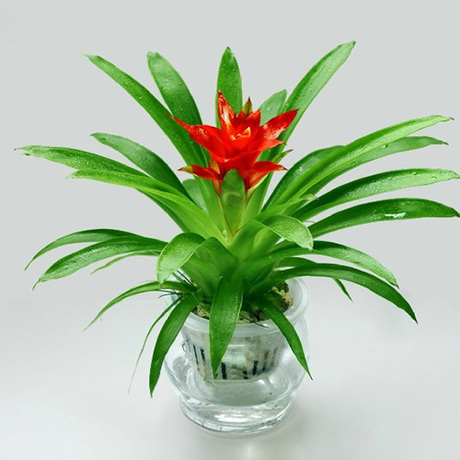
How to Grow Bromeliads, Bromeliad Pictures
Ornamental bromeliads were introduced to China since the 1980s and have been welcomed by many people in some coastal cities. In 1994, at the Guangzhou Lunar New Year flower market, each pot of imported bromeliad sold for 150 to 200 yuan, three times more expensive than azaleas, and they were quickly bought up by flower lovers.
Currently popular ornamental bromeliads in China include Billbergia, Cryptanthus, Aechmea, variegated pineapple, and Aechmea chantinii. Their plants grow in tufts of grassy stems, and the stems are generally short. The leaves are long and narrow, sword-shaped or various strap shapes, and most leaf margins have serrations. The leathery leaves are brilliantly colorful. The flowers they produce are even more varied. Both flowers and leaves look as if coated with a layer of wax, soft yet firm and glossy. The bases of the top leaves often overlap tightly into an outward-spreading rosette, like a man-made water container, which can store water to slowly "drink" during drought. Therefore it has become a famous indoor foliage and flowering plant. As a living room decoration, it is both warm and restrained, and very enjoyable to view.
Identification and selection:
The leaves of Billbergia are long and narrow like swords, green and glossy. From winter to early spring, a bright red columnar inflorescence emerges from the tender green leaf tube, about 30 cm tall; at the top are 6 to 12 small flowers, with 3 petals, pale yellow-green with blue edges, curling outward after opening. When in full bloom, strings of blue-green flowers against the red bracts look especially gorgeous and eye-catching, and the viewing period can last up to two months.
Cryptanthus, also known as the small pineapple, is most suitable for potted display. Its leaves are firm and slender with wavy edges, and the colors include cream yellow, red or purplish red, with long vertical stripes radiating across the leaf surface like a crab pattern; the flowers are white or light green, growing among the leaf clusters to form a disc.
Aechmea, also known as Aechmea fasciata and silver vase plant, has plants made up of 10 to 20 leaves forming a rosette, with a cup-shaped base. The leaf tips are blunt and turned outward, green, with the surface coated in silver-white, and the leaf surface has irregular brownish and dark green horizontal stripes and patches. Between summer and autumn, after the peach-red columnar flowers, about 15 cm tall. The dense small flowers open blue at first, then turn rose red, like a dragonfly spreading its wings in flight, and the viewing period can last several months.
The leaves of the variegated pineapple are sword-shaped, curling outward, crisp and glossy. The upper surface of the leaves is dark green, with yellow-green edges, and some leaves gradually show uneven yellow-green stripes in the middle as well. The underside is light green, with the same faint yellow-green stripes as the upper surface. In spring and summer, the cylindrical flower bud emerging from the leaf tube is about 2.5 cm thick, wrapped from bottom to top by 25 to 30 sepals like bamboo shoot shells into a column ranging from dark red to pink, closely resembling a red bamboo shoot set in the leaf tube. Within two to three weeks, the columnar bud splits open and sends up a straight flower stem, bearing a dozen or so small flowers, each showing yellow, red and purple from bottom to top, very enjoyable to view.
Aechmea chantinii, also known as the torch, is a hybrid. The leaf edges are smooth and without serrations. An upright flower stem emerges from the center, up to 35 to 40 cm long, with a spike inflorescence at the top, and the flower spike has 2 to 4 branches. The bracts are dark red, thick and glossy, and the whole inflorescence looks like a blazing torch; the flowering period can last three months, making it a favorite among ornamental bromeliads.
Care and propagation:
Ornamental bromeliads are extremely easy to care for; as long as you grasp their habit of liking high temperatures, humidity and partial shade, they can be kept year-round in a warm, bright room. In winter they can take full sun; in spring and autumn they should have morning and evening light; in summer avoid direct sunlight. With bright light, the leaf colors are vivid. The overwintering temperature should preferably not be lower than 10°C; above 20°C is not conducive to the plant's dormancy and will affect the next year's growth and flowering.
During the growing season from late spring to autumn, you can appropriately increase watering, and you can also pour some clean water into the leaf tube; change the water once every half month to prevent it from spoiling and smelling. Frequently spray water on the leaf surface. In winter the pot soil should be on the dry side, but not too dry. From May to September, apply nitrogen fertilizer once a week, and appropriately increase phosphorus and potassium fertilizer before flowering to promote larger and more colorful flowers. When flowering, do not pour water into the tube, and keep it away from sunlight to prolong the flowering period. After flowering, the plant enters dormancy, and the flower stalk must be cut off to reduce nutrient consumption. In winter do not pour water into the tube.
The root system of ornamental bromeliads is not well developed, with no main root, and some roots even like to be exposed to air, so planting in small, shallow pots will grow and develop better than in large, deep pots. The potting soil is best made of leaf mold with a small amount of garden soil, or a half-and-half mix of peat and perlite.
After flowering, the central leaf rosette dies, while the side shoots continue to grow. When this side shoot is 15 cm tall, it can be removed from the mother plant with its roots and planted separately. Doing so can only "pass down a single line from generation to generation", so the number propagated is limited. Therefore, it is best to combine this with repotting in spring, cutting off the small tubers growing from the mother plant's tuber for cuttings, or dividing the rooted young shoots sprouting from the roots of the old plant; all should be kept shaded, moist and warm, and when the roots grow to 2 to 3 cm, they can be planted out. If cultivated properly, one mother plant can propagate about 10 plants per year.
A horticulturist discusses the key points to note in bromeliad care:
Liu Ping, horticulturist at a flower show base in Beijing: Because the bromeliad's native state is as an epiphyte under trees in tropical rainforests, its demand for sunlight is not especially great; when it is exposed to sunlight for too long, some of its leaves will turn yellow, and then the flower tips will dry out somewhat, and similar problems.
Tip one: The bromeliad likes partial shade, so avoid harsh sun exposure; place it in a partially shaded spot or near a bright window, indoors.
Reporter: So what temperature is suitable for the bromeliad?
Liu Ping: Actually, the flowers we grow now are no longer wild native flowers; most of them are in greenhouses, after long-term domestication, so growing them indoors generally poses no problem.
Reporter: Is there a minimum temperature limit?
Liu Ping: In winter, if it doesn't go below about 15 degrees, there should be no problem; most homes have heating, so there should be no problem.
Tip two: The temperature for growing bromeliads must not be lower than 15 degrees
Reporter: Is there anything else to avoid? For example, can I put it next to the radiator or under the air conditioner?
Expert: Under the air conditioner there should be no problem, but it is best not to put it under the radiator, because in that case it dries out especially badly, and it will be scorched; a person can't keep standing next to the radiator being baked either, as it easily causes internal heat.
Tip three: Do not place bromeliads next to heating equipment
Actually, once you remember these few points, caring for bromeliads becomes much easier, but there is one more thing to remind you of: the bromeliad's biggest weakness is not fear of cold, but fear of waterlogging, so there is a lot of knowledge in watering. Many people think watering flowers is easy, isn't it just pointing a spray bottle at the flower? If that's what you think, you are greatly mistaken; if you don't believe it, let me ask another expert.
Interview with Xia Baorui, senior horticulturist:
Xia: When watering, we usually understand it as watering the pot soil; for bromeliads, water the pot soil when the surface is slightly dry, when the top 1 to 2 cm is dry, then water a second time; it must not be too wet, as too wet easily rots the roots.
Reporter: Its roots are quite tender, right?
Xia: Right, bromeliads all have a leaf tube, a water trough, and you must ensure there is always water in the trough and that it is not interrupted; after some time, say about ten days, you should replace the water in the leaf tube to prevent it from smelling; usually you can also spray misty water on the surface, leaves and flowers.
What basic knowledge is there for growing bromeliads? For example, what kind of fertilizer to apply? What to do after the leaves have spots? How to handle new shoots?
Answer: In daily care, bromeliads should be placed in a partially shaded, ventilated spot and grown under scattered light. Strong light easily scorches the leaves and causes mottled spots; but be careful not to leave them in too shady a place for long, as the beautiful leaf colors often become lighter and duller as a result, causing regret in terms of ornamental value.
Under conditions of dry climate, stuffy heat and low humidity, the leaf margins and tips of bromeliads very easily become scorched and withered, so keep the pot soil moist, spray clean water on the leaf surface 1 to 2 times a day, and fill the cup-shaped center of the leaf rosette with clean water. Bromeliads were originally epiphytic plants, with a root system that is not well developed, only small and short roots, so be sure not to apply too much fertilizer, to prevent root rot and yellowing leaves; apply thin fertilizer water instead.
The leaf axils at the base of ornamental bromeliads will continuously produce small shoots; when they grow 5 to 6 leaves, they can be cut off for cutting propagation, and in about 1 month they will grow root hairs. For bromeliad planting soil, it is best to choose a loose mixed potting soil of peat soil, humus soil and tree fern debris.
Bromeliad Pictures, How to Grow Bromeliads
The bromeliad is like a fairy among flowers, with unparalleled elegance. Placing a few pots of bromeliads in a room can help enhance the peaceful atmosphere at home, and the bromeliad also carries the auspicious meaning of "fortune rising above the head". The Chinese New Year is coming soon, and placing a few pots of bromeliads at home can improve the environment. Below, let's look at how to grow bromeliads.
Bromeliad pictures Bromeliad growing methodsI. Bromeliad growing methods——Environment
The bromeliad itself is a plant grown in rainforests, and in terms of environment it likes high temperatures and humidity. Indoors, places with plenty of sunlight and sufficient water are all suitable for placing bromeliads. The bromeliad needs a temperature of about 20 degrees, so it is a flower very suitable for indoor growing. A humid environment is equally important for bromeliads, so in addition to regular watering, water should also be evenly sprayed on the flowers and leaves of the bromeliad.
II. Bromeliad growing methods——Soil
The planting soil for bromeliads should best be a nutrient soil well mixed of peat soil and humus soil; this kind of soil makes it easier for the bromeliad to absorb water and is conducive to the absorption of nutrients. When planting bromeliads, when the surface shows slight cracking, water appropriately to keep the soil moist.
III. Bromeliad growing methods——Temperature
The growing temperature for bromeliads also needs attention; it is best to keep the temperature around 30 degrees, and the lowest growing temperature must not be below humidity. Too low a temperature will damage the growth of the bromeliad.
Bromeliad growing methods, Bromeliad growing methods and precautions, How to grow bromeliads
If you have ever seen a bromeliad, you surely know how it got its name; just as you have seen, its petals are very similar to pineapple leaves, and its brilliant flowers and gorgeous patterns are fascinating. Beyond its appearance, it can also purify indoor air, filling the home with green vitality and at the same time fulfilling its flower language - perfection. Such a good flower is of course also easy to grow; below we will introduce the bromeliad growing methods.
Key point for growing bromeliads - Water
Water is the source of life and the key to development. The water bromeliads like best has a pH of 5.5-6.5, which is most conducive to nutrient absorption and can also reduce the pressure the roots bear from the outside. So the ideal thing is to water with rainwater as the ideal irrigation; if not, watering with lake water and surface water is also good. If conditions allow, you can buy a spray bottle, which not only helps prevent water from accumulating at the bottom of the flowerpot, but can also lower the indoor temperature.
Key point for growing bromeliads - Light
The bromeliad is an indoor plant that likes shade and is not suitable for direct sunlight, but it also needs sunlight. According to traditional growing experience, 3 hours a day is best. In spring and autumn there is no need to say much, but it is worth noting that in summer there must be no direct sunlight, and in winter the temperature must be above 10° and below 20°, which is conducive to the plant's rest and will not affect the next year's growth.
Key point for growing bromeliads - Fertilizing
The bromeliad was originally an epiphytic plant, and its root system is not well developed, with no main root, only weak roots, so do not add too much fertilizer to the pot; this is also the main reason many people say the leaves turn yellow and the roots rot during growing. Here the editor suggests planting in small, shallow pots, letting some of its roots touch the air; as for the soil, leaf mold plus a little garden soil, or a half-and-half mix of peat and perlite, is fine.
Summary: Actually, the bromeliad growing method is just this simple; as long as you do these few things, you can grow the lovely flower you planted with your own hands, which is not only beautiful but also purifies indoor air. Let's give it a try.
[Related articles]
?Pink rose pictures ?Curtain matching ?Forget-me-not flowers ?Rainbow cross-stitch
?Orange jasmine bonsai ?Eucalyptus growing ?Artificial flower vines ?Poppy growing
?Masson pine pictures ?Pine bonsai ?Daphne odora ?Marigold growing
?Chinese rose pictures ?Dawn redwood bonsai ?Poppy growing ?Mimosa information