How to grow variegated greater periwinkle? With pictures of variegated greater periwinkle
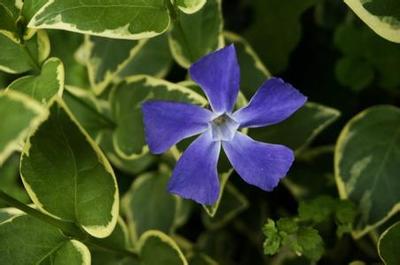
How to grow variegated greater periwinkle, pictures of variegated greater periwinkle
When grown in pots, pay attention to shading in summer and move them indoors to overwinter in winter. During the growing season, keep the potting soil moist, do not let it get too dry, and also pay attention to ventilation. It is suitable to apply thin, diluted fertilizer, 2-3 times a year is enough; if too much fertilizer is applied, the plant will lose its graceful characteristics. When planting, heavy pruning should be carried out to promote branching. After that, carry out appropriate pruning once every spring, cutting back the main vines to control excessive growth. At ordinary times, pay attention to environmental ventilation.
Soil
Ivy is not demanding about soil, tolerates poor soil, and likes moist, loose, fertile sandy soil; it dislikes saline-alkaline soil. Generally, fertile loose soil is mostly used as the potting medium, such as equal parts of garden soil and leaf mold mixed together; it can also be prepared from leaf mold, peat soil and fine sand with a small amount of base fertilizer, or mixed from garden soil, about 1/4 plant ash and a small amount of base fertilizer. Plant ash can both keep the potting soil loose and breathable and provide more potassium fertilizer to meet the growth needs of ivy. It can also be grown in sphagnum moss alone.
Light
Ivy is a typical shade-loving climbing flower and shrub; it tolerates shade and moisture, and can also grow in a full-light environment. It can be grown long-term in a bright room. In a dark room, as long as supplementary lighting is provided, it can also grow well. It grows well under warm and humid climatic conditions, and is not cold-tolerant.
In spring, when branches and leaves sprout abundantly, whether variegated or green-leaved, they should be placed in the sun to receive sufficient light; only then will the branches and leaves grown be lush and sturdy. At ordinary times, they should be placed under diffused light so that the leaf color is deep green and glossy. In a shaded environment, the leaf color of variegated varieties is even more beautiful. In the intense heat of summer, they must be placed in a cool, ventilated place.
Watering
The rainy season and high summer temperatures are what you must be most careful about. For ivy placed outdoors during the rainy season, as soon as there is standing water in the pot, it should be poured out promptly to avoid the roots being soaked for a long time and rotting. In summer, the ambient temperature is high, which is unfavorable for ivy growth; growth stalls above 30°C, so it is better to use more foliar water spraying and watering. If water is insufficient, the base of the plant tends to lose leaves; if watered too much, root rot easily occurs. You can choose to water in the early morning or evening to avoid a large difference between soil temperature and water temperature, which causes root stress and injury and eventually leads to the plant withering and dying.
In winter, put it in a greenhouse to overwinter; indoor air humidity should be maintained and it should not be too dry, but the potting soil should not be too wet.
When transplanting, be careful to keep soil around the roots, as this makes it easier to survive.
Pest control
Strengthening ventilation and air permeability can reduce the occurrence of pests. Ivy often suffers from aphids in spring, and under conditions of high temperature, dryness and poor ventilation, it is also prone to damage by red spiders, scale insects and mites, so pesticides should be applied early for control.
In the stuffy summer climate, pests easily occur, mainly scale insects, especially numerous on the underside of leaves and on petioles; strengthening ventilation and air permeability can reduce the occurrence of pests. If there are few pests, you can use an old toothbrush dipped in soapy water to brush them clean. If there are many pests, you can spray with 40% omethoate 800-times solution to kill them, spraying once every 7 days, continuously 2 to 3 times.
How to grow variegated greater periwinkle, cutting propagation and management of variegated greater periwinkle
Variegated greater periwinkle is also called variegated ivy. It is a variety of greater periwinkle in the genus Vinca of the family Apocynaceae. It is distributed in Jiangsu and other places in mainland China. It is low-growing with trailing, creeping branches, reaching more than 2 m in length. Its leaves are elliptical and opposite, with petioles; the edges of the leaves are white, with yellow-white spots. Now let us take a look at the cultivation methods of variegated greater periwinkle!
Growth habits of variegated greater periwinkle
Variegated greater periwinkle likes light and tolerates shade, and also tolerates low temperatures; at -7°C, field planting shows no frost damage. It is evergreen all year round; the vines produced by tillering and the small violet flowers that bloom in March cover the ground like a flower-studded green carpet, making a very spectacular sight. It is a relatively ideal ground-cover material for both foliage and flower appreciation. It is highly adaptable, not demanding about soil, and fast-growing.
Propagation methods of variegated greater periwinkle
1. Division: Division propagation is best carried out in spring. At this time, cut off the old branches from the previous year, dig out the plant and separate it, replant separately, and water thoroughly.
2. Cuttings: Cutting propagation can be carried out throughout the year. The cutting medium uses perlite, vermiculite or sand with good water retention. Autumn and winter cuttings are best carried out in a greenhouse or a cold frame. In winter, using an electrically heated hotbed in a greenhouse gives a higher rooting rate.
Cultivation methods of variegated greater periwinkle
1. Soil: Variegated greater periwinkle likes relatively fertile, moist soil. Cultivation requires loose, humus-rich sandy loam. For potting, a mixture of leaf mold, garden soil and river sand can be used as the medium.
2. Pinching: For variegated greater periwinkle, multiple plants can be planted in the same pot at the same time and pinched in a timely manner, which allows rapid shaping. To promote more branching, pinching can be carried out several times during the growing season. Mounding soil at the nodes can produce more adventitious roots and promote vine growth.
3. Watering: When cultivating variegated greater periwinkle, water during drought, pay attention to drainage in the rainy season, and water fully during the growing season to keep the potting soil moist. At the same time, apply liquid fertilizer 1-3 times a month to ensure rapid and fast growth of the vines and a deep green, glossy leaf color.
4. Light: Variegated greater periwinkle is suitable for a bright environment, but in midsummer avoid direct strong light to prevent burning the leaves. Appropriate shading is necessary, and a semi-shaded environment is best.
5. Temperature: Although variegated greater periwinkle prefers warmth during growth, it is also cold-tolerant. In winter it can tolerate low temperatures of around 0°C, and except in severe cold, it can maintain perfect color all year round.
6. Diseases: Variegated greater periwinkle often suffers from fusarium wilt, canker and leaf spot. It can be controlled by spraying with equal-strength Bordeaux mixture.
7. Pests: The pests of variegated greater periwinkle include scale insects and root-knot nematodes. For scale insects, spray with 25% phosmet emulsifiable concentrate 1000-times solution; for root-knot nematodes, use 3% carbofuran granules for control.
Variegated greater periwinkle: is variegated greater periwinkle poisonous? How to cultivate it at home
Recently I heard someone asking whether variegated greater periwinkle is poisonous, which triggered a lot of discussion. Because many people have actually never heard of what variegated greater periwinkle is, they therefore know even less whether it is poisonous. In fact, this variegated greater periwinkle is a variety of greater periwinkle in the genus Vinca of the family Apocynaceae, and is a very common foliage plant in daily life. When people ask whether it is poisonous, it is caused by their not having a deep understanding of it. So let us take a look at variegated greater periwinkle below.
Introduction to variegated greater periwinkle
Variegated greater periwinkle, also called variegated ivy, is a variety of greater periwinkle in the genus Vinca of the family Apocynaceae. At present it is mainly distributed in Jiangsu and other places in our country. Variegated greater periwinkle is a trailing subshrub that grows creeping; a well-grown variegated greater periwinkle can reach a length of more than 2 m. The leaves of variegated greater periwinkle are elliptical and ovate in shape, with acute tips, petioles, bright green and glossy, while the leaf margins are cream-yellow, and its tillering ability is very strong. Variegated greater periwinkle has flowers; their flower shape resembles a salverform corolla, and the solitary flowers are violet-colored, looking very elegant and beautiful. Variegated greater periwinkle is a plant that can purify air and green the environment, and it is not poisonous.
Propagation methods of variegated greater periwinkle
At present, two methods are mainly used to propagate variegated greater periwinkle: division and cuttings. Division propagation of variegated greater periwinkle is mainly carried out in spring; after cutting off the old branches on the plant, the new plants are separated out for separate planting. Cutting propagation of variegated greater periwinkle can be carried out in all four seasons and is currently the most commonly used method. When taking cuttings, select robust and plump variegated greater periwinkle branches as cuttings, but note that the length of the cuttings should be determined according to the season: in winter it should be longer, about 10-13 cm; in summer, when water evaporation is high, the cuttings should not be too long, about 8-10 cm. The upper part of the cutting should retain 2 leaves, while the lower part should be cut off. Finally, plant it in perlite or sandy soil, then water, and be careful to water thoroughly.
Cultivation and management of variegated greater periwinkle
1. Variegated greater periwinkle likes a fertile environment. When cultivating, prepare loose, humus-rich sandy soil, or use a mixture of leaf mold and river sand as the soil medium. At the same time, apply liquid fertilizer 1 to 3 times a month.
2. Variegated greater periwinkle very much likes a warm environment with sufficient sunlight. It should be given plenty of sun to maintain its growth temperature. However, its cold tolerance is quite good, and it can still survive at 0°C in winter. At the same time, summer sunlight is strong, so attention should be paid to shading it to avoid burning the leaves.
3. Variegated greater periwinkle likes moisture. During the growing period, its growth speed is fast, so it should be watered fully to keep the potting soil moist. But in severe cold, the water requirement is low, so the frequency of watering should be reduced; likewise, in the rainy season, the amount of water should also be reduced.
4. Variegated greater periwinkle is prone to pests and diseases. Diseases are mostly fusarium wilt, canker and leaf spot, while pests are mainly scale insects and root-knot nematodes. During cultivation, attention should be paid to preventing pests and diseases, and once any are found, they need to be dealt with promptly.
Conclusion: In short, variegated greater periwinkle is a very good foliage plant for purifying air and greening the environment. It contains no toxins at all, and its flower shape and color are relatively elegant and beautiful, so it has a certain ornamental value and can be used as a potted plant for decoration with good results.
[You may be interested in]
?Complete collection of leaf collage pictures ?How to install a Mongolian yurt mosquito net ?What are the benefits of drinking chrysanthemum tea ?Oil painting ?Window paper-cuts
?What is the flower language of lavender ?Which brand of digital oil painting is good ?What kind of fabric is polyester fiber ?Dendrobium ?Summer sleeping mat