Golden-edged June Snow Pictures and Detailed Care Methods
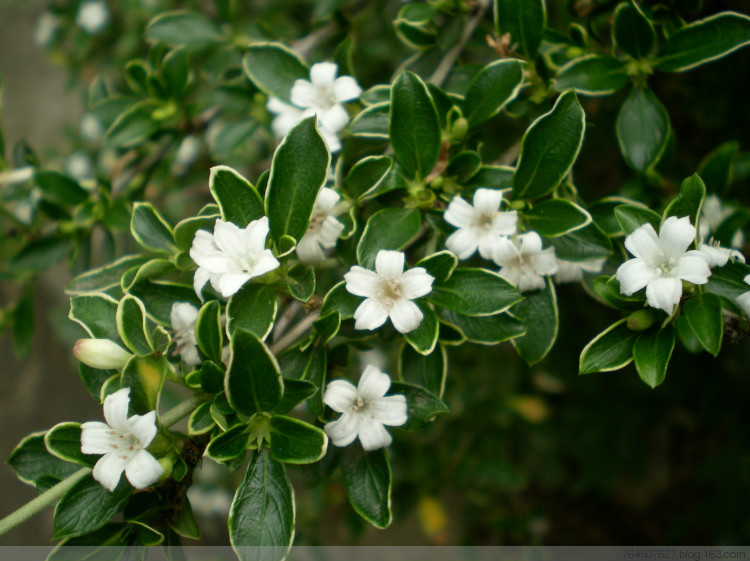
Golden-edged June Snow Pictures How to Grow Golden-edged June Snow
Clumping perennial old plants can also be propagated by division in spring. Around some naturally self-sown old stumps, many root-sucker seedlings often appear, which can be dug up and used as propagation material.
Golden-edged June Snow grown in the ground is simple and low-maintenance to manage. In the south it can be planted in mass in gardens to form shrub thickets; viewed from afar in summer, it is as white as snow, giving a feeling of coolness and elegance. It is usually mostly used for shaped potted display or for making stump bonsai.
First train the plant into a single-trunk form, then prune and wire the side branches according to the design concept to make various styles of bonsai, all of which can achieve ideal results. In summer it should be kept outdoors for care; if placed indoors, it must be in a bright spot with increased ventilation, otherwise the branches will grow leggy, the leaf color will turn yellow, and the lower leaves will often drop in large numbers.
Throughout the year, care should keep the potting soil moderately dry and moist. In the heat of summer and during dry spells, the potting soil should be kept moist regularly, and water should be sprayed on the leaves to keep the foliage fresh. During the growing season, liquid fertilizer can be applied 3 to 4 times. In winter, if you do not continue to enjoy the foliage, you can let it drop its leaves, then move it to a cellar or bury it entirely in soil to overwinter. If brought into a low-temperature greenhouse to overwinter, it can remain evergreen; the room temperature must not be lower than 6°C, and good ventilation and sufficient light should be maintained. Before bringing pots out in early spring, potted plants should be given short pruning and pinching to keep the plant shape symmetrical and full; bonsai need pruning and shaping for artistic work.
How to Grow Golden-edged June Snow
Golden-edged June Snow, also known as Mantianxing and Baimagu, is an evergreen or semi-evergreen clumping small shrub in the Rubiaceae family, genus Golden-edged June Snow. It is native to the provinces south of the Yangtze River in China and is distributed in Jiangsu, Zhejiang, Jiangxi, Guangdong, Guangxi, Taiwan, and other places. The ornamental plant is low-growing, with a height of less than 1 m. Old stems are brown with obvious wrinkles; young branches are slender and upright, green. Leaves are opposite, very small, less than 1 cm long, ovate to ovate-elliptic, entire, obtuse at the tip, thickly leathery, dark green, and glossy. The flowers are small, with a funnel-shaped corolla, white, often with a light pink-purple blush; flowers are small, about 0.7 cm in diameter, solitary or clustered at the branch tips or leaf axils, blooming from May to June; the drupe is spherical and ripens in October.
Golden-edged June Snow prefers a environment with sufficient sunlight, and is also fairly shade-tolerant. It dislikes fierce winds and scorching sun, and in hot summer weather it should be given light shade. It is not strict about temperature and is highly drought-tolerant. It is not demanding about soil, but grows best in loose, fertile, well-drained neutral to slightly acidic soil. It has strong sprouting and suckering ability and tolerates pruning.
Golden-edged June Snow grown in the open is simple and low-maintenance to manage. In the south it can be planted in mass in gardens to form shrub thickets; viewed from afar in summer, it is as white as snow, giving a feeling of coolness and elegance. It is usually mostly used for pruned and shaped potted display or for making stump bonsai. First train the whole plant into a single-trunk form, then prune and wire the side branches according to the design concept to make various styles of bonsai, all of which can achieve ideal results. In summer it should be kept outdoors for care; if placed in a living room, it must be in a bright spot with increased ventilation, otherwise the stems and branches will grow leggy, the leaf color will turn yellow, and the lower flowers and leaves will often drop in large numbers. Throughout the year, care should keep the potting soil moderately dry and moist. In the heat of summer and during dry spells, the potting soil should be kept moist regularly, and water should be sprayed on the leaves to keep the stems, branches, and leaves fresh. During the growing season, apply fertilizer once every half month, for 3-4 applications. In winter, if you do not continue to enjoy the foliage, you can let its leaves wither and drop, then move it to a cellar or bury it entirely in soil to overwinter, with the temperature kept above 5°C. If brought into a lower-temperature greenhouse to overwinter, it can remain evergreen; the room temperature must not be lower than 6°C, and good ventilation and sufficient sunlight should be maintained. Before bringing pots out in early spring, potted plants should be given short pruning and pinching to keep the plant shape symmetrical and full; bonsai need pruning and shaping for artistic work.
Golden-edged June Snow is usually propagated by cuttings. Hardwood cuttings can be taken from March to April, or softwood cuttings from June to July. It is not demanding about the cutting medium; the best option is fully decomposed leaf mold mixed evenly with river sand in equal parts, spread on concrete and sun-sterilized for 1-2 days, then placed into the cutting container. This type of cutting medium contains certain natural hormones and nutrients, which help the cuttings root and survive and grow quickly, healthily, and vigorously. Clumping perennial old plants can also be propagated by division in spring. Around some naturally self-sown old stumps, many root-sucker seedlings often appear, which can be dug up and used as propagation material.
How to Grow Golden-edged June Snow and Points to Note
Golden-edged June Snow, also known as Mantianxing and Baimagu, is an evergreen or semi-evergreen clumping small shrub in the Rubiaceae family, genus Golden-edged June Snow. It is native to the provinces south of the Yangtze River in China and is distributed in Jiangsu, Zhejiang, Jiangxi, Guangdong, Guangxi, Taiwan, and other places. The ornamental plant is low-growing, with a height of less than 1 m. Old stems are brown with obvious wrinkles; young branches are slender and upright, green. Leaves are opposite, very small, less than 1 cm long, ovate to ovate-elliptic, entire, obtuse at the tip, thickly leathery, dark green, and glossy. The flowers are small, with a funnel-shaped corolla, white, often with a light pink-purple blush; flowers are small, about 0.7 cm in diameter, solitary or clustered at the branch tips or leaf axils, blooming from May to June; the drupe is spherical and ripens in October.
Golden-edged June Snow prefers a environment with sufficient sunlight, and is also fairly shade-tolerant. It dislikes fierce winds and scorching sun, and in hot summer weather it should be given light shade. It is not strict about temperature and is highly drought-tolerant. It is not demanding about soil, but grows best in loose, fertile, well-drained neutral to slightly acidic soil. It has strong sprouting and suckering ability and tolerates pruning.
Golden-edged June Snow grown in the open is simple and low-maintenance to manage. In the south it can be planted in mass in gardens to form shrub thickets; viewed from afar in summer, it is as white as snow, giving a feeling of coolness and elegance. It is usually mostly used for pruned and shaped potted display or for making stump bonsai. First train the whole plant into a single-trunk form, then prune and wire the side branches according to the design concept to make various styles of bonsai, all of which can achieve ideal results. In summer it should be kept outdoors for care; if placed in a living room, it must be in a bright spot with increased ventilation, otherwise the stems and branches will grow leggy, the leaf color will turn yellow, and the lower flowers and leaves will often drop in large numbers. Throughout the year, care should keep the potting soil moderately dry and moist. In the heat of summer and during dry spells, the potting soil should be kept moist regularly, and water should be sprayed on the leaves to keep the stems, branches, and leaves fresh. During the growing season, apply fertilizer once every half month, for 3-4 applications. In winter, if you do not continue to enjoy the foliage, you can let its leaves wither and drop, then move it to a cellar or bury it entirely in soil to overwinter, with the temperature kept above 5°C. If brought into a lower-temperature greenhouse to overwinter, it can remain evergreen; the room temperature must not be lower than 6°C, and good ventilation and sufficient sunlight should be maintained. Before bringing pots out in early spring, potted plants should be given short pruning and pinching to keep the plant shape symmetrical and full; bonsai need pruning and shaping for artistic work.
Golden-edged June Snow is usually propagated by cuttings. Hardwood cuttings can be taken from March to April, or softwood cuttings from June to July. It is not demanding about the cutting medium; the best option is fully decomposed leaf mold mixed evenly with river sand in equal parts, spread on concrete and sun-sterilized for 1-2 days, then placed into the cutting container. This type of cutting medium contains certain natural hormones and nutrients, which help the cuttings root and survive and grow quickly, healthily, and vigorously. Clumping perennial old plants can also be propagated by division in spring. Around some naturally self-sown old stumps, many root-sucker seedlings often appear, which can be dug up and used as propagation material.
How to Grow June Snow
June Snow is a type of small shrub. Because its flowers are white and fine, with snow-white flower color, blooming in June with white covering the whole branches, looking like white snow from a distance, it is called June Snow. It is relatively small, and the gaps between branches and leaves are fairly large. Generally it reaches only about 90 cm at most. The flowers are mostly small, and the corolla is often white-pink. It blooms in June and the flowers fade in July. It grows all over the country. Common types include Golden-edged June Snow, Yinmu, and Fuoban June Snow.
June Snow has relatively strong cold tolerance, which is why it can be planted all over the country. However, it generally grows under tree shade. The site is nutrient-rich, with slightly acidic pH, and loose soil allows it to grow very well. In the wild, it is mostly found in deep mountains and old forests without light. It likes shady environments, but is suitable for diffused light.
How to Grow June Snow
1. June Snow generally uses transplanting or cuttings as the main means of propagation. Generally, March is suitable for transplanting. Use sandy soil, with light fertilizer being sufficient; you only need to ensure the soil is rich in organic matter and has good drainage and ventilation.
2. During the growing period, its water needs should be watered appropriately. Because it is relatively cold-tolerant, mainly in summer you should follow the principle of watering when the soil is dry; in winter it is not suitable to water much.
3. Appropriate fertilization is necessary for its growth. Although extensive, low-input care is sufficient, during the growing period, around April, applying appropriate fertilizer will make it bloom very well. Remember not to use concentrated fertilizer.
4. During the growth process, some forked branches can cause growth to be unsuitable. Properly pruning the branches will make its growth and vigor better. And during pruning, soil loosening should be reasonably arranged to ensure the soil is loose. This is especially true for pruning some diseased branches.
5. June Snow is relatively easy to grow and has fewer pests. Generally, aphids come to bother it, and other pests are rare. A local method is to mix Fengyoujing with water and spray it on the plant; generally the dilution ratio should be high, otherwise it will backfire. If the roots rot, they can be cut off, and appropriate medication should be added for treatment.
6. When potting, generally before budding you can appropriately do pruning and pinching work, appropriately lower the height, and control growth.
7. As a slightly shade-loving plant, June Snow cannot be exposed to too much sun. Only occasional diffused light can allow appropriate photosynthesis. In daily care it needs shading, and in summer water the leaves to lower the temperature.
June Snow is an everyday evergreen plant in all four seasons, with many bloom cycles and a short flowering period, so it is very suitable for ornamental cultivation. Moreover, in the Anhui and Jiangsu area, several types are very suitable for bonsai cultivation and are suitable for placing on tables or in living rooms for viewing.
The Effects and Functions of June Snow
Landscape Value of June Snow
Because June Snow blooms in summer, its corolla is funnel-shaped, its calyx is colored and has fine hairs, and its flowers are small and clustered, it is also called Mantianxing. The plant is relatively short and suitable for potting. Although the plant is short, its growth resembles old tree roots, so people like it.
Medicinal Value of June Snow
June Snow is a Rubiaceae plant, and the medicines it is combined with have the effects of clearing heat and detoxifying, promoting urination and dispelling wind, and relieving muscles and bones in bruises and injuries. Generally, its Western medicine components can be used for colds and fever, bacterial infections, and some inflammations can be effectively reduced. Its traditional Chinese medicine components are often used in many medical treatments for rheumatoid arthritis or enteritis, and it is a relatively valuable medicinal herb.
Bonsai Making with June Snow
June Snow bonsai is generally very popular in the Anhui and Jiangsu area, because the types from this generation are very suitable for making bonsai. June Snow's texture is also very soft and not easy to break, which gives the possibility of bonsai shaping. Common bonsai on the market include twisted styles, cliff styles, and so on.
1. Divide plants in March; propagation can be done during spring and summer. Mainly by cuttings.
2. When buds sprout in spring, fix the main trunk and main branches with metal wire, and prune or pinch the remaining branches.
3. Around March, transplanting can be carried out. Purple clay is best for the flower pot, sandy soil is good for the potting soil, and it is best to add diverse organic matter.
4. Before growth and flowering, water and fertilizer can be regulated: do not water if not dry, and water less in winter. Apply appropriate fertilizer in April when the plant is mature.
5. In daily growth, this level is generally best at 70%. During growth it can be placed in the sun, except in summer. In summer, place it in a cool place and do not expose it to scorching sun.
6. Repotting time is generally in autumn or early spring. Remove old soil and add new soil, prune the root system, and the leaves can also be pruned at that time. This is a good time to raise the roots; appropriately raising the roots to form exposed roots can increase ornamental value.
Golden-edged June Snow Pictures
Golden-edged June Snow is an evergreen or semi-evergreen clumping small shrub. The plant is low-growing, with a height of less than 1 meter; it has many dense branches and looks messy; young branches are green with fine hairs and have a foul odor when rubbed; flowers are white with a red blush or light pink-purple, solitary or in many-flowered clusters, with a funnel-shaped corolla, small flowers densely borne at the tips of small branches; the small drupe is nearly spherical, and the flowering period is from June to July. It prefers warm, humid climate conditions and semi-shaded, semi-sunny, loose, fertile, well-drained soil, with neutral and slightly acidic soil especially suitable, and its cold resistance is not strong. It is suitable for flowerbed borders, flower hedges, and understory plants; planted in flower borders on both sides of courtyard paths and walkways, it is extremely unique; interplanted on rockery and rocky sites it is also very suitable; it is also an excellent material for making bonsai.
Picture: Golden-edged June Snow Pictures
Picture: Golden-edged June Snow Pictures
Picture: Golden-edged June Snow Pictures
Picture: Golden-edged June Snow Pictures
Can Golden-edged June Snow Be Made into Bonsai? Growing Tips for Golden-edged June Snow Bonsai
Golden-edged June Snow is a variety of June Snow. Its tree form is graceful, and when it blooms its appearance is very charming, making it a very popular ornamental flower. So, how do you grow Golden-edged June Snow? Below is the editor's detailed introduction.
1. Light:Suitable light is what allows Golden-edged June Snow to grow better, so in normal times, if the light conditions are poor, place Golden-edged June Snow in the sun to receive light; if the sunlight is too strong, then you should do a good job of shading to avoid Golden-edged June Snow being harmed by overly strong light.
2. Temperature:Suitable temperature is what allows Golden-edged June Snow to grow better. Golden-edged June Snow generally likes a warm growing environment, and its cold resistance is not very good, so you should do a good job of cold protection and warmth in winter. Generally it should not be lower than 5°C.
3. Water:Do a good job of watering. Golden-edged June Snow's demand for water is still relatively large, but even so, you should pay attention to controlling the amount of watering. During the growing season, you should water more, but note that you should not water too much, to avoid waterlogging, which affects root growth. In summer, because water evaporates too quickly, in addition to watering more, you should also spray clean water on the plant.
4. Fertilizing:Reasonable fertilization is what allows Golden-edged June Snow to grow better. Although Golden-edged June Snow's demand for fertilizer is not very large, fertilizer is sometimes needed. Generally, during the growing period the demand for fertilizer is relatively large, but not very much; you only need to fertilize two to three times; when fertilizing, choose fully decomposed, dilute liquid fertilizer;
5. Pruning:Do pruning work at the right time: Golden-edged June Snow grows relatively fast. In order to maintain the beauty of the bonsai and avoid the bonsai style becoming misshapen, you need to prune at the right time. For pruning, generally choose mid-April, or during the June flowering period. In April, prune away some branches; in June, remove some excess flowers, thereby avoiding excessive waste of nutrients and allowing the plant to grow better.
In fact, Golden-edged June Snow is very easy to grow. As long as you pay attention to growing tips such as light, temperature, and water, you can grow a very good Golden-edged June Snow bonsai. Friends who like bonsai can look at the Golden-edged June Snow bonsai growing tips compiled by the editor above.