How to grow Osteospermum, precautions, and pictures
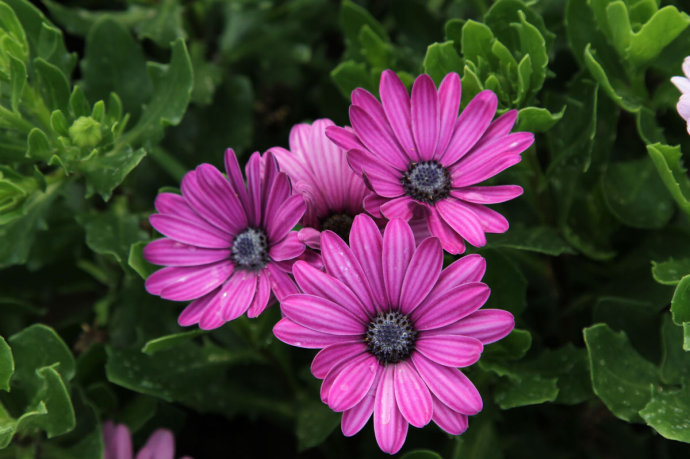
How to grow Osteospermum and precautions, Osteospermum pictures
Sun-loving, moderately cold-tolerant, able to endure low temperatures of -3°C to -5°C. Drought-tolerant. Prefers loose, fertile sandy loam. Performs even better in moist, well-ventilated environments. Strongly branching, no pinching required. Blooms early, with a long flowering period. Low temperatures favor flower bud formation and blooming. In regions with a mild climate, it can grow year-round.
Whether used as a potted flower for desktop display or for early-spring landscaping, Osteospermum is a rare and valuable floral material. If used as a component of a flower border, set off against green grass and ornamental stones, it can better display its harmonious natural beauty.
Osteospermum has a long flowering period, strong adaptability, is easy to cultivate, and simple to maintain. Like ordinary herbaceous flower varieties, it is propagated by seed sowing and then cultivated for production, and robust seedlings can be grown. The optimum germination temperature is 18-20°C, and germination occurs in 7-10 days. Cultivation techniques:
Germination stage - preparation phase, substrate pH: 6.2-6.5; a pH below 6.0 can cause poisoning by iron, sodium, and the like.
Note: Giving a short period of 2 weeks of light (9 hours/day) after sowing can prompt Osteospermum plants to flower in a short, sturdy state.
Germination stage - Stage 1, the radicle appears in 1-2 days.
Appearance characteristics: At the end of Stage 1, the radicle and cotyledons appear.
Moisture: Keep moisture content moderate; do not soak through. Cover the seeds with a layer of vermiculite to maintain moisture.
Temperature: 22-24°C, effective concentration value: <0.5
Light: No light required.
Germination stage - Stage 2
Appearance characteristics: At the end of Stage 2, roots are 1.27-2.54 cm long, the cotyledons are fully developed, and the germination process is complete.
Moisture: The substrate should be slightly moist, not soaked through.
Substrate temperature: After dry leaves appear, lower the temperature to 20-21°C.
Fertilizer: Apply 50-75 ppm calcium-containing nitrogen fertilizer.
Substrate effective concentration value: 0.5-0.75
Light: Light intensity should not exceed 25,000 lux; high light will cause premature maturation of the plants, while a short period of light can prompt the plants to flower in a short, sturdy state.
Germination stage - Stage 3
Appearance characteristics: At the end of Stage 3, roots are 3.81-5.08 cm long, plants are 1.27-2.54 cm tall, and the first true leaf appears.
Moisture: Keep moisture content moderate; excessive drying causes premature flowering of the plants, and a constant state of drying out will lead to bud drop. Soaked substrate will cause poor root development.
Substrate temperature: 18-20°C.
Fertilizer: 1-2 times per week, nitrogen fertilizer at 150 ppm.
Substrate effective concentration value: 0.75-1.0
Light: See Stage 2
Germination stage - Stage 4
Appearance characteristics: At the end of Stage 4, the root system can firmly support the plant, and more than 2 true leaves appear.
Moisture: See Stage 3. Soaked substrate or excessive ammonia fertilizer can cause excessively rapid plant growth.
Substrate temperature: If the leaves spread outward excessively, lower the temperature to 17-18°C.
Fertilizer: See Stage 3
Substrate effective concentration value: See Stage 3
Nutrients: Calcium and boron are of great significance to the growth of plants during the flowering period. Bud drop indicates a deficiency of these two nutrients, and excessive ammonia fertilizer will delay the appearance of buds or reduce the number of buds.
Light: See Stage 2
Growth regulation: African marigold is sensitive to B-Nine, Sumagic, and Bonzi; carry out growth regulation after 3-4 true leaves appear.
Growth period
Transplant before the Osteospermum root system is fully developed; delaying transplanting will cause earlier flowering.
Substrate pH: 6.2-6.5; African marigold can be used to detect low pH. Low pH (<6.0) is characterized by yellow leaves and scorched leaf edges.
Moisture: Let the substrate dry out somewhat between waterings. Do not let the substrate dry out completely; soaked substrate will cause excessive plant growth.
Temperature: 18-23°C during the day, 13-18°C at night. Excessively high temperatures make the flowers smaller. The Primrose series is sensitive to cool climates. When temperatures are too low in early spring, yellowing may occur; if humidity rises, the plants will show a healthy green color.
Fertilizer: Alternately apply 150-200 ppm calcium fertilizer and ammonia fertilizer. However, excessive application of ammonia fertilizer will cause excessive plant growth.
Nutrients: Yellow leaves and scorched yellow spots on the leaves are signs of iron poisoning; keep the pH above 6.0 and prevent the application of excessive iron-containing substances.
Growth regulation: African marigold is sensitive to B-Nine, Sumagic, and Bonzi; Antigu is naturally dwarf and requires no growth regulation.
Common pests: Aphids
Common diseases: Root rot
Planting schedule: The planting schedule should be based on the season and weather. In most regions, producing African marigold in combination trays can be completed in 10-12 weeks, and 10.16 cm pots will require an additional 2 weeks.
Flowerbed performance: The warm tones of Osteospermum match the bright colors of pelargonium and morning glory. The Inca and Rerfection series can be planted at centers of 25.4-30.48 cm. The Antign series is naturally dwarf and suitable for flowerbed border edging, and Antigna can also be planted at flowerbed centers of 25.4 cm.
Sowing time for Osteospermum, appreciation of Osteospermum pictures
Osteospermum is a flower with good branching at the base and a rounded plant shape; Osteospermum has dark green leaves, is easy to cultivate, is a cool-season flower, and comes to market very early.
What is Osteospermum
Osteospermum is a perennial herbaceous flowering plant of the family Asteraceae with a perennial root system; it is native to South Africa and has been introduced into China from abroad in recent years for flower cultivation. Dwarf varieties grow 20-30 cm tall, with green stems and flower heads, mostly clustered into corymb-like clusters, in colors such as white, pink, red, purplish red, blue, and purple; the flowers are single-layered, with a flower diameter of 5-6 cm, and 1000 seeds weigh about 11 grams. Tall varieties of the same genus grow 60 cm tall, are subshrubs, and can be cultivated as cut flowers in their place of origin.
Growth habits
Osteospermum is a herbaceous flower whose place of origin is South Africa; it likes sunlight, is moderately cold-tolerant, likes fertile soil, grows better in moist, ventilated environments, branches strongly, blooms early, has a long flowering period, and can grow year-round.
Applications
Whether used as a potted flower for desktop display or for early-spring landscaping, Osteospermum is a rare and valuable floral material. If used as a component of a flower border, set off against green grass and ornamental stones, it can better display its harmonious natural beauty.
Sowing time for Osteospermum
Time: November to January.
Plug tray: According to the purpose of production, choose 72, 128, or 200 plug trays.
Sowing method: Dibbling, one seed per cell.
Substrate: Mix peat : vermiculite = 3:1, pH 6.2-6.5; too low will cause poisoning by certain metal elements (such as iron, sodium, etc.). Drench the plug tray thoroughly the day before sowing and set aside for use.
Covering material: Cover the seeds with medium-grade vermiculite to facilitate aeration and drainage. After sowing, to ensure the temperature and humidity needed for germination, the plug tray can be covered with plastic film.
Pests and diseases and their control
Osteospermum is simple to cultivate and manage, with few pests and diseases. The common pest is aphids, which can be controlled by spraying the plants with 80% dichlorvos emulsifiable concentrate at 800-1000 times dilution or Yibianjing at 1000 times dilution.
The first common disease is root rot, mostly caused by overwatering. It can be prevented by appropriately controlling water and keeping the substrate slightly moist and on the dry side. Once root damage is found, repot promptly and replace the substrate. The second is yellow leaves; the causes of yellow leaves and control measures are as follows: ① Yellow leaves mainly occur on young leaves and often show spots. The cause is that the substrate pH is too low, causing iron poisoning; the substrate pH can be adjusted by watering with limewater at an appropriate concentration; ② The temperature during the seedling stage is too low; the nighttime temperature can be appropriately raised; ③ Nitrogen fertilizer application is insufficient; the amount of nitrogen fertilizer can be appropriately increased.
More information >>
|What does a white rose symbolize|What plants protect against computer radiation|How to grow succulents|Indoor foliage plants|
|Effects and benefits of Gynostemma pentaphyllum|Effects and benefits of honeysuckle|Handmade roses|Schlumbergera pictures|
|Effects and benefits of osmanthus tea|How to grow Serissa japonica |How to fold a lily |Lavender flowering period |