Is Kalanchoe toxic? Detailed guide to growing methods and precautions
Is Kalanchoe toxic? Growing methods and precautions for Kalanchoe
Kalanchoe prefers warmer temperatures; the suitable growing temperature is no more than 30 degrees during the day and no less than 18 degrees at night. If the temperature is too high or too low, it will affect its normal growth.
Kalanchoe has a relatively low water requirement; finish watering before noon, and the leaves must stay dry before nightfall. It is a short-day plant and will not bloom until at least 6 weeks after treatment. During short-day treatment there must be at least 14 hours of darkness per day. Generally speaking, from October 1 to March 1 of the following year is the natural short-day period. For plants grown in larger pots, long-day treatment should be given in the early growth stage, and once the plant reaches a certain size, short-day treatment can be given to make it bloom. Otherwise, the plant may be on the small side.
Kalanchoe is generally not pinched in Europe and America, but in China it can be pinched as needed. Pinched plants generally have a better shape; a single plant grown in a pot of 15 cm or more should be pinched, usually 3~4 weeks after planting. Removing some flower buds when they first appear can promote the formation of more buds. After flowering, remove the spent flowers promptly.
The flower language of Kalanchoe: great fortune and prosperity, long life, and auspicious blessings of happiness and longevity.
Kalanchoe is native to Africa. It likes a warm, slightly humid and sunny environment, is not cold-tolerant, and its suitable growing temperature is 15-25°C. In summer, when the high temperature exceeds 30°C, growth is checked, and in winter the indoor temperature needs to be 12-15°C. Below 5°C, the leaves turn red and the flowering period is delayed. If the room temperature exceeds 24°C during the winter-spring flowering period, flowering will be inhibited; if the temperature is around 15°C, Kalanchoe will keep flowering continuously.
Kalanchoe is drought-tolerant and not demanding about soil; fertile sandy loam is best. Kalanchoe is a short-day plant and is fairly sensitive to photoperiod. For plants that are growing well, giving short-day treatment (8-9 hours of light per day) for 3-4 weeks will bring out flower buds and flowering.
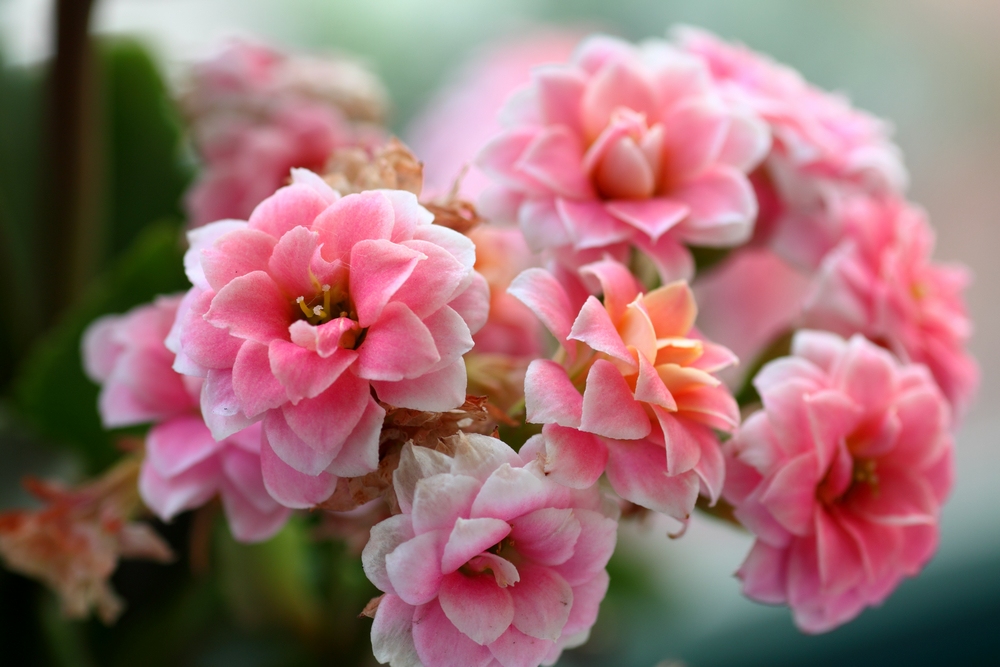
Kalanchoe has a compact shape, crystal-clear leaves, and dense, brilliant flowers, giving an excellent ornamental effect. In addition, since it flowers in winter and spring when few flowers are available, and its flowering period is long and can be controlled, it is a popular and excellent indoor potted flower. Placed in halls and living rooms in winter, it brings a full sense of spring.
Kalanchoe plants are small and delicate, compact in shape, with emerald green leaves and dense flowers. It is an ideal indoor potted flower for winter and spring. Its flowering period coincides with Christmas, New Year's Day and the Spring Festival, making it very suitable for placing on windowsills, desks and tables. Used in flower troughs, display windows and halls in public places, its overall ornamental effect is excellent. Because of the name "longevity", giving a pot of Kalanchoe to relatives and friends during festivals is very appropriate and pleasing, symbolizing great fortune and prosperity and a long life.
Kalanchoe likes full sunlight, and when grown at home it should be placed in a spot with direct sunlight all year round. But around midday in summer it should be shaded appropriately and can be moved indoors, otherwise the light is too strong and the leaves easily turn yellow. Conversely, if the light is insufficient, not only will the branches be thin and spindly and the leaves thin with an unattractive plant shape, but the number of flowers will also decrease, the flower color will be less bright, and a large number of leaves will drop, losing its ornamental value.
Kalanchoe is drought-tolerant, so it does not need a lot of watering; just water thoroughly once every 3-4 days and keep the potting soil slightly moist. In winter at low temperatures and in the rainy season, watering should be controlled to avoid root rot.
During the peak growing season, apply a dilute compound liquid fertilizer once every 2-3 weeks to promote robust growth and abundant flowering. After flower buds form in November, apply 1-2 additional doses of 0.2% potassium dihydrogen phosphate or 0.5% superphosphate solution, and the flowers will be more numerous, more brightly colored and longer-lasting.
In winter, attention must be paid to cold protection; the room temperature must not be lower than 12°C, and 15-18°C during the day and above 10°C at night is best. If the temperature is too low, the leaves turn red, and the flowering period is delayed or normal flowering does not occur, affecting the festive display.
Kalanchoe is phototropic, so during growth you should turn the pot to adjust the light so that the plant receives even light and the branches grow evenly in all directions. After the flowers fade, promptly cut off the spent flowers to avoid consuming nutrients and affecting the number of flowers the next time. Generally, repot once each spring after flowering; use a potting soil made by mixing 4 parts humus soil, 4 parts garden soil, 2 parts river sand, plus a small amount of bone meal. This growing medium is loose, fertile, well-draining and slightly acidic, which is good for the growth and development of Kalanchoe.
Suitable growing temperature. Generally, the suitable growing temperature for Kalanchoe is 15°C to 25°C. If the temperature is too high or too low, Kalanchoe may enter a dormant state, affecting its growth needs. Therefore, during cultivation, avoid exposure to strong sun in summer, and when winter temperatures are too low, Kalanchoe can be moved indoors for growing;
Suitable light duration. Kalanchoe generally likes to grow in an environment with plenty of sunlight, but apart from avoiding strong sun exposure in summer, it can be placed in a sunny spot in ordinary seasons. If Kalanchoe is kept in a shady environment for a long time, it is unfavorable for its growth needs and can also cause easy leaf drop and no flowers;
Sufficient water for growth. As far as the growing habits of Kalanchoe are concerned, it is a drought-tolerant flower, so Kalanchoe does not need a lot of watering; generally watering once every 3-4 days is enough, while mainly keeping the potting soil moist. Also note that in humid seasons watering should mainly be controlled to prevent excessive water causing root rot in Kalanchoe;
Moderate fertilization. During the growth period, Kalanchoe also needs sufficient nutrients, so during its peak growing season, apply a compound liquid fertilizer about once every two weeks, which helps promote the growth needs of Kalanchoe and helps it produce more abundant flowers;
Pest and disease control. As the environment becomes milder, Kalanchoe also easily suffers from pest and disease infection. Pay attention to keeping indoor ventilation to prevent pests and diseases from entering the room, and also mainly use some insecticides to prevent pest and disease infection. The main diseases seen are downy mildew and anthracnose;
Is Kalanchoe toxic? Growing methods and precautions for Kalanchoe
Kalanchoe is a common indoor potted flower. What puzzles many people is whether Kalanchoe is toxic. Can it be placed in the bedroom? Next, Xiao Qi will share knowledge such as whether Kalanchoe is toxic and the growing methods and precautions for Kalanchoe.
Is Kalanchoe toxic?
Generally, toxic plants also refer to poisoning after eating them; usually if you do not eat them, there is no problem. In addition, some aromatic plants placed indoors can cause us discomfort, but this is not toxicity. Kalanchoe absorbs carbon dioxide, releases oxygen, and has a strong air-purifying effect.
Kalanchoe is not toxic, and it can also absorb harmful gases and purify the air. Kalanchoe is a CAM plant; its stomata close during the day and only open at night to release oxygen while absorbing carbon dioxide. Therefore, Kalanchoe has a very good air-purifying effect, especially at night, and can make the air in a closed room fresh.
So Kalanchoe is not only non-toxic, but also has a very good effect on purifying indoor air and beautifying the home environment. We can buy and grow it with confidence.
Growing methods for Kalanchoe
1. Suitable growing temperature
Generally, the suitable growing temperature for Kalanchoe is 15°C to 25°C. If the temperature is too high or too low, Kalanchoe may enter a dormant state, affecting its growth needs. Therefore, during cultivation, avoid exposure to strong sun in summer, and when winter temperatures are too low, Kalanchoe can be moved indoors for growing.
2. Sufficient water
As far as the growing habits of Kalanchoe are concerned, Kalanchoe is a drought-tolerant flower, so Kalanchoe does not need a lot of watering; generally watering once every 3-4 days is enough, while mainly keeping the potting soil moist. Also note that in humid seasons watering should mainly be controlled to prevent excessive water causing root rot in Kalanchoe.
3. Suitable light duration
Kalanchoe generally likes to grow in an environment with plenty of sunlight, but apart from avoiding strong sun exposure in summer, it can be placed in a sunny spot in ordinary seasons. If Kalanchoe is kept in a shady environment for a long time, it is unfavorable for its growth needs and can also cause easy leaf drop and no flowers.
4. Moderate fertilization
During the growth period, Kalanchoe also needs sufficient nutrients, so during its peak growing season, apply a compound liquid fertilizer about once every two weeks, which helps promote the growth needs of Kalanchoe and helps it produce more abundant flowers.
5. Pest and disease control
As the environment becomes milder, Kalanchoe also easily suffers from pest and disease infection. Pay attention to keeping indoor ventilation to prevent pests and diseases from entering the room, and also mainly use some insecticides to prevent pest and disease infection. The main diseases seen are downy mildew and anthracnose.
Precautions for growing Kalanchoe
1. In winter, attention must be paid to cold protection; the room temperature must not be lower than 12°C, and 15-18°C during the day and above 10°C at night is best. If the temperature is too low, the leaves turn red, and the flowering period is delayed or normal flowering does not occur, affecting the festive display.
2. Kalanchoe is drought-tolerant, so it does not need a lot of watering; just water thoroughly once every 3-4 days and keep the potting soil slightly moist. In winter at low temperatures and in the rainy season, watering should be controlled to avoid root rot.
3. During the peak growing season, apply a dilute compound liquid fertilizer once every 2-3 weeks to promote robust growth and abundant flowering. After flower buds form in November, apply 1-2 additional doses of 0.2% potassium dihydrogen phosphate or 0.5% superphosphate solution, and the flowers will be more numerous, more brightly colored and longer-lasting.
The above isIs Kalanchoe toxic?andGrowing methods and precautions for Kalanchoeintroduced. The most suitable growing temperature for Kalanchoe is 15°C to 25°C. If the temperature is too high or too low, it may enter a dormant state and stop growing. I hope everyone will pay attention.
Is Kalanchoe toxic? Growing methods and precautions for Kalanchoe
Kalanchoe is a common indoor potted flower. What puzzles many people is whether Kalanchoe is toxic. Can it be placed in the bedroom? Next, Xiao Qi will share knowledge such as whether Kalanchoe is toxic and the growing methods and precautions for Kalanchoe.
Is Kalanchoe toxic?
Generally, toxic plants also refer to poisoning after eating them; usually if you do not eat them, there is no problem. In addition, some aromatic plants placed indoors can cause us discomfort, but this is not toxicity. Kalanchoe absorbs carbon dioxide, releases oxygen, and has a strong air-purifying effect.
Kalanchoe is not toxic, and it can also absorb harmful gases and purify the air. Kalanchoe is a CAM plant; its stomata close during the day and only open at night to release oxygen while absorbing carbon dioxide. Therefore, Kalanchoe has a very good air-purifying effect, especially at night, and can make the air in a closed room fresh.
So Kalanchoe is not only non-toxic, but also has a very good effect on purifying indoor air and beautifying the home environment. We can buy and grow it with confidence.
Growing methods for Kalanchoe
1. Suitable growing temperature
Generally, the suitable growing temperature for Kalanchoe is 15°C to 25°C. If the temperature is too high or too low, Kalanchoe may enter a dormant state, affecting its growth needs. Therefore, during cultivation, avoid exposure to strong sun in summer, and when winter temperatures are too low, Kalanchoe can be moved indoors for growing.
2. Sufficient water
As far as the growing habits of Kalanchoe are concerned, Kalanchoe belongs to the drought-tolerant type of flower, so Kalanchoe does not need a lot of watering; generally watering once every 3-4 days is enough, while mainly keeping the potting soil moist. Also note that in humid seasons watering should mainly be controlled to prevent excessive water causing root rot in Kalanchoe.
3. Suitable light duration
Kalanchoe generally likes to grow in an environment with plenty of sunlight, but apart from avoiding strong sun exposure in summer, it can be placed in a sunny spot in ordinary seasons. If Kalanchoe is kept in a shady environment for a long time, it is unfavorable for its growth needs and can also cause easy leaf drop and no flowers.
4. Moderate fertilization
During the growth period, Kalanchoe also needs sufficient nutrients, so during its peak growing season, apply a compound liquid fertilizer about once every two weeks, which helps promote the growth needs of Kalanchoe and helps it produce more abundant flowers.
5. Pest and disease control
As the environment becomes milder, Kalanchoe also easily suffers from pest and disease infection. Pay attention to keeping indoor ventilation to prevent pests and diseases from entering the room, and also mainly use some insecticides to prevent pest and disease infection. The main diseases seen are downy mildew and anthracnose.
Precautions for growing Kalanchoe
1. In winter, attention must be paid to cold protection; the room temperature must not be lower than 12°C, and 15-18°C during the day and above 10°C at night is best. If the temperature is too low, the leaves turn red, and the flowering period is delayed or normal flowering does not occur, affecting the festive display.
2. Kalanchoe is drought-tolerant, so it does not need a lot of watering; just water thoroughly once every 3-4 days and keep the potting soil slightly moist. In winter at low temperatures and in the rainy season, watering should be controlled to avoid root rot.
3. During the peak growing season, apply a dilute compound liquid fertilizer once every 2-3 weeks to promote robust growth and abundant flowering. After flower buds form in November, apply 1-2 additional doses of 0.2% potassium dihydrogen phosphate or 0.5% superphosphate solution, and the flowers will be more numerous, more brightly colored and longer-lasting.
The above isIs Kalanchoe toxic?andGrowing methods and precautions for Kalanchoeintroduced. The most suitable growing temperature for Kalanchoe is 15°C to 25°C. If the temperature is too high or too low, it may enter a dormant state and stop growing. I hope everyone will pay attention.
Recommended reading:
①How to care for cyclamen
②When does the goldfish plant bloom, and growing methods for the goldfish plant
③Growing methods and precautions for string of pearls, and propagation methods for string of pearls
④Reasons for yellowing leaves in clivia, and what to do when clivia leaves turn yellow