Reasons and Solutions for Yellowing and Withered Leaves on Anthurium
What to Do When Anthurium Leaves Turn Yellow and Withered
Before understanding what to do when anthurium leaves turn yellow, you first need to figure out why your anthurium leaves are turning yellow. Generally, anthurium leaves turning yellow is caused by the following reasons: 1. Anthurium leaves turn yellow mainly due to root rot caused by overly low temperatures.
2. Too much fertilizer and water, because excessive fertilizer application causes a disruption in the metabolism of the flamingo lily.
3. Excessive watering can also cause anthurium leaves to turn yellow and affect their ornamental value.
4. Excessive light can cause anthurium leaves to turn yellow and lose their luster, and can also lead to slow growth, short petioles, small leaves, and curling that does not spread out.
5. Vigorous growth but no flowering is generally caused by a placement location that is too dark and excessive nitrogen fertilizer.
What should be done when anthurium leaves turn yellow? Too much watering, lack of sunlight, and other factors can all cause anthurium leaves to turn yellow, so we need to treat the cause accordingly.
1. When yellow leaves appear on anthurium, pay attention to checking for root rot, and once there is root rot, cut it off promptly.
2. Excessive watering or excessive light can easily lead to yellow leaves and curled edges, so pay attention to adjusting the position of the pot.
3. Anthurium has wide leaves and large flowers, so when misting, also wipe the flowers and leaves at the same time; keeping them fresh and clean is the key to a beautiful plant.
4. Anthurium flowers are slightly toxic, and the toxin mainly comes from the sap; do not accidentally ingest them, and wash your hands after each care session.
5. Anthurium is best grown outdoors, or in a well-ventilated corner that is not easily touched.
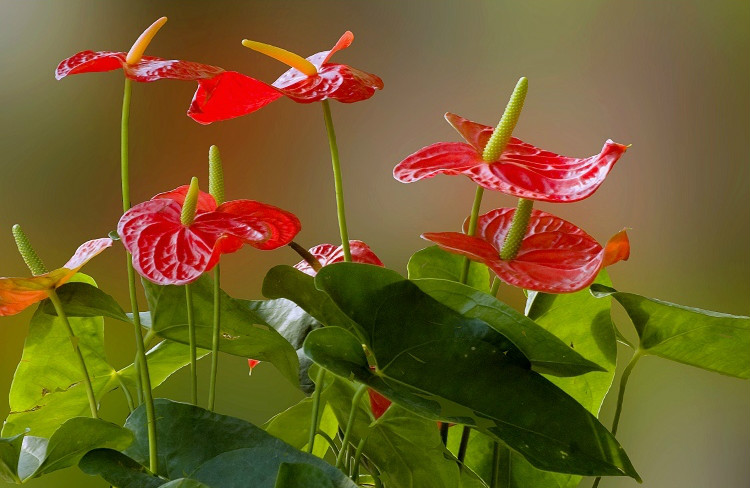
Now that we understand what to do when anthurium leaves turn yellow, the editor will finally teach everyone how to pair anthurium. Anthurium combines the three vivid colors of red, green, and yellow in one plant, rich but not monotonous, colorful but not cluttered. Use the vibrant anthurium to set off and echo other green plants.
In this way, you can create a tranquil space, allowing you to comfortably spend a quiet moment and feel the various flavors you most long for in life. Indoors alone, simply using friendly wooden furniture, wallpaper, fabric, tableware, and green plants in careful combination can complete a pleasant picture comparable to an outdoor pastoral life.
What to Do When Anthurium Leaves Turn Yellow and Withered
Flower enthusiasts who have kept anthurium will all encounter the situation of anthurium leaves turning yellow. Below, I have consulted relevant materials to introduce to everyone the methods for solving anthurium leaf yellowing.
Handling method: First cut off the yellow leaves, place it in a cool place, wait until the water is almost dry and then water again, and do not rush to fertilize. There may be two situations: one is that the air humidity is too low, that is, too dry; the other situation is a lack of trace mineral elements.
Control temperature and humidity well, let it get some sun in the morning and evening, and fertilize appropriately.
The symptoms of yellowing, drying, and rotting leaves in anthurium are caused by bacteria. Spraying chili water cannot cure it; chili water is for preventing and controlling insect pests, not bacterial damage. To eliminate bacteria, spray a 0.3% solution of garlic juice, a 0.2% solution of vinegar, or fungicides such as carbendazim or chlorothalonil at 800-1000 times dilution for prevention and control.
But this cannot solve the fundamental problem, because the appearance of such symptoms in anthurium is due to an unsuitable care environment. Anthurium should be managed in a semi-shaded, moist, and warm environment. The best temperature is between 20-25°C, and it must not exceed 33°C, otherwise symptoms of discomfort easily appear; air humidity must be between 75-90%, and below 50%, leaves easily develop scorched edges and drying.
Fertilization should also not be too concentrated. The potting soil should be watered with fully water-soluble fertilizer, and ordinary chemical fertilizers should not be applied, because anthurium cannot absorb them and fertilizer damage will occur.
The cultivation substrate for anthurium is generally imported peat, which has strong fertilizer and water retention capacity, but after drying out completely it is not easy for it to absorb water, so it should be watered thoroughly when slightly moist, and should not be watered after completely drying out or in a waterlogged state. The peat on the surface showing dryness is the signal to water. If the substrate contains too much water and watering is not done according to the see-dry-see-wet principle, it is very easy to cause root rot and lead to poor growth of the whole plant. Because anthurium finds it difficult to absorb ordinary chemical fertilizers, it is better to use only fully water-soluble fertilizers such as 'Huaduoduo', and the amount of fertilizer applied must not be too large. The principle is to apply dilute fertilizer frequently; if too much is absorbed by the plant, it will cause fertilizer damage, with leaves turning black and wilting, and the plant dying. Be careful not to pour tea water or similar liquids into the potting soil, as this will cause fatal damage.
The care environment should preferably be semi-shaded, and cannot be fully shaded or fully sunny, but anthurium is especially fond of light, so the growth direction should be rotated frequently to maintain a beautiful plant shape. The water quality must be clean, or it can be fertilizer water, but tap water must not be used directly for watering, because harmful substances such as chlorine in tap water will cause poor growth of anthurium, or even death. The water should be left to stand for about 2 days before watering. It is best to place it close to the anthurium, so that there is no temperature difference between the water temperature and the potting soil temperature, and the fine roots of the anthurium will not be damaged.
What to Do When Anthurium Leaves Turn Yellow and Withered
China Landscape Web, January 10 news: Flower enthusiasts who have kept anthurium will all encounter the situation of anthurium leaves turning yellow. Below, I have consulted relevant materials to introduce to everyone the methods for solving anthurium leaf yellowing.
Handling method: First cut off the yellow leaves, place it in a cool place, wait until the water is almost dry and then water again, and do not rush to fertilize. There may be two situations: one is that the air humidity is too low, that is, too dry; the other situation is a lack of trace mineral elements.
Control temperature and humidity well, let it get some sun in the morning and evening, and fertilize appropriately.
The symptoms of yellowing, drying, and rotting leaves in anthurium are caused by bacteria. Spraying chili water cannot cure it; chili water is for preventing and controlling insect pests, not bacterial damage. To eliminate bacteria, spray a 0.3% solution of garlic juice, a 0.2% solution of vinegar, or fungicides such as carbendazim or chlorothalonil at 800-**** times dilution for prevention and control.
But this cannot solve the fundamental problem, because the appearance of such symptoms in anthurium is due to an unsuitable care environment. Anthurium should be managed in a semi-shaded, moist, and warm environment. The best temperature is between 20-25°C, and it must not exceed 33°C, otherwise symptoms of discomfort easily appear; air humidity must be between 75-90%, and below 50%, leaves easily develop scorched edges and drying.
Fertilization should also not be too concentrated. The potting soil should be watered with fully water-soluble fertilizer, and ordinary chemical fertilizers should not be applied, because anthurium cannot absorb them and fertilizer damage will occur.
The cultivation substrate for anthurium is generally imported peat, which has strong fertilizer and water retention capacity, but after drying out completely it is not easy for it to absorb water, so it should be watered thoroughly when slightly moist, and should not be watered after completely drying out or in a waterlogged state. The peat on the surface showing dryness is the signal to water. If the substrate contains too much water and watering is not done according to the see-dry-see-wet principle, it is very easy to cause root rot and lead to poor growth of the whole plant. Because anthurium finds it difficult to absorb ordinary chemical fertilizers, it is better to use only fully water-soluble fertilizers such as 'Huaduoduo', and the amount of fertilizer applied must not be too large. The principle is to apply dilute fertilizer frequently; if too much is absorbed by the plant, it will cause fertilizer damage, with leaves turning black and wilting, and the plant dying. Be careful not to pour tea water or similar liquids into the potting soil, as this will cause fatal damage.
The care environment should preferably be semi-shaded, and cannot be fully shaded or fully sunny, but anthurium is especially fond of light, so the growth direction should be rotated frequently to maintain a beautiful plant shape. The water quality must be clean, or it can be fertilizer water, but tap water must not be used directly for watering, because harmful substances such as chlorine in tap water will cause poor growth of anthurium, or even death. The water should be left to stand for about 2 days before watering. It is best to place it close to the anthurium, so that there is no temperature difference between the water temperature and the potting soil temperature, and the fine roots of the anthurium will not be damaged.