How to grow large-flowered geraniums? Cultivation methods and photo appreciation
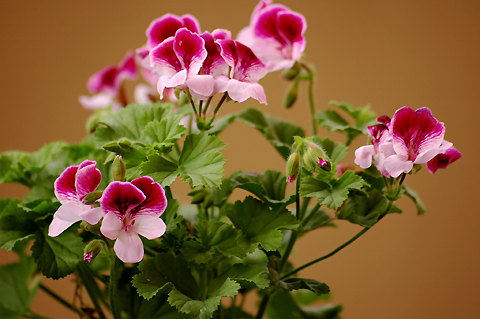
What are large-flowered geraniums like? Large-flowered geranium photos
Cultivation management
It prefers a cool climate, and the suitable growth temperature is 5°C~25°C. The plant enters a semi-dormant state during the high-temperature period in summer, and in cold winter areas it only needs a little protection to overwinter. It prefers an environment with sufficient light, is tolerant of dryness, and avoids waterlogging. It requires a loose cultivation substrate with good drainage and rich in organic matter. Large-flowered geraniums are sown from late winter to early spring, and the flowering period runs through the entire summer. When sown in late summer, with the overwintering temperature kept above 5°C, they can bloom in spring. The seeds avoid light when germinating, and sowing requires covering with a 3~5mm thick substrate or 2~4mm thick coarse-grained vermiculite. Sowing can use a 128-cell plug tray, with imported peat as the substrate, adding 10% large-grained perlite with a diameter of 3~5mm, keeping the substrate moderately moist, not too wet, and sprouting in 5 to 10 days.
The seedling raising cycle is 5 to 6 weeks, divided into 4 stages. The first stage, from sowing to the appearance of the radicle; the second stage, from the appearance of the radicle to the expansion of the cotyledons, completion of germination, and the growth of one true leaf. After emergence, the substrate moisture should be reduced to facilitate root development. The third stage, from the appearance of one true leaf and the beginning of growth, reaching the transplanting standard. The fourth stage, ready for transplanting or storage and transport. In the first stage, the germination temperature is 21°C~24°C, requiring 3 to 5 days, and the substrate should be moderately moist. In the second stage, the temperature is 21°C~24°C, fertilizing once a week is acceptable, with N:P:K of 15:0:15 and 20:10:20 fertilizers used alternately, at a concentration of 50~75ppm, requiring 5 to 10 days, with the substrate moderately moist. In the third stage, the temperature is 18°C~21°C, the fertilization concentration is 100~150ppm, fertilizing twice a week, requiring 14 to 21 days, basically reaching four leaves and one heart. In the fourth stage, the temperature is 17°C~18°C, requiring 7 days, with the fertilization concentration the same as the third stage, after which they can be planted into 14cm×12cm pots.
pH value The pH value of the water should be adjusted to slightly acidic, preferably 5.5 to 6.5, and the substrate pH value is best controlled at 6.2~6.5. Temperature Throughout the seedling raising period, the substrate temperature should preferably not be lower than 18°C, as too low a temperature hinders the growth and development of the seedlings.
Origin information
Native to South Africa, the Cape of Good Hope area, and cultivated throughout the world. The types and varieties are rich, and the most widely used in China is the geranium (commonly known as wax red in Shanghai). The large-flowered geranium is also called the woolly-leaved geranium, and is less commonly used in China, yet it is the potted flower species with the largest flowers in the Geranium genus.
[Breeding science progress] Blooms in April. Significance and progress The large-flowered geranium is a perennial evergreen herbaceous flower of the Geraniaceae family, Geranium genus. The varieties have many flower colors, including pink, light red, deep red, white, brown, purple, light purple, pure white, pinkish white, scarlet, purplish red, orange red, bicolor, etc. In full bloom, a large flower ball composed of more than ten small flowers can continue to bloom for more than half a month, with brilliant colors and wide garden applications. Tissue culture of other Geranium genus geraniums has been reported, but tissue culture of the large-flowered geranium has not yet been reported.
Large-flowered geranium Large-flowered geranium varieties and complete flower language guide
The large-flowered geranium is a relatively common plant in the north, a close relative of the geranium, a plant of the Geraniaceae family and Geranium genus. Its whole plant is hairless or sparsely covered with silky hairs. The leaves of the large-flowered geranium are ovate or nearly round, relatively thick in texture, with longer petioles, and the flowers are relatively large, with quite a few flower colors. Because the large-flowered geranium has large flowers, bright colors, and is relatively cold-resistant, it is very popular. Today, let everyone take a look with the editor at an introduction to large-flowered geranium varieties and flower language.
Introduction to the large-flowered geranium
The large-flowered geranium is a perennial herb, reaching up to 30-40 cm in height, with an upright stem and branches. Its base is woody, covered with spreading long soft hairs. The leaves of the large-flowered geranium are alternate, the stipules are dry and membranous, triangular-wide ovate, the leaves are 8-10 mm long and 6-8 mm wide. Its lower petioles are 8-13 cm long, and the upper petioles are relatively short, covered with soft hairs. The leaves of the large-flowered geranium are round-kidney-shaped, with a heart-shaped or truncate base. Its corolla is pink, light red, deep red or white. The flowering period is in July-August each year.
Large-flowered geranium varieties
The large-flowered geranium belongs to the Geraniaceae family, Geranium genus, and large-flowered geraniums grown at different latitudes and longitudes in different regions grow differently, which also makes their varieties different. The large-flowered geranium, called the woolly-leaved geranium, is relatively rare in China, but this plant is the one with the largest flowers among geraniums. Because the large-flowered geranium has quite a few flower colors, its flower colors include deep red, brown, light purple, pinkish white, scarlet, purplish red, bicolor and white.
Large-flowered geranium flower language
The flower language of the large-flowered geranium is a chance encounter, happiness is right by your side. The flower language of large-flowered geraniums of different colors is also different, and the flower language of the red large-flowered geranium is that you linger in my mind. The flower language of the pink geranium is being very happy to stay by your side. The geranium is the pride of the African people and is also very popular in Europe, and in Hungary the colorful large-flowered geranium is even designated as the national flower.
The value of the large-flowered geranium
The large-flowered geranium can be used to condition the skin, has strong affinity, and can combine with organic fats to make cream products. If you use facial cleanser made from geranium to wash your face every day, it can be very effectively absorbed by the skin. The large-flowered geranium has the effect of shrinking pores and promoting blood circulation. After use, it will make pale skin more rosy and vibrant, and make the skin bright, smooth and delicate. It is the most natural beauty product. It is also very good for sagging, pore-clogged and oily skin.
Summary: The above is the editor's introduction to large-flowered geranium varieties and flower language. After reading the editor's introduction, I believe everyone has a relatively good understanding. The large-flowered geranium has strong adaptability, bright flower colors, and a long flowering period, and is very suitable for indoor placement and flowerbed arrangement.
How to do vernalization treatment for large-flowered geraniums? The "vernalization" operation for large-flowered geraniums
Previously, on a geranium forum, I saw a flower friend asking about geranium vernalization knowledge. Some flower friends asked when large-flowered geraniums should be vernalized. What is vernalization? How should large-flowered geranium vernalization be handled? With these questions, the editor below will combine the maintenance experience of flower friends to tell everyone about large-flowered geranium vernalization knowledge.
1. What is vernalization?
Vernalization - some flowers need low-temperature conditions to promote flower bud formation and flower organ development. This process is called the vernalization stage, and the low-temperature stimulation and treatment process that causes flowers to pass through the vernalization stage is called vernalization.
2. The role of vernalization
Vernalization can make Angel geraniums produce more flowers, but for most large-flowered geraniums already available in China, vernalization is necessary, otherwise they may not bloom.
3. Specific operation of vernalization
Starting from November to the end of December, place the flowers in an indoor building room without heating, and do not expose them to sunlight during vernalization. If the corridor temperature is also not low, they can be placed on an enclosed north-facing balcony.
Theoretically, the temperature is suitable when controlled at 5°C-10°C. Practical conclusion: 5-8°C is best.
Generally speaking, if the temperature exceeds 10°C, the vernalization time needs to be extended; if it exceeds 15°C, vernalization cannot be completed.
After vernalization ends, bring the flowers back, place them indoors to warm up and expose them to sunlight. After mid-January, buds appear, and flowering begins around the Spring Festival. Prerequisite: heating. In the Beijing area, following the above method, large-flowered geraniums bloom continuously from the Spring Festival, and can be seen until mid-July, until the end of the dog days, about a 5-month flowering period. Of course, late-blooming varieties may only bloom around March.
In addition, upright geraniums and trailing geraniums that can bloom without vernalization should be moved indoors for the night around the Frost's Descent solar term.
Summary: The above is an introduction to geranium vernalization knowledge. I hope it will be helpful to flower friends growing geraniums.