Ixora Care and Growing Guide with Photo Gallery
How to Grow Ixora, Ixora Photos
Introduction
Scientific name: Ixora chinensis Lam.
Family name: Rubiaceae, genus Ixora
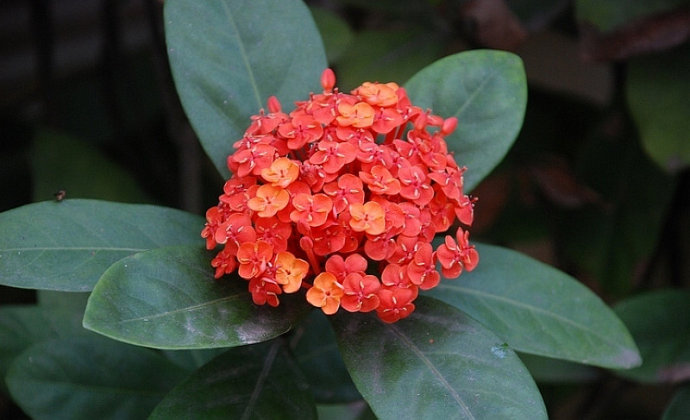
Characteristics: Evergreen shrub, up to 2 m tall, with side branches ascending and upright; leaves opposite, glossy, ovate-lanceolate or elliptical, entire, almost sessile, stipules also opposite; inflorescence terminal, composed of dozens of flowers forming a hemispherical cluster, each flower having a slender tube, with four rounded petals, flower color orange-red to deep red, blooming in summer and autumn, with a very long flowering period.
Uses: Generally propagated mainly by cuttings; besides ixora, white ixora (Ixora parviflora) is also common, with dark green leaves and white flowers with lanceolate petals.
Morphological Characteristics
The flowers belong to a terminal corymb; each cluster has about 20-30 small flowers growing from the corolla tube and then splitting into 4-5 elliptical petals, with the tube about 2.5 cm long, and the corolla mostly brick red. The 20-30 clustered small flowers as a whole present a large spherical shape, rich and colorful, resembling a hydrangea, so it is also called "red hydrangea." Because it is also famous for Shandan Mountain in South China, its place of origin, it is also known as "Shandan flower." As for Ixora parviflora, although it also has 20-30 small flowers growing in clusters, its shape is mostly semicircular, and its petals are rather pointed and long. In Okinawa, Japan, because this flower has three flowering periods a year and the pedicels are in a three-segment overlapping state, it also has the alias "three-segment flower."
The flowering period of ixora is very long. Generally, flowers can be seen from late April each year to around late January of the following year, with the peak blooming period roughly from mid-May to late November. Spherical berries can also form, but usually it mostly does not bear fruit, so ixora with fruit is rarely seen.
Medicinal Functions
Nature, Flavor, and Functions
Flower: sweet and bland, cool. Root: bitter, slightly astringent, cool. Flower: clears heat and cools blood, dissipates stasis and relieves pain. Root: clears heat and cools blood, invigorates blood and relieves pain. Main indications and usage.
Flower: high blood pressure, irregular menstruation, amenorrhea, traumatic injury, sores and boils. Root: cough, hemoptysis, rheumatic joint pain, stomach pain, female amenorrhea, swollen and painful sores, traumatic injury. Flower: internal use: decoct in water, 10-15 g. External use: appropriate amount, crush and apply. Root: external use: appropriate amount, grind into powder and mix for application. Internal use: decoct in water, 10-35 g.
Uses and Cultivation
Ornamental Value
Ixora is native to tropical Asia and has more than 20 varieties. It is an evergreen shrub or small tree, with opposite, entire leaves. It can bloom throughout the year, but blooms more abundantly in summer and autumn. The flowers are terminal, with 4 petals gathered into clusters. The flowers are delicate and gorgeous, drought-tolerant and high-temperature-tolerant, and vigorous in growth. It is suitable for garden landscaping and potted cultivation.
Cultivation
Propagation is mostly by cuttings. It is best carried out in June-July. In the rainy season, take one-year-old branches, cut them into sections 10-15 cm long, remove the basal leaves, and insert them at a room temperature of 24-30°C into a sand bed (pot) or directly into a sandy soil ground bed. If before cutting, the base of the cuttings is soaked in 0.5% indolebutyric acid solution for 3-5 seconds, the rooting period can be shortened and the root system will be especially well developed. After insertion, water daily to keep the sandy loam moist. Roots can form in about 30 days, and 10 days after rooting they can be transplanted or potted.
Seed propagation: collect seeds in winter and sow in the following spring. The suitable germination temperature is 22-24°C. Sow in indoor seedling trays, and germination takes about 20-25 days. When 3-4 pairs of true leaves have grown, the seedlings can be transplanted into 8 cm pots. However, the time to reach mature plant stage is relatively long. When branches are numerous and dense, layering can also be used. At 20 cm from the tip, perform ring barking, bind with peat and film, and healing and rooting can occur in about 2 months.
[Cultivation Management] Ixora likes sunlight and warmth and is not cold-tolerant. It should be placed in a sunny courtyard, roof garden, or south-facing or west-facing balcony. When the minimum winter temperature drops to 5°C, it should be moved indoors and kept in a sunny spot inside a windowsill, where maintaining a room temperature above 5°C allows it to overwinter safely. In the following spring, when the temperature is stable above 10°C, it can be moved outdoors. Besides being planted in the ground, ixora can also be grown in pots.
For potted ixora, it is best to choose a clay pottery pot with good permeability. If using a less permeable but more attractive purple clay pot or plastic pot, you can line the bottom of the pot with broken tiles or crushed hard plastic foam blocks to enhance air permeability and drainage. The potting soil should be acidic soil rich in humus, loose, and fertile, with a pH value of 5.0-6.5 being suitable. Do not use saline-alkali soil or heavy clay. The culture soil can be prepared with 4 parts leaf mold, 4 parts sandy loam, and 2 parts river sand, with an appropriate amount of decomposed soybean cake powder or sesame oil residue mixed in. A small amount of hoof powder can also be placed at the bottom of the pot as base fertilizer. Potted plants are moved out in early April and kept in a semi-shaded place. Ixora likes fertilizer. During the growing season, apply a small amount of nitrogen-phosphorus-potassium compound fertilizer about once every half month. Do not apply nitrogen fertilizer alone, otherwise the branches and leaves will grow excessively and there will be fewer flowers. From mid-April to early May, apply decomposed soybean cake water twice; from mid-May to bud appearance, apply 2-3 times decomposed liquid fertilizer mixed with nitrogen and phosphorus; during the flowering period, 2-3 applications of decomposed phosphorus liquid fertilizer are also needed. The potting soil should be kept alternately dry and wet: water when dry, and stop once thoroughly watered; do not allow waterlogging. In spring, water once every 4 days; in summer, generally water once every 1-2 days, and sprinkle water around the potted flowers once each morning and evening to increase air humidity. In summer, watering with soft water is preferable; hard water is unfavorable to ixora growth, causing yellow leaves in mild cases and death in severe cases. To overcome the alkalinity of soil and water, water once a week with alum fertilizer water during the growing season so that the plant maintains dark green leaves. In autumn, appropriately control the amount of water, which can make the branch tissues more substantial; in winter, watering should be strictly controlled. North of the Yangtze River, when watering, it is advisable to add a little ferrous sulfate to the water (500:1), to prevent long-term irrigation with alkaline water from alkalizing the potting soil, yellowing the leaves, and causing the plant to die. When the seedlings are 15-20 cm tall, pinch the tops once to encourage more side branches and earlier full shaping.
In early winter, shape and prune the plant, retaining healthy branches and cutting off diseased and pest-damaged branches, weak branches, and overly dense branches. When pruning ixora, attention should be paid to pinching. When seedlings are 15 to 20 cm tall, pinch once to encourage more branching and make the plant shape fuller. After flowering, pruning should also be carried out several times. When repotting and changing soil each spring, overwintered old plants should be heavily pruned, leaving about 20 cm. Old plants need to be repotted and have their soil changed once a year. In winter, it can overwinter outdoors in South China; elsewhere it must be moved indoors, with room temperature kept no lower than 2°C. During the growing period, it is prone to scale insects, which need timely control.
Culture
Flower Language
1] Unity;
2] Early birth of a precious child
3] Rebirth
According to legend, a very, very long time ago, the human world suffered a disaster, the people had no means of livelihood, and all living beings were afflicted. A fairy happened to pass by and saw this, so she went to Taishang Laojun's alchemy room to steal the elixir. But before long the matter was exposed, and Taishang Laojun ordered other fairies to pursue this fairy and recover the elixir. Just as they were about to catch up, the fairy scattered the elixir at the last moment. After the elixir fell into the mortal world, it became the ixora, and from then on no disaster ever appeared in the human world again. Therefore, the flower language of ixora symbolizes the birth of new life, that is, rebirth.
National Flower of Myanmar
It is also the national flower of Myanmar.
How to grow ixora? Ixora care methods
Ixora is also known as Shandan flower, Longchuan flower, dwarf ixora, etc. It is an evergreen shrub plant of the genus Ixora in the family Rubiaceae. It can bloom throughout the year, but blooms more abundantly in summer and autumn. The flowers are terminal, with 4 petals gathered into clusters. The flowers are delicate and gorgeous, drought-tolerant and high-temperature-tolerant, and vigorous in growth. It is suitable for garden landscaping and potted cultivation. Now let us take a look at how to grow ixora!
Growth Habits of Ixora
Ixora is more suited to high temperatures and environments with sufficient sunlight. It likes a humid and hot climate and is not tolerant of low temperatures. The suitable growth temperature is 23-32°C. When the temperature is below 20°C, its growth weakens and flowering decreases noticeably, but if sunlight is sufficient, there will still be a certain number of flower buds. When the temperature is below 10°C, its physiological activity decreases and growth slows. When the temperature is below 0°C, frost damage occurs. It likes acidic soil, and the most suitable soil pH is 5-5.5. Soil with good drainage and good fertilizer retention can allow it to grow well.
Propagation Methods of Ixora
1. Cuttings: For ixora cutting propagation, June-July is preferable. Select semi-mature branches 10-15 cm long and insert them into a sand bed. The suitable temperature is 24-30°C, and rooting occurs 40-50 days after insertion.
2. Sowing: Collect ixora seeds in winter and sow in spring. The suitable germination temperature is 22-24°C, and germination occurs 20-25 days after sowing. When 3-4 pairs of true leaves have grown, the seedlings can be transplanted into 8 cm pots.
3. Layering: For ixora plants with many and dense branches, perform ring barking 20 cm from the tip, wrap with peat and film, and healing and rooting can occur in more than 2 months.
Ixora Care Methods
1. Soil: For growing ixora, fertile, loose, and well-drained acidic sandy loam is best. For potted plants, use a mixed soil of culture soil, peat soil, and coarse sand, with a pH of 5-5.5 being suitable.
2. Watering: Ixora likes moisture and fears dryness. Keeping the potting soil moist is beneficial for shoot sprouting and leaf growth. However, if it is too moist for a long time, part of the root system is prone to rot, affecting growth and flowering.
3. Sunlight: Ixora needs sufficient sunlight. Under sufficient sunlight, the leaves are emerald green and glossy, which is beneficial for inflorescence formation, and the flowering is neat and vivid. Proper shading during strong summer light can extend the viewing period of the flowers.
4. Temperature: The suitable growth temperature for ixora is 15-25°C, from March to September it is 24-30°C, and from September to the following March it is 13-18°C. In winter, the temperature should not be lower than 0°C; if too low, it is prone to frost damage.
5. Fertilization: During the growing period of ixora, apply once every half month a liquid fertilizer made by mixing nitrogen, phosphorus, potassium, ferrous sulfate, and horseshoe pieces in a ratio of 1:1:1:2:3, adding water, and fermenting until decomposed.
6. Pruning: Ixora pruning is mostly carried out after plants are moved outdoors in spring, mainly by properly thinning the branches to facilitate ventilation and light penetration. In addition, proper pinching during the flowering period can make it produce more buds and flowers.
7. Pests and Diseases: Ixora is often harmed by leaf spot disease and anthracnose, which can be sprayed with 1000 times dilution of 10% antiseptic 401 acetic acid solution. For pest damage, there is harm from scale insects, which can be killed by spraying with 1500 times dilution of 40% omethoate emulsifiable concentrate.
Ixora Care Methods and Precautions for Growing Ixora
Ixora likes sunlight and warmth and is not cold-tolerant. It should be placed in a sunny courtyard, roof garden, or south-facing or west-facing balcony. When the minimum winter temperature drops to 5°C, it should be moved indoors and kept in a sunny spot inside a windowsill, where maintaining a room temperature above 5°C allows it to overwinter safely. In the following spring, when the temperature is stable above 10°C, it can be moved outdoors. Besides being planted in the ground, ixora can also be grown in pots. For potted ixora, it is best to choose a clay pottery pot with good permeability. If using a less permeable but more attractive purple clay pot or plastic pot, you can line the bottom of the pot with broken tiles or crushed hard plastic foam blocks to enhance air permeability and drainage. The potting soil should be acidic soil rich in humus, loose, and fertile, with a pH value of 5.0-6.5 being suitable. Do not use saline-alkali soil or heavy clay. Ixora has vivid flower colors and great ornamental value, and is deeply loved by many people. Below, let us look at ixora care methods and precautions.
Ixora Care Methods 1. Soil RequirementsIxora has relatively high soil requirements. It is best to choose loose, breathable, and well-drained acidic soil. The pH value of the soil needs to be between 5 and 5.5. Soil that is too acidic or alkaline is not conducive to plant growth.
2. Sufficient LightPlant growth cannot be separated from sufficient sunlight, and the same is true for ixora. When growing ixora at home, it needs to be placed in a sunny place, and sufficient light must be maintained every day. However, when summer light is strong, proper shading is needed.
3. Temperature ControlThe suitable temperature for ixora growth is around 15 to 25°C. It is a flower that can tolerate high temperatures and also a certain degree of low temperature. However, when growing it in winter, the temperature cannot be lower than 0°C, otherwise the plant will suffer frost damage.
4. Sufficient WateringIxora is a flower that relatively likes water, so when growing it at home, you can water it frequently, but the amount of water must be limited. There must be no water accumulation in the potted flowerpot. Too much water will cause the plant's root system to rot.
5. Sufficient FertilizationIxora likes fertilizer. During the growing period, it needs to be fertilized once every half month. Generally, the best fertilizer is a liquid fertilizer made by mixing nitrogen, phosphorus, potassium, ferrous sulfate, and horseshoe pieces in a ratio of 1:1:1:2:3.
6. Shaping and PruningIxora must be pruned as necessary at certain times. When pruning, the main tasks are proper branch thinning and pinching, so that the plant can have better ventilation and light transmission and produce more flowers.
Precautions for Growing Ixora in SpringIt is now spring, and friends who grow ixora at home should pay attention. In spring, temperatures rise and the sunshine is bright, making this a very rapid growth stage for ixora, so everyone must grasp the timing well. First, when the outdoor temperature is around 15°C, ixora should be repotted. However, before repotting, ixora also needs proper pruning, so that more flowers will bloom in summer. Second, after successful repotting, the potted ixora should be placed on a balcony at home for cultivation, mainly maintaining sufficient light for the plant. When the plant produces new leaves, fertilization can gradually begin little by little.