How much does a small-leaf banyan bonsai cost? With care methods included
In our country, a tree means wealth, and everyone likes wealth to roll into the home, so they keep trees at home. The small-leaf banyan is a very good bonsai, it is very beautiful, and it can also be pruned into shapes. How do you keep a small-leaf banyan alive? What is the price of a potted small-leaf banyan? Let's take a look together with Women's Net:
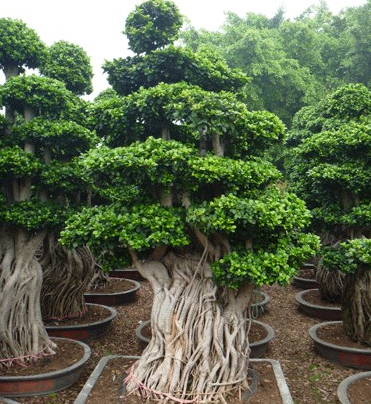
How to care for a small-leaf banyan bonsai
Soil: The banyan is strongly vigorous by nature, and is not strict about the choice of growing medium. If conditions allow, a sandy soil mixed with coal cinder can be used. If not, ordinary soil will also do. For finished plants, coir substrate can also be used as the growing medium.
Watering: Watering should follow the principle of "dry then wet", that is, each time you water you should water thoroughly, until water seeps out of the drainage hole at the bottom of the pot, but do not give half-watering (that is, wet on top and dry below). In hot seasons, spray water on the leaves or the surrounding environment often to lower the temperature and increase air humidity. Water less often in winter and spring, and more often in summer and autumn.
Fertilizing: The banyan does not like heavy feeding; applying just over 10 granules of compound fertilizer each month is enough. When fertilizing, bury the fertilizer into the soil along the edge of the pot, and water immediately after fertilizing. The main components of the fertilizer are nitrogen, phosphorus and potassium.
Pest and disease control: Damage to or rotting of the root system of the small-leaf banyan will cause leaf drop, so the banyan needs to be repotted regularly, and diseased, dead roots, weak roots and damaged roots should be trimmed, dipped in a growth agent and then planted back into the pot. The main insect pests of the small-leaf banyan are aphids, red spider mites and scale insects, etc.; omethoate at 500 ppm can be sprayed on the leaves.
Placement: It is suitable to place it in a warm, humid, airy place with plenty of sunlight. It can adapt to indoor environments and is easy to care for; in summer it needs slight shading, and it can be displayed indoors for long periods under scattered light.
Watering: Watering should follow the principle of "dry then wet", that is, each time you water you should water thoroughly, until water seeps out of the drainage hole at the bottom of the pot, but do not give half-watering (that is, wet on top and dry below). After one watering, wait until the soil surface turns pale and the top layer of soil is dry, then water a second time, and never wait until the potting soil is completely dry before watering. In hot seasons, spray water on the leaves or the surrounding environment often to lower the temperature and increase air humidity. Water less often in winter and spring, and more often in summer and autumn.
Pruning is one means of shaping a small-leaf banyan. Pruning can achieve the goal of giving the banyan a graceful form. Pruning should be done at the right time and for the right tree. The small-leaf banyan can generally be pruned in all four seasons. In actual maintenance and shaping, pruning is the main method and tying is secondary; pruning once a year is appropriate, and vigorous-growing ones can be pruned twice, waiting until the forked branches growing from the shortened branches are thick and strong before pruning again.
Pinching out the growing tip can promote the sprouting of axillary buds, produce more branches, expand the crown, and at the same time inhibit excessive leggy growth of the branches. The timing and frequency of pinching depend greatly on the tree species. For the small-leaf banyan, the leaf tip can generally be pinched off when new shoots sprout and grow 2-3 leaves. When new branches and leaves sprout again, pinch in the same way. Repeating this operation can achieve the goal of making the crown full.
Bud thinning means that when a tree sprouts, often many buds sprout at the same time. To ensure a concentrated supply of water and nutrients, keep the well-positioned buds and remove unnecessary buds, so as to form a more ideal tree shape. For species with strong sprouting ability such as the Chinese elm and Serissa, even more attention should be paid to wiping off buds that are unfavorable to the shape at any time.
Notes on the small-leaf banyan:
Water-yellowing: Tender leaves turn dull yellow and lose their luster, old leaves show no obvious change, branches are thin and yellow-green, and new shoots shrivel and stop growing, indicating overwatering. Take the small-leaf banyan out of the pot, place it in a ventilated, shady spot to let the root ball dry by itself, and then put it back into the pot.
Lack of light: If the small-leaf banyan is placed in a shaded environment for a long time, the leaves cannot get enough sunlight and cannot form chlorophyll; the whole plant's leaves turn yellow and then drop. Supplementing light can prevent this problem.
Lack of fertilizer: This shows as tender leaves becoming paler in color, turning yellow or light green, while old leaves remain relatively normal or gradually turn from green to yellow. Check the potting soil of the small-leaf banyan; if there is caking, the soil should be changed. Usually apply light fertilizer frequently and water with some alum water at the right time.
Fertilizer-yellowing: Yellowing of flowers and plants caused by too much fertilizer or too high a concentration shows as dry brown tips on new leaves; generally the leaf surface is thick and lacks luster, and is uneven and not spread out, while old leaves turn scorched yellow and drop. Fertilizing should be stopped immediately, and in severe cases a large amount of clean water should be used to flush out part of the fertilizer.
Small-leaf banyan price:
From just over 40 to several hundred, varying widely; this mainly depends on the brand and on whether the small-leaf banyan looks good.
What should you do if a small-leaf banyan bonsai drops its leaves?
The small-leaf banyan is a plant that quite likes sunlight. Leaf drop may be due to low temperature, lack of water or insufficient sunlight. Move it under the sun to get some sun and water it a little, and it will be fine.
Care methods and precautions for the small-leaf banyan bonsai. How to care for a small-leaf banyan bonsai
The small-leaf banyan has powerful fibrous aerial roots; some aerial roots hang down and enter the ground, shaped like pillars; some wind downward, with twisted, interlocking roots, quite spectacular. So what are the care methods and precautions for the small-leaf banyan bonsai? Let's take a look below.
I. Introduction to the small-leaf banyan bonsai
The small-leaf banyan bonsai is a variety cultivated by grafting the leaves of the small-leaf banyan tree onto old wild banyan trunks. Among household plant bonsais, the small-leaf banyan bonsai is loved and welcomed by people for its year-round greenness and its characteristics of greening the environment and purifying the air. The small-leaf banyan tree has leathery leaves, and the leaf surface is dark green and glossy, evergreen all year round. The small-leaf banyan's branches are soft and it has powerful fibrous aerial roots; some aerial roots hang down and enter the ground, shaped like pillars, and some wind downward, with twisted, interlocking roots, making a very beautiful sight.
II. Care methods for the small-leaf banyan bonsai
1. Moisture
When the small-leaf banyan is planted in a pot, always pay attention to the moisture of the soil in the pot. Improper moisture is very harmful to the small-leaf banyan: if there is not enough water, the small-leaf banyan will wither from lack of water; if there is too much water, the root system will rot. Usually when watering the small-leaf banyan, you can follow the principle of "dry then wet"; feel the moisture level of the soil with your hand beforehand, then water. There is no need to water too much; just the right amount is fine.
2. Temperature
The small-leaf banyan is a tropical plant and by nature likes warm places with plenty of sunlight. So when caring for a small-leaf banyan bonsai, also pay attention to the temperature of the surrounding environment. If the surrounding temperature is too low, the bonsai should be moved indoors. In winter, the minimum temperature for the small-leaf banyan's growth is about 5°C. Usually the small-leaf banyan bonsai should also be placed in a place with plenty of sunlight; in summer, when the sunlight is too strong, it needs to be shaded.
3. Soil
The small-leaf banyan likes loose, fertile soil. When planting it in a pot, it is best to choose loose, well-aerated leaf mold. You can also mix garden soil, humus soil and sandy soil in a ratio of 2:2:1. In addition, you can place some moss on top of the small-leaf banyan bonsai, which can increase the drainage and air permeability of the small-leaf banyan bonsai.
4. Fertilizing
The small-leaf banyan likes fertilizer as it grows, and needs a lot of fertilizer during its growing period, but note that fertilizing must be appropriate; too many applications and too much fertilizer will also harm the normal growth of the small-leaf banyan. Generally, applying liquid fertilizer 1-2 times a month during the growing season is enough.
5. Pest and disease control
The main insect pests of the small-leaf banyan bonsai are aphids, red spider mites and psyllids, etc. When caring for a small-leaf banyan bonsai normally, be sure to place it in a sunny, ventilated and well-lit spot to avoid pests and diseases. In addition, the bonsai can also be pruned promptly and appropriately to prevent pests and diseases in the small-leaf banyan.
6. Pruning
During the peak growing season of the small-leaf banyan, careful pinching and bud thinning should be done, and in autumn one major pruning is enough. Cut off the small-leaf banyan's dead branches, diseased branches, leggy branches, twin branches and crossing branches, so that the whole bonsai has a pleasing irregular height and a sense of layered beauty.
III. Precautions for caring for a small-leaf banyan bonsai
Applying fertilizer: The small-leaf banyan does not like heavy feeding; applying just over 10 granules of compound fertilizer each month is enough. When fertilizing, bury the fertilizer into the soil along the edge of the pot, and water immediately after fertilizing. The main components of the fertilizer are nitrogen, phosphorus and potassium.
Key watering points: The small-leaf banyan should be watered according to "dry then wet", that is, each time you water you should water thoroughly, until water seeps out of the drainage hole at the bottom of the pot, but do not give half-watering (that is, wet on top and dry below). Water less often in winter and spring, and more often in summer and autumn.
Key pruning points: The small-leaf banyan has strong sprouting ability, and pruning can be carried out all year round. Generally, thinning is done in early spring, cutting off unwanted crossing branches, overlapping branches, opposite branches, as well as dead branches and diseased branches. At ordinary times, leggy branches can be cut off at any time to keep the tree shape attractive.
Changing the potting soil: Because the small-leaf banyan grows fast, it should be repotted once every spring. Potted plants grown in strips should not be too large, otherwise it easily leads to leggy branches and leaves. It likes acidic soil; if the growing medium is alkaline, the leaves will turn yellow. The substrate can be made from materials such as leaf mold, peat soil, pond soil, perlite or coarse sand.
Key propagation points: The small-leaf banyan is propagated by sowing or cuttings.
Cuttings: Bury the treated cuttings upright at the bottom of the pit in time; the plant and row spacing is generally 20 cm × 20 cm, the base of the cutting goes 30-40 cm into the soil, and the branch is exposed 1.5 m above the soil, then fill in the soil and firm it. After cutting is completed, immediately water thoroughly to settle the roots, and soak the cutting bed through. Be sure to make the base of the cutting closely contact the soil, so that the cut end can absorb water from the soil. For cuttings of 2-3 year old large branches of the small-leaf banyan, this should be done before the branches sprout. According to observation, when the soil temperature of the cutting bed reaches above 16°C, the cuttings begin to root.
Pest and disease control:
1. Reasonable planting density. Because the small-leaf banyan grows rapidly and has a broad crown, the plant spacing should be appropriately increased, generally above 5 m.
2. Strengthen cultivation management, mainly by pruning overly dense branches and leaves and overwintering branch tips and diseased tips in winter; this measure is very effective for controlling psyllids.
3. Chemical control of the small-leaf banyan. Because psyllids and thrips easily develop resistance, never use the same pesticide alone for a long time or apply it at excessive concentration. The specific methods include spraying and injection: (1) For spraying, 40% omethoate mixed with decamethrin can be used. The spraying machinery can be a modified 2-4 ton water truck, with the water tank holding the pesticide liquid, a diesel engine driving a high-pressure water pump, and a car-wash high-pressure water gun spraying the tree crown, which can quickly spray through dense branches and leaves along the street, with a vertical range of up to 15 m, achieving an ideal conventional spraying effect. This method is highly efficient for street trees along streets and roads, but the pesticide also causes greater environmental pollution. (2) For trunk injection, choose a motorized hole-drilling and injection machine to drill injection holes of 4-8 cm diameter at a 45 degree angle. The pesticide can be methamidophos emulsifiable concentrate; for 10 cm, 15 cm and 20 cm, inject 2 ML, 4 ML and 8 ML respectively. This method causes little environmental pollution, provides thorough control and has a long lasting effect (effective for 20 days), but because the small-leaf banyan trunk is full of sap, the injection holes easily collect water and the holes heal with difficulty. Therefore, drilling and injecting once in May or October each year is appropriate, and the drilling should be kept to about 6 cm as much as possible.
IV. Experience in caring for a small-leaf banyan bonsai
1. After rain during the plum rain season, the small-leaf banyan should be checked promptly and any accumulated water in the pot poured out. During overwintering, watering should be controlled, keeping the potting soil in a slightly dry state.
2. The small-leaf banyan is not very cold-tolerant. When the temperature drops below normal temperature, it will produce a large amount of leaf drop; below 0°C the plant will suffer freezing damage and die. The overwintering temperature should not be lower than 5°C, and in winter it should be placed indoors to protect it from the cold.
Placing a pot of lush green small-leaf banyan bonsai in the home can not only decorate the home, but also purify the air. The above is the relevant introduction to the care methods and precautions for the small-leaf banyan bonsai. We hope it is helpful to everyone.
Care methods and precautions for the small-leaf banyan bonsai
The small-leaf banyan, also called the elegant banyan, is a plant of the genus Ficus in the mulberry family. The small-leaf banyan is an evergreen small tree with luxuriant branches and leaves and an umbrella-shaped or round crown. It has the characteristics of good shade and a strong ability to absorb smoke and dust, and is often used by people in major landscape greening such as roads, squares, parks, residential communities and courtyards. Nowadays many people like to use small-leaf banyan bonsai as a home plant decoration. However, few people know the care methods and precautions for the small-leaf banyan bonsai. Let's take a look below at the care methods and precautions for the small-leaf banyan bonsai.
Introduction to the small-leaf banyan bonsai
The small-leaf banyan bonsai is a variety cultivated by grafting the leaves of the small-leaf banyan tree onto old wild banyan trunks. Among household plant bonsais, the small-leaf banyan bonsai is loved and welcomed by people for its year-round greenness and its characteristics of greening the environment and purifying the air. The small-leaf banyan tree has leathery leaves, and the leaf surface is dark green and glossy, evergreen all year round. The small-leaf banyan's branches are soft and it has powerful fibrous aerial roots; some aerial roots hang down and enter the ground, shaped like pillars, and some wind downward, with twisted, interlocking roots, making a very beautiful sight.
Care methods and precautions for the small-leaf banyan bonsai
Moisture
When the small-leaf banyan is planted in a pot, always pay attention to the moisture of the soil in the pot. Improper moisture is very harmful to the small-leaf banyan: if there is not enough water, the small-leaf banyan will wither from lack of water; if there is too much water, the root system will rot. Usually when watering the small-leaf banyan, you can follow the principle of "dry then wet"; feel the moisture level of the soil with your hand beforehand, then water. There is no need to water too much; just the right amount is fine.
Temperature
The small-leaf banyan is a tropical plant and by nature likes warm places with plenty of sunlight. So when caring for a small-leaf banyan bonsai, also pay attention to the temperature of the surrounding environment. If the surrounding temperature is too low, the bonsai should be moved indoors. In winter, the minimum temperature for the small-leaf banyan's growth is about 5°C. Usually the small-leaf banyan bonsai should also be placed in a place with plenty of sunlight; in summer, when the sunlight is too strong, it needs to be shaded.
Soil
The small-leaf banyan likes loose, fertile soil. When planting it in a pot, it is best to choose loose, well-aerated leaf mold. You can also mix garden soil, humus soil and sandy soil in a ratio of 2:2:1. In addition, you can place some moss on top of the small-leaf banyan bonsai, which can increase the drainage and air permeability of the small-leaf banyan bonsai.
Fertilizing
The small-leaf banyan likes fertilizer as it grows, and needs a lot of fertilizer during its growing period, but note that fertilizing must be appropriate; too many applications and too much fertilizer will also harm the normal growth of the small-leaf banyan. Generally, applying liquid fertilizer 1-2 times a month during the growing season is enough.
Pest and disease control
The main insect pests of the small-leaf banyan bonsai are aphids, red spider mites and psyllids, etc. When caring for a small-leaf banyan bonsai normally, be sure to place it in a sunny, ventilated and well-lit spot to avoid pests and diseases. In addition, the bonsai can also be pruned promptly and appropriately to prevent pests and diseases in the small-leaf banyan.
Pruning
During the peak growing season of the small-leaf banyan, careful pinching and bud thinning should be done, and in autumn one major pruning is enough. Cut off the small-leaf banyan's dead branches, diseased branches, leggy branches, twin branches and crossing branches, so that the whole bonsai has a pleasing irregular height and a sense of layered beauty.
Conclusion: Placing a pot of lush green small-leaf banyan bonsai in the home can not only decorate the home, but also purify the air. The above is the relevant introduction to the care methods and precautions for the small-leaf banyan bonsai. We hope it is helpful to everyone.