What to Do When Spider Plant Leaves Turn Yellow? Detailed Guide to Growing Methods and Precautions
Spider plants are also a fairly common plant in the home, green all year round, and they do not turn yellow and wither just because winter has arrived. There are also many precautions when growing spider plants. Why do spider plant leaves turn yellow as they are being grown? What is the reason? Let's take a look together with Women's Network:
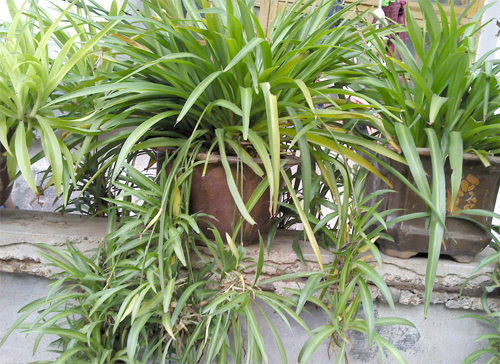
Growing methods and precautions for spider plants:
1. Temperature regulation. Spider plants like a warm, humid climate and are not cold-tolerant. They grow fastest at 20-24°C, stop growing above 30°C, and their leaves easily turn yellow with dry tips.
2. Light regulation. When grown outdoors in summer, care should be taken to provide shade so the light is not too strong, otherwise sunscald easily occurs.
3. Water and fertilizer regulation. During the peak growing seasons of spring and autumn, watering should be plentiful, the potting soil should be kept moist at all times, and the leaves and branches should be sprayed frequently with clean water at a temperature close to room temperature to prevent dry tips, but there must be no waterlogging.
4. Pruning and repotting. As the plant grows larger, to maintain a good plant shape, old leaves at the base should be pruned frequently.
5. Pest control. Spider plants have dense foliage and poor ventilation, making them susceptible to scale insects, so prevention should be the priority.
Reasons why spider plant leaves turn yellow:
1. Excessive fertilization, exceeding the plant's needs. After fertilizing, the leaves will appear glossy and uneven, and later, after part of the root system rots, the leaves turn yellow due to malnutrition. So at this time, fertilization should be stopped, more water should be given, or the roots should be washed once by turning the pot, and replacing the soil with new soil is also a very good method. It can be seen that the concentration of the soil solution in the space is very important.
2. The soil has not been turned for a long time, and the soil has become compacted, so after all the nutrient elements in the pot are exhausted. The most important three elements, nitrogen, phosphorus, and potassium, are lacking, causing the leaves to gradually turn yellow. At this time, the soil should be replaced, or fertile loam should be used promptly and alum fertilizer water should be applied.
3. Spider plants belong to the semi-shade type of flowers, but they also need light, so at least 4-5 hours of light should be ensured every day. Otherwise, chlorophyll decreases and the leaves will also turn yellow. The best method is to place them under an indoor incandescent lamp or keep them on a balcony.
Solutions for spider plant leaves turning yellow:
1. Spider plant leaves turning yellow may be caused by too much fertilizer, exceeding the plant's needs. At first the leaves are glossy but uneven, then the root system rots and the leaves turn yellow. Fertilization should be stopped, more clean water should be poured, or the pot should be turned to clean the roots and replace the soil with new soil.
2. Spider plant leaves turning yellow may also be caused by not repotting and changing the soil for a long time. The various nutrient elements contained in the potting soil have been exhausted, and the three key elements nitrogen, phosphorus, and potassium have not been replenished in time. The plant lacks nutrients, and the leaves show a yellow, thin appearance. Fertile loam should be used promptly and alum fertilizer water should be applied.
3. Spider plant leaves turning yellow may also be caused by insufficient light. Although spider plants belong to the semi-shade type of flowers, they still need at least four hours or more of diffused light every day, otherwise chlorophyll decreases and the leaves turn yellow.
4. The potting soil's air permeability and water permeability are poor, causing the potting soil to remain waterlogged and not dry out for a long time, making root respiration difficult, so the leaves naturally turn yellow. At this time, the soil should be loosened promptly and moisture should be controlled. Fifth, water has been poured without soaking through for a long time. The roots of the spider plant lose water, and the lower old leaves turn yellow. Water should be poured thoroughly to keep the potting soil warm and moist.
That is all for the introduction to spider plant growing methods and ways to solve yellowing leaves. Have you learned something?
Growing Methods and Precautions for Spider Plants: What Are the Growing Methods and Precautions for Aptenia Cordifolia?
The original name of Aptenia cordifolia is heartleaf ice plant. It is a perennial evergreen herb of the Aizoaceae family and the genus Aptenia. Because its branches and vines are relatively soft, and after extending they become semi-prostrate, with the branches hanging down, it looks very much like a spider plant, so people call it Aptenia cordifolia. Aptenia cordifolia is a begonia-type plant and can be used for potted ornamentation. Placing it on a windowsill or on a desk is very nice as an accent. Today, everyone, let's learn together with the editor about the introduction to the growing methods and precautions for Aptenia cordifolia.
Introduction to Aptenia Cordifolia
Aptenia cordifolia is a perennial evergreen herbaceous plant. Its stems lie slanting and spread out, 30-60 cm long, branched, slightly fleshy, hairless, with small granular protrusions. The leaves are opposite, and the leaf blades are heart-shaped ovate and flat. The flowers of Aptenia cordifolia are solitary, terminal or axillary, and most of the petals are red-purple and spoon-shaped. Its flowering period is in July-August every year. The branches and stems of Aptenia cordifolia are about 20 cm long, fleshy and thick, bright green, with angular branches, and after extending they become semi-prostrate. Aptenia cordifolia blooms at the tips of the branches. After flowering, it branches out, is rose-red, with pale yellow at the center of the flower, somewhat like a chrysanthemum, with narrow glossy petals, opening successively from spring to autumn.
How to Grow Aptenia Cordifolia
Aptenia cordifolia likes sunlight and is a plant that should grow in a dry, ventilated environment. It avoids high temperature and excessive humidity, and likes to grow in well-drained sandy soil. It is not cold-tolerant, and its suitable growing temperature is 15-25°C. Aptenia cordifolia does not have a very high demand for fertilizer and water. Generally, from March to September is its growing period, and during this time its water demand is relatively large. After September, Aptenia cordifolia enters a slow growth period. Generally during this time, its watering amount should be reduced, and it should be moved indoors to overwinter.
Growing Methods for Aptenia Cordifolia
Propagation Methods
Generally, propagation of Aptenia cordifolia uses cuttings, carried out in spring and autumn, and it is very easy to root. When propagating by cuttings, take a mature branch, let it dry for a moment, then insert it into prepared potting soil, place it in a cool, ventilated place, and keep the soil slightly moist. After about a week, you can see its branch stand upright, which indicates that its new branch has begun to take root.
Temperature and Light
Apart from needing shade at noon in summer, Aptenia cordifolia can be given sufficient light at other times, especially in winter. While ensuring temperature, it should also be placed in a sunny spot to receive sunlight.
Watering and Fertilizing
Because Aptenia cordifolia has thin woody and fibrous layers, its transport of water and nutrients is relatively slow. Therefore, during cultivation, when fertilizing, concentrated fertilizer must not be used; thin fertilizer must be applied frequently. In winter, it is better to keep it dry, and large amounts of water must not be poured. Every year from March to September is the peak growing season for Aptenia cordifolia. During this time, it needs a large amount of water, especially during the high temperatures of summer, when its watering amount should be increased, but its potting soil must not be allowed to become waterlogged.
Loosening Soil and Pruning
When Aptenia cordifolia enters winter, it will stop growing and enter dormancy. At this time, diseased and pest-damaged branches, overlapping branches, twin branches, thin and weak branches, senescent branches, inward-growing branches, and leggy branches can be cut away promptly. Through thinning, heading back, and removing tillers, the lifespan of Aptenia cordifolia is extended. In winter, the soil layer also needs to be turned and dug so that the surface soil and deep soil are exchanged. Repeated turning and drying makes the soil loose and breathable.
Precautions for Aptenia Cordifolia
1. If Aptenia cordifolia is placed in a place with insufficient light for a long time, it easily causes its leaf color to become pale, lacking vitality, and even the leaves to drop, losing ornamental value.
2. During cultivation, watering it too much will cause root rot, and in severe cases it may die.
3. Aptenia cordifolia does not have a very high demand for fertilizer and water. During its peak growing season, applying thin fertilizer once every half month is enough. If too much fertilizer is applied, it will cause its growth to slow down.
Summary: The above is the editor's introduction to how to grow Aptenia cordifolia and what the growing methods and precautions are. After reading the editor's introduction, I believe everyone has a fairly good understanding. In fact, Aptenia cordifolia can be used for potted ornamentation, and can be used as an accent on windowsills or desks. Sometimes many people confuse it with Panax notoginseng because their appearances are quite similar. Aptenia cordifolia is a begonia-type plant. Panax notoginseng should be a certain plant similar to Sedum spectabile in the Crassulaceae family.
How to Grow Spider Plants: Growing Methods and Precautions for Spider Plants
Spider plants are a very easy-to-grow indoor foliage plant, and they are also a plant we often see in life. So do you all know how to grow spider plants? Today let's share the growing methods and precautions for spider plants.
I. Introduction to Spider Plants
Spider plants are commonly known as hanging basin grass, native to Africa, and are now cultivated and grown all over the world, while Europeans call them spider grass or airplane grass. The biggest feature of spider plants is that mature plants will from time to time grow new stems, and the new stems will then grow small plantlets. They like a warm, humid, semi-shade growing environment and are suitable for long-term indoor cultivation. The flowers of spider plants are mainly white, several in a cluster, looking fresh and pleasant, with relatively high ornamental value.
II. Types of Spider Plants
There are many types of spider plants. Common ones include spider plant, purple spider plant, flowering spider plant, golden-leaf spider plant, silver-edged spider plant, and so on. Among them, the spider plant's stems and leaves are not distinct, the leaves droop, and the leaves are dark green. It blooms in June and July every year, and the flowers are pale yellow and white. Purple spider plant is also called painted spider plant; the main vein of the leaf is purple, the stems are jointed, each node produces leaves, the leaves are thick and glossy, all drooping downward, and it blooms from June to October every year, with pink flowers. Flowering spider plant has vine-like stems, drooping branches and leaves, leaves shaped like peaches, with golden patterns along the leaf edges and through the center of the leaf veins, and the back of the leaf is purple and shiny. Golden-edged spider plant has yellow lines surrounding the green leaf edges, making a particularly beautiful contrast. Silver-edged spider plant has green leaves edged in white, even more vivid, and more distinctive when viewed. In addition, there are also golden-centered spider plant, silver-centered spider plant, broadleaf spider plant, middle-striped spider plant, and so on.
III. Growing Methods for Spider Plants
Growing spider plants actually does not require too much effort. In daily maintenance, the main things are regular watering and preventing accidental damage. The difficulty lies in persisting in paying attention and not forgetting about them and leaving them unattended for a long time. Here, the Tubatu editor mainly breaks down the growing methods for spider plants from 9 aspects that need attention or may have problems during the growing process.
1. Suitable light: Spider plants like a semi-shade environment. Spider plants are very sensitive to light. If exposed to direct sunlight in summer and autumn, the leaves will wither and yellow, and even the whole plant may die. Therefore, strong direct sunlight should be avoided, and they should be placed in a cool, ventilated place, with attention paid to maintaining environmental humidity. At most, they can only receive some slanting light in the morning and evening. In winter, because the sunlight is not strong, spider plants can be allowed to receive some direct sunlight appropriately.
2. Growing temperature: Spider plants like a warm, humid climate and are not tolerant of severe cold or intense heat. The most suitable growing temperature for spider plants is 15-25°C, and the winter room temperature must not be lower than 5°C. In high-temperature seasons, strong direct light should be avoided and sparse shade should be maintained; in low-temperature cold periods, more sunlight is appropriate so as to keep the leaf color bright. In Guangdong Province of China, the temperatures in spring, summer, and autumn are all suitable for the growth of spider plants, but when the winter temperature is lower than 5-7°C, attention must be paid to cold protection and.
3. Watering: Spider plants like water. Because their fleshy roots have well-developed water-storage tissue, they have relatively strong drought resistance, but from March to September, during the peak growing period, the water demand is relatively large, so they should be watered and misted frequently to increase humidity and keep the potting soil completely moist. During the winter dormant period, watering can be done after the soil about one centimeter below the surface of the potting soil has dried. It should be noted that if the soil is too dry, the leaf cluster will temporarily fade. Although it will recover its original color after watering again, the leaf tips may permanently turn brown. Around noon and in the evening, water should also be sprayed on the branches and leaves,
4. Fertilizing: Spider plants are relatively fertilizer-tolerant plants. If fertilizer and water are insufficient, they easily become scorched and aged, the leaves turn yellow, and they lose ornamental value. For spider plants that have already begun to grow small plantlets, a nitrogen-based topdressing can be applied once every half month. Well-growing spider plants can also go without fertilizer.
5. Soil: For growing spider plants, it is suitable to use light, fertile sandy loam, and the soil is required to contain humus and have strong permeability. For potting, a mixture of equal parts leaf mold or peat soil, garden soil, and river sand with a small amount of base fertilizer can be used as the substrate. After repotting, attention should be paid to re-mixing new soil.
6. Changing soil and repotting: Spider plant cultivation generally involves repotting once every 2-3 years, but in specific care, in order to seek lush stems and leaves, soil can be changed and the pot can be changed once every March.
7. Disease and pest control: Spider plant cultivation generally rarely suffers from diseases and pests. When disease occurs, it is usually root rot caused by waterlogging in the potting soil and poor ventilation. At this time, pesticide should be sprayed promptly for control.
8. Pruning: In terms of pruning, yellow leaves should be cut off at any time normally. Once a year in March, the pot can be turned, and old roots, rotten roots, and excess fibrous roots can be cut off. In early to mid-May, some old leaves of the spider plant can be cut off, which will prompt the spider plant to sprout more new leaves and small spider plantlets.
9. Hydroponic spider plants: Spider plants can also be grown hydroponically. When carrying out hydroponics, first take the potted spider plant out of the pot, wash the soil off with water, cut off old leaves and old roots, place it in a hydroponic vessel, and then pour in clean water. Note that there should not be too much water, just enough to reach the root crown. For vigorous growth, a few drops of nutrient solution can be added to the water. The vessel can be a wide-mouthed glass bottle, glass cup, or other container. The water in the container can be changed every few days, or some water can simply be added.
IV. Precautions for Growing Spider Plants
1. Spider plants are a fertilizer-tolerant plant. If nutrients are insufficient, the leaves turn yellow and the plant easily becomes scorched and aged.
2. In spring and autumn, semi-shade is preferable. In summer, it is suitable to receive light in the morning and evening, with shading at noon, avoiding direct sun exposure. In winter, more sunlight is appropriate. During the growing period, the potting soil should be moist and must not be waterlogged.
3. Repot once every spring (mid-to-late March).
4. In summer, avoid direct sunlight. Keep the potting soil moist at all times. Apply liquid fertilizer once every 15-20 days.
5. After mid-October, suspend the flower pot indoors in a position close to the sunny side and convenient for viewing. In winter, water after the potting soil about 1 cm below the surface has dried.
6. When the climate is dry in summer and autumn, increase the air humidity around the plant through measures such as misting.
7. In winter, the potting soil should be kept on the dry side. If the potting soil is too moist, it will induce gray mold and cause leaf rot.
8. Indoor light must not be too dark, otherwise the leaf color becomes pale or yellow-green.
9. When watering, avoid pouring water into the center of the plant, otherwise it easily causes the tender leaves to rot.
10. Too much fertilizer, exceeding the plant's needs. At first the leaves are glossy but uneven, then the root system rots and the leaves turn yellow. Fertilization should be stopped, more clean water should be poured, or the pot should be turned to clean the roots and replace the soil with new soil.
11. If the pot has not been turned and the soil has not been changed for a long time, the various nutrient elements contained in the potting soil have been exhausted, and the three key elements nitrogen, phosphorus, and potassium have not been replenished in time. The plant lacks nutrients, and the leaves show a yellow, thin appearance. Fertile loam should be used promptly and alum fertilizer water should be applied.
V. What to Do When Spider Plant Leaves Turn Yellow
Spider plant leaves turning yellow during growth can be caused by many reasons. When spider plant leaves turn yellow, corresponding measures should be taken to improve it.
1. Too much fertilizer, exceeding the plant's needs. At first the leaves are glossy but uneven, then the root system rots and the leaves turn yellow. Fertilization should be stopped, more clean water should be poured, or the pot should be turned to clean the roots and replace the soil with new soil.
2. The pot has not been turned and the soil has not been changed for a long time. The various nutrient elements contained in the potting soil have been exhausted, and the three key elements nitrogen, phosphorus, and potassium have not been replenished in time. The plant lacks nutrients, and the leaves show a yellow, thin appearance. Fertile loam should be used promptly and alum fertilizer water should be applied.
3. Although spider plants belong to the semi-shade type of flowers, they still need at least four hours or more of diffused light every day, otherwise chlorophyll decreases and the leaves turn yellow.
4. Poor air permeability and water permeability of the potting soil. The potting soil remains waterlogged and does not dry out for a long time, making root respiration difficult, causing the leaves to turn yellow. The soil should be loosened promptly and moisture should be controlled.
5. Water has not been poured through for a long time. The roots of the spider plant lose water, and the lower old leaves turn yellow. Water should be poured thoroughly to keep the potting soil warm and moist.
VI. Benefits of Spider Plants
Spider plants have an extremely strong ability to absorb toxic gases. Generally, if 1-2 pots of spider plants are grown in a room, the toxic gases in the air can be almost completely absorbed. According to scientific analysis, spider plants can absorb 95% of the carbon monoxide and 85% of the formaldehyde in the air. Therefore, spider plants are not only an excellent hanging foliage plant for the home, but also a good indoor air-purifying flower, hence the beautiful name "green purifier."