Why isn't your rose blooming? Learn to identify and prune blind shoots
Many people nowadays love growing roses, but in the process of growing them, when everyone else's roses are blooming, why won't your own roses bloom? It turns out blind shoots have appeared. How do you identify blind shoots? What is the correct way to prune them?
As long as roses are cultivated properly, any shoot can bloom (note: this means new shoots of the current year). The flowering pattern is that a flowering shoot forms from an axillary bud or latent bud, and then blooms at the tip of the shoot, so it can be concluded that any rose, regardless of variety type (miniature rose, floribunda, hybrid tea, English rose, or climbing rose, etc.), will definitely bloom as long as it has shoots!
Those shoots that cannot bloom are what we call blind shoots! These shoots no longer differentiate flower buds or leaf buds, and their growth stagnates, so they are also called capped shoots.
So how do you identify a blind shoot? The main thing is to look at whether there is an obvious bud at the tip of the shoot.
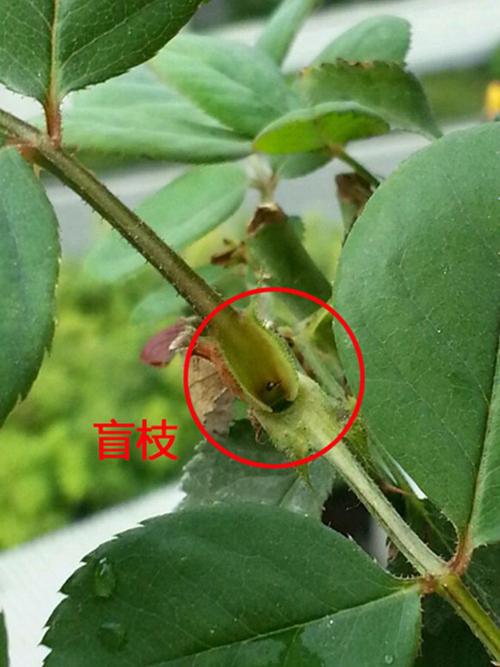
There are mainly five reasons why blind shoots form:
1. Lack of fertilizer. As is well known, roses are fertilizer-loving plants with a large growth volume and abundant blooms, so without nutrient supply they naturally become weak and listless.
2. No pruning in winter. Roses can only bloom on strong shoots of the current year, so roses must be pruned every winter to promote the sprouting of new flowering shoots the following year.
3. Insufficient light. The reason is similar to lack of fertilizer: without photosynthesis there are fewer nutrients, and there is no nutrition to develop flower buds. Light is best at more than 6 hours per day to ensure a sufficient nutrient supply.
4. Low temperature. Generally, when the temperature is below 12°C, blind shoots are especially likely to grow.
5. Lack of water, compacted soil
So after discovering blind shoots, what should be done? Cut them off! After all, we grow roses to enjoy the flowers..
The pruning method is also very simple: follow the blind shoot downward, find the fullest bud, and cut off the upper part of the shoot about 1 cm above the bud.
After removing apical dominance, the remaining buds will sprout new shoots.
In addition, water and fertilizer should be increased, and improvements should be made according to the causes of the blind shoots
Of course, if the plant is still very small or all the growth consists of blind shoots, it is recommended to leave the blind shoots and strengthen light, water and fertilizer. As long as there are enough nutrients, these blind shoots will sprout sooner or later.
When the rose flowering season arrives but there are no blooms, you should carefully check whether the rose has grown blind shoots. Remove them quickly and it can still bloom, and the rose will grow better and better.
Spring pruning of climbing roses
Among the huge modern rose population, climbing roses are a relatively special type. This type mainly originated from hybrid tea roses, hybrid perpetual roses, miniature roses, floribunda roses and Bourbon roses through bud sports, as well as from crosses between hybrid tea roses and Bourbon roses, etc. Their kinship is close and complex, and it is precisely because of this complexity that their flowering habits differ. Therefore, climbing roses are mainly divided into two flowering categories: first, continuous flowering, meaning they can bloom continuously 3 times or more within the entire annual growth cycle. Second, non-continuous flowering, meaning they bloom only once in spring or twice in spring and autumn within the entire annual growth cycle. The "abundance or scarcity" and "diligence or laziness" of climbing rose flowering are closely related to pruning methods.
Pruning of continuously flowering plants
Taking plants 3 years old or older as an example, only two prunings are done in the entire annual growth cycle, in spring and autumn. Spring pruning should be done before budbreak, cutting only dead branches, blind shoots and excessive inner branches. Unless there are special circumstances, do not blindly carry out moderate or heavy pruning, otherwise the spring flower quantity will be greatly reduced. If following a maintenance plan for blooming at the end of September or the beginning of October, taking into account the temperature differences between northern and southern China, pruning can be carried out in several different periods such as early August, late August and early September to achieve the goal of blooming at the end of September.
Pruning of non-continuously flowering plants
Taking plants 3 years old or older as an example, only one pruning is done in the entire annual growth cycle, in spring and before budbreak. Unless it is for rejuvenating old plants, transplanting, or severe pests and diseases, generally only dead branches, blind shoots and excessive inner branches should be pruned, and moderate or heavy pruning must never be done. Otherwise, varieties that bloom only once a year in spring will not bloom that year, and varieties that bloom only twice a year in spring and autumn will bloom only in autumn that year or even not bloom in autumn at all.
From this it can be seen that pruning climbing roses requires care. In many years of practice there have been quite a few lessons in this regard. Professionals should control the source and the technical aspects well. When introducing climbing rose varieties, attention should be paid to identifying their flowering habits, and climbing rose varieties with high ornamental value and application value should be introduced as much as possible in order to achieve the best landscape effect.
Text on the left: The intensity of pruning is determined by the variety and the growth rate of the plant. Generally, the 3 buds below the pruning cut become flowering shoots. Text on the right (from top to bottom): light pruning (cut off 1/4 of plant height), moderate pruning (cut off 1/2), heavy pruning (cut off 2/3).
The systematic classification of roses is roughly as follows: Old roses (Old); Hybrid Tea roses (HT); Floribunda roses (F); Miniature roses (Min); English roses (ER). This time I will write about the pruning methods for Old roses and Hybrid Tea roses. Pruning methods for the HT line (large-flowered varieties that bloom in all seasons):
Top right: HT line. Top left: On the middle part of a flowering shoot from last May, look for a strong outward-facing bud, and cut off the upper part about 5 mm above the bud. Bottom left: For new basal shoots that emerged last year, prune on the first section (shoots newly produced after flowering pruning) to suppress excessive elongation of the shoot. Bottom right: Remove aged branches from the base close to the roots, and also cut off thin branches and dead branches.
If 1/2 to 2/3 of the shoots are cut off (moderate and heavy pruning), the number of flowers the following year will decrease because there are not many flower buds, but this is a pruning method suited to this system that lets it produce full and gorgeous large flowers.
Pruning methods for Old roses:
Top: Old rose line. Bottom left: Cut off thin branches and dead branches. Bottom right: For strong shoots, just trim the tips slightly (the overly thin tip portions of shoots, and the tops of shoots that branched heavily after flowering).
Old roses also need winter pruning. Because tree shapes vary, it is hard to generalize in a few words, but generally the pruning amount should be less than for the HT line, leaving more shoots. Pruning too heavily will suppress the growth of flower buds. The pruning methods for shoots are explained below; please look at the sketch:
A bud facing the center of the plant shape is called an inner bud, and a bud facing outward is called an outer bud. Pruning is basically done at the position of an outer bud. Pruning at the position marked by the blue line makes the shoot grow outward, ensuring ventilation and light for the plant. Pruning at the position marked by the red line makes the shoot grow inward, and they easily crowd together, affecting the plant's ventilation and light.
About the position and angle of shoot pruning:
Top left: The correct cut, made 5~8 mm above a chosen strong bud, slanting parallel to the bud. Bottom left: If pruned too close to the bud, the bud will not sprout. Top right: The slanted cut and the bud face in opposite directions. Bottom right: If too much is left above the bud, the shoot easily turns black from top to bottom.
The cut should be made 5~8 mm above a strong bud, slanting parallel to the bud. Please prune at a chosen strong bud using the correct method. Be sure to choose a sharp pair of shears; if the shears are too blunt, the cut will crush the tissues and easily cause dead branches.
A plump, strong bud is as follows:
The lower bud is a plump, strong bud. The upper bud has grown too long. Please look at the sketch below:
Top left: A good bud, a strong unswollen bud, compact, round and plump. Bottom left: A bud that still has not swollen; if there is no good bud, prune here. Top right: A thin, elongated and non-compact bud; it cannot be expected to produce good flowers. Bottom right: A bud that has already swollen will also become a weak shoot. I think this figure is easy to understand.
This concludes the explanation of winter pruning of roses. Because there are many methods, this article is for reference only. Please note that maintenance methods differ depending on the rose system. I hope everyone's roses can bloom with gorgeous and splendid flowers in spring!: