How to Grow, Color, and Prune Endless Summer Hydrangeas
Endless Summer is what we call the hydrangea, and it is used quite a lot at weddings. Most brides choose Endless Summer for their bouquets. The flowers of Endless Summer are very large, like a hydrangea ball, which is why it is called hydrangea. How do you grow Endless Summer? What are the tricks for coloring and pruning?
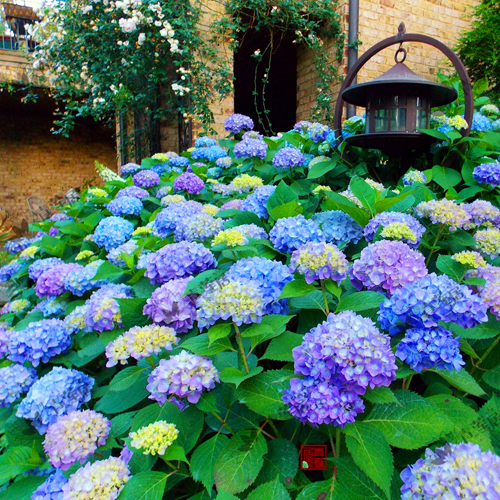
In May, at the end of spring and the beginning of summer, blue or pink hydrangeas begin to bloom one after another, so beautiful it hardly seems real. The big-flowered hydrangea Endless Summer is even more unable to hold back its restlessness, standing out alone and blooming early on the branches. The lovely "Endless Summer" is a variety of hydrangea, belonging to the Saxifragaceae family and the Hydrangea genus. Its flowering period is June to September, and it gets its name because it can bloom beautiful flowers throughout the entire summer.
The origin of Endless Summer:
As for the origin of "Endless Summer," we have to go back to the mid-1980s, when a salesperson from Bailey Nurseries discovered a hydrangea in a garden in Cottager Grove, a suburb of St. Paul, Minnesota, that was able to differentiate and form flower buds on young branches, but at the time it did not attract people's attention. It was not until 2003 that Bailey Nurseries introduced this rather unique hydrangea, named it "Endless Summer," and applied for new variety protection.
The characteristics of Endless Summer:
The biggest difference between "Endless Summer" and other types of hydrangea lies in the length of the flowering period. Scholars at the University of Florida found that the flowering period of "Endless Summer" is on average 10-12 weeks longer than that of ordinary hydrangeas, and its ability to tolerate low temperatures is stronger than that of ordinary hydrangeas, so it can also bloom in colder environments.
How to grow Endless Summer:
1. Planting location
The planting location of "Endless Summer" in the garden has the greatest impact on its blooming. Hydrangea is a short-day plant that prefers a warm, humid, and semi-shaded environment, but if the daily light duration is less than 2-3 hours, the number of flowers will decrease. The best planting location is one that can receive at least six hours of dappled light each day and is sheltered from the wind.
2. Fertilizing
Fertilizing is also a very important factor affecting the blooming of "Endless Summer." In spring or early summer, ground-planted seedlings should be given a good-quality slow-release fertilizer, preferably a slow-release fertilizer with an NPK content of 10-40-10. Container-grown "Endless Summer" also needs additional liquid fertilizer during the growing season, but it should not be fertilized too much, otherwise more old leaves will be produced and the number of flower buds will become fewer and fewer. When the plant's growth slows down and it is preparing to dormant for the winter, stop applying chemical fertilizer.
3. Watering
The amount of watering is also an important factor affecting blooming. Too much watering easily causes root rot, and can also lead to situations such as more leaves and fewer flower buds and a delayed flowering period. In particular, note that when the temperature is relatively high, it is normal for the plant to wilt, and it is best not to water or to water less, so as to avoid scalding the plant.
4. Winter covering
Protecting "Endless Summer" in the first few years of planting is very important. To ensure the plant overwinters safely, keep the soil moist in autumn, and stop watering when it freezes in winter. Before "Endless Summer" fully enters dormancy, cover the plant with wood chips, dead leaves, and the like to achieve a warming effect. But when covering, note that there is no need to cover the stems all the way from the roots to the tips.
Winter covering can not only protect "Endless Summer" through the winter safely, but also prevent spring frost damage. Because the flower buds of "Endless Summer" appear in early spring, late frost damage will harm the development of tender buds and the formation of new buds. Effective covering can protect new buds and their later growth and development. When it thaws in spring, remove the covering in time so as not to affect the sprouting and blooming of old branches at the base.
Pruning Endless Summer:
Spring is the best time to prune "Endless Summer." It should be noted that, unlike ordinary hydrangeas, "Endless Summer" can bloom on both new and old branches, and can continuously differentiate flower buds and keep blooming throughout the season. Experience shows that for newly planted, relatively small plants, it is best not to prune at first, because the formation of flower buds requires a relatively long process. For plants that have grown for many years, early spring low temperatures will affect them, and the plants will grow slowly; as the temperature rises, growth will accelerate rapidly. When new shoots are found to have grown, cut off the old branches about 1 cm from the base of the new shoots. Removing spent flowers or picking off flowers can promote the plant to produce more flowers. Many people like to cover the base of the plant with spent flowers, which can enhance the plant's frost resistance and also protect new flower buds from frost and low temperatures, but they should be removed promptly in spring.
Coloring Endless Summer:
"Endless Summer" also has the characteristic of blooming flowers of different colors according to different soil pH levels. In alkaline soil with a pH of 6.0-7.0, it will bloom pink flowers, and in acidic soil with a pH of 5.0-5.8, it will bloom blue flowers. If you want the plant to bloom in the flower color you need, you can use lime and aluminum sulfate to adjust the soil's pH.
The applications of Endless Summer:
For a long time, hydrangea has been deeply loved by growers for its huge flower balls and gorgeous flower colors, and it has been widely cultivated in courtyards and gardens. "Endless Summer" undoubtedly provides growers with a better choice. Its colorful flower colors and ultra-long flowering period give "Endless Summer" a huge market for application in courtyards and gardens.
That is all for the introduction to knowledge about Endless Summer. If you like it, hurry up and plant it in your own home.
How to Grow Hydrangeas (Environment, Pruning, Fertilizing)
Some flower lovers are especially fond of hydrangeas, but because they do not understand the methods and precautions for growing hydrangeas, they do not dare to take the plunge. This article introduces hydrangea care from various aspects such as the planting environment, medium and flower pots, pruning, fertilizing, and coloring. This article is not theoretical knowledge, but the personal experience of a flower lover, and it is well worth studying for flower lovers who like hydrangeas.
1. Planting environment
Hydrangea is a shade-tolerant plant, but that does not mean they do not like the sun. For the same variety, in an environment with sufficient sunlight, the branches are thick and strong, not prone to falling over, and the flowers are large and brightly colored. But hydrangea's degree of shade tolerance is also one of its major characteristics. With less than one hour of sunlight, it can still bloom; but the flowering branches may be slender and prone to falling over. The degree of softness or hardness of the branches is also related to the variety. Some varieties are simply naturally drooping by nature, and these varieties can be planted in raised flower beds so that the branches droop naturally, forming a different viewing angle. Sometimes, a shortcoming is an advantage.
The cold tolerance of hydrangea is slightly worse than that of roses. Flower lovers in the north should protect the old branches when the temperature is below minus ten degrees, otherwise the branches that bloom on old wood will be frostbitten and will be unable to bloom the next year. (The picture below shows the blooming Blue Mama.)
2. Planting medium and flower pots
Hydrangea also does not have high requirements for the medium and soil; it only needs slightly higher moisture retention. Because hydrangea has luxuriant branches and leaves, starting in April, when water transpiration is rapid, you must ensure that it does not become dehydrated before the next watering, so the medium needs to be slightly moisture-retentive, or the flower pot should be a bit larger. Generally, a 1-gallon pot can be used for half a year starting from rooting and planting of cuttings; after that, you need to use at least a 5-gallon pot (or a flower pot with a diameter of more than 40 cm). If the flower pot is small, it is recommended to control the plant shape when pruning. When the temperature is relatively high, it is recommended to water twice a day, and avoid watering on the flowers, because when the flowers and leaves are wet and then exposed to strong sun, it can easily cause sunburn. Do not manage hydrangeas with the habits you use for growing succulents. (The picture below shows Blue Mama at the end of April.)
3. Pruning
Most hydrangeas (except Endless Summer and panicle hydrangea, etc.) bloom on old branches, and I strongly urge everyone to read this item carefully. Old branches differentiate flower buds in autumn and winter, so pruning must be completed before autumn (the end of August). Cut off spent flowers, cut off aged branches, and shorten branches as needed to control the plant shape. If the planting site is large enough, leave more branches. (The picture below shows Blue Mama and Spirit in early March.)
The Endless Summer series and panicle hydrangea are varieties that bloom on new branches, so you can be a bit ruthless when pruning.
4. Fertilizing
Hydrangea has a relatively large demand for fertilizer, but fertilizing has many finer points. Because flower buds differentiate in autumn and winter, I generally apply fertilizer for the first time in autumn (October). This fertilizing is mainly compound fertilizer (that is, long-acting fertilizer, such as Osmocote, Miracle-Gro, Magic Fertilizer, and the like; for types, you can refer to those used for roses). The second fertilizing is in winter (around January). This fertilizing is mainly organic fertilizer (finished products such as chicken manure fertilizer; raw fertilizer is not recommended). After budding begins in March, apply liquid fertilizer once every 1-2 weeks, and it is recommended to directly use flowering fertilizer (liquid fertilizer with a high phosphorus and potassium content). For ground planting, do not be stingy with fertilizer. For potted planting, everyone can try Magic Fertilizer. Personally, I think that although Magic Fertilizer is expensive, it has high cost performance, is clean and labor-saving, and the effect is good.
5. Coloring
Most flower lovers look forward to hydrangeas blooming blue. Since the principle is that acidic pH produces blue, alkaline produces red, and neutral produces mixed colors, it is recommended that everyone adjust the color as needed. But color adjustment needs to be carried out early, at least starting in winter, and color adjustment is most effective when flower buds are differentiating. There are many kinds of color-adjusting agents, and everyone can find them on their own.
According to my personal experience, sometimes color adjustment is not the only effective method. In the same flower bed, it is still quite common for blue and pink to bloom at the same time. In addition, from the beginning to the middle and then the late stage of hydrangea blooming, the color changes at each stage. Even if you do not adjust the color, you can still enjoy different shades throughout the flowering period. (In the picture below, the left is the flower of Spirit, with the color lasting until mid-July, and the right is the color of Spirit when it first opens.)
6. Propagation by cuttings
The main way hydrangeas reproduce is by cuttings. Generally after flowering (after the flowers finish blooming or when you no longer want to look at the flowers), cut branches for cuttings. It can be said that hydrangea is an extremely easy plant to root from cuttings. You can take cuttings in the way used for roses, cutting a section of branch (leave half a leaf on one side; the leaf in the picture below is cut off by another half). The cut branches should be inserted for cuttings immediately. If you do not have time for cuttings, you can first put the whole branch in water, and when you have time to take cuttings, cut it into sections one by one.
Insert them in vermiculite for 20 days, then dig them out and use a planting medium such as peat for temporary planting or final planting. You can also insert the branches directly into the planting medium, and the survival rate will still be very high. If you are going to insert the branches directly into the planting medium, it is recommended not to use fertilizer in the medium. For those rooted in vermiculite, after they are planted in pots and show signs of growth, sprinkle some slow-release fertilizer such as Osmocote. For those rooted in planting medium, when they sprout leaves (about 45 days or so), you can sprinkle slow-release fertilizer. As shown in the picture below, these were cuttings taken in early June 2014, and by the end of August they were already this big, so at this time they should be moved to a pot of more than 2 gallons. These seedlings all bloomed in 2015.