How to grow Stapelia gigantea, and is the flower toxic?
Stapelia gigantea is very beautiful, just like a starfish, and its flowers are lovely too, but the smell is bad, hence the saying that it is a stink flower. So what is the growing method for Stapelia gigantea? Is the Stapelia gigantea flower toxic?
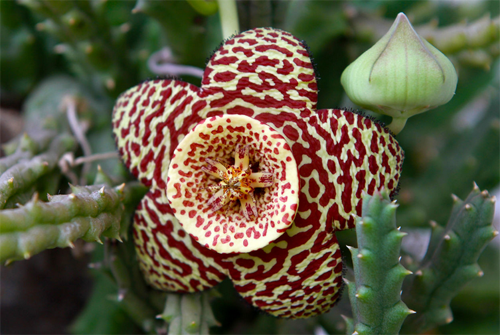
Stapelia gigantea (also called starfish flower, carrion flower) has flowers that smell of rotting meat at night. It is a plant in the Apocynaceae family and the Stapelia genus, and the flowers have leopard-print markings! It likes a warm, dry environment!
Introduction to Stapelia gigantea:
It is a perennial succulent herbaceous plant. The plant height is 20-40 cm, grayish green, with 4-angled stems densely covered with fine hairs, fleshy and thick; the flowers are basal, star-shaped with 5 lobes, with transverse stripes, dark purplish brown, 12-15 cm in diameter, with a special stench like rotting meat.
How to grow Stapelia gigantea:
The potting soil should be well-drained; sandy loam is best for pot cultivation.
Fertilize once every 2-3 weeks during the growing season; water when the soil surface dries out; it needs plenty of sunlight, with about 50% shade in summer. The overwintering temperature is about 10°C, and repot once every 2-3 years.
1. Temperature:
It likes warmth and tolerates drought. In summer during high temperatures it goes fully or semi-dormant; the overwintering temperature is 50.
2. Light:
It likes a semi-shaded environment; avoid direct strong sunlight.
3. Water:
Water thoroughly during the growing seasons in spring and autumn; control watering in summer; keep the potting soil slightly dry in winter.
4. Air
humidity: Keep the air dry, and improve ventilation in summer.
5. Fertilizing:
In spring and autumn, apply a dilute liquid fertilizer once about every half month; stop fertilizing in summer.
6. Repotting:
Repot every spring using fertile soil rich in humus.
7. Propagation:
Division can be done together with spring repotting; both rooted and unrooted divisions can survive. You can also cut healthy, plump fleshy stems during the growing season, let them dry slightly, and then insert them in sandy soil for cuttings.
Common plants in the genus:
Stapelia gigantea S. gigantea
Stapelia pulchella S. pulchella
Stapelia gigantea has upright fleshy stems shaped like a rhinoceros horn, and strange flowers that look just like a starfish. It is a beautiful indoor ornamental flower.
Although it looks rather strange, many plant lovers still like them! However, people with trypophobia cannot stand its flowers; they just can't bear the look of them!
If there is someone with trypophobia at home, you can try Stapelia gigantea; someone with trypophobia will definitely go crazy seeing this. The flowers of Stapelia gigantea are very large and also have a stench, but rest assured, it is only a bit smelly, not toxic, so you can keep it at home with peace of mind.
Why are succulents called succulents (origin of the name)? Are succulent plants toxic?
Succulent plants are currently a very popular type of plant. Because of their unique appearance, they have become a hugely popular plant form. But why are succulents so prevalent, and why do people call this kind of plant succulent? Why not take a look with the editor.
Why are succulents called succulents
Succulent plants refer to higher plants with enlarged vegetative organs, usually having three vegetative organs - roots, stems, and leaves - and three reproductive organs - flowers, fruits, and seeds. In horticulture, they are also called succulent plants or succulent flowers, but the name succulent plants is the most commonly used.
Are succulent plants toxic?
Most succulent plants in the Euphorbiaceae family are toxic. But toxic means the plant's sap is toxic; if you do not eat it, there will be no problem... Normal display is certainly beneficial and harmless.
Which succulent plants are toxic
1. Stapelia gigantea
Stapelia gigantea has captured the hearts of many succulent lovers with its unique appearance. This succulent has relatively thick roots and stems, grows upward, and is four-angled. The surface has jagged protrusions, and the color is grayish green. It is named because its shape closely resembles a rhinoceros horn. The flowers of Stapelia gigantea are relatively large, pale yellow like a starfish, and usually bloom in autumn.
Because it contains sap in its body, human contact can cause symptoms such as allergies. Those who keep this succulent at home should not touch it carelessly.
2. Euphorbia tirucalli
Euphorbia tirucalli has many other names, such as pencil tree, iron tree, fairy stick, and so on. It is a plant in the Euphorbiaceae family and Euphorbia genus. Its flowering period is from June to September, and its fruiting period is from July to November. This flower is native to the Mediterranean coast, where the environment is dry, so Euphorbia tirucalli is mostly leafless or has few leaves. Because its appearance is especially like green jade, it is called green jade tree.
The entire plant of Euphorbia tirucalli has toxic sap and is highly irritating. If the skin comes into direct contact with it, it may cause symptoms such as skin inflammation, pustules, pain, itching, redness, and swelling.
3. Euphorbia neriifolia
Euphorbia neriifolia likes hot, sunny living conditions, and its place of origin is eastern India. Its ridged fleshy stems are deformed into a cockscomb shape or a flat fan shape, and it comes from a fasciated variety of Euphorbia neriifolia.
The whole plant contains white milky sap and is highly toxic. After human contact, symptoms of skin allergies such as itching and redness and swelling will appear. If accidentally ingested, it can cause poisoning, and you should seek medical attention immediately.
How to grow common succulent plants
1. Plant cultivation always comes down to three points: water, medium, and light, and succulents are no exception. Light mainly affects whether the plant grows well and is more of an advanced-level factor. But water and medium can directly affect whether the plant lives or dies. Many beginners, when they first start growing something, always casually use some soil, then enthusiastically and carefully water the plant every day... and then... there is no then...
2. The soil should be loose, breathable, and well-drained, but with a certain water-holding capacity, and neutral or slightly acidic. There are many media suitable for growing succulents, but a very important point is that they must be sterile. The direct cause of succulent death is often rot, and the only direct cause of plant rot is fungal infection. During the transplanting process of succulents, if the medium itself carries various pathogens, plus improper later care (such as frequent watering), it is very easy to cause fungal infection.
3. Therefore, when choosing soil at the very beginning, you should choose sterile or sterilized soil. There are two common ways to sterilize: one is to use fungicides such as carbendazim, and the other is to use high temperature sterilization. For example, I have heard of someone stir-frying it in a pan, and I have also heard of someone putting soil in a microwave to heat it. Good medium, good start.
4. The watering principle is "dry then wet", that is, when the soil has dried out completely, water thoroughly. If it is hard to judge whether the soil has dried out, you can insert a toothpick into the soil, and when it is time to water, just check how dry or wet the toothpick is. "Dry then wet" is a common term in flower cultivation, meaning water thoroughly once, then wait until the soil is almost dry before watering a second time. Its purpose is to prevent root rot caused by overwatering and pests and diseases caused by dampness. Of course, it does not need to be so strict; as long as you do not water too frequently, it generally will not cause succulent death.
5. Succulents all like sunlight, and a certain amount of light will make them grow better. Growing succulents is actually not difficult; in fact, just rough care is enough! Many beginners kill their succulents because they water too frequently.
Many people grow succulents, but few people are poisoned by succulents. This shows that normal growing will not cause poisoning. As long as they are not eaten, they will not cause harm, and some succulents even have certain edible value, so everyone can grow them with peace of mind.
Can succulent plants be put in the sun? Is it good to put succulent plants in the bedroom?
Everyone is very familiar with succulent plants. They are not only delicate, small, and very beautiful, but also easier to grow than ordinary flowers. The leaves of succulent plants are thick and cute, and they will also change color as conditions change. But many flower lovers are especially puzzled: succulents become more brightly colored in the sun, but they are also easily sunburned. So can succulent plants be put in the sun or not?
Can succulent plants be put in the sun
It depends on the situation. First, the general principle: succulent plants like sunlight, so getting more sun is not wrong, but above 30°C and below 5°C, the succulents enter dormancy and need to be moved indoors.
Haworthia cooperi and similar: cannot be exposed to strong sun; one hour each in the morning and afternoon is enough.
Portulacaria afra 'Medio-picta', Portulacaria afra 'Variegata', etc.: summer-growing type, but it is best not to expose them to strong sun.
For other succulents, get as much sun as possible. The greater the temperature difference, the more vivid the color, the thicker the powdery coating, and the cuter the shape. Spring and autumn are suitable for outdoor growing, that is, leaving them outside to grow; this is the golden period for growth. They cannot be taken outside in midsummer and winter.
Is it good to put succulent plants in the bedroom
They can be placed in the bedroom. Most plants carry out photosynthesis during the day, absorbing carbon dioxide and releasing oxygen, and carry out respiration at night, absorbing oxygen and releasing carbon dioxide. So ordinary plants are generally not very suitable for indoor cultivation and placement, as they increase the carbon dioxide content at night, and night is often the time when people rest in the room, which is bad for human health. But many cacti and succulents are exactly the opposite. Because they grow in arid and hot areas, during the day they close their stomata to avoid water loss, and at night their stomata open to absorb CO2 and then form malic acid stored in the large vacuoles, releasing CO2 during the day for photosynthesis. This unique metabolic method is called "Crassulacean acid metabolism." So cacti and succulent plants are very suitable for indoor cultivation and placement.
The difference between indoor growing and outdoor growing of succulents
Indoor growing: there is not too much sunlight, no rainwater watering, no natural breeze, and succulents grown indoors are more delicate and weak.
Outdoor growing: succulents grown outdoors rely almost entirely on nature, so whether in color or shape they are much better than those grown indoors. They even become very tough.
So if you want succulents to grow better and stronger, it is best to move them outdoors. But succulents that have been grown indoors for a long time are not recommended to be moved outdoors, because they have adapted to the indoor environment and have become very weak, so they are no longer suitable for outdoor growing. (The weakness here refers to the plant's adaptability.)
Which succulent plants are toxic
1. Stapelia gigantea
Stapelia gigantea has captured the hearts of many succulent lovers with its unique appearance. This succulent has relatively thick roots and stems, grows upward, and is four-angled. The surface has jagged protrusions, and the color is grayish green. It is named because its shape closely resembles a rhinoceros horn. The flowers of Stapelia gigantea are relatively large, pale yellow like a starfish, and usually bloom in autumn.
Because it contains sap in its body, human contact can cause symptoms such as allergies. Those who keep this succulent at home should not touch it carelessly.
2. Euphorbia tirucalli
Euphorbia tirucalli has many other names, such as pencil tree, iron tree, fairy stick, and so on. It is a plant in the Euphorbiaceae family and Euphorbia genus. Its flowering period is from June to September, and its fruiting period is from July to November. This flower is native to the Mediterranean coast, where the environment is dry, so Euphorbia tirucalli is mostly leafless or has few leaves. Because its appearance is especially like green jade, it is called green jade tree.
The entire plant of Euphorbia tirucalli has toxic sap and is highly irritating. If the skin comes into direct contact with it, it may cause symptoms such as skin inflammation, pustules, pain, itching, redness, and swelling.
3. Euphorbia neriifolia
Euphorbia neriifolia likes hot, sunny living conditions, and its place of origin is eastern India. Its ridged fleshy stems are deformed into a cockscomb shape or a flat fan shape, and it comes from a fasciated variety of Euphorbia neriifolia.
The whole plant contains white milky sap and is highly toxic. After human contact, symptoms of skin allergies such as itching and redness and swelling will appear. If accidentally ingested, it can cause poisoning, and you should seek medical attention immediately.
In fact, whether succulents should be put in the sun depends on the situation and environment. Although succulents will turn red or become more brightly colored and beautiful under sunlight, they cannot be exposed to strong sun. Once exposed to strong sun, the damage to succulents will be relatively great.