What types of holly planting techniques are there?
When it comes to holly, it is relatively common and can be found in many places, having made many contributions to our country's landscaping. What are the planting methods for holly? What classifications are there?
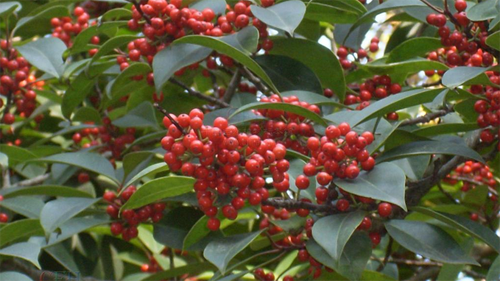
Introduction to holly:
Holly is also called northern mistletoe, mistletoe, frozen holly, parasitic seed, etc.!
It can be seen all over our country! I believe most flower lovers are no strangers to it.
Their flowering period is April to May, and the fruiting period is September to November. However, many landscaping varieties do not show flowers or fruit, all due to differences between varieties.
Holly planting techniques:
There are so many varieties, but most of them prefer a warm environment, and their cold resistance and drought resistance are quite good! It likes fertile, loose, well-drained, slightly acidic soil! It is very tolerant of pruning.
Notes:
If you want to plant a holly tree, it is recommended to propagate by cuttings. If you can collect ripe fruit, that also works!
Generally, during the plum rain season, take a section of one-year-old branch for cuttings. A branch length of 6-8 cm is enough. Cut off the lower leaves, leaving only 1-2 leaves, insert to a depth of 1/2, cultivate in slightly moist sandy soil, place in a shaded, ventilated environment, spray water frequently to keep it moist, and roots will form after about 1 month.
Once it has grown a bit larger, transplant it, moving it together with the soil ball, and the survival rate is 100%. Overly dense branches and leaves should be pruned, otherwise it is prone to disease. Usually just make sure the potting soil does not become waterlogged! There is nothing else to pay attention to!
What types of holly trees are there:
Japanese holly
Irish holly
Smooth holly
American holly
Hawaiian holly
That is all for the cultivation methods and types of holly. Have you already mastered the methods?
Cultivation and planting techniques for holly trees
Image: Holly
[Common questions] Cultivation and planting techniques for holly trees
[Expert answer]
Environmental requirements
Holly is suitable for planting in moist, semi-shaded places. It likes fertile soil, but can also grow well in ordinary soil, and does not have strict environmental requirements.
Planting methods
Sowing: Harvest after the fruit ripens in autumn, rub off the fruit skin, rinse clean, stratify the seeds with moist sand at low temperature to promote germination, and sow before March of the following spring. Seedlings grow slowly and must be carefully maintained and managed. If holly seeds are not treated to promote germination, they often do not germinate until the following year.
Cuttings: Softwood cuttings are suitable during the plum rain season. The cuttings should be 6-8 cm long. Cut off the lower leaves, leaving only 1-2 leaves and shortening them. Insert to a depth of 1/2. Sandy soil must be used as the substrate. After inserting, build a shade frame, spray water frequently, and keep moist. Roots will form after about 1 month. You can first cut diagonally from the middle-upper part of the crown, take a vigorous side branch 5-10 cm long, cut off the lower small leaves, and keep all the upper leaves. Then treat with rooting powder and insert the cut end downward into the seedbed. The seedbed site should be chosen in a ventilated, shade-tolerant place, and shaded cuttings are also acceptable, with an extremely high survival rate.
Watering and fertilizing
After young seedlings planted that year are watered thoroughly once, they can be left to grow naturally. Depending on soil moisture, water once every 15 days. Combined with cultivating and weeding, apply appropriate topdressing 1-2 times each spring and autumn, generally with a thin liquid fertilizer mainly based on nitrogen.
Shaping and pruning
Holly sprouts and grows branches multiple times each year and is extremely tolerant of pruning. In summer, shaping and pruning should be done once. In autumn, according to different landscaping needs, it can be flat-pruned or pruned into a spherical or conical shape, with appropriate thinning of branches to maintain a certain crown shape and branch posture. In places where winter is relatively cold, measures such as mounding soil for cold protection can be taken.
Pest control
The main disease of holly is leaf spot, which can be controlled with carbendazim and chlorothalonil.
[Editor's comments] The above is the holly tree cultivation and planting techniques compiled for you by the First Agricultural Economics editor. For more related materials, such as"Types of Holly Trees" and "Propagation Methods of Holly Trees", please follow the relevant channels of First Agricultural Economics, or the special topic channel. Later, we will present to you aspecial topic on holly tree planting, please stay tuned!
What are the varieties of landscaping saplings? Landscaping sapling planting techniques
Landscaping saplings refer to the flowers, grasses, and saplings used for landscaping construction. Urban construction cannot do without landscaping, and landscaping cannot do without nursery stock. Landscaping nursery stock is an important part of landscaping projects.
Landscaping sapling prices
Different saplings have different prices. Generally, Putuo saplings cost from a few yuan to more than ten yuan.
Landscaping sapling varieties
Trees and shrubs
This category is the most common among landscaping saplings and also the one with the most varieties. The most commonly seen trees and shrubs in life mainly include London plane, elm, ginkgo, white magnolia, palm, potted Chinese rose, osmanthus, four-season osmanthus, and winter jasmine, etc. In addition, this category also includes many kinds such as Chinese privet, red-leaf willow, August osmanthus, red-fruited holly, boxwood, black locust, camptotheca, and camphor, etc. Some more valuable tree species may not be seen often by everyone.
Tree stump bonsai
This category of tree species is mostly seen in parks and attracts attention for being small and unique. Tree stumps and bonsai, after being trimmed by craftsmen, often give people a fresh new feeling. It mainly includes several varieties such as Buddhist pine stump landscapes, Taiwan, China Buddhist pine stump landscapes, crape myrtle stump landscapes, and red fringeflower stump landscapes.
Where are landscaping saplings available
There are many places that sell landscaping nursery stock. It mainly depends on what you want to buy, then which places are cheaper, and then whether the shipping cost is worthwhile. For example, relatively concentrated places for landscaping nursery stock in Hunan include Tiaoma, Baijia, and Huangxing Town. Tancheng in Shandong has relatively many ginkgo trees. Nanjing has many cedars, and there are also places such as Xiaoshan in Zhejiang.
Landscaping sapling planting
Landscaping saplings can be planted throughout the year, but after saplings are planted, only two seasons have a relatively high survival rate. The first season is from late autumn to early winter, that is, from late October to early December. At this time, the weather has already turned cool, evaporation has reached a relatively low level, and the moisture content in the soil is stable. During the growth season of summer and autumn, the saplings have accumulated rich nutrients. Under high soil temperatures, the root system will remain active until the beginning of next spring. The sapling root system does not have a dormant season. Planting saplings at this time avoids the problems of short growth time and inability to ensure survival when planting in spring.
Varieties such as cherry blossom, dragon-claw pagoda tree, poplar, willow, spruce, and maple are all suitable for planting in this season. Shrubs and ground cover plants such as photinia, French blue, peony, tansy, lilac, and oleander are also suitable for planting at this time.