How to Grow Bleeding Heart Vine (Clerodendrum thomsoniae) and Things to Note, with Pictures of the Flowers
Why is this plant called "dragon spitting pearls"? Because when the flower blooms and the petals open, there is another flower emerging from inside, and it is very beautiful. So what are the growing methods for bleeding heart vine? What things should be noted? What do the pictures of its flowers look like?
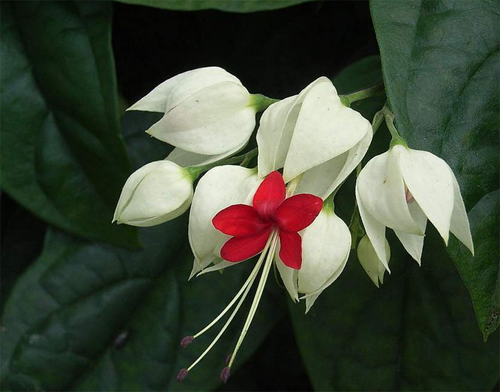
How to Grow Bleeding Heart Vine and Things to Note:
Introduction to Bleeding Heart Vine:
Bleeding heart vine is a climbing plant that can grow to over 5 m tall. It can climb walls as it grows, and can also be kept as a potted plant. Its leaves are fairly large, often oval in shape! Set off against the small white flowers, it looks exceptionally delicate!
Growing Environment:
Bleeding heart vine likes a warm, humid, semi-shaded environment with plenty of sunlight, and is not cold-tolerant. The overwintering temperature should be above 15°C. Being below 10°C for a long time can cause leaf drop and even death.
It is generally propagated by cuttings: cut a few healthy stems and insert them into slightly moist potting soil. Propagation by seed is more difficult, as the seeds have a short lifespan and should be sown immediately after collection.
The optimum growing temperature for bleeding heart vine is 18-24°C, and the winter temperature should not be lower than 8°C. Above 5°C the stems and leaves are prone to cold damage; in mild cases this causes leaf drop, and in severe cases the young stems wither.
It is actually fairly tolerant of high temperatures. At temperatures above 30°C, as long as water is supplied adequately, it can still grow normally. However, if you want it to bloom, it should not be too hot; this is a bit like hydrangea. During the flowering period the temperature should be lower, around 17°C.
1. Potting Soil Selection
For bleeding heart vine, use fertile, loose, well-drained, slightly acidic sandy loam.
For potting, use a mix of culture soil or peat soil and coarse sand. Potted bleeding heart vine is commonly grown in 12-15 cm pots, with 3 plants per pot.
2. Watering and Fertilizing
During the growing period it needs plenty of water. If the soil is too wet, it will cause the leaves to turn yellow and drop. If the stems do not wither, stop watering and let it recover and sprout new leaves.
Fertilize once every half month. During the flowering season of bleeding heart vine, apply 1-2 additional applications of phosphorus and potassium fertilizer, or use "Huiyou" 20-8-20 all-season high potassium nitrate fertilizer. In winter, reduce watering and stop fertilizing.
3. Proper Pinching Back
To shape an elegant plant form for bleeding heart vine, when potted cuttings or seedlings have grown to 15 cm, cut the stems 10 cm above the pot rim to encourage the growth of thick new shoots.
During the growing period, strictly control the height of the branches and pay attention to pinching back and removing the growing tips, so that the branches are neat and the future flowering is dense.
Half a month after pinching, apply daminozide or chlormequat to control plant height, achieving a short plant with lush leaves and abundant flowers.
4. Shaping and Pruning
When repotting each spring, prune and shorten the aboveground branches so the plant is rounded and tidy, with more branches and more flowers.
Bleeding heart vine is a climbing evergreen small shrub. To keep its plant form attractive, pruning must be strengthened. Generally, when repotting in early spring in April, cut the plant 10-15 cm above the pot rim, remove the upper part, and encourage the growth of thick new shoots.
5. Pinching
During the growth and development period, pay attention to pinching to control the height of the branches and keep them neat. After each flowering, promptly cut off the flower stems so the plant form is low and full.
6. Light
Just do not expose it to scorching sun; scorching sun will make the leaves turn yellow. Apart from providing appropriate shade during the hottest part of summer, it can be kept in full sun the rest of the time!
Pictures of Bleeding Heart Vine Flowers:
How to Grow Bleeding Heart Vine and Things to Note, Pictures of Bleeding Heart Vine Flowers
Bleeding heart vine has unusual flower shapes and blooms profusely. Bleeding heart vine flowers can be used on flower trellises, and it is also kept as a potted plant to accent windowsills and small summer courtyards. The whole plant can be used as medicine. So how do you grow bleeding heart vine? Let's take a look at how to grow bleeding heart vine, things to note, and pictures of bleeding heart vine flowers.
I. How to Grow Bleeding Heart Vine and Things to Note
1. Planting: For potted bleeding heart vine, generally repot once every 1-2 years, either in early spring or after the flowers fade. When repotting, first cover the drainage hole with broken tile pieces, then add a small amount of bone meal as base fertilizer, then fill in new culture soil (4 parts leaf mold, 4 parts garden soil, 2 parts sand), plant the plant, and leave 2-3 cm of rim space at the top for fertilizing and watering. After repotting, water thoroughly, place in a shaded spot to recover, and after recovery move it to a sunny place for care.
2. Watering: Bleeding heart vine is fairly sensitive to moisture. During the stem and leaf growing period, keep the soil moist, but do not overwater. Too much water causes it to grow only vines without flowering, and can even make the leaves turn yellow and drop, with the roots rotting and dying. In the hot summer season, water fully and provide appropriate shade. In winter, reduce watering to let it go dormant so it can overwinter safely.
3. Light: Bleeding heart vine needs plenty of light in winter. When the weather is too hot in summer, it should be shaded, otherwise the leaves turn yellow. When light is insufficient, it will produce vine-like growth and not bloom. Flower bud differentiation is not affected by photoperiod, but stronger light promotes flower bud differentiation and development. It should not be placed in darkness for too long; at temperatures above 21°C, more than 24 hours will cause the flowers to drop.
4. Soil: Use fertile, loose, well-drained sandy loam.
5. Fertilizing: Do not fertilize too much. During the flowering season, apply diluted, well-rotted cake fertilizer water once every 7-10 days, for 3-4 applications in a row. If yellowing is found during cultivation of bleeding heart vine, apply 0.2% ferrous sulfate water together with topdressing, and the leaves will gradually turn from yellow to green.
II. Pictures of Bleeding Heart Vine Flowers
Pictures of Bleeding Heart Vine Flowers
Pictures of Bleeding Heart Vine Flowers
Pictures of Bleeding Heart Vine Flowers
Pictures of Bleeding Heart Vine Flowers
The above ishow to grow bleeding heart vine and things to noteas well aspictures of bleeding heart vine flowersthat we have shared. Bleeding heart vine is delicate and lovely, yet not fussy, with tenacious vitality that resists the heat of summer. You might as well try growing it.
How to Grow Bleeding Heart Vine and Things to Note
Propagation Methods
Cutting Propagation
Cuttings are generally taken from May to June each year. You can choose the tender tips of healthy, disease-free branches, or cut the lower old branches into 8-10 cm stem sections as cuttings. Bud grafting takes the lateral buds on the branches, with a part of the xylem, as the scion. Root cuttings use root-like stolons cut into 8-10 cm lengths as cuttings. The cutting bed can use substrates such as peat, perlite, leaf mold, river sand and vermiculite. Spring and autumn are best for cuttings. The suitable temperature for cuttings is 21°C, and a cutting bed temperature of 26°C is very favorable for rooting. Roots can form 3 weeks after cutting. If the base of the cuttings is treated with 0.5%-0.8% indolebutyric acid solution for 1-2 seconds, rooting will be faster and more abundant.
Seed Propagation
Sowing can be done in a shallow pot from March to April each year, with the temperature kept at 24°c. Seedlings emerge in 10 days. When the seedlings are 10 cm tall, repot and transplant them, and they can bloom in the 2nd year. Seed propagation is not easy to succeed with, so cutting propagation is recommended.

Planting Management
Potted bleeding heart vine is commonly grown in 12-15 cm pots, with 3 plants per pot. During the growing period it needs plenty of water. If the soil is too wet, it will cause the leaves to turn yellow and drop. If the stems do not wither, stop watering and let it recover and sprout new leaves.
Fertilize once every half month. During the flowering season of bleeding heart vine, apply 1-2 additional applications of phosphorus and potassium fertilizer, or use "Huiyou" 20-8-20 all-season high potassium nitrate fertilizer. In winter, reduce watering and stop fertilizing.
To shape an elegant plant form for bleeding heart vine, when potted cuttings or seedlings have grown to 15 cm, cut the stems 10 cm above the pot rim to encourage the growth of thick new shoots. During the growing period, strictly control the height of the branches and pay attention to pinching back and removing the growing tips, so that the branches are neat and the future flowering is dense. Half a month after pinching, apply daminozide or chlormequat to control plant height, achieving a short plant with lush leaves and abundant flowers.
When repotting each spring, prune and shorten the aboveground branches so the plant is rounded and tidy, with more branches and more flowers.
Planting
For potted bleeding heart vine, generally repot once every 1-2 years, either in early spring or after the flowers fade. When repotting, first cover the drainage hole with broken tile pieces, then add a small amount of bone meal as base fertilizer, then fill in new culture soil (4 parts leaf mold, 4 parts garden soil, 2 parts sand), plant the plant, and leave 2-3 cm of rim space at the top for fertilizing and watering. After repotting, water thoroughly, place in a shaded spot to recover, and after recovery move it to a sunny place for care. Watering