Propagation Methods and Price Guide for the Japanese Aralia
The Japanese aralia is extremely beautiful to look at, and it is also one of the money trees; many people love growing it. What are the propagation methods of the Japanese aralia? What kind of plant is the Japanese aralia exactly? What is its price?
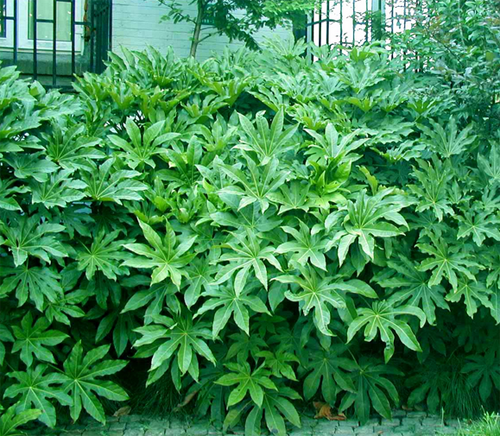
Propagation methods of the Japanese aralia:
Usually division and seed sowing; sowing is done in May after the natural fruits ripen, while division is done in spring, and transplanting with a soil ball has a very high success rate!
It easily grows side shoots, so division is also very feasible; divide it when transplanting, plant it in slightly moist sandy soil, keep it slightly moist, ventilated and shaded, and it can take root in half a month! Cuttings work the same way!
During transplanting you can spray a little water on it, which helps it adapt to the new environment faster!
Brief introduction to the Japanese aralia:
The Japanese aralia has large leaves like duck feet, but split into many leaflets, usually eight, though there are also nine and seven, so don't worry too much about it, and there are also variegated-leaf varieties!
This plant is shade-tolerant and likes to grow in a cool, warm and moist environment, and it is also fine to keep it indoors! But if you want it to bloom, it is better to grow it outdoors!
It usually blooms in summer and autumn and can keep blooming into winter, a very long flowering season; the flowers are conical clusters at the top, a bit like small dandelions, and from winter to May of the following year is the fruiting season, with small black berries that look rather unfriendly!
Would anyone like its little flowers? And its little fruits? But after seeing them, I still think it should properly serve as a foliage plant.
Actually it can also grow into a small tree, reaching over 5 m at the tallest, in the wild at least! The ones usually seen indoors are just over half a meter tall, and its smooth leaves show a netted vein pattern, which is quite charming!
The Japanese aralia originally lived in moist mountain forests, and now it is very common to plant it in urban landscaping courtyards; it is a subtropical variety that likes a cool, warm and moist climate and does not like dryness and cold! Gardeners in the north can only grow it indoors!
It likes well-drained, slightly acidic soil, and neutral soil is fine too! It grows very easily!
Japanese aralia price:
This depends on the size of the Japanese aralia; generally, for 20 to 50 cm ones, 1.28 yuan per plant, and you need to pot them yourself when you get them.
Japanese aralia price guide, complete collection of Japanese aralia pictures
The Japanese aralia is actually named because its leaves are palm-shaped and look as if they have 8 corners; its leaf clusters are glossy and verdant at the four nodes, and the leaves are like green palms. It is fairly shade-tolerant and often grows in gardens or is planted beside rockeries and large trees; of course, it can also serve very well as a foliage plant for indoor display or for decorating halls and meeting rooms.
[Growth Habits]
The Japanese aralia likes a warm and humid climate and is fairly shade-tolerant but cannot tolerate drought; it also has a certain cold hardiness, and it is best planted in well-drained, moist sandy loam.
[Cultivation Methods]
Fertilizing and watering: from April to October is the vigorous growth period of the Japanese aralia, and at this time we fertilize it once every 2 weeks, while after October we should stop fertilizing it. In the hot summer and autumn seasons, water it frequently and be sure to spray water on its leaves and the surrounding space to raise the air humidity; after October, watering should be strictly controlled.
Light and temperature: the Japanese aralia likes a cool environment, and its best growing temperature is between 10-25 degrees Celsius; it is also a semi-shade plant and dislikes strong sunlight. When cultivated in a greenhouse, it needs more light in winter, while in spring, summer and autumn it should be appropriately shaded from the sun. A short period of direct sunlight in summer can also cause sunscald, but if the light is insufficient for a long time its leaves will become small and thin. After being moved outdoors in April, it should be placed under tree shade for care.
Loosening the soil and repotting: we can repot it once every 1-2 years, and repotting is generally done in March-April. When loosening the soil and repotting, it is best to add base fertilizer to the bottom of the pot, and the potting soil can be made from a mix of humus soil or peat soil; it can also be mixed with river sand or perlite, and of course fine sand can also be used for cultivation.
Division: when repotting in spring, we can tip the plant that has filled the pot out of the pot, then prune its poorly growing roots, cut the original clump into many separate plants, transplant them into pots of suitable size, and place them in a well-ventilated, shady environment for care; after 2-3 weeks they can be moved to normal management. Division propagation should be done by dividing and planting right away, which can greatly improve the survival rate.
[Price]
Generally the price of the Japanese aralia is not expensive, about 3.5 yuan per plant, and different local consumption conditions will cause the price of the Japanese aralia to fluctuate, but the range of fluctuation is not very large.
Japanese aralia price
The price of the Japanese aralia varies quite a lot depending on the place of origin, height, crown width and appearance; generally, plants 20-100 cm tall cost around 0.2-12 yuan per plant, and plants 100-180 cm tall cost around 15-180 yuan per plant.
The prices introduced above are for your reference only. The Japanese aralia is commonly grown as a potted plant, but did you know it can actually be grown in water too? Below, let me introduce its water culture method.