How is Cissus sicyoides propagated and how fast does it grow, and will it attract snakes?
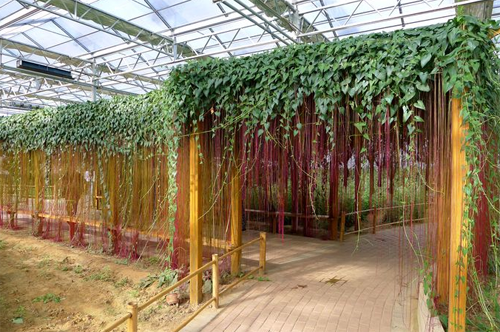
Cissus sicyoides looks just like a curtain and is extremely beautiful. If you plant one in front of your home, it becomes a natural screen. So what is the propagation method of Cissus sicyoides? Does it grow fast? Will it attract snakes?
Propagation method of Cissus sicyoides:
Propagation is generally done by cuttings. During pruning, cut off a robust branch segment about 10 cm long and stick it directly into slightly moist sandy soil. Of course, you can also put it directly into clean water, where it will root faster.
Note: newly cut cuttings will also grow many aerial roots. At this time the aerial roots should not be kept. Wait until it is transplanted and growing steadily; only then do the aerial roots no longer need to be cut off!
Pest and disease control of Cissus sicyoides:
If ventilation is poor, with muggy heat plus dampness, it easily gets anthracnose; the branches and leaves turn grayish brown, and there are also small pink spots!
So usually ventilate more and prune more. Pay attention to the amount of watering; if the soil is not dry, do not water. If you see lush branches, you can prune them a little!
At the early stage of anthracnose, spray with thiophanate-methyl, once every seven days, 2 to 3 times in a row is enough
Will Cissus sicyoides attract snakes?
It really can attract snakes. The area covered by Cissus sicyoides is relatively damp and not very ventilated, which is an environment snakes quite like.
Does Cissus sicyoides grow fast?
It grows very fast, as long as there is plenty of water, but do not let water accumulate, as that easily causes yellow leaves. Its spreading ability is very strong, so you need to build some large trellises for it to climb. With other things done well, like ventilation and light, as long as water does not accumulate, it will grow very well!
Cissus sicyoides L. Cissus sicyoides illustrated guide: how to grow Cissus sicyoides / how to propagate Cissus sicyoides
Cissus sicyoides profileCissus sicyoides L.
Aliases: creeping fig vine, bead-curtain vine, one curtain of sweet dreams, wealth curtain
Classification: vine flowering plant
Family and genus: Plantae, Angiosperms, Dicotyledoneae, Vitaceae, Cissus
Full bloom period: summer and autumn
Cissus sicyoides is a perennial evergreen climbing herbaceous vine, entirely hairless, with slender branches and tendrils; leaves are simple and alternate, long heart-shaped, with serrated leaf margins, 5 to 10 cm, with long petioles. Its special feature is that mature plants can grow reddish-brown, metallic-lustrous, unbranched, slender aerial roots from the stem nodes, up to 3 m long.
How to grow Cissus sicyoides and precautions, introduction to Cissus sicyoides
Cissus sicyoides is a perennial evergreen climbing herbaceous vine, entirely hairless, with slender branches and tendrils; leaves are simple and alternate, long heart-shaped, with serrated leaf margins, 5 to 10 cm, with long petioles. Its special feature is that mature plants can grow reddish-brown, metallic-lustrous, unbranched, slender aerial roots from the stem nodes, up to 3 m long.
Morphological characteristics of Cissus sicyoides: branches
Cissus sicyoides is a perennial evergreen climbing herbaceous vine, entirely hairless, with slender branches and tendrils;
Leaves
Cissus sicyoides has simple alternate leaves, long heart-shaped, with serrated leaf margins, 5 to 10 cm, with long petioles. Its special feature is that mature plants can grow reddish-brown, metallic-lustrous, unbranched, slender aerial roots from the stem nodes, up to 3 m long, with hundreds or thousands hanging beneath the trellis in an extremely elegant and uniquely styled display. When aerial roots extend to the ground (soil), they will penetrate into the soil to absorb nutrients, making the leaves greener and the flowers more beautiful, and making the whole plant more vigorous.
Flowers
Cissus sicyoides blooms in summer and autumn, with cymes, small flowers with 4 petals, about 1.5 cm, pale greenish white.
Fruit
The fruit of Cissus sicyoides is nearly spherical, about 1 cm in diameter, green when young and purple-black when ripe, containing 1 seed. Cissus sicyoides has extremely strong vitality and is a very easy garden plant to cultivate.
Cissus sicyoides bears fruit in July to August.
Ecological habits of Cissus sicyoides
Cissus sicyoides is a sun-loving plant, drought-tolerant, high-temperature-tolerant, and also slightly shade-tolerant. Drainage and sunlight must be good. Its spreading ability is extremely strong, so the trellis set up must be large; guide the branch growth direction at any time. Soil: choose a growing medium with good water retention that does not accumulate water as ideal. Sunlight: about 80 to 100% (full sun). Temperature: the suitable growth temperature is about 22 to 30°C. In winter it will drop leaves, grow slowly, and not grow aerial roots; when the temperature is below 10°C, cold protection must be carried out. In summer it grows quickly, so prune in time to help ventilation. Watering: once every 1 to 2 days in summer, once every 2 to 3 days in winter. Fertilizing: apply a light fertilizer once every 2 to 3 months. Pest and disease problems are not serious; always keep it well ventilated.
Cultivation techniques of Cissus sicyoides: cuttings of Cissus sicyoides
Propagation of Cissus sicyoides mainly uses water culture and cuttings, but mainly water culture. The method is simple with a high survival rate, and it can be done in spring, summer and autumn.
The method is: combined with pruning, cut the pruned vines into 10 cm segments, then insert them directly into a mineral water bottle filled with water. Generally they will root in about 15 days. After the young seedlings have a certain number of roots, they can be planted into the final planting pots.
Note for cuttings of Cissus sicyoides: aerial roots have the function of absorbing moisture and nutrients from the air, so after planting for a period there is no need to water and fertilize again. But they should be pruned and tidied in time; in one year a large number of aerial roots can grow, completing the landscape.
Planting method
Soil
For the soil for planting Cissus sicyoides, generally any ordinary soil is suitable; yellow soil, mud, clay loam, sandy loam and gravelly soil can all be used for planting, as long as the soil has a certain fertility and a slightly moist soil layer.
Management of seedlings and mature plants
To strengthen the management of Cissus sicyoides during the seedling and mature plant stages, the following 2 points should be done:
During the growth period of Cissus sicyoides seedlings and mature plants, apply chemical fertilizer twice to promote seedling growth; in the first year of cultivation the trellis can be completely covered;
During the seedling and mature plant stage, Cissus sicyoides can grow some red aerial roots on the stem nodes, but these aerial roots should be removed when the Cissus sicyoides plant grows onto the trellis;
Density
The planting density of Cissus sicyoides should be chosen according to local conditions, mainly considering the guide poles for guiding the branches. Due to the limited number of guide poles and the overall landscape, Sunshine Seedling Network reminds that to achieve the goal of rapid forest formation, it is best to plant 2-6 plants at one point. One point can be planted per trellis; for corridors and landscape walls, the method of planting multiple plants at one point can be used, with a distance of 5-10 m.
Pruning and shaping
According to different landscape uses, first set up the necessary structural facilities, such as trellises, pergolas, arches and other fixed frames. As needed, the spacing of Cissus sicyoides is generally 2 to 3 m, the planting pit is dug about 0.5 m, and more than half of the pit is filled with fully decomposed organic fertilizer. After planting and surviving for a period, choose a robust branch as the main vine for cultivation, cut off the immature twining part at the tip to ensure the growth advantage of the main vine, carefully wind the main vine onto the support with rope, and let it grow in a clockwise direction; for branches growing from the base, the thick and strong ones can be kept for later use, but all the small and thin ones should be removed so that all the nutrients at the base are supplied to the main vine for growth; when the vine grows onto the trellis, the side branches should not be removed. At this time these side branches need to be evenly distributed in other directions so as to grow into a formed landscape.
Disease control of Cissus sicyoides: anthracnose
Anthracnose is more likely to occur in greenhouses with poor ventilation, high air humidity and relatively high temperature and humidity. The parts of Cissus sicyoides it harms are tender shoots and fruits. The lesions are grayish brown, nearly round, with obvious concentric rings or whorled small black spots. There are dark brown line patterns at the lesions, and when humid the lesions show small pink spots or mucus.
Control methods
(1) Adjust the cultivation position of Cissus sicyoides, keep it away from the water curtain to reduce humidity, and improve ventilation conditions.
(2) Water appropriately; do not water if not dry, to increase the plant's resistance.
(3) At the early stage of disease, use 70% Daconil M wettable powder at 500 times dilution, or 70% thiophanate-methyl wettable powder at 1000 times dilution, sprayed alternately, once every seven days, 2 to 3 times in a row is enough.
Distribution area of Cissus sicyoides
Origin of Cissus sicyoides: tropical America.
Uses of Cissus sicyoides
Cissus sicyoides is suitable for green corridors, green walls or shade sheds.
Cissus sicyoides blooms from summer to autumn, with pale greenish white flowers, and bears fruit in July to August. Its most special feature is that Cissus sicyoides can grow slender reddish-brown aerial roots from the stem nodes, hanging beneath the trellis with a unique style.
Cissus sicyoides is very suitable as a green corridor, green wall or shade shed. The newly grown aerial roots of Cissus sicyoides are red, and after a period they turn yellow-green, so the upper and lower colors of the whole strand of aerial roots are different, making it even more charming. Cissus sicyoides is the best heat-insulating curtain. It is said that at the Neiwan Scenic Area in Hsinchu, Taiwan, China, many shops use Cissus sicyoides for landscaping; its slender long strands are just like a curtain, becoming a scenery there.
Cissus sicyoides pictures
Propagation of Cissus sicyoides
Water culture propagation
Aerial roots are the main part for propagation. When propagating by water culture, prune the branches to about 10CM, then insert them into a container filled with water. They will root in about ten days. When they have grown to a certain number, they can be planted. No need to water and fertilize, only prune on time.
Cutting propagation
First choose fertile and moist soil.
Then set up a trellis to guide branch growth. You can directly place the seeds in the soil below the trellis, with no need to fertilize or water; it will absorb moisture from the air by itself, and you only need to prune on time.