What are the planting methods and alternate names of the Cissus sicyoides?
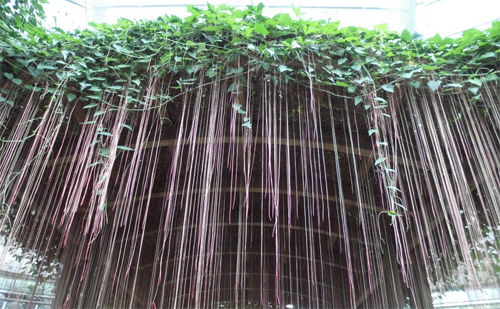
Cissus sicyoides is like a waterfall, like a curtain, hanging down, and it is very beautiful. How do you plant Cissus sicyoides? What nice alternate names does Cissus sicyoides have?
How to plant Cissus sicyoides:
1. Soil selection
It is not very fussy, and ordinary garden soil is enough for it to grow very well, though slightly fertile sandy soil lets it grow even better! Except in winter, you can usually keep the soil slightly moist.
2. Aerial root treatment
Keep newly planted Cissus sicyoides slightly moist. Aerial roots that appear while it is still climbing should be removed in time so they do not affect strong growth. During this period, you can fertilize once or twice, applying light fertilizer sparingly!
Once the vine has climbed onto the prepared trellis, you can let its aerial roots grow freely!
3. Sunlight and watering
Plenty of sunlight is certainly better. Although it is fairly shade tolerant, if you want it to grow more luxuriantly, give it more sun. You can water it fairly often, but be careful not to let the soil become waterlogged.
4. Pruning
During the growth period, Cissus sicyoides will produce many weak branches. At the beginning, keep only the main stem growing and remove the others, which helps it climb faster and grow more luxuriantly and robustly!
Cissus sicyoides also has many advantages: drought tolerant, high temperature tolerant, and shade tolerant. What an easy plant to grow.
It also loses its leaves in winter, and it is not very cold tolerant. Below 10 degrees, it needs protection from the cold and warmth retention!
Alternate names of Cissus sicyoides:
A Curtain of Dreams, Mandi Rong, Fugui Curtain, and others;
The newly grown aerial roots are red, and they slowly turn yellow-green. Each stage has its own charm, and both are enchanting and romantic scenery!
What leaves the deepest impression is its slender reddish-brown aerial roots. The aerial roots are very long (up to more than 3 m), and numerous aerial roots hang from the branches. Using "A Curtain of Dreams" to describe it could not be more fitting!
Cissus sicyoides has just such a magical effect. Hurry and plant one in front of your home, and then summer will not be so hot.
How to plant Cissus sicyoides
Cissus sicyoides, also known as Yimping Vine, Zhulian Vine, and others, is a perennial evergreen climbing herbaceous plant in the grape family, genus Cissus. Many flower lovers do not know how to plant Cissus sicyoides. In fact, it is not that difficult. Compared with pruning and shaping, planting is much easier. As long as you pay attention to a few of its habits, you can grow Cissus sicyoides well.
Cissus sicyoides originated in tropical America and has strong adaptability to soil, able to grow in soils of various types; however, note that the soil must not become waterlogged and must drain well. The best is sandy soil rich in organic matter. Cissus sicyoides likes a environment with ample sunlight, and its suitable growth temperature is between 20°C—35°C; Cissus sicyoides has a very strong spreading ability. In winter, although it loses its leaves, its growth speed is extremely slow, or its aerial roots grow slowly. It stops growing in environments below 10°C (in northern regions, it is difficult to grow because of climate issues).
During the growth period of Cissus sicyoides seedlings as they become mature plants, you can apply fertilizer twice to promote seedling growth (note not to apply too much). In the first year of planting, it can basically cover the trellis completely; during the period when the seedlings become mature plants, Cissus sicyoides will grow some red aerial roots on the stem nodes. These aerial roots should be removed when the Cissus sicyoides plant grows onto the trellis; when the aerial roots grow onto the trellis, you can prune them into shapes according to your own interests and preferences.
After Cissus sicyoides becomes a mature plant, it does not need pruning. Under severe cold winter climate conditions, you only need to remove some diseased and insect-damaged branches, dead branches, or some overly long branches.
Below are some points to note:
1. Plant symmetrically on both sides of the trellis, with a distance of 2—3 m between each Cissus sicyoides;
2. After Cissus sicyoides has been planted and has survived for a period of time, choose a robust Cissus sicyoides branch as the main vine for cultivation, and cut off the immature twining part at the leading end. For example, branches can easily be thinned to reduce some unimportant branches and ensure the growth advantage of the main vine;
3. Use string to carefully wind the main vine of Cissus sicyoides onto the support so that it can grow by winding in a clockwise direction;
4. For branches growing from the base of Cissus sicyoides, the thick and strong ones can be kept for later use, but all the thin small stems must be removed so that all the nutrients at the base are supplied to the main vine for growth;
5. When the vines of Cissus sicyoides grow onto the trellis, the branches should no longer be removed. At this time, these branches need to be evenly distributed in other directions so as to grow into a fully formed landscape.
Propagation of Cissus sicyoides:
There are mainly three methods for propagating and cultivating Cissus sicyoides: the first is the stem cutting method; the second is the seed propagation method; the third is the air layering method. Among them, the stem cutting method has the advantages of simple operation and a high survival rate. It involves cutting the removed branches into two bud-bearing stem segments and inserting them into a moist medium or fine sand, keeping them moist. The seed propagation method, however, is cumbersome to carry out and has a slow growth speed.
Cissus sicyoides Cissus sicyoides L. Cissus sicyoides illustrated guide: how to grow Cissus sicyoides / how to propagate Cissus sicyoides
Cissus sicyoides profileCissus sicyoides Cissus sicyoides L.
Alternate names: Mandi Rong, Zhulian Vine, A Curtain of Dreams, Fugui Curtain
Category: vine flowers
Family and genus: Plantae, Angiosperms, Dicotyledoneae, Vitaceae, Cissus
Full bloom period: summer and autumn
Cissus sicyoides is a perennial evergreen climbing herbaceous vine, entirely hairless, with slender branches and tendrils; leaves are simple and alternate, long heart-shaped, with serrated leaf margins, 5-10 cm, and long petioles. Its distinguishing feature is that mature plants can grow reddish-brown, metallic-lustrous, unbranched, slender aerial roots from the stem nodes, up to 3 m long.
Cultivation methods and precautions for Cissus sicyoides Introduction to Cissus sicyoides
Cissus sicyoides is a perennial evergreen climbing herbaceous vine, entirely hairless, with slender branches and tendrils; leaves are simple and alternate, long heart-shaped, with serrated leaf margins, 5-10 cm, and long petioles. Its distinguishing feature is that mature plants can grow reddish-brown, metallic-lustrous, unbranched, slender aerial roots from the stem nodes, up to 3 m long.
Morphological characteristics of Cissus sicyoides: branches
Cissus sicyoides is a perennial evergreen climbing herbaceous vine, entirely hairless, with slender branches and tendrils;
Leaves
Cissus sicyoides has simple alternate leaves, long heart-shaped, with serrated leaf margins, 5-10 cm, and long petioles. Its distinguishing feature is that mature plants can grow reddish-brown, metallic-lustrous, unbranched, slender aerial roots from the stem nodes, up to 3 m long, with hundreds or thousands hanging beneath the trellis in an extremely elegant and uniquely styled way. When aerial roots extend to the ground (soil), they will penetrate into the soil to absorb nutrients, making the leaves greener, the flowers more beautiful, and the whole plant more vigorous.
Flowers
Cissus sicyoides blooms in summer and autumn, with cymes, small 4-petaled flowers, about 1.5 cm, pale greenish-white.
Fruit
The fruit of Cissus sicyoides is nearly spherical, about 1 cm in diameter, green, and purple-black when mature, containing 1 seed. Cissus sicyoides has extremely strong vitality and is a very easy garden plant to cultivate.
Cissus sicyoides bears fruit in July-August.
Ecological habits of Cissus sicyoides
Cissus sicyoides is a sun-loving plant, drought tolerant, high temperature tolerant, and also slightly shade tolerant. Drainage and sunlight must be good. Its spreading ability is extremely strong, and the trellis set up must be large; guide the branch growth direction at any time. Soil: choose a growing medium with good water retention that will not become waterlogged, which is ideal. Sunlight: about 80-100% (full sun). Temperature: the suitable growth temperature is about 22-30°C. In winter it will lose its leaves, grow slowly, and not grow aerial roots. Below 10°C, cold protection must be carried out. In summer it grows quickly, and timely pruning is needed to improve ventilation. Watering: once every 1-2 days in summer, and once every 2-3 days in winter. Fertilizing: apply light fertilizer once every 2-3 months. Pest and disease problems are not serious, and ventilation should be maintained regularly.
Cultivation techniques of Cissus sicyoides: Cissus sicyoides cuttings
The propagation of Cissus sicyoides mainly uses water culture and cuttings, but mainly water culture. The method is simple and the survival rate is high, and it can be done in spring, summer, and autumn.
The method is: in combination with pruning, cut the removed vines into 10 cm stem segments, then insert them directly into a mineral water bottle filled with water, and they will generally root in about 15 days. After the young seedling roots have reached a certain number, they can be planted into a fixed planting pot.
A note on Cissus sicyoides cuttings is that aerial roots have the function of absorbing moisture and nutrients from the air, so after planting for a period of time, there is no need to water and fertilize again. However, timely pruning and tidying should be done, and in one year a large number of aerial roots can grow, completing the landscape.
Planting methods
Soil
For soil for planting Cissus sicyoides, it is suitable to choose ordinary soil. Yellow soil, mud, clay loam, sandy loam, and gravelly soil can all be used for planting. As long as the soil has a certain fertility and a slightly moist soil layer, that is enough.
Seedling-to-mature-plant management
To strengthen the management of Cissus sicyoides during the seedling-to-mature-plant period, the following 2 points should be done:
During the growth period of Cissus sicyoides seedlings as they become mature plants, apply chemical fertilizer twice to promote seedling growth, and in the first year of cultivation the trellis can be completely covered;
During the seedling-to-mature-plant period, Cissus sicyoides can grow some red aerial roots on the stem nodes, but these aerial roots should be removed when the Cissus sicyoides plant grows onto the trellis;
Density
The planting density of Cissus sicyoides should be selected according to local conditions, mainly considering the guide rods for guiding branches. Because the number of guide rods restricts the overall landscape, Sunshine Seedling Network suggests that to achieve the goal of rapid forest formation, it is best to plant 2-6 plants at one point. One trellis can be planted at one point. For corridors and landscape walls, Cissus sicyoides can be planted at one point with multiple plants, at a distance of 5-10 m.
Pruning and shaping
According to different landscape uses, first set up the necessary structural facilities, such as trellises, pergolas, arches, and other fixed support forms. As needed, the spacing of Cissus sicyoides is generally 2-3 m, and the planting hole is dug about 0.5 m, with more than half of the hole filled with decomposed organic fertilizer. After planting and surviving for a period of time, choose a robust branch as the main vine for cultivation, cut off the immature twining part at the leading end, ensure the growth advantage of the main vine, and use string to carefully wind the main vine onto the support so that it grows by winding in a clockwise direction; for branches growing from the base, the thick and strong ones can be kept for later use, but all the thin small ones must be removed so that all the nutrients at the base are supplied to the main vine for growth; when the vines grow onto the trellis, the branches should no longer be removed. At this time, these branches need to be evenly distributed in other directions so as to grow into a fully formed landscape.
Disease control of Cissus sicyoides: anthracnose
Anthracnose is more likely to occur in greenhouses with poor ventilation, high air humidity, and relatively high temperature and humidity. It harms the tender shoots and fruits of Cissus sicyoides. The lesions are grayish-brown, nearly circular, with obvious concentric rings or whorled small black spots. There are dark brown line markings at the lesions, and when humid, pinkish small spots or mucus appear on the lesions.
Control methods
(1) Adjust the cultivation location of Cissus sicyoides, keep it away from water curtains to reduce humidity, and improve ventilation conditions.
(2) Water appropriately, do not water when not dry, and increase the plant's resistance.
(3) In the early stage of the disease, use 70% Dacotech M wettable powder at 500 times dilution, or 70% thiophanate-methyl wettable powder at 1000 times dilution, and spray alternately, once every seven days, for 2-3 consecutive times.
Distribution area of Cissus sicyoides
Place of origin of Cissus sicyoides: tropical America.
Uses and functions of Cissus sicyoides
Cissus sicyoides is suitable for green corridors, green walls, or shade sheds.
Cissus sicyoides blooms from summer to autumn, and the flowers are pale greenish-white. It bears fruit in July-August. Its most special feature is that Cissus sicyoides can grow slender reddish-brown aerial roots from the stem nodes, hanging beneath the trellis with a unique style.
Cissus sicyoides is very suitable as a green corridor, green wall, or shade shed. The newly grown aerial roots of Cissus sicyoides are red, and after a period of time turn yellow-green, so the upper and lower parts of the entire string of aerial roots differ in color, adding even more charm. Cissus sicyoides is the best heat-insulating curtain. It is said that at the Neiwan Scenic Area in Hsinchu, Taiwan, China, many shops use Cissus sicyoides for landscaping. The slender long strands, like a curtain, have become a scenery there.
Cissus sicyoides pictures