Chinese Elm Bonsai Cultivation Methods and Price Introduction
The Chinese elm is extremely well suited to bonsai, and it grows to look truly beautiful; one glance and you sense a classical charm within it. How should a Chinese elm bonsai be cultivated? How much does one pot sell for?
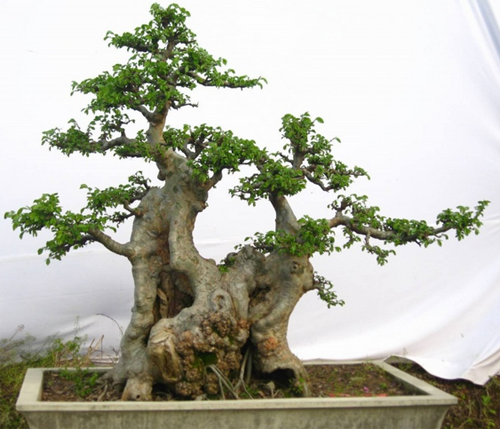
How to grow a Chinese elm bonsai:
The Chinese elm is the small-leaved elm, not the common elm; its form is rather elegant, and its greatest feature is the mottled bark and trunk. In autumn the leaves change color. It is a deciduous tree.
1. Selecting the stump
When buying a Chinese elm bonsai, you must examine the stump carefully. The fresher the stump material, the better. Do not assume that a withered, rotten stump has more charm. Some even have poorly developed root systems. Beginners should first keep the Chinese elm alive, then shape it slowly!
2. Pre-planting treatment
First comes the care of its wounds and cut surfaces. Care must be meticulous; some people do not handle it properly, causing the wounds to bleed large amounts of sap when they touch water.
After the stump material has been trimmed, be sure to smooth the cut surfaces and wounds. For large cut surfaces, it is best to trim the bark and xylem into a 45-degree bevel. This can prevent bacterial infection and also helps the wounds heal and roots form sooner.
3. Drying the wounds
After treating the wounds, you cannot pot it up immediately. Place the treated stump in a shady, cool spot for a few hours until the wounds heal and no sap remains; a protective film will form on the surface. This ensures a higher germination rate for the planted Chinese elm, and it is also something beginners overlook!
4. Cleaning the tree stump
Those mottled Chinese elm stumps have many holes, and all the debris inside the holes must be cleaned out completely. It is easy for insect eggs (termites and so on) to hide in there. If you want it to grow healthily, the necessary cleaning is a must. Who told the Chinese elm to have so many pests and diseases!
5. Choosing the pot and soil
The Chinese elm likes dryness and fears dampness. An unglazed clay pot is best as the container. For the medium, it is best to use humus soil, pine needle soil and loess mixed in a 4:3:3 ratio. This kind of soil is both breathable and water-retentive, and it will not become waterlogged.
6. Small watering tips
Line the bottom of the pot with several layers of tile shards, pebbles and the like, then add a layer of coarse sand on top. After filling with soil, shake it a few times first, then press it down firmly along the edge of the pot to prevent hollows from forming under the stump roots, which would affect root development.
Notes:
After watering thoroughly to settle the roots, cover it with a plastic bag (this step is the most important for rooting and sprouting), and place it in a relatively fixed spot. Do not move it often (a cool, shaded, ventilated place), so as not to disturb the stump roots and break off root sprouts. Control watering, mist the branches and trunk more, and keep the potting soil on the dry side.
Do not fertilize newly planted stumps, and do not use base fertilizer either. Generally wait until a few months after they have survived, then give a little; after autumn you can give a little!
Chinese elm bonsai prices:
The price of a Chinese elm bonsai mainly depends on the tree's form and size. For small saplings, 10 yuan can buy quite a large bundle, but after planting a Chinese elm bonsai you need to shape it yourself.
Bonsai investment is gradually hitting its stride
Flower and Bonsai Network introduction: Today the Flower and Bonsai Network editors bring you an article about bonsai investment gradually hitting its stride. Let's take a look!
["Alternative bonsai" is about to be snapped up! In the field of art market investment, today's bonsai market has already sent investors a rare, cheap invitation to the classics.]
Text by Chao Shanshan, reporter for Xiaokang Caizhi
Rising as early as the dawn light is Gao Shengbao, a bonsai master who lives in Chaoyang District, Beijing. His courtyard of several hundred square meters is filled with distinctive bonsai in all kinds of postures.
Summer has arrived, and Mr. Gao has to water his whole courtyard of bonsai twice a day, once in the morning and once in the evening. Besides watering, his daily must-dos also include pruning branches, trimming crowns, fertilizing... These bonsai have accompanied him for more than thirty years. Mr. Gao says with a smile: "Some bonsai are older than my children, and I have spent more time with them than with my children." His close friend Mr. Ma Yiqun revealed to the reporter: "The most ordinary bonsai in Old Gao's home is worth at least tens of thousands, and it would not be a small number that sell for hundreds of thousands or even millions."
Bonsai investment is gradually hitting its stride
The bonsai business has existed since ancient times. As early as the Neolithic Age from 10,000 BC to 4,000 BC, our ancestors already planted plants in vessels for ornamental viewing. According to existing archaeological and documentary records, during the excavation of the Hemudu Neolithic site in Yuyao County, Zhejiang Province, a piece of pottery with a five-leaf pattern was found; on the pottery was carved a square pottery basin, and in the basin was planted a plant resembling a lily of the valley. Mr. Gao Shengbao told the reporter: "Our country's bonsai had already developed considerably as early as the Northern Wei and Northern Qi periods, and at that time it had already begun to be exported to Turkic and other neighboring countries or ethnic groups."
In China, along with the development of bonsai, bonsai investment has also had different temperatures in different historical periods. Taking modern times as an example, from World War II to the Cultural Revolution, bonsai was in a period of stagnation. After the 1970s, the development of bonsai in China gradually recovered. In 1979, the State Bureau of Urban Construction hosted in Beijing the first national "Bonsai Art Exhibition" since the founding of New China, displaying as many as 1,100 pots of various bonsai. After that, the Flower and Bonsai Branch of the Chinese Society of Landscape Architecture held a "China Bonsai Evaluation Exhibition" every few years. Similar bonsai art exhibitions held irregularly all over the country objectively pushed Chinese bonsai art to keep innovating on the basis of inheriting tradition, and also accelerated its development.
The 1990s were the golden age of Chinese bonsai art. Mr. Gao Shengbao told the reporter: "After the World Flower Expo, the scale of the fourth bonsai art exhibition was already very large, and at this time Chinese bonsai began to be exported." In the early days of the founding of New China, Chinese bonsai always had the problem of being difficult to quarantine -- at customs, because issues such as plant quarantine and soil quarantine for bonsai could not be solved, Chinese bonsai remained hidden away. After the 1990s, the development of soilless cultivation in China solved this problem. Mr. Gao told the reporter: "Every year many tree species from Lingnan, such as banyan and Chinese elm, are exported to the Netherlands, the United States, Germany and many other countries. It can be said that by now, Chinese bonsai absolutely deserves to be called world-renowned."
Under the macro environment of a virtuous cycle in bonsai development, bonsai investment is also gradually hitting its stride. Masters such as Lingnan bonsai masters Kong Taichu, Mo Mianfu, Suren and Lu Xueming; Suzhou bonsai master Zhu Zi'an; and Shanghai-style bonsai master Yin Zimin and others, on the basis of inheriting the traditions of their schools, also made innovations to varying degrees. Besides appearing in the "Bonsai Art Exhibition," they were even more sought after by buyers after the exhibitions. A pot of osmanthus bonsai by Mr. Gao Shengbao, "Harmony Is Precious," won a gold award in a bonsai evaluation, and a Korean buyer offered 580,000 yuan. Mr. Gao said: "In recent years bonsai has developed faster and faster. When I first entered the bonsai collecting world, this price was unimaginable."
The temptation of a "value depression"
Mr. Gao Shengbao told the reporter: "Which financial crises have had a huge impact on the art market, and bonsai is no exception, but it is also for this reason that the overall value of the current bonsai market is generally undervalued, making it a good time to invest."
Compared with traditional fields such as calligraphy and painting and porcelain, the bonsai market has always been in a relatively "blank" period. The lack of a broad foundation for appreciation and of specialized techniques for maintaining bonsai intensifies the risk of bonsai investment. Mr. Gao told the reporter: "A friend of mine bought a bonsai for more than one million at a bonsai exhibition, and because he did not know how to care for it, it died less than a month after he got home." Although the bonsai market did indeed become "hot" for a while in the 1990s, in view of this risk, many bonsai experts believe that contemporary bonsai artworks are relatively cheap and also have a certain room for appreciation.
Are there many bonsai artists today?
Are there many people playing with bonsai now?
Are contemporary bonsai prices high enough?
When we raise these questions, the answers we get are basically negative. Besides revealing the awkward situation of contemporary bonsai, these answers also send us a cheap invitation to enter the bonsai investment market. As everyone knows, history always belongs to the category of time. Art history also repeatedly inspires us: some so-called obscure arts of today may very well become the traditional classics of tomorrow.
The plan to snap up alternative bonsai
Mr. Gao Shengbao told the reporter: "Traditional Chinese culture divides bonsai into 'four grades,' namely absolute masterpieces, divine works, fine works and exquisite works. Bonsai of different grades have different prices."
Although there are traditional standards for judging whether bonsai is good or bad, according to different personal preferences, when collecting and investing in bonsai, if you emphasize individuality, it can sometimes have more appreciation potential than a mechanical, by-the-book collecting approach. Mr. Gao told the reporter: "I think that as long as it is a tree species that can be made into bonsai, if it has ornamental value in proportion and tree form; can be potted; and after artificial processing can fully express the author's personal thoughts and feelings, only then is it a truly alternative bonsai worth investors investing in."
Let us search the following scenes for a plan to snap up the alternative bonsai that belongs to you.
SCENE 1: Price
Bonsai is an art variety with a very strong artistic character. Since bonsai has not yet entered auction houses, the value of contemporary bonsai is very vague, and pricing is naturally very difficult. But for the artistic value of bonsai, there are also the most basic traditional standards of measurement.
Mr. Gao Shengbao told the reporter: "First is the stump material, that is, the tree species. This is the most basic factor determining the price of bonsai. For example, given the same stump material, one being elm and one being pine, when the shaping art is comparable, the price of the pine must be higher than that of the elm." The south emphasizes pines and cypresses, while the north emphasizes hornbeam, elm, yellow vitex and so on. At present, relatively precious fine stump materials include Taiwan false cypress and yew; because the species are rare, the price of the tree species itself is already very high. If artificial shaping and cultivation are added, the price at sale is of course even higher.
Next is stump age and pot age. So-called stump age is the natural growth years of the tree species before potting, and pot age refers to the years of artificial cultivation after the tree stump is put into a pot. Mr. Gao told the reporter: "A stump age of one hundred years cannot compare with a stump age of one thousand years. But even if the stump age is very long, without pot age it will not be worth much. For example, comparing one potted for twenty years with one potted for one hundred years, there is a difference of eighty years of effort, and the artistic value of the two bonsai is of course also separated. In this situation, the prices of the bonsai will also differ greatly."
Third is shaping. So-called bonsai shaping is artificially creating from the growth characteristics of the bonsai itself. Generally, bonsai shaping is natural plus artificially cultivated. Mr. Gao said: "For example, a bonsai shaped like an immortal must be better than one shaped like a piece of stone, and the price is also higher." The development of bonsai shaping also advances with the times. Contemporary bonsai is already very different from ancient traditional bonsai. At present, the more common and investor-favored ones mainly include forest-style bonsai, slanting-trunk-style bonsai, hanging-style bonsai and sea-probing-style bonsai, among others.
Finally there is the scarcity factor of bonsai. Mr. Gao said: "For example, some scarce resources, plus very long pot age and stump age, such bonsai can be considered scarce resources, and of course the price is high."
SCENE 2: Investment advantages
Compared with the excessive hype of many categories in the art market in recent years, bonsai belongs to a genuinely obscure art. In this situation, it is bound to attract a lot of attention. Mr. Gao Shengbao told the reporter: "With the continuous holding of 'bonsai exhibitions,' the future market prospects for bonsai should be very good."
Bonsai is more popular in the south than in the north. Mr. Gao Shengbao told the reporter: "In the south there are many large-area bonsai museums, but in the north, especially Beijing, they are relatively rare."
At present in the north, bonsai is still a market with great potential. As the popularity of traditional Chinese studies grows, some artworks favored by ancient literati are increasingly favored by contemporary people. Bonsai art is a unique shaping art combining ink painting and garden scenery. Besides centrally representing literati sentiment, it is also increasingly becoming an ideal miniature "hidden paradise" in contemporary urban life.
Because there are not many artists engaged in bonsai, the excellent artists' works produced are also very few. In this situation, if you have a discerning eye and can buy excellent artists' works, and on the premise that the collector's own skills are relatively high, there is no problem in doubling the price of your bonsai.
SCENE 3: Room for appreciation
Unlike many categories of artwork, the collection and investment of bonsai has a certain particularity.
Mr. Gao Shengbao told the reporter: "Take calligraphy and painting: after buying them and taking them home, you only need to protect them, for example keeping them away from moisture and sunlight; it is a very simple way of maintenance. Take porcelain, furniture and so on: you only need to keep them intact, without bumps or deformation. But bonsai is different. Unlike them, it is a living artwork. If you can care for this life well, its room for appreciation is unpredictable."
Collecting and investing in bonsai is actually a process of participating in bonsai creation. It can also be put this way: a good bonsai is made by combining the objective conditions of the bonsai itself with the collector's personal alternative creative spirit. Take Mr. Gao's "Harmony Is Precious" as an example. When he bought it in the 1980s for 30,000 yuan, it was just a bonsai of ordinary artistic value. After twenty years of cultivation, Mr. Gao "grafted" his own personal aesthetic taste onto "Harmony Is Precious." This "grafting" of personal taste directly raised the economic value of "Harmony Is Precious" by nearly 20 times.
In the process of bonsai investment, emphasizing individuality is quite necessary. The investment value of alternative bonsai must be higher than that of vulgarly catering to popular taste, and it also has more room for appreciation.
Bonsai, the art of accenting space -- Mr. Mo Yao receives an exclusive interview with Jiatu Network
As people increasingly recognize traditional Chinese culture and traditional garden culture, Mo Yao's artistic-conception bonsai is being accepted by more and more people. This is also full affirmation of the modest contribution Mr. Mo Yao has made to reviving traditional Chinese culture. Not long ago, Jiatu Network conducted a special interview on aspects of Mo Yao's artistic-conception bonsai such as its creativity, artistry and plasticity. Below is the full content of Jiatu Network's exclusive interview with Mr. Mo Yao. Please enjoy it.Full text of the exclusive interview:
Bonsai expresses the existence of a scene, an abstract reproduction of natural landscape. Through observation and association with the scenery in the natural world, people harmoniously gather the various beauties of the natural landscape into the bonsai they create. But is bonsai art too highbrow for ordinary people? Mr. Mo Yao, a literati garden designer, not only shows us his aesthetically beautiful bonsai works, but also teaches us how to appreciate bonsai, how to match a pot of bonsai in a space, and how to make a beautiful pot of bonsai by ourselves.
Mo Yao's bond with bonsai
Jiatu Network: You are already very famous in the garden world, and now you have surprised us again. The small bonsai you design and make are very fascinating. What attracted you to begin bonsai design? Mo Yao: In ancient times, when building traditional gardens, there were no specialized garden designers as there are now. When traditional building masters did garden courtyard design, they were all called garden makers. Garden makers needed to possess many professional qualities and understand knowledge in various fields, such as geomancy (feng shui), planting trees, painting, poetry, horticulture, architecture, philosophy, craftsmanship and mathematics, and at the same time they also had to go to the construction site in person to pile up mountains and manage water, plant plants and so on. Bonsai making can be regarded as a required course for garden makers. Without understanding bonsai making, one cannot experience the relationship between mountains and water. To become a master, one must understand how to condense the natural mountains and waters of the earth into a small bonsai. There were mainly two reasons why I began bonsai making. The first reason is that once I attended a bonsai exhibition and saw that the bonsai on display were all high-end, with extremely expensive prices, often hundreds of thousands or millions, which meant that bonsai could not be integrated into ordinary families and could only appear in a limited scope. Ordinary people could not afford them, so that traditional Chinese culture could not flow. In the end this could only lead to bonsai becoming exhibits in a history museum, which is a very regrettable thing. The second reason is that I needed to improve my own design cultivation. In bonsai, the spatial relationship between mountains and water and the ideas of seeing the big in the small and the small in the big are of great help to my design.
Jiatu Network: Your bonsai works are very poetic and picturesque; seeing them is like reading an ancient poem. This is like Chinese literati painting, where the painting contains poetic lines and feelings. So what is your creative inspiration? Mo Yao: One route to creative inspiration is to seek it in poetry and comprehend it in Chinese painting. Chinese poetry is three-dimensional and vital; it is a four-dimensional space; while Chinese painting has artistic conception. In addition, my inspiration also comes from materials I have collected over many years of traveling among mountains and waters. These images have existed in my mind for many years and keep appearing during creation. For example, when I go to Huangshan, this place can enable me to create countless bonsai, because it has many scenic spots that merge into my mind. Another example is when I go to Huashan, as well as Shidu and Pinggu, which are very close to Beijing; these places all have many beautiful images that are preserved in my mind and appear one by one when needed. What is usually called a certain point triggering inspiration is only for graphic design. A master of bonsai making will use all the naturally beautiful scenery on earth and express it through artistic forms. Traveling all the mountains and rivers of the world is enough for several generations to create.
Appreciation of bonsai
Jiatu Network: Bonsai pays great attention to composition. For your works, please explain to us how to appreciate a bonsai artwork. Mo Yao: To appreciate bonsai, you must first know that there is scenery in the pot, and second appreciate the plant's form. Through the plant's form you can feel the power of nature and the wonder of the earth creating all things. Then look at the shape of the stones. Some stones are shaped like layer upon layer of mountains, with distant mountains and near mountains. The bonsai created is equivalent to taking a photograph of nature. In the bonsai there are mountains and water, riverbanks, reefs, and even cranes, fishermen and boats. All of this can instantly make the sense of space vivid, and every place can be connected to let you go deep into it, as if you were in such an environment, empathizing with the beauty of nature. Bonsai is a natural artwork; it is the beauty of nature attracting your eye, and you do not need to think about it. It is three-dimensional, letting you merge into it in an instant, as if you heard the flow of water, the singing of fishermen, the cry of cranes and the soughing of pines. It is a dynamic four-dimensional space three-dimensional artwork.
Jiatu Network: Teacher Mo Yao, you yourself do garden design, so you should be very familiar with the habits of various plants. Please recommend a few bonsai that are relatively easy to grow. Mo Yao: There are too many easy-to-grow bonsai. For example, Buddhist pine and bamboo-leaf plum are both very easy to grow, and Chinese elm, cypress, asparagus fern, orchid, red maple, ginkgo, pomegranate and so on are also relatively easy to grow. One thing I want to say is that all plants, as long as you care for them attentively, will grow well, because plants, like people, have life and emotions. If you treat them well, they will show you a sunny spring and brilliant scenery.
Bonsai and space
Jiatu Network: Bonsai has always been favored by refined scholars and is also a good green plant for decorating a home, but Chinese bonsai is even more an artwork. What do you think is the relationship between bonsai and space? Mo Yao: Bonsai is a point, and through this point we hope to achieve the effect of human cultivation and self-refinement. The scenery of bonsai can be transformed into artistic conception, and this artistic conception can let people cultivate their state of mind. It is also an artwork. Unlike Chinese painting, oil painting, sculpture, antiques, ceramics, iron and copper, this kind of artwork, bonsai, is vital and constantly changing. With the changes of the four seasons, plants also change. For example, the Chinese elm drops its leaves when it should, the leaves of the red maple sometimes turn red and sometimes green, and bamboo is also always constantly changing. Through this constantly changing point, vitality is formed and transformed into space, giving people different feelings and letting people and scenery resonate with each other within the spatial scope.
Jiatu Network: Many people have a little confusion. Bonsai is a traditional Chinese art, but now most of our home spaces are modern in feel. Is this contradictory? Is bonsai only suitable for spaces in Chinese style?
Mo Yao: This is a mistaken idea. As long as they are people on earth, they will love nature. Bonsai is a concentration of nature. It has nothing to do with style and nothing to do with the space one lives in. The only difference is that when choosing a pot you may occasionally choose one that suits you, not any difference in the scenery. Because people of any ethnicity and country love nature; we are only extracting the beauty of nature. It is not only a product of China, but even more a product of the whole world. The Daoist idea that "nature creates all things" depicts a state of mind of non-action and freedom, and through bonsai one can comprehend the way of nature.
Jiatu Network: What effect does the placement of bonsai have on space, and what are the benefits of placing bonsai at home? Mo Yao: Placing a pot of bonsai at home can make one feel happy. Bonsai is made through the combination of stones and plants, and it is good for human health. Stones emit a kind of magnetic field, which helps improve a person's body and mind; while plants belong to yang, and can regulate the aura and feng shui indoors, which is beneficial to the transformation of the aura of the spatial environment. Its benefit is that it can change small feng shui and big feng shui. Small feng shui can change the indoor atmosphere and magnetic field; big feng shui changes one's inner state, making one happy, and at the same time, under the regulating effect of the magnetic field and atmosphere, it can calm the mind. "One should give rise to a mind that dwells nowhere"; the mind thus given rise to is a calm mind, a pure mind, a kind mind, a loving mind and a sincere mind.
DIY bonsai
Jiatu Network: If conditions allow, can we DIY a bonsai at home? What tools and materials do we need to prepare? Mo Yao: To DIY a bonsai, you first need to choose a pot. There are many kinds of pots, including pottery pots, porcelain pots and so on. Second, you need to choose stones; there are also many kinds of stones, such as Qinglong stone, Yingde stone, Huangshan stone, water-washed stone, pebbles and so on. You also need to prepare plants. Plants are divided into evergreen and deciduous. Evergreen plants include Buddhist pine, bamboo-leaf plum and cypress; deciduous plants include Chinese elm, pomegranate, ginkgo and so on. In addition, you also need soil. Various nutrient soils are sold on the market, and you can also cultivate some yourself. When making bonsai, do not wear gloves. Let your hands directly communicate emotionally with the soil; soil is good for nourishing the spleen and stomach.
Jiatu Network: Teacher Mo Yao, you yourself do garden design, so you should be very familiar with the habits of various plants. Please recommend a few bonsai that are relatively easy to grow.
Mo Yao: There are too many easy-to-grow bonsai. For example, Buddhist pine and bamboo-leaf plum are both very easy to grow, and Chinese elm, cypress, asparagus fern, orchid, red maple, ginkgo, pomegranate and so on are also relatively easy to grow. One thing I want to say is that all plants, as long as you care for them attentively, will grow well, because plants, like people, have life and emotions. If you treat them well, they will show you a sunny spring and brilliant scenery.
Mr. Mo Yao, whose name is Guo Liwen, is a native of Luling, a well-known garden designer, a senior cultural figure, and an artistic-conception bonsai artist. He grew up in a garden family and loved nature, plants and calligraphy from childhood. He learned from ancient sages and craftsmen and took nature as his teacher, drawing on natural culture through the way of literati self-cultivation. For many years the gentleman has been committed to reviving traditional Chinese garden culture and classical bonsai art, creating artistic-conception bonsai that uses silent poetry and three-dimensional painting to create life and spirituality.
Scan to follow the Yingshan Yue service account