How to Grow Banana Shrub (Michelia figo) and Its Blooming Time
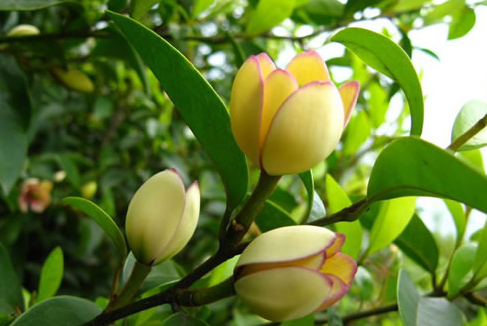
How can banana shrub have such a magical name? Actually, this is quite normal, because this flower is always in bud, not fully open. When does banana shrub bloom?
How to grow banana shrub:
1. Watering
Normally keep the potting soil moist, but never too wet.
Because its roots are mostly fleshy, too much watering or waterlogging after rain will cause root rot, so humidity should be carefully controlled during the rainy season.
During the growing period and before flowering, it needs more water, so water once a day. In hot summer weather, water the leaf surface to maintain a certain air humidity. In autumn and winter, because sunshine is shorter, watering once or twice a week is enough.
2. Fertilizing
Banana shrub likes fertilizer. Mostly use rotted cake fertilizer, bone meal, chicken and duck manure, and fish offal and other composted fertilizers diluted with water. During the growing season (April to September), apply fertilizer once every 15 days or so, and stop fertilizing during the flowering period and after October.
If the leaves are found not to be bright and deep green, apply one dose of alum fertilizer water.
3. Pruning
Banana shrub should not be pruned excessively. Normally, after flowering, prune the leggy branches, diseased and weak branches, and overly dense overlapping branches that affect the tree shape, and remove the fruit after flowering to reduce nutrient consumption. Before spring budding, appropriately thin out some old leaves to stimulate new branches and leaves.
4. Repotting
Repot once every 1 to 2 years, preferably before new leaves emerge each spring, or after flowering, and it can also be done in autumn. When repotting, remove an appropriate portion of the compacted old soil, replace it with fertile, loose potting soil, cut off dead branches and overly old roots, and place sufficient base fertilizer at the bottom of the pot.
Banana shrub likes to grow in a semi-shaded, moist environment and does not like strong sunlight, so it needs shading in summer.
When the environment is dry or there is a lot of sun exposure, the leaves tend to turn yellow and wilt, and growth is poor.
In winter, move it indoors, or move it under the eaves facing south.
When does banana shrub bloom:
Banana shrub usually blooms abundantly from April to May. If the tips are pruned frequently, it can bloom in three seasons a year, except winter. Although the flowers are not as many as in April to May, the flowers still have a very pleasant fragrance.
For first-time growers, banana shrub is still fairly easy to kill, so attention is still needed. Pay attention to the blooming time of banana shrub, otherwise if you miss the flowering period, you will not see the flowers.
What Is Banana Shrub Good For? How to Grow Banana Shrub
Banana shrub is an evergreen shrub, 2 m to 3 m tall, with grayish-brown bark and dense branches; the leaves are leathery, narrowly elliptic or obovate-elliptic. The flowering period is March to May, and the fruiting period is July to August. It is native to the southern provinces and regions of South China, and there are wild plants in Dinghu Mountain, Guangdong, growing in shady mixed forests on slopes. It is an aromatic flowering plant, with buds as smooth as jade and a fragrance as subtle as orchid. How should banana shrub be grown? How can it be grown better? Also, what is banana shrub good for? Below, we will explain the uses and growing methods of banana shrub, hoping to help everyone.
When Does Banana Shrub Bloom
Although the flowers are not as many as in April to May, the flowers still have a very pleasant fragrance. Banana shrub usually blooms abundantly from April to May. If the tips are pruned frequently, it can bloom in three seasons a year, except winter.
How to Grow Banana Shrub
1. Watering. Normally keep the potting soil moist, but never too wet. Because its roots are mostly fleshy, too much watering or waterlogging after rain will cause root rot, so humidity should be carefully controlled during the rainy season. During the growing period and before flowering, it needs more water, so water once a day. In hot summer weather, water the leaf surface to maintain a certain air humidity. In autumn and winter, because sunshine is shorter, watering once or twice a week is enough.
2. Fertilizing. Banana shrub likes fertilizer. Mostly use rotted cake fertilizer, bone meal, chicken and duck manure, and fish offal and other composted fertilizers diluted with water. During the growing season (April to September), apply fertilizer once every 15 days or so, and stop fertilizing during the flowering period and after October. If the leaves are found not to be bright and deep green, apply one dose of alum fertilizer water.
3. Pruning. Banana shrub should not be pruned excessively. Normally, after flowering, prune the leggy branches, diseased and weak branches, and overly dense overlapping branches that affect the tree shape, and remove the fruit after flowering to reduce nutrient consumption. Before spring budding, appropriately thin out some old leaves to stimulate new branches and leaves.
4. Repotting. Repot once every 1 to 2 years, preferably before new leaves emerge each spring, or after flowering, and it can also be done in autumn. When repotting, remove an appropriate portion of the compacted old soil, replace it with fertile, loose potting soil, cut off dead branches and overly old roots, and place sufficient base fertilizer at the bottom of the pot.
5. Ventilation. After banana shrub is brought indoors around Frost's Descent, keep the indoor air fresh. If ventilation is poor, it is easily harmed by pests such as aphids and scale insects. If it is placed in a greenhouse heated with coal in winter, large amounts of harmful gases such as carbon monoxide and sulfur dioxide will poison the plant. Therefore, on sunny and windless noons, open the windows for ventilation and light.
6. Fertilizing. Banana shrub grown in the north is in a dormant or semi-dormant state in winter and does not need much fertilizer. An appropriate application of base fertilizer mainly consisting of organic fertilizer should be given to help banana shrub bloom the following year.
7. Pest and disease prevention. The main diseases include black mold and chlorosis. A 0.5-degree Bordeaux mixture can be sprayed, or 5% alcohol can be used to wipe off mold stains; a 0.1% to 0.2% ferrous sulfate solution can be sprayed to control chlorosis. The main pests include scale insects, aphids, and red spiders, which can be killed by spraying 80% dichlorvos at 1000 to 1500 times dilution.
Uses of Banana Shrub
When banana shrub blooms, displaying it indoors fills the room with fragrance; it is an ornamental plant beautiful in both flower and leaf. A banana shrub bonsai should be placed in a semi-shaded and moist location, avoiding direct strong sunlight, and attention should be paid to shading in summer. If the environment is dry and there is sun exposure, the leaves tend to turn yellow and wilt, and growth is poor. In winter, move it indoors, or move it under the eaves facing south.
Because the scent of banana shrub is rich and long-lasting yet not heavy or greasy, it is also an excellent natural spice, used to press and refine fragrant oil, and its flowers can also be picked as a spice used when making tea.
The Flower Language of Banana Shrub
The flower language of banana shrub is reserve, implicitness, beauty, dignity, purity, and nobility. This is because the flower of banana shrub opens without fully opening, seeming to smile without speaking. Therefore, to a large extent it represents the Chinese people's implication of subtlety and suggestion. So, its flower language is implicitness and reserve.
The above is our explanation of the uses and growing methods of banana shrub. Is everyone clear now? For more home decoration knowledge, please pay attention.
Growing Guide to Banana Shrub: How to Grow Banana Shrub
Do you still remember the ode to banana shrub, "The flower blooms without opening its mouth, shy and bowing its head, as if a beauty smiles, deep feelings flowing secretly"? Since ancient times, there have been poems, lyrics, and songs praising the delicate beauty of banana shrub, so we can know how intoxicating banana shrub is. We are also deeply attracted by banana shrub, so what exactly are the growing methods for banana shrub? Let the editor explain in detail.
1. What Is Banana Shrub
Banana shrub, also known as Hanxiao Mei, is native to southern China and is cultivated south of the Yangtze River. It is one of the evergreen shrubs, usually about 2-3 m tall, with grayish-brown bark and dense branches and leaves. It blooms in spring (March to May) and bears fruit in summer (July to August). If flower lovers like to observe wild banana shrub, they can go to the shady mixed forests of Dinghu Mountain in Guangdong to look for traces of it, and may make an unexpected discovery.
2. Growing Conditions for Banana Shrub
1. Temperature: Banana shrub likes to grow in relatively shady places, and what it dreads most is strong sunlight. Therefore, when growing it at home, attention should be paid to shading it from sunlight in summer, and before frost in late autumn it should be quickly placed in a greenhouse, allowing it to overwinter at a temperature of about 10°C.
2. Soil: Banana shrub is suitable for growing in slightly acidic soil, and its pH value is best controlled between 5.0 and 5.5.
3. Drainage: Banana shrub needs to grow in an environment with good drainage conditions.
3. How to Grow Banana Shrub
1. Prepare a pot with good permeability, and mix leaf mold, garden soil, rotted stable manure soil, and sand in a ratio of 4:3:2:1. At this point the soil is ready.
2. Normally keep the pot moderately moist, and appropriately increase the frequency of watering during the growing period and early flowering stage. Note that the watering frequency in summer differs slightly from that in autumn and winter. In summer it needs watering once every few days, and during high temperatures water the leaf surface at the appropriate time, while in autumn and winter it only needs watering once or twice a week.
3. Banana shrub needs shading in summer to avoid strong light scorching the leaves. After autumn turns cool, it needs more sunlight, while in winter it only needs to be placed indoors in a sunny and ventilated spot.
4. The overwintering temperature of banana shrub needs to be controlled above 5°C and below 15°C, otherwise it will affect its normal physiological activities and growth the following year.
5. Banana shrub needs fertilizing once every half month during the growing period and flowering period, and fertilizing should stop after October, otherwise its appearance will be affected.
6. When banana shrub suffers pest damage, targeted medicines need to be used to eliminate the pests, and it must never be left to fend for itself.
7. Banana shrub is inherently unsuitable for excessive pruning, so when diseased or damaged branches appear, only simple pruning is needed, and before spring budding cut off some old leaves to stimulate the sprouting of new branches and leaves.
If you have recently been worrying about what to grow at home, you might consider banana shrub!