When does Calibrachoa bloom best? Planting methods and precautions
Calibrachoa is extremely beautiful to look at, grows abundantly, and its blooms are gorgeous, producing many small flowers that even resemble morning glories a little. What are the planting methods and precautions for Calibrachoa? Which month is best for blooming?
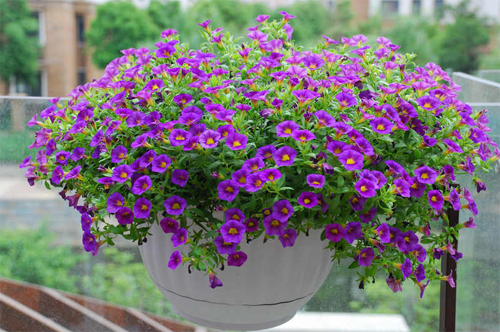
Planting methods and precautions for Calibrachoa:
1. Potting soil and watering
It likes fertile, loose humus soil, which helps it grow roots faster. As for watering, aside from watering less in winter, keep the soil moist in the other seasons, and in dry environments you also need to mist it frequently!
2. Repotting and transplanting
Calibrachoa is generally propagated by sowing seeds, and seeds sown that year can bloom the same year. However, because it does not tolerate transplanting well, sow the seeds evenly, wait until the root system is strong before transplanting, and be careful not to damage the roots. Place it in a cool spot to recover for a week, mist the leaves morning and evening, and then gradually introduce it to light!
3. Light and fertilizing
It is quite fond of sunlight; without sun it grows very weak and has few branches, so growing it outdoors gives the best results. Calibrachoa likes organic fertilizer, so during the growing season apply light fertilizer frequently!
4. Temperature and humidity
Calibrachoa has poor cold tolerance, and too much climate fluctuation can easily kill it, though this is only fitting for its delicate appearance! Protect it from the cold in winter, and keep it ventilated and cool in summer.
Care tips:
To grow a lush pot of Calibrachoa, you need to learn to pinch off the growing tips to encourage branching. Plant one per pot, or two at most! You can plant two colors together!
Pest and disease control:
Normally it has few pests or diseases! In the hot, humid summer it is prone to downy mildew, and it can also get leaf spot, and if not handled well it will attract aphids and other insects!
For downy mildew and leaf spot, promptly remove the diseased leaves, and spray with chlorothalonil and amobam respectively.
Aphids are the most troublesome; as soon as you spot insects, isolate the plant from other plants immediately, and spray with pesticides such as omethoate or dichlorvos to kill them.
Which month does Calibrachoa bloom best:
The flowering season of Calibrachoa begins in spring, and in Europe it can bloom from April each year all the way until frost. It can bloom the same year after sowing, and the flowering period lasts several months. The flower is trumpet-shaped; flower forms include single, double, ruffled petal edges, or irregular serrated edges; flower colors include red, white, pink, purple, and various kinds with speckles, netting, and stripes. Calibrachoa flowers are extremely beautiful, so hurry and grow them.
How to grow Calibrachoa? Cultivation methods and precautions for Calibrachoa
Calibrachoa is a perennial herbaceous plant of the genus Petunia in the Solanaceae family, and is a common indoor potted plant. The flowers of Calibrachoa are slightly smaller and profuse like little bells; when in bloom, the flowers cover the branches like a waterfall, very lovely, and it has high ornamental value. So, how do you grow Calibrachoa? The cultivation methods and precautions for Calibrachoa are introduced below.
Image: Calibrachoa
I. Cultivation methods for Calibrachoa
1. Transplanting:Calibrachoa transplants poorly. Once the roots are damaged, it takes a long time to recover, and in severe cases it is hard to save. Therefore, the best time to transplant is after the roots have filled a small pot, and when transplanting you must be careful to avoid damaging the roots. After a successful transplant, it needs a week to recover; first place it in a shaded spot, mist the leaf surface morning and evening, and then move it to a full-sun environment to grow.
2. Fertilizing:Calibrachoa does not need much fertilizer to grow. Prepare a small amount of base fertilizer, which can be mixed at a ratio of worm castings : soil (1:3). During the growing season, also apply light fertilizer, and the application frequency can be increased.
3. Light and moisture:Calibrachoa grows better in an environment with plenty of sunlight, and can also grow normally in semi-shaded environments. Sufficient sunlight helps promote branching and increase the number of flowers. In summer, when temperatures are high, pay attention to replenishing water. If dehydration causes the stems and leaves to wilt, the leaf surface likewise needs a supply of moisture.
Image: Calibrachoa
II. Precautions for growing Calibrachoa
1. Pests and diseases:Common pests and diseases of Calibrachoa include stem blight, whitefly, and aphids. When stem blight is found, immediately prune away the diseased branches; for aphids and whitefly, promptly spray effective insecticides, and never wait until the pest problem worsens before treating it.
2. Choosing a pot:Planting three Calibrachoa plants in an ordinary flower pot is enough, and because the flowers are so numerous, planting just one is also fine. A reasonable pinching method can make even a single plant grow into a beautiful flower ball. If you choose Calibrachoa of different colors to plant, you need to consider exactly how to combine them based on the different plant characteristics.
[Editor's concluding remarks]Calibrachoa likes an environment with plenty of sunlight; with good sunlight it branches vigorously and blooms abundantly, so attention should be paid to this during care. The above has introduced the cultivation methods and precautions for Calibrachoa, and I hope it will be helpful to everyone!
Cultivation methods and precautions for Calibrachoa
1. Introduction
Scientific name: Calibrchoa ‘Million Bells’Aliases: small-flowered petunia, dancing spring flower
Family and genus: Solanaceae, Petunia genus
2. Morphological characteristics
Calibrachoa, in China, growers call it dancing spring flower, and "Calibrachoa" is a variety of small-flowered petunia. Fischer has 22 varieties with rich colors, but so far I have only photographed more than ten varieties. As a grower, that is a bit of a pity! It is a perennial herbaceous plant with a dormant root system, the whole plant densely covered with fine downy hairs, leaves narrowly elliptical or oblanceolate, with entire margins. The corolla is funnel-shaped, with rich colors. The flowering season is spring.Compared with ordinary petunias, its flowers and leaves are both smaller, but the blooming period of a single flower is longer; each flower stays open for about a week. The flowers cover the branches like a waterfall, and the little flowers are very lovely. Because the flowers resemble little bells and are so numerous, people affectionately call it "Calibrachoa." Similar to petunia, its flowers are slightly smaller, but more numerous, denser, and longer-lasting, and therefore more popular. Those who own "Calibrachoa" call themselves "millionaires"; if you own 10 pots of "Calibrachoa," then you are a "ten-millionaire," someone everyone envies, is jealous of, or even wants to "rob."In flower lovers' circles, cultivating, exchanging, and showing off these beautiful flowers has already become a fashion. They can go to great lengths to bring excellent varieties from abroad, then distribute seeds even smaller than sesame seeds evenly one by one into small germination cups, waiting for the flower babies to sprout; they can also organize group purchases of various flower-growing supplies across regions, and dozens of people can charter a luxury bus to go to flower farms for a big shopping spree...
Calibrachoa and petunia both belong to the Solanaceae family and are annual plants. Their flower shape is similar to that of small-flowered petunias, but their petals are thicker and more upright, and the flower stems are semi-lignified, making them more resistant to rain than general Solanaceae plants. The dancing spring flower has a relatively long flowering period; in Europe it can bloom from April each year all the way until frost. The flowering period in China remains to be summarized through cultivation. The dancing spring flower can be grown outdoors in summer in most parts of China. It has strong resistance and very few pests and diseases, and it has a relatively high demand for iron. Compared with petunia, it needs somewhat more fertilizer and water.
3. Cultivation techniques
1. Calibrachoa is relatively intolerant of transplanting and cultivation; after root damage it recovers rather slowly, and may even up and die on you. So for transplanting and cultivation it is best to move it after the roots have filled a small pot. Be careful not to damage the roots when moving it. After moving, it needs a week to recover (place it in a cool, shady spot, and mist the leaf surface morning and evening), then gradually transition it to a full-sun environment.)2. Calibrachoa does not like heavy fertilizer; the base fertilizer should be applied sparingly. If you have worm castings, you can mix them into the soil (about 1/3) for use. During the growing season, it is also better to apply light fertilizer frequently.
3. Calibrachoa seems to have relatively poor adaptability to climate. In 2006 (the first year), countless of my Calibrachoa died or were injured, and in 2007 there was a very big improvement, with basically none dying young. So everyone needs to be patient and confident, and when Calibrachoa gets sick or even dies, do not lose heart. Promptly cut branches for cuttings (a common propagation method for cultivating plants) (I will explain later how to take cuttings (a common propagation method for cultivating plants)) to propagate.
4. Calibrachoa likes sun and also tolerates partial shade. With good sunlight it branches vigorously and blooms abundantly. In the high-temperature summer season, replenish water promptly. If dehydration causes the stems and leaves to wilt ([plant] wither), besides promptly watering, it is best to also mist the leaf surface to replenish moisture.
5. Common pests and diseases of Calibrachoa include stem blight, aphids, and whitefly. Once stem blight is found, immediately prune away the diseased branches; for aphids and whitefly, deal with them early using the corresponding insecticides, and do not wait until sooty mold is triggered before spraying.
6. Usually, for pots like 2981 and 3035, planting three plants is more appropriate. Of course, one plant is also fine. Through proper pinching, a single plant can still form a beautiful flower ball. However, Calibrachoa plants of different colors have somewhat different characteristics, so when mixed planting it is best to consider how to combine them.
The white Calibrachoa grows with creeping stems and branches vigorously, suitable for hanging basket cultivation, or as an edging when mixed planting; the blue Calibrachoa grows upright, and pinching can promote branching and control plant shape, making it very good for pots and hanging baskets; the pink Calibrachoa and light purple Calibrachoa have thick, hard stems, so pinch more appropriately to control plant shape, and pot cultivation is better; the Fischer Calibrachoa branches well and has softer stems, so hanging baskets and pots are both fine.
Calibrachoa can be grown as a perennial. During growth, dehydration may cause the leaves at its base to wither and the stems to become lignified. You can wait until after flowering to carry out hard pruning, leaving only about 10cm of stem, and it can also regrow new branches without affecting the next bloom.